
Optimización de la limitación del Pit final mediante el Algoritmo Lerchs & Grossmann en Python
DOI:
https://doi.org/10.17268/jamm.2025.003Keywords:
Lerchs & Grossmann, modelo de bloques, planificación minera, limite final de pitAbstract
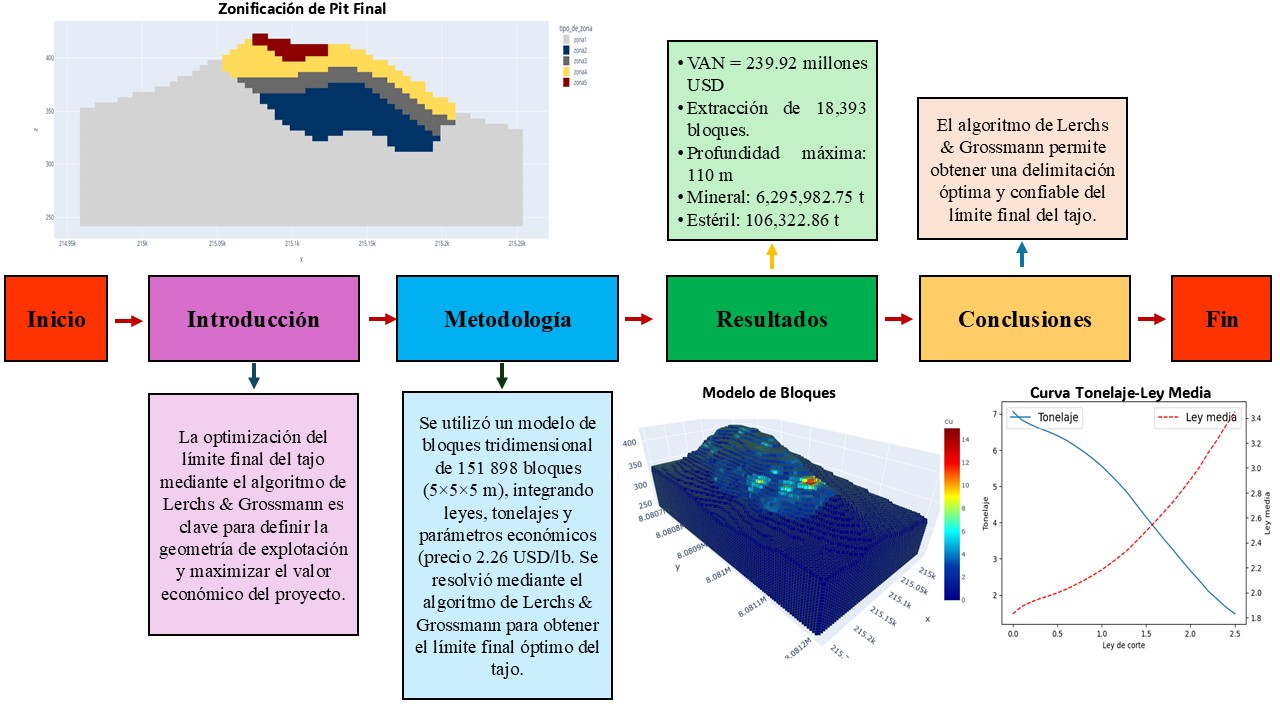
La optimización del límite final del tajo (UPL) es una etapa desisiva al momento de planficar la explotacion de minas a tajo abierto, debido a que afecta directamente la rentabilidad del proyecto. Este estudio busca determinar el UPL usando el algoritmo de Lerchs y Grossmann (LG). Se maximiza el Valor Actual Neto (VAN) a través de una implementación computacional reproducible en Python. La metodología se basa en un modelo de bloques sintético que incluye 151,898 bloques de 5 × 5 × 5 m. Este modelo tiene información espacial (X, Y, Z), leyes de cobre variables, una densidad constante y parámetros económicos definidos. El análisis se realizó en Google Colab con Python 3.12.12. Se consideró un precio del cobre de 2.26 USD/lb, un costo de venta de 0.12 USD/lb, un costo de minado de 6.15 USD/t y supuestos económicos constantes, sin descuento temporal, para un escenario de planificación de tajo final. Los resultados indican que la optimización mediante LG crea un tajo final con 18,393 bloques, un tonelaje de mineral de 6,295,982.75 t, 106,322.86 t de material estéril, una profundidad máxima de 110 m y un volumen total de 3,523,275 m³. Esto resulta en un VAN de 239.92 millones de USD. El algoritmo de LG es un método sólido y eficiente para optimizar el UPL. Ofrece soluciones económicamente óptimas y técnicamente consistentes para estudios de planificación minera estratégica.
Referencias
[1] L. Si, C. Fan, Q. Zhuo, R. Rybár, M. Beer, and L. Bednárová. Mining and Processing of Mineral Resources. Processes, vol. 13, no. 9, p. 2823, 2025. DOI: https://doi.org/10.3390/PR13092823
[2] N. Adibi, M. Ataee-Pour, and M. Rahmanpour. Integration of sustainable development concepts in open pit mine design. Journal of Cleaner Production, vol. 108, pp. 1037–1049, 2015. DOI: https://doi.org/10.1016/J.JCLEPRO.2015.07.150
[3] P. Söderholm and N. Svahn. Mining, regional development and benefit-sharing in developed countries. Resources Policy, vol. 45, pp. 78–91, 2015. DOI: https://doi.org/10.1016/J.RESOURPOL.2015.03.003
[4] K. R. Long. Economics of mining law. Nonrenewable Resources, vol. 4, no. 1, pp. 74–83, 1995. DOI: https://doi.org/10.1007/BF02257018
[5] P. Zhang et al. Geotechnical risk management to prevent coal outburst. International Journal of Mining Science and Technology, vol. 26, no. 1, pp. 9–18, 2016. DOI: https://doi.org/10.1016/J.IJMST.2015.11.003
[6] R. K. Mishra et al. Geotechnical Risk Management Concept for Intelligent Deep Mines. OnePetro, 2017.
[7] N. L. Mai, O. Erten, and E. Topal. A new generic open pit mine planning process. International Journal of Coal Science & Technology, vol. 3, no. 4, pp. 407–417, 2016. DOI: https://doi.org/10.1007/S40789-016-0152-Z
[8] M. Blom, A. R. Pearce, and P. J. Stuckey. Short-term planning for open pit mines. International Journal of Mining, Reclamation and Environment, vol. 33, no. 5, pp. 318–339, 2019. DOI: https://doi.org/10.1080/17480930.2018.1448248
[9] R. D. Cairns and N. Van Quyen. Optimal exploration and exploitation of heterogeneous mineral deposits. Journal of Environmental Economics and Management, vol. 35, no. 2, pp. 164–189, 1998. DOI: https://doi.org/10.1006/JEEM.1998.1027
[10] C. Castañón et al. Resource and Reserve Calculation in Seam-Shaped Deposits. Minerals, vol. 7, no. 5, p. 72, 2017. DOI: https://doi.org/10.3390/MIN7050072
[11] R. Goodland. Responsible Mining: The Key to Profitable Resource Development. Sustainability, vol. 4, no. 9, pp. 2099–2126, 2012. DOI: https://doi.org/10.3390/SU4092099
[12] D. L. Bikubanya and B. Radley. Productivity and profitability of gold mining mechanisation. Extractive Industries and Society, vol. 12, p. 101162, 2022. DOI: https://doi.org/10.1016/J.EXIS.2022.101162
[13] S. Bohidar et al. Design of novel UPFC based damping controller. International Journal of Emerging Electric Power Systems, vol. 26, no. 3, pp. 563–574, 2025. DOI: https://doi.org/10.1515/IJEEPS-2024-0138
[14] D. Fensel et al. The Unified Problem-Solving Method Development Language. Knowledge and Information Systems, vol. 5, no. 1, pp. 83–131, 2003. DOI: https://doi.org/10.1007/S10115-002-0074-5
[15] R. Underwood and B. Tolwinski. A mathematical programming viewpoint for solving the ultimate pit problem. European Journal of Operational Research, vol. 107, no. 1, pp. 96–107, 1998. DOI: https://doi.org/10.1016/S0377-2217(97)00141-0
[16] A. D. Mwangi et al. Ultimate Pit Limit Optimization Methods in Open Pit Mines. Journal of Mining Science, vol. 56, no. 4, pp. 588–602, 2020. DOI: https://doi.org/10.1134/S1062739120046885
[17] L. M. Hirsch and J. F. Schuette. Graph theory applications to geologic models. Computers & Geosciences, vol. 25, no. 2, pp. 127–139, 1999. DOI: https://doi.org/10.1016/S0098-3004(98)00116-2
[18] F. Liu et al. Geostatistics-based characterization of rock mass. Bulletin of Engineering Geology and the Environment, vol. 80, no. 2, pp. 1683–1700, 2020. DOI: https://doi.org/10.1007/S10064-020-02023-2
[19] J. Li et al. Modeling spatial variability of mechanical parameters. International Journal of Rock Mechanics and Mining Sciences, vol. 181, p. 105859, 2024. DOI: https://doi.org/10.1016/J.IJRMMS.2024.105859
[20] M. V. Deutsch. Open-pit mine planning with operational constraints. 2023.
[21] M. Zuckerberg, J. Van Der Riet, W. Malajczuk, and P. Stone. Optimal Life-of-Mine Scheduling for a Bauxite Mine. Journal of Mining Science, vol. 47, no. 2, pp. 158–165, 2011. DOI: https://doi.org/10.1134/S1062739147020031
[22] C. Meagher, R. Dimitrakopoulos, and D. Avis. Optimized open pit mine design, pushbacks and the gap problem. Journal of Mining Science, vol. 50, no. 3, pp. 508–526, 2014. DOI: https://doi.org/10.1134/S1062739114030132
[23] G. G. You. Mine Planning and Open Pit Optimization. Mining Project Value Optimization, pp. 91–111, 2025. DOI: https://doi.org/10.1007/978-981-97-7883-6_5
[24] R. Khalou Kakaei. Optimum Pit Design in Open Pit Mining with Floating Cone Method II and Lerchs–Grossmann Algorithm, 2005.
[25] N. Morales, E. Jélvez, and P. Nancel-Penard. Comparison of conventional and direct block scheduling methods for open pit mines, 2015.
[26] D. S. Hochbaum. A new-old algorithm for minimum-cut and maximum-flow in closure graphs. Networks, vol. 37, no. 4, pp. 171–193, 2001. DOI: https://doi.org/10.1002/NET.1012
[27] N. Azadi, H. Mirzaei-Nasirabad, and A. Mousavi. Evaluating the efficiency of the genetic algorithm in ultimate pit design. International Journal of Mining and Geo-Engineering, vol. 57, no. 1, pp. 55–58, 2023. DOI: https://doi.org/10.22059/IJMGE.2022.340973.594963
[28] D. S. Hochbaum. The Pseudoflow Algorithm for the Maximum Flow Problem. Lecture Notes in Computer Science, vol. 1412, pp. 325–337, 1998. DOI: https://doi.org/10.1007/3-540-69346-7_25
[29] C. L. Anderson. Implementations of the Pseudoflow Algorithm for the Maximum Flow Problem. 2007.
[30] B. Fishbain, D. S. Hochbaum, and S. Mueller. Competitive study of the pseudoflow algorithm. Journal of Real-Time Image Processing, vol. 11, no. 3, pp. 589–609, 2013. DOI: https://doi.org/10.1007/S11554-013-0344-3
[31] D. S. Hochbaum and J. B. Orlin. Simplifications of the pseudoflow algorithm. Networks, vol. 61, no. 1, pp. 40–57, 2013. DOI: https://doi.org/10.1002/NET.21467
[32] M. Deutsch, E. González, and M. Williams. Using simulation to quantify uncertainty in ultimate pit limits. Mining Engineering Magazine, 2015.
[33] D. Gawariya and S. C. Jain. Ultimate Pit Limit Optimization of Opencast Mine Using Surpac. Journal of Scientific Research and Technology, pp. 34–44, 2024.
[34] O. Adeyi et al. Process optimization and economic analysis of bioactive extracts. Heliyon, vol. 8, no. 4, p. e09216, 2022. DOI: https://doi.org/10.1016/J.HELIYON.2022.E09216
[35] M. Jamshidi and M. Osanloo. UPL determination of multi-element deposits. Journal of Mining and Environment, vol. 9, no. 1, pp. 61–72, 2018. DOI: https://doi.org/10.22044/JME.2017.5763.1387
[36] A. D. Akbari, M. Osanloo, and M. A. Shirazi. Ultimate Pit Limit determination under uncertainty, 2008.
[37] M. Ataee-Pour. A Linear Model for Determination of Block Economic Values, 2005.
[38] H. Dehghani and M. Ataee-Pour. Economic uncertainty and block value. Archives of Mining Sciences, vol. 57, no. 4, pp. 991–1014, 2012. DOI: https://doi.org/10.2478/V10267-012-0066-6
[39] M. Balci and M. Kumral. Capacity planning in open-pit mines. Mineral Economics, vol. 38, no. 2, pp. 425–443, 2025. DOI: https://doi.org/10.1007/S13563-025-00495-W
[40] A. Richmond. Direct Net Present Value Open Pit Optimisation. Advances in Applied Strategic Mine Planning, pp. 217–228, 2018. DOI: https://doi.org/10.1007/978-3-319-69320-0_15
[41] D. Kržanović, B. Kolonja, and D. Stevanović. Maximizing the net present value by applying an optimal cut-off grade. Acta Montanistica Slovaca, vol. 20, no. 1, pp. 49–61, 2015.
[42] H. Askari-Nasab and K. Awuah-Offei. Open pit optimisation using discounted economic block values. Mining Technology, vol. 118, no. 1, pp. 1–12, 2009. DOI: https://doi.org/10.1179/037178409X12450752943243
[43] S. Boachie. Optimised Open Pit Design Using Minesight Software. International Journal of Multidisciplinary Studies and Innovative Research, vol. 12, no. 3, pp. 38–41, 2023. DOI: https://doi.org/10.53075/Ijmsirq/09843432543424
[44] P. G. F. Teixeira. Análise comparativa da otimização de cava através do algoritmo de Lerchs & Grossmann, 2024.
[45] R. Khalokakaie, P. A. Dowd, and R. J. Fowell. Lerchs-Grossmann algorithm with variable slope angles. Mining Technology, vol. 109, pp. 77–85, 2000. DOI: https://doi.org/10.1179/MNT.2000.109.2.77
[46] S. M. E. Jalali and M. Ataeepour. Modification of Lerchs and Grossmann Algorithm for Pit Limit Optimization. Journal of Mining Engineering, vol. 1, no. 2, pp. 1–7, 2007.
[47] A. D. Mwangi et al. Ultimate Pit Limit Optimization Methods in Open Pit Mines. Journal of Mining Science, vol. 56, no. 4, pp. 588–602, 2020. DOI: https://doi.org/10.1134/S1062739120046885
[48] R. Dimitrakopoulos, L. Martinez, and S. Ramazan. Maximum upside/minimum downside optimization of open pit design. Journal of Mining Science, vol. 43, no. 1, pp. 73–82, 2007. DOI: https://doi.org/10.1007/S10913-007-0009-3
[49] M. Z. Abzalov. Localised Uniform Conditioning for block modelling. Mathematical Geology, vol. 38, no. 4, pp. 393–411, 2006. DOI: https://doi.org/10.1007/S11004-005-9024-6
[50] The application of multi-parametric block models to mining processes. Journal of the Southern African Institute of Mining and Metallurgy, 2010. DOI: https://doi.org/10.10520/AJA0038223X_3253
[51] R. P. King. Modeling and Simulation of Mineral Processing Systems. Elsevier, 2001.
[52] T. Tholana and C. Musingwini. Probabilistic block economic value calculation. Minerals, vol. 12, no. 4, 2022. DOI: https://doi.org/10.3390/MIN12040437
[53] E. S. Chung et al. Economic value of biventricular pacing. Journal of Medical Economics, vol. 22, no. 10, pp. 1088–1095, 2019. DOI: https://doi.org/10.1080/13696998.2019.1652184
[54] O. O. Adewoyin et al. Evaluation of geotechnical parameters using geophysical data. Journal of Engineering and Technological Sciences, vol. 49, no. 1, pp. 96–114, 2017. DOI: https://doi.org/10.5614/J.ENG.TECHNOL.SCI.2017.49.1.6
[55] A. Prästings, J. Spross, and S. Larsson. Characteristic values of geotechnical parameters in Eurocode 7. Proceedings of the Institution of Civil Engineers – Geotechnical Engineering, vol. 172, no. 4, pp. 301–311, 2019. DOI: https://doi.org/10.1680/JGEEN.18.00057
[56] S. M. Jowitt and B. A. McNulty. Geology and Mining: Mineral Resources and Reserves. SEG Discovery, no. 125, pp. 27–36, 2021. DOI: https://doi.org/10.5382/GEO-AND-MINING-11/596384
[57] S. McManus et al. Uncertainty assessment of spatial domain models. Ore Geology Reviews, vol. 133, p. 104098, 2021. DOI: https://doi.org/10.1016/J.OREGEOREV.2021.104098
[58] M. Böhmer and M. Kucera. Prospecting and Exploration of Mineral Deposits. Springer, 2014.
[59] P. Henrique and A. Campos. Spatial modeling and mine scheduling. 2023.
[60] MiningMath. Economic values documentation. 2025. https://miningmath.com/docs/knowledgebase/formatting-data/economic-values/
[61] M. Batty and Y. Xie. Modelling inside GIS: model structures and exploratory spatial data analysis. International Journal of Geographical Information Systems, vol. 8, no. 3, pp. 291–307, 1994. DOI: https://doi.org/10.1080/02693799408902001
[62] A. Hekmat, R. Fustos Toribio, and A. Ramirez-Madrid. Geo-metallurgical optimisation of block destinations integrating decision tree classification and game theory. International Journal of Mining and Reclamation Environment, vol. 39, no. 10, pp. 768–788, 2025. DOI: https://doi.org/10.1080/17480930.2025.2475186
[63] V. Lishchuk. Geometallurgical programs – critical evaluation of applied methods and techniques, 2025. https://www.diva-portal.org/smash/record.jsf?pid=diva2:999773
[64] R. Chowdhury, G. Bhattacharya, and S. Metya. Geotechnical Slope Analysis, 2nd ed., CRC Press, 2023. DOI: https://doi.org/10.1201/9780203386279
[65] H. I. Chaminé and I. Fernandes. Engineering geology mapping and GIS-based tools in geotechnical practice. Springer Tracts in Civil Engineering, pp. 3–27, 2023. DOI: https://doi.org/10.1007/978-3-031-05875-2_1
[66] P. M. Dight. Slope stability 2020: Proceedings of the International Symposium on Slope Stability, 2020.
[67] B. Enkhbayar. Open-pit slope geotechnical considerations and its effects on mine planning, 2020. https://scholarworks.alaska.edu/handle/11122/11894
[68] S. Mosch, D. Nikolayew, O. Ewiak, and S. Siegesmund. Optimized extraction of dimension stone blocks. Environmental Earth Sciences, vol. 63, no. 7, pp. 1911–1924, 2010. DOI: https://doi.org/10.1007/S12665-010-0825-7
[69] J. Poniewierski. Block model knowledge for mining engineers, 2025. https://www.linkedin.com/in/julianponiewierski/
[70] M. Kumral and Y. A. Sari. Underground mine planning for stope-based methods. AIP Conference Proceedings, vol. 2245, 2020. DOI: https://doi.org/10.1063/5.0006787
[71] A. D. Akbari, M. Osanloo, and M. A. Shirazi. Ultimate pit limit determination through minimizing risk costs, 2008.
[72] S. Moradi Pirbalouti and H. Askari-Nasab. Optimization approach for ultimate pit and push-back design, 2015.
[73] J. Chen. UpDown directed acyclic graph approach for sequential pattern mining. IEEE Transactions on Knowledge and Data Engineering, vol. 22, no. 7, pp. 913–928, 2010. DOI: https://doi.org/10.1109/TKDE.2009.135
[74] F. Flouvat et al. Mining evolutions of complex spatial objects using directed acyclic graphs. Knowledge and Information Systems, vol. 62, no. 10, pp. 3931–3971, 2020. DOI: https://doi.org/10.1007/S10115-020-01478-9
[75] A. Fariha et al. Mining frequent patterns from human interactions. Lecture Notes in Computer Science, vol. 7818, pp. 38–49, 2013. DOI: https://doi.org/10.1007/978-3-642-37453-1_4
[76] J. de J. Costa et al. Mining directed acyclic graphs in educational data. Information Sciences, vol. 482, pp. 266–278, 2019. DOI: https://doi.org/10.1016/J.INS.2019.01.032
[77] R. Carlos and S. Carboni. Optimización de diseños de minas subterráneas usando el algoritmo pseudoflow. Pontificia Universidad Católica del Perú, 2024. https://hdl.handle.net/20.500.12404/28828
[78] M. C. Djilani. Interactive open-pit design using parameterization techniques, 1997.
[79] Y. Zhao. Algorithms for optimum design and planning of open-pit mines, 2010. https://www.proquest.com
[80] H. Amankwah. Mathematical Optimization Models and Methods for Open-Pit Mining. Linköping University, 2011.
[81] W. Cai. Application of network flow and zero-one programming to open pit mine design problems, 2011.
[82] J. L. V. Mariz and A. Soofastaei. Advanced Analytics for Surface Mine Planning. Springer, 2022. DOI: https://doi.org/10.1007/978-3-030-91589-6_9
[83] J. J. Marquina Araujo. Delimitación del pit final mediante el modelo pseudoflow. Universidad Nacional de Trujillo, 2023. https://hdl.handle.net/20.500.14414/18184
[84] R. Das, E. Topal, and E. Mardaneh. Review of open pit mine and waste dump schedule planning. Resources Policy, vol. 85, p. 104064, 2023. DOI: https://doi.org/10.1016/J.RESOURPOL.2023.104064
[85] P. M. Palei and S. K. Choudhury. Production scheduling of iron deposits under grade uncertainty. Journal of Mines, Metals & Fuels, vol. 68, no. 3, 2020.
[86] D. A. Castro Solis. Aplicación del algoritmo Lerchs y Grossmann 3D para delimitar el pit final de un yacimiento cuprífero. Universidad Nacional de Trujillo, 2022.
Downloads
Published
How to Cite
Issue
Section
License
Copyright (c) 2025 Journal of Advanced Mining Modeling

This work is licensed under a Creative Commons Attribution 4.0 International License.
Los autores aceptan los siguientes términos:
- Los autores conservan íntegramente sus derechos de autor, incluyendo los derechos sobre ideas, métodos, procesos, procedimientos, modelos, datos y resultados descritos en el artículo, así como cualquier derecho de marca o patente que pudiera derivarse del trabajo.
- Los autores conceden a Journal of Advanced Mining Modeling (JAMM) el derecho de primera publicación y autorización para difundir el artículo a través de su plataforma oficial, repositorios institucionales, bases de datos académicas, sistemas de indexación y otros canales de divulgación científica.
- Los autores pueden celebrar acuerdos contractuales adicionales, de manera independiente y no exclusiva, para la distribución de la versión publicada del artículo (por ejemplo, depositarlo en repositorios institucionales, publicarlo como capítulo de libro o incluirlo en compilaciones académicas), siempre que se cite de forma adecuada la publicación inicial en Journal of Advanced Mining Modeling (JAMM).
- Toda reutilización del contenido deberá incluir la referencia completa del artículo y el reconocimiento explícito de su publicación original en Journal of Advanced Mining Modeling (JAMM), indicando autores, título del trabajo, volumen, número y año de publicación.




 All articles are published under the