
Analysis of rice (Oryza sativa l.) bioeconomy: Data Envelopment Analysis method highlights the need for cooperation to improve productivity and sustainability
DOI:
https://doi.org/10.17268/sci.agropecu.2026.040Palabras clave:
sustainability, environment, cost efficiency, allocative efficiency, technical efficiencyResumen
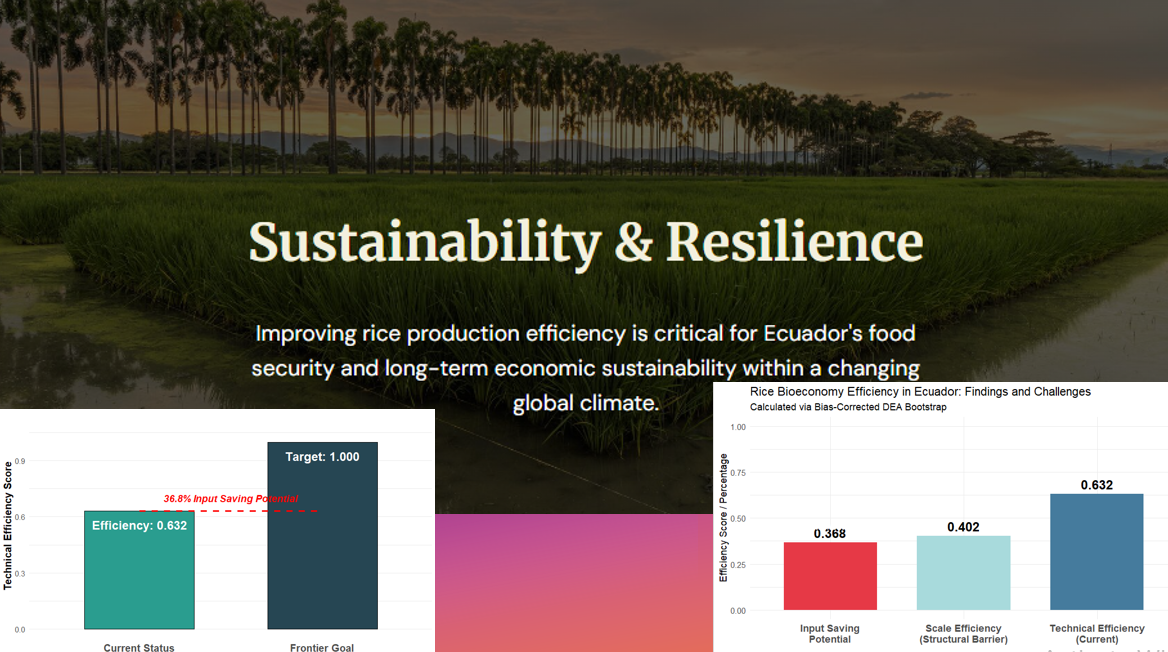
Rice (Oryza sativa L.) production is a cornerstone of Ecuador's economy. This research evaluates the efficiency of 609 production units during 2019, addressing the need for statistical robustness in agricultural efficiency estimators. Using a national representative survey, Data Envelopment Analysis (DEA) was applied under Variable Returns Scale (VRS) and Constant Returns to Scale (CRS). To account for sampling noise, the Simar & Wilson (2007) bootstrap procedure (2,000 replications) was implemented to provide bias-corrected scores and 95% confidence intervals. The bootstrap-corrected analysis revealed a mean technical efficiency of 0.632 (95% CI: 0.596 – 0.668), suggesting a potential 36.8% input reduction without output loss. Significant provincial heterogeneity was observed: Manabí led in technical efficiency (0.743), while El Oro achieved the highest cost efficiency (0.435) due to superior allocative performance. Conversely, Loja showed high technical proficiency (0.645) but the lowest allocative efficiency (0.197). Findings underscore that "one-size-fits-all" policies are inadequate; instead, province-specific interventions, focusing on scale optimization and financial training, are required to enhance the sustainability of Ecuador's rice bioeconomy.
Citas
Aliyu, A., & Bello, K. (2018). Data envelopment analysis of rubber smallholders: BCC and CCR models and bootstrapping technique. International Journal of Research-Granthaalayah, 6, 346-368. https://doi.org/10.29121/granthaalayah.v6.i5.2018.1463
Antriyandarti, E. (2015). Competitiveness and Cost Efficiency of Rice Farming in Indonesia. Journal of Rural Problems, 51(2),74-85, https://doi.org/10.7310/arfe.51.74
Abdul Wadud, M. (2003). Technical, Allocative, and Economic Efficiency of Farms in Bangladesh: A Stochastic Frontier and DEA Approach. The Journal of Developing Areas, 37(1), 109–126. http://www.jstor.org/stable/4192941 .
Ajibefun, I. A., & Daramola, A. G. (2003). Determinants of technical and allocative efficiency of micro‐enterprises: firm‐level evidence from Nigeria. African development review, 15(2‐3), 353-395. https://doi.org/10.1111/j.1467-8268.2003.00077.x
Bui, T. L., Tran, H. C., Azadi, H., & Lebailly, P. (2018). Improving the technical efficiency of Sengcu rice producers through better financial management and sustainable farming practices in mountainous areas of Vietnam. Sustainability, 10(7), 2279. https://doi.org/10.3390/su10072279
Barrett, C. B., Moser, C. M., McHugh, O. V., & Barison, J. (2004). Better technology, better plots, or better farmers? Identifying changes in productivity and risk among Malagasy rice farmers. American Journal of Agricultural Economics, 86(4), 869-888. https://doi.org/10.1111/j.0002-9092.2004.00640.x
Battese, G. E., & Coelli, T. J. (1992). Frontier Production Functions. Technical Efficiency and Panel Data: With Application to Paddy Farmers in India. J. Prod. Anal., 3, 153–169. https://doi.org/10.1007/BF00158774
Banker, R. D., Charnes, A., & Cooper, W. W. (1984). Some models for estimating technical and scale inefficiencies in data envelopment analysis. Management Science, 30(9),1031-1142. https://doi.org/10.1287/mnsc.30.9.1078
Cai, R., Zhao, H., Wang, S., & Ma, J. (2026). Subsidies and allocative efficiency in China’s rice production: does farm size matter?. Applied Economics, 58(15), 2909-2922. https://doi.org/10.1080/00036846.2025.2482242
Castro, M., Duarte, A. R., Villegas, A., & Chanci, L. (2023). The effect of crop insurance in Ecuadorian rice farming: a technical efficiency approach. Agricultural Finance Review, 83(3), 478-497. https://doi.org/10.1108/AFR-10-2022-0122
Castro Alvarez, M. D., Zúniga-Gonzalez, C. A., Andrade, R. S. (2025). Data for Analysis of rice (Oryza sativa l.) bioeconomy: a DEA approach to economy efficiency. Mendeley Data, V2, https://doi.org/10.17632/rsknb2b8z6.2
Coelli, T., Rahman, S., & Thirtle, C. (2002). Technical, allocative, cost and scale efficiencies in Bangladesh rice cultivation: a non‐parametric approach. Journal of agricultural economics, 53(3), 607-626. https://doi.org/10.1111/j.1477-9552.2002.tb00040.x
Coelli, T.J. (1997). A Multi-Stage Methodology for the Solution of Oriented DEA Models, mimeo. Armidale: Centre For Efficiency and Productivity Analysis, University of New England. 50 pp.
Christopher, L.M., Orozco, F., Averett, J. Muñoz, F., Romero, M. J. and Barahona, A. (2020). Agricultural food production diversity among female small holder farmers in a region of the Ecuadorian Andes experiencing nutrition transition. Nutrients, 12(8), 2454. https://doi.org/10.3390/nu12082454
Chegini, M. G., Yousefi, S., & Borojani, G. (2016). Factors affecting the efficiency of human resources in Guilan's rice processing industry. International Journal of Agricultural Management and Development 7(3), 383-93.
Charnes, A., Cooper, W., & Rhodes, E. (1978). Measuring the efficiency of decision making units. European Journal of Operational Research, 2(6), 429-444. https://doi.org/10.1016/0377-2217(78)90138-8
de Wit, C.T. (1992). Resource use efficiency in agriculture. Agricultural Systems, 140(1–3), 125-151, https://doi.org/10.1016/0308-521X(92)90018-J
Dey, S., Abbhishek, K., Saraswathibatla, S., Kuttippurath, J., Singh, P. K., & Das, D. (2024). Can cropping systems be energy efficient: performance measure for various rice-based cropping systems in peninsular India. Journal of Agriculture and Food Research, 18, 101516. https://doi.org/10.1016/j.jafr.2024.101516
Farrell, M. J. (1957). The Measurement of Productive Efficiency. Journal of the Royal Statistical Society, A CXX, Part 3, 253-290.
Gregory, P. J., Ingram, J. S. I., & Brklacich, M. (2005). Climate change and food security. Phil. Trans. R. Soc., 360(1463), 2139-2148. http://doi.org/10.1098/rstb.2005.1745
Henderson, H. (2015). Considering technical and allocative efficiency in the inverse farm size-productivity relationship. Journal of Agricultural Economics, 66(2), 442-469. https://doi.org/10.1111/1477-9552.12086
jasim N. J., & Zanzal, H. T. (2022). Estimating the economic efficiency of cucumber crop the protected houses in Diyala governorate (Baquba an Applied model) for the 2021 agricultural season. Tikrit Journal for Agricultural Sciences, 22(3), 12-19. https://doi.org/10.25130/tjas.22.3.2
Li, G., Wang, X., Ma, D., & Zhao, C. (2025). Does the Scale of Contiguous Plots Significantly Influence Rice Production Efficiency? Empirical Evidence From China Land Economic Survey Data. Sage Open, 15(4). https://doi.org/10.1177/21582440251400498
Mivumbi, M., & Yuan, X. (2023). Sustainable Environmental Economics in Farmers’ Production Factors via Irrigation Resources Utilization Using Technical Efficiency and Allocative Efficiency. Sustainability, 15, 4101. https://doi.org/10.3390/su15054101
Medina-Litardo, R.C., García-Bendezú, S. J., Carrillo-Zenteno, M. D., Pérez-Almeida, I., & Moran, E. (2022). Salinity of soil and irrigation water on rice productivity in the canton of San Jacinto de Yaguachi, Ecuador. Agrociencia, 56(7). https://doi.org/10.47163/agrociencia.v56i7.2602
Munim, Z. H. (2020). Does higher technical efficiency induce a higher service level? A paradox association in the context of port operations. The Asian Journal of Shipping and Logistics, 36(4), 57-68. https://doi.org/10.1016/j.ajsl.2020.02.001
Minten, B., Murshid, K. A. S., & Reardon, T. (2013). Food quality changes and implications: evidence from the rice value chain of Bangladesh. World Development, 42, 100-113. https://doi.org/10.1016/j.worlddev.2012.06.015
Marc Jim, M., Villano, R., & Fleming, E. (2012). Factors influencing farmers’ adoption of modern rice technologies and good management practices in the Philippines, Agricultural Systems, 110, 41-53, https://doi.org/10.1016/j.agsy.2012.03.010
Ortega-Pacheco, D., Castro-Verdezoto, P. L., Mendoza-Jiménez, M. J., Almeida Benalcázar, E., & Castro, M. P. (2021). Social and Economic Contribution of the Bioeconomic Sector in Ecuador: A Methodological Approach. In: Venkatramanan, V., Shah, S., Prasad, R. (eds) Sustainable Bioeconomy. Springer, Singapore. https://doi.org/10.1007/978-981-15-7321-7_3
Portalanza, D., Torres, M., Rosso, F., Zuluaga, C.F., Durigon, A., Horgan Finbarr, G., Alava, E., Ferraz, S. (2024). Climate variability and change in Ecuador: dynamic downscaling of regional projections with RegCM4 and HadGEM2-ES for informed adaptation strategies. Frontiers in Climate, 6, 1344868. https://doi.org/10.3389/fclim.2024.1344868
Pérez, S. G. C., González, C. A. Z., Jurado, A. T., & Flores, Y. M. (Eds.). (2026). Sustainability in Latin America: A Bioeconomic Approach. Springer Nature. 166 pp. https://doi.org/10.1007/978-3-032-09787-3
Portalanza, D., Horgan, F. G., Pohlmann, V., Vianna Cuadra, S., Torres-Ulloa, M., Alava, E., Ferraz, S., Durigon, A. (2022). Potential Impact of Future Climates on Rice Production in Ecuador Determined Using Kobayashi’s ‘Very Simple Model’. Agriculture 12, 1828. https://doi.org/10.3390/agriculture12111828
Pereira, M. A., Ferreira, D. C., Figueira, J. R., & Marques, R. C. (2021). Measuring the efficiency of the Portuguese public hospitals: A value modelled network data envelopment analysis with simulation. Expert systems with applications, 181, 115169. https://doi.org/10.1016/j.eswa.2021.115169
Pokharel, K. P., & Featherstone, A. M. (2018). Estimating multiproduct and product‐specific scale economies for agricultural cooperatives. Agricultural Economics, 50(3), 279-289. https://doi.org/10.1111/agec.12483
Tittonell, P., Vanlauwe, B., de Ridder, N., & Giller, K. E. (2007). Heterogeneity of crop productivity and resource use efficiency within smallholder Kenyan farms: soil fertility gradients or management intensity gradients? Agricultural systems, 94(2), 376-390. https://doi.org/10.1016/j.agsy.2006.10.012
Thanawong, K., Perret, S.R., & Basset-Mens, C. (2014). Eco-efficiency of paddy rice production in Northeastern Thailand: a comparison of rain-fed and irrigated cropping systems. Journal of Cleaner Production, 73, 204-217. https://doi.org/10.1016/j.jclepro.2013.12.067
Tey, Y. S., & Brindal, M. (2014). Factors Influencing Farm Profitability. In: Lichtfouse, E. (eds) Sustainable Agriculture Reviews. Sustainable Agriculture Reviews, Chapter 15.Springer Nature Link. https://doi.org/10.1007/978-3-319-09132-7_5
Torres Álava, F., Guerrero F, Varas Maenza, C., & Solis Barros, T. (2022). Circular economy vision for local development focused on waste derived from two agricultural crops in Ecuador. Journal of Business and Entrepreneurial Studie, 6(4). https://doi.org/10.37956/jbes.v6i4.318
Sarker, J. R., Rolfe, J. & Ananda, J. (2026). Bangladeshi coastal rice farmers navigate environmental uncertainty through adaptive management strategies. Discover Food, 6, 87. https://doi.org/10.1007/s44187-026-00836-w
Seck, P. A, Diagne, A., Mohanty, S., Wopereis, S. M. C. (2012). Crops that feed the world 7: Rice. Food Sec., 4, 7–24 https://doi.org/10.1007/s12571-012-0168-1
Serraj, R., McNally, K. L., Slamet-Loedin, I., Kohli, A., Haefele, S. M., Atlin, G., & Kumar, A. (2011). Drought resistance improvement in rice: an integrated genetic and resource management strategy. Plant Production Science, 14(1), 1-14. https://doi.org/10.1626/pps.14.1
Simar, L., Wilson, P. W. (2007). Estimation and inference in two-stage, semi-parametric models of production processes. J. Econom., 136(1), 31–64. https://doi.org/10.1016/j.jeconom.2005.07.009
Simar, L., Wilson, P. W. (1998). Sensitivity analysis of efficiency scores: How to bootstrap in nonparametric frontier models. Manag. Sci., 44(1),49–61. https://doi.org/10.1287/mnsc.44.1.49
Tran, H. H., Datai, H., & Haiu Nu., A. T. (2026). Technical Efficiency of Organic and Conventional Rice Farming in Central Vietnam: A Meta-frontier DEA Analysis. J. Glob. Innov. Agric. Sci., 14(2), 711-719. https://doi.org/10.22194/JGIAS/26.1805
Watkins, K. B., Hristovska, T., Mazzanti, R., Wilson Jr, C. E., & Schmidt, L. (2014). Measurement of technical, allocative, economic, and scale efficiency of rice production in Arkansas using data envelopment analysis. Journal of Agricultural and Applied Economics, 46(1), 89-106. https://doi.org/10.1017/S1074070800000651
Wassmann, R., Jagadish, S.V. K., Sumfleth, K., Pathak, H., Howell, G., Ismail, A.,& Heuer, S. (2009). Regional vulnerability of climate change impacts on Asian rice production and scope for adaptation. Advances in agronomy, 102, 91-133. https://doi.org/10.1016/S0065-2113(09)01003-7
Yuan, M., Wang, J., Wu, G., Jin, J., Hu, Y., Liu, C., Miao, Q., Wu, P., & Sun, Y. (2026). Mechanical Side-Deep Fertilization Synergizes with Controlled-Release Fertilizer to Drive Low-Carbon and High-Efficiency Rice (Oryza sativa L.) Production. Agriculture, 16(6), 651. https://doi.org/10.3390/agriculture16060651
Zuniga-Gonzalez, C. A., Quiroga-Canaviri, J. L., Brambila-Paz, J. J., Ceballos-Pérez S. G., & Rojas-Rojas, M. M. (2024a). Formulation of an innovative model for the bioeconomy. PLoS ONE, 19(11), e0309358. https://doi.org/10.1371/journal.pone.0309358
Zúniga-González, C. A., López, M. R., Icabalceta-Mairena, J. L., Vivas-Viachica, E. A., & Blanco-Orozco, N. V. (2024b). Study of the Efficiency and Productivity of the Productive Paths of the Bioeconomy in the CNU Universities. In Handbook on Data Envelopment Analysis in Business, Finance, and Sustainability: Recent Trends and Developments (pp. 221-250). https://doi.org/10.1142/9781800615786_0007
Zuniga-Gonzalez, C. A. (2023). TFP Bioeconomy Impact post Covid-19 on the agricultural economy. PLoS ONE, 18(11), e0288885. https://doi.org/10.1371/journal.pone.0288885
Zúniga-González, C. A. (2024). Productivity growth and technical efficiency changes in Rice farms: An input-oriented study using biosolid. In Handbook on data envelopment analysis in business, finance, and sustainability: Recent trends and developments (pp. 551-574). https://doi.org/10.1142/9781800615786_0019
Descargas
Publicado
Cómo citar
Número
Sección
Licencia
Derechos de autor 2026 Scientia Agropecuaria

Esta obra está bajo una licencia internacional Creative Commons Atribución-NoComercial 4.0.
Los autores que publican en esta revista aceptan los siguientes términos:
a. Los autores conservan los derechos de autor y conceden a la revista el derecho publicación, simultáneamente licenciada bajo una licencia de Creative Commons que permite a otros compartir el trabajo, pero citando la publicación inicial en esta revista.
b. Los autores pueden celebrar acuerdos contractuales adicionales separados para la distribución no exclusiva de la versión publicada de la obra de la revista (por ejemplo, publicarla en un repositorio institucional o publicarla en un libro), pero citando la publicación inicial en esta revista.
c. Se permite y anima a los autores a publicar su trabajo en línea (por ejemplo, en repositorios institucionales o en su sitio web) antes y durante el proceso de presentación, ya que puede conducir a intercambios productivos, así como una mayor citación del trabajo publicado (ver efecto del acceso abierto).