
Determination of the Physical and Chemical Characteristics of Dry Cacao Beans (Nacional and CCN-51) in Collection Centers in Bolívar Canton
DOI:
https://doi.org/10.17268/agroind.sci.2026.02.02Keywords:
Quality, variety, fermentation, post-harvest, characterizationAbstract
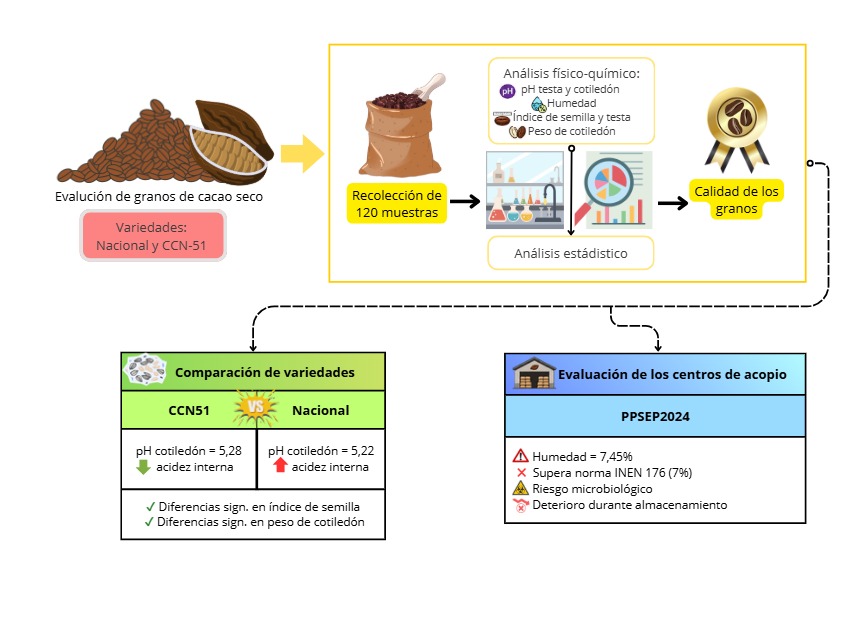
The objective of this study was to evaluate the physical and chemical characteristics of dried cocoa beans from the Nacional and CCN-51 varieties in collection centers in the Bolívar canton, Manabí. A total of 120 samples were collected using an analytical-descriptive approach and an exploratory research design. The methodology included instrumental techniques such as precision balance, pH meter, and moisture meter, and statistical tests such as Shapiro-Wilk, Levene’s test, ANOVA, and Student’s t-test were applied. Among the most relevant results, significant differences were identified in variables such as testa and cotyledon pH, as well as seed index and cotyledon weight between the two varieties. The PPSEP2024 collection center showed high moisture levels, which could affect bean quality. In conclusion, it was evident that both genetic variety and post-harvest handling directly influence cocoa quality. These results provide key information to improve collection processes and strengthen the competitiveness of Ecuadorian cocoa in specialized markets.
References
Ackah, E., & Dompey, E. (2021). Effects of fermentation and drying durations on the quality of cocoa (Theobroma cacao L.) beans during the rainy season in the Juaboso District of the Western-North Region, Ghana. Egyptian Journal of Experimental Biology (Botany), 45. https://doi.org/10.1186/s42269-021-00634-7
Aguilar, H. (Ed.). (2016). Manual para la evaluación de la calidad del grano de cacao. Honduras.
Andrade-Almeida, J., Rivera-García, J., Chire-Fajardo, G. C., & Ureña-Peralta, M. O. (2019). Propiedades físicas y químicas de cultivares de cacao (Theobroma cacao L.) de Ecuador y Perú. Enfoque UTE, 10(4), 1–12. https://doi.org/10.29019/enfoqueute.v10n4.529
ANECACAO. (2024). Tipos de cacao. https://anecacao.com/cacao-en-el-ecuador/tipos-de-cacao/
Camargo, I., Rodriguez, L., Olejua, R., Montenegro, A., & Quintana, L. (2024). High temperature and nib acidification during cacao-controlled fermentation improve cadmium transfer from nibs to testa and the liquor’s flavor. Scientific Reports, 14, 62609. https://doi.org/10.1038/s41598-024-62609-8
Capa, M. C. S., Ramón, C. M., Tierras, Y. B. V., Cachiguango, R. A. B., Cárdenas, A. S. C., & Romero, C. A. R. (2019). Evaluation of the cocoa bean (Theobroma cacao L.), using two fermentators, Orellana and Sucumbíos Provinces, Ecuador. International Journal of Engineering Research & Technology, 8(7). https://doi.org/10.17577/IJERTV8IS070154
CMS, A. (2024, 2 de noviembre). Las provincias ecuatorianas líderes en la producción de cacao. Forbes Ecuador.
Cortez, D., Flores, M., Calampa, L., Oliva-Cruz, M., Goñas, M., Meléndez-Mori, J. B., & Chavez, S. G. (2024). From the seed to the cocoa liquor: Traceability of bioactive compounds during the postharvest process of cocoa in Amazonas-Peru. Microchemical Journal, 201, 110607. https://doi.org/10.1016/j.microc.2024.110607
Dzelagha, B. F., Ngwa, N. M., & Nde Bup, D. (2020). A review of cocoa drying technologies and the effect on bean quality parameters. International Journal of Food Science, 2020(1), 8830127. https://doi.org/10.1155/2020/8830127
Erdfelder, E., Faul, F., & Buchner, A. (1996). GPOWER: A general power analysis program. Behavior Research Methods, Instruments, & Computers, 28(1), 1–11. https://doi.org/10.3758/BF03203630
Gil, M., Uribe, D., Gallego, V., Bedoya, C., & Arango-Varela, S. (2021). Traceability of polyphenols in cocoa during the postharvest and industrialization processes and their biological antioxidant potential. Heliyon, 7(8), e07776. https://doi.org/10.1016/j.heliyon.2021.e07776
González, A. F. R., García, G. A. G., Polanía-Hincapié, P. A., López, L. J., & Suárez, J. C. (2024). Fermentation and its effect on the physicochemical and sensory attributes of cocoa beans in the Colombian Amazon. PLOS ONE, 19(10), e0306680. https://doi.org/10.1371/journal.pone.0306680
Jiménez, J., Rodríguez, G., Saltos, R., Brito, B., Espín, H., & Samaniego, I. (2024). Mejoramiento y homologación de los procesos y protocolos de investigación, validación y producción de servicios en cacao y café. INIAP, Estación Experimental Tropical Pichilingue.
La Rosa, L. V. de. (2025). La tecnología de fermentación que transformó el cacao ecuatoriano y multiplicó por cuatro su producción. KCH FM.
López-Hernández, M. D. P., & Criollo-Nuñez, J. (2022). Cambios fisicoquímicos en la fermentación y secado de materiales de cacao en Colombia. Ciencia en Desarrollo, 13(2), 25–34. https://doi.org/10.19053/01217488.v13.n2.2022.14214
Marcucci, M. C., Gonç, A., Silva Alves, F. da, Gonç, C. P., Sawaya, A. C. H. F., Alonso, R. C. B., Oliveira, M. M. de, & Barbin, D. F. (2021). Parámetros de calidad, contenidos de cafeína y teobromina y actividad antioxidante del chocolate artesanal y comercial de Brasil. Open Access Library Journal, 8(5), 1–18. https://doi.org/10.4236/oalib.1107377
Orbe Chamorro, M., Manosalvas-Quiroz, L.-A., Pinto Mosquera, N. P., & Samaniego, I. (2024). Effect of fermentation parameters on the antioxidant activity of Ecuadorian cocoa (Theobroma cacao L.). AIMS Agriculture and Food, 9(3), 677–692. https://doi.org/10.3934/agrfood.2024047
Ordoñez Choez, S. J. F. (2019). Cascarilla de cacao (Theobroma cacao L.) de líneas híbridas para la. Revista Científica de la Universidad de Cienfuegos, 136–141.
Ortiz, Y. C. (2021). Caracterización de cacao. Universidad Nacional Abierta y a Distancia.
Prado, F. (2019). Caracterización agronómica y morfológica de fruto y semilla de cuatro clones promisorios de cacao (Theobroma cacao L.). Universidad Nacional de San Cristóbal de Huamanga.
Priambodo, Saputro, Reza Pahlawan, M. F., Dwi Saputro, A., & Evi Masithoh, R. (2022). Determination of acid level (pH) and moisture content of cocoa beans at various fermentation level using visible near-infrared (Vis-NIR) spectroscopy. IOP Conference Series: Earth and Environmental Science, 985(1), 012045. https://doi.org/10.1088/1755-1315/985/1/012045
Rojas, K. E., García, M. C., Cerón, I. X., Ortiz, R. E., & Tarazona, M. P. (2020). Identification of potential maturity indicators for harvesting cacao. Heliyon, 6(2), e03416. https://doi.org/10.1016/j.heliyon.2020.e03416
Schilling, R. (2009). Manual para el manejo de cosecha, postcosecha y clasificación de cacao. Honduras.
Subroto, E., Djali, M., Indiarto, R., Lembong, E., & Baiti, N. (2023). Microbiological activity affects post-harvest quality of cocoa (Theobroma cacao L.) beans. Horticulturae, 9(7), 805. https://doi.org/10.3390/horticulturae9070805
Tuenter, E., Delbaere, C., De Winne, A., Bijttebier, S., Custers, D., Foubert, K., & Pieters, L. (2020). Non-volatile and volatile composition of West African bulk and Ecuadorian fine-flavor cocoa liquor and chocolate. Food Research International, 130, 108943. https://doi.org/10.1016/j.foodres.2019.108943
Vera Chang, J., Vallejo Torres, C., Párraga Moran, D., Morales Rodríguez, W., & Macías Véliz, J. (2014). Atributos físico-químicos y sensoriales de las almendras de quince clones de cacao nacional (Theobroma cacao L.) en el Ecuador. Ciencia y Tecnología, Universidad Técnica Estatal de Quevedo.
Published
How to Cite
Issue
Section
License
Copyright (c) 2026 Carlos Enrique Veliz Anzules, Anthonny Josué Moran Chalen, Diana Carolina Cedeño Alcivar

This work is licensed under a Creative Commons Attribution-NonCommercial 4.0 International License.
Los autores conservan sus derechos de autor sin restricciones.