
Isosteric heat of sorption in powders produced from agro-industrial byproducts: a systematic review and meta-analysis
DOI:
https://doi.org/10.17268/sci.agropecu.2026.039Palavras-chave:
Powder by-products, sorption properties, isosteric heat, principal component analysis, powder propertiesResumo
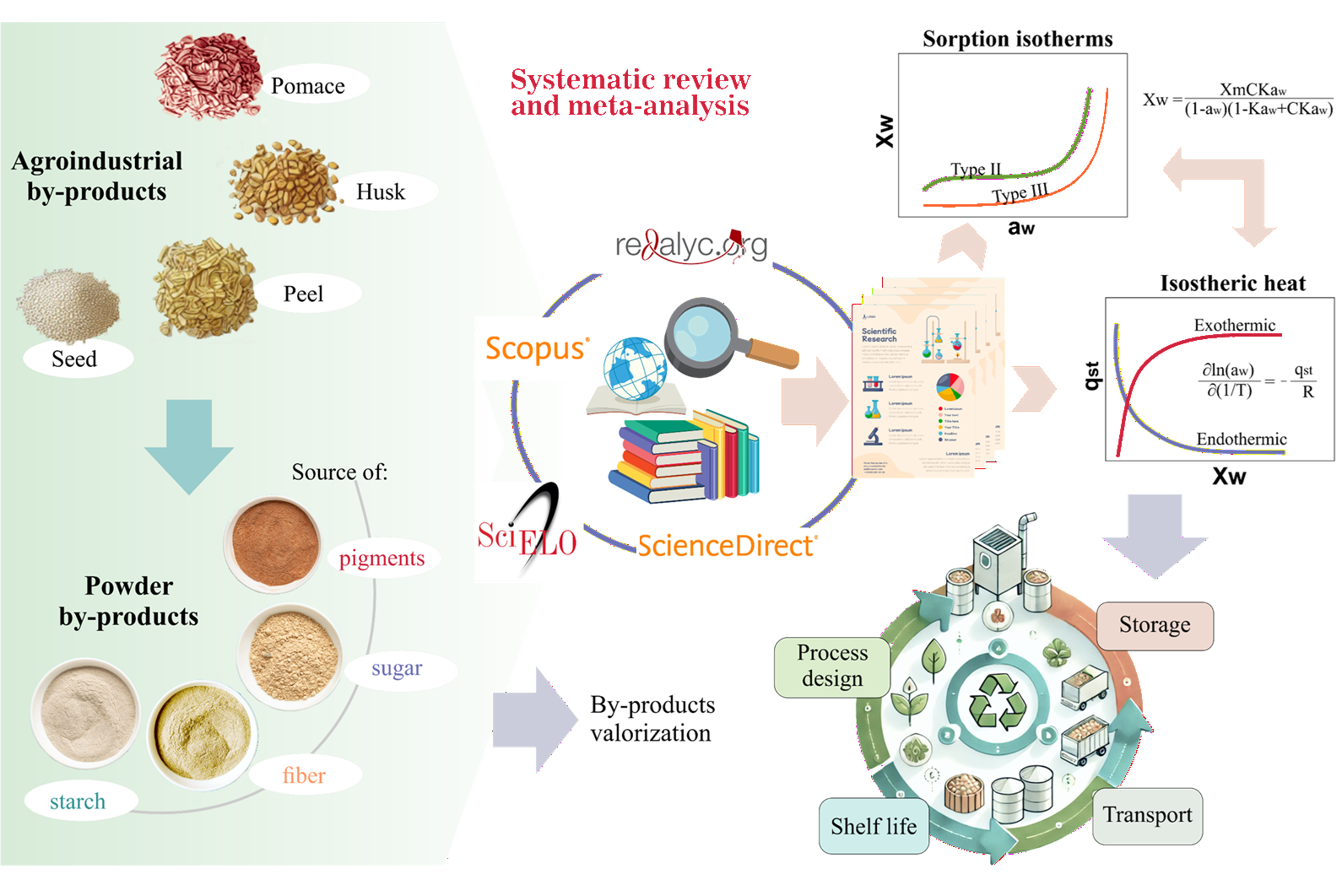
This systematic review and meta-analysis aimed to analyze data published since 2007 on the isosteric heat of sorption ( ) in powdered foods derived from agro-industrial by-products, in order to support the optimization of dehydration processes and their sustainable use in the food industry. Twenty-five studies were included following a structured search strategy. Results showed that powdered by-products predominantly exhibit Brunauer type II (sigmoidal) and type III isotherms, strongly influenced by their composition. Type II curves were associated with protein-, starch-, and biopolymer-rich powders, while type III behavior characterized sugar- and fiber-rich matrices. The Guggenheim–Anderson–de Boer (GAB) model consistently provided the best fit (R² > 0.90), with monolayer moisture content ( ) ranging from 0.006 to 0.6 g water/g dry matter and generally decreasing with temperature. Cluster analysis grouped powders according to values, composition, and temperature, highlighting the role of matrix structure in water retention behavior. The isosteric heat of sorption ( ) exhibited both endothermic and exothermic behavior (–88.4 to 58.0 kJ/mol), with higher energy requirements during desorption. Principal Component Analysis (PCA) revealed that is mainly associated with fiber-rich matrices, whereas the GAB parameter C is linked to carbohydrate and lipid fractions. In contrast, showed weak association with the principal components, indicating that sorption energetics are not directly aligned with structural variability but rather reflect localized molecular interactions. Overall, sorption behavior of powdered by-products is governed by the combined effect of composition, structural water retention, and energetic interactions, which are critical for improving drying and storage conditions.
Referências
Acurio, L., Salazar, D., García, M. E., García-Segovia, P., Martínez-Monzó, J., & Igual, M. (2024). Characterization, mathematical modeling of moisture sorption isotherms and bioactive compounds of Andean root flours. Current Research in Food Science, 8. https://doi.org/10.1016/j.crfs.2024.100752
Ahmad, T., Esposito, F., & Cirillo, T. (2024). Valorization of agro-food by-products: Advancing sustainability and sustainable development goals 2030 through functional compounds recovery. In Food Bioscience (Vol. 62). Elsevier Ltd. https://doi.org/10.1016/j.fbio.2024.105194
Al-Mahasneh, M. A., Rababah, T. M., Al-U’Datt, M. H., & Yang, W. (2010). Moisture adsorption thermodynamics of fractionated sesame hulls (sesamum indicum l.). Journal of Food Process Engineering, 33(5), 802–819. https://doi.org/10.1111/j.1745-4530.2008.00306.x
Al-Mahasneh, M. A., Rababah, T. M., & Yang, W. (2007). Moisture sorption thermodynamics of defatted sesame meal (DSM). Journal of Food Engineering, 81(4), 735–740. https://doi.org/10.1016/j.jfoodeng.2007.01.010
Ankita, & Prasad, K. (2016). Adsorption Studies of Radish Leaf Powder. MATEC Web of Conferences, 57. https://doi.org/10.1051/matecconf/20165704002
Aouaini, F., Knani, S., Ben Yahia, M., Bahloul, N., Ben Lamine, A., & Kechaou, N. (2016). New insights on energetic analysis of water adsorption isotherms of the Pelargonium graveolens: Modeling, interpretations and pore sizes distribution based on statistical physics approach. RSC Advances, 6(63), 58796–58804. https://doi.org/10.1039/c6ra06559g
Arslan, N., & Toǧrul, H. (2006). The fitting of various models to water sorption isotherms of tea stored in a chamber under controlled temperature and humidity. Journal of Stored Products Research, 42(2), 112–135. https://doi.org/10.1016/j.jspr.2005.01.001
Arslan-Tontul, S., Gunisik, A., & Tontul, I. (2024). Moisture sorption isotherm and thermodynamic analysis of egg powders dried by foam-mat-assisted refractance window drying. Journal of the Science of Food and Agriculture, 104(14), 8646–8654. https://doi.org/10.1002/jsfa.13692
Arthur, E., Tuller, M., Moldrup, P., Greve, M. H., Knadel, M., & de Jonge, L. W. (2018). Applicability of the Guggenheim–Anderson–Boer water vapour sorption model for estimation of soil specific surface area. European Journal of Soil Science, 69(2), 245–255. https://doi.org/10.1111/ejss.12524
Balakrishnan, S., Chandrasekaran, I. R., Jegadeesan, R., Ramachandran, K., Govindasamy, A. K., & Kandasamy, G. (2025). Eco-innovation in action: valorizing vegetable waste into high-value ingredients for sustainable applications. In Frontiers in Sustainable Food Systems (Vol. 9). Frontiers Media SA. https://doi.org/10.3389/fsufs.2025.1507120
Bogoeva, A. L., & Durakova, A. G. (2020). Sorption characteristics of full-fatted grape seeds flour of Bulgarian origin. Journal of Agriculture and Food Research, 2. https://doi.org/10.1016/j.jafr.2020.100026
Boudalia, S., Symeon, G. K., Dotas, V., Gueboudji, Z., Kouadri, I., Sehili, B., Terfa, M. T., Smeti, S., Gueroui, Y., & Bousbia, A. (2026). The Valorization of Agrifood Byproducts and Waste to Advance the Sustainable Development Goals: Current State and New Perspectives. Sustainability, 18(5), 2165. https://doi.org/10.3390/su18052165
Brunauer, S., Deming, L. S., Deming, W. E., & Teller, E. (1940). On a Theory of the van der Waals Adsorption of Gases. https://doi.org/doi:10.1021/ja01864a025
Carvalho Lago, C., & Noreña, C. P. Z. (2015). Thermodynamic analysis of sorption isotherms of dehydrated yacon (Smallanthus sonchifolius) bagasse. Food Bioscience, 12, 26–33. https://doi.org/10.1016/j.fbio.2015.07.001
Cheng, X., Ling, P., Iqbal, M. S., Liu, F., Xu, J., & Wang, X. (2023). Water adsorption properties of microalgae powders: Thermodynamic analysis and structural characteristics. Journal of Stored Products Research, 101. https://doi.org/10.1016/j.jspr.2023.102093
Cheng, X., Zhang, M., & Adhikari, B. (2020). Moisture adsorption in water caltrop (Trapa bispinosaRoxb.) pericarps: Thermodynamic properties and glass transition. Journal of Food Process Engineering, 43(8). https://doi.org/10.1111/jfpe.13442
Corrêa, P. C., Baptestini, F. M., Vanegas, J. D. B., Leite, R., Botelho, F. M., & De Oliveira, G. H. H. (2017). Kinetics of water sorption of damaged bean grains: Thermodynamic properties. Revista Brasileira de Engenharia Agricola e Ambiental, 21(8), 556–561. https://doi.org/10.1590/1807-1929/agriambi.v21n8p556-561
Cristina Duarte Marques, R., Resende Oliveira, É., Silva Mendes Coutinho, G., Emannuele Chaves Ribeiro, A., Souza Teixeira, C., Soares Soares Júnior, M., & Caliari, M. (2020). Modeling sorption properties of maize by-products obtained using the Dynamic Dewpoint Isotherm (DDI) method. Food Bioscience, 38. https://doi.org/10.1016/j.fbio.2020.100738
Cuq, B., Rondet, E., & Abecassis, J. (2011). Food powders engineering, between knowhow and science: Constraints, stakes and opportunities. Powder Technology, 208(2), 244–251. https://doi.org/10.1016/j.powtec.2010.08.012
de Souza, S. J. F., Alves, A. I., Vieira, É. N. R., Vieira, J. A. G., Ramos, A. M., & Telis-Romero, J. (2015). Study of thermodynamic water properties and moisture sorption hysteresis of mango skin. Food Science and Technology (Brazil), 35(1), 157–166. https://doi.org/10.1590/1678-457X.6557
Duarte, Y., Chaux, A., Lopez, N., Largo, E., Ramírez, C., Nuñez, H., Simpson, R., & Vega, O. (2017). Effects of Blanching and Hot Air Drying Conditions on the Physicochemical and Technological Properties of Yellow Passion Fruit (Passiflora edulis Var. Flavicarpa) by-Products. Journal of Food Process Engineering, 40(3). https://doi.org/10.1111/jfpe.12425
Edrisi Sormoli, M., & Langrish, T. A. G. (2016). Spray drying bioactive orange-peel extracts produced by Soxhlet extraction: Use of WPI, antioxidant activity and moisture sorption isotherms. LWT, 72, 1–8. https://doi.org/10.1016/j.lwt.2016.04.033
Fan, K., Chen, L., Wei, X., He, J., & Yan, F. (2015). Moisture Adsorption Isotherms and Thermodynamic Properties of Auricularia auricula. Journal of Food Processing and Preservation, 39(6), 1534–1541. https://doi.org/10.1111/jfpp.12379
García-Pérez, J. V., Cárcel, J. A., Clemente, G., & Mulet, A. (2008). Water sorption isotherms for lemon peel at different temperatures and isosteric heats. LWT, 41(1), 18–25. https://doi.org/10.1016/j.lwt.2007.02.010
Goneli, A. L. D., Corrêa, P. C., de Oliveira, G. H. H., Resende, O., & Mauad, M. (2016). Moisture sorption isotherms of castor beans. Part 1: Mathematical modeling and hysteresis. Revista Brasileira de Engenharia Agricola e Ambiental, 20(8), 751–756. https://doi.org/10.1590/1807-1929/agriambi.v20n8p751-756
Hickey, A. J., & Giovagnoli, S. (2018). Pharmaceutical Powder and Particles (R. Zavod, Ed.). American Association of Pharmaceutical Scientist. https://doi.org/https://doi.org/10.1007/978-3-319-91220-2
Kaderides, K., & Goula, A. M. (2017). Development and characterization of a new encapsulating agent from orange juice by-products. Food Research International, 100, 612–622. https://doi.org/10.1016/j.foodres.2017.07.057
Li, X., Han, X., Tao, L., Jiang, P., & Qin, W. (2021). Sorption equilibrium moisture and isosteric heat of Chinese wheat bran products added to rice to increase its dietary fibre content. Grain and Oil Science and Technology, 4(4), 149–164. https://doi.org/10.1016/j.gaost.2021.09.001
Lisboa, H. M., Duarte, M. E., & Cavalcanti-Mata, M. E. (2018). Modeling of food drying processes in industrial spray dryers. Food and Bioproducts Processing, 107, 49–60. https://doi.org/10.1016/j.fbp.2017.09.006
Muzaffar, K., & Kumar, P. (2016). Moisture sorption isotherms and storage study of spray dried tamarind pulp powder. Powder Technology, 291, 322–327. https://doi.org/10.1016/j.powtec.2015.12.046
Osorio-Arias, J., Delgado-Arias, S., Duarte-Correa, Y., Largo-Ávila, E., Montaño, D., Simpson, R., & Vega-Castro, O. (2020). New powder material obtained from spent coffee ground and whey protein; Thermal and morphological analysis. Materials Chemistry and Physics, 240. https://doi.org/10.1016/j.matchemphys.2019.122171
Panesar, R., Kaur, S., & Panesar, P. S. (2015). Production of microbial pigments utilizing agro-industrial waste: A review. In Current Opinion in Food Science (Vol. 1, Number 1, pp. 70–76). Elsevier Ltd. https://doi.org/10.1016/j.cofs.2014.12.002
Paul, I. D., & Das, M. (2019). Moisture sorption isotherm and thermodynamic properties of Jamun (Syzygium cumini L.) powder made from jamun pulp and seed. International Journal of Food Studies, 8(1), 111–126. https://doi.org/10.7455/ijfs/8.1.2019.a10
Piercy, E., Verstraete, W., Ellis, P. R., Banks, M., Rockström, J., Smith, P., Witard, O. C., Hallett, J., Hogstrand, C., Knott, G., Karwati, A., Rasoarahona, H. F., Leslie, A., He, Y., & Guo, M. (2022). A sustainable waste-to-protein system to maximise waste resource utilisation for developing food- and feed-grade protein solutions. In Green Chemistry (Vol. 25, Number 3, pp. 808–832). Royal Society of Chemistry. https://doi.org/10.1039/d2gc03095k
Polachini, T. C., Betiol, L. F. L., Lopes-Filho, J. F., & Telis-Romero, J. (2016). Water adsorption isotherms and thermodynamic properties of cassava bagasse. Thermochimica Acta, 632, 79–85. https://doi.org/10.1016/j.tca.2016.03.032
Prasantha, R. (2018). Prediction of Moisture Adsorption Characteristics of Dehydrated Fruits Using the GAB Isotherm Model. Annals of Agricultural and Crop Sciences, 3(1). www.austinpublishinggroup.com
Ramírez-Pulido, B., Bas-Bellver, C., Betoret, N., Barrera, C., & Seguí, L. (2021). Valorization of Vegetable Fresh-Processing Residues as Functional Powdered Ingredients. A Review on the Potential Impact of Pretreatments and Drying Methods on Bioactive Compounds and Their Bioaccessibility. In Frontiers in Sustainable Food Systems (Vol. 5). Frontiers Media S.A. https://doi.org/10.3389/fsufs.2021.654313
Ray, S., & Boruah, B. (2024). Food Science and Applied Biotechnology Current progress in the valorization of food industrial by-products for the development of functional food products. Food Science and Applied Biotechnology, 2024(2), 2024. https://doi.org/10.30721/fsab2024.v7.i2
Ribeiro-Filho, N., Akepach, P., & Sanchez de Alsina, O. L. (2021). Hygroscopicity and isosteric heat of cashew apple waste, non-fermented and fermented. Food Bioscience, 42. https://doi.org/10.1016/j.fbio.2021.101103
Rifna, E. J., Singh, S. K., Chakraborty, S., & Dwivedi, M. (2019). Effect of thermal and non-thermal techniques for microbial safety in food powder: Recent advances. In Food Research International (Vol. 126). Elsevier Ltd. https://doi.org/10.1016/j.foodres.2019.108654
Rosa, D. P., Evangelista, R. R., Borges Machado, A. L., Sanches, M. A. R., & Telis-Romero, J. (2021). Water sorption properties of papaya seeds (Carica papaya L.) formosa variety: An assessment under storage and drying conditions. LWT, 138. https://doi.org/10.1016/j.lwt.2020.110458
Rosa, G. S., Moraes, M. A., & Pinto, L. A. A. (2010). Moisture sorption properties of chitosan. LWT, 43(3), 415–420. https://doi.org/10.1016/j.lwt.2009.09.003
Sahu, C., Patel, S., & Khokhar, D. (2021). Sorption behavior and isosteric heat of maize-millet based protein enriched extruded product. Heliyon, 7(4). https://doi.org/10.1016/j.heliyon.2021.e06742
Santos, D., Lopes da Silva, J. A., & Pintado, M. (2022). Fruit and vegetable by-products’ flours as ingredients: A review on production process, health benefits and technological functionalities. In LWT (Vol. 154). Academic Press. https://doi.org/10.1016/j.lwt.2021.112707
Sarnavi, H. J., Precoppe, M., García-Triñanes, P., Chapuis, A., Tran, T., Bradley, M. S. A., & Müller, J. (2023). Determining the heat of desorption for cassava products based on data measured by an automated gravimetric moisture sorption system. Journal of the Science of Food and Agriculture, 103(1), 389–399. https://doi.org/10.1002/jsfa.12153
Sawhney, I. K., Sarkar, B. C., Patil, G. R., & Sharma, H. K. (2014). Moisture sorption isotherms and thermodynamic properties of whey protein concentrate powder from buffalo skim milk. Journal of Food Processing and Preservation, 38(4), 1787–1798. https://doi.org/10.1111/jfpp.12148
Silva, E. K., Borges, S. V., da Costa, J. M. G., & Queiroz, F. (2015). Thermodynamic properties, kinetics and adsorption mechanisms of Swiss cheese bioaroma powder. Powder Technology, 272, 181–188. https://doi.org/10.1016/j.powtec.2014.12.002
Simal, S., Femenia, A., Castell-Palou, Á., & Rosselló, C. (2007). Water desorption thermodynamic properties of pineapple. Journal of Food Engineering, 80(4), 1293–1301. https://doi.org/10.1016/j.jfoodeng.2006.10.001
Siqueira-de-Lima, M., Cagnin, C., Borges-Machado, A. L., Ribeiro-Sanches, M. A., Telis-Romero, J., & Resende, O. (2024). Thermodynamic approach on water vapor sorption of Curcuma longa L. flour. LWT, 206. https://doi.org/10.1016/j.lwt.2024.116592
Spada, J. C., Noreña, C. P. Z., Marczak, L. D. F., & Tessaro, I. C. (2013). Water adsorption isotherms of microcapsules with hydrolyzed pinhão (Araucaria angustifolia seeds) starch as wall material. Journal of Food Engineering, 114(1), 64–69. https://doi.org/10.1016/j.jfoodeng.2012.07.019
Tadapaneni, R. K., Yang, R., Carter, B., & Tang, J. (2017). A new method to determine the water activity and the net isosteric heats of sorption for low moisture foods at elevated temperatures. Food Research International, 102, 203–212. https://doi.org/10.1016/j.foodres.2017.09.070
Tao, Y., Wu, Y., Yang, J., Jiang, N., Wang, Q., Chu, D. T., Han, Y., & Zhou, J. (2018). Thermodynamic sorption properties, water plasticizing effect and particle characteristics of blueberry powders produced from juices, fruits and pomaces. Powder Technology, 323, 208–218. https://doi.org/10.1016/j.powtec.2017.09.033
Thys, R. C. S., Noreña, C. P. Z., Marczak, L. D. F., Aires, A. G., & Cladera-Olivera, F. (2010). Adsorption isotherms of pinhão (Araucaria angustifolia seeds) starch and thermodynamic analysis. Journal of Food Engineering, 100(3), 468–473. https://doi.org/10.1016/j.jfoodeng.2010.04.033
Ueda, J. M., Morales, P., Fernández-Ruiz, V., Ferreira, A., Barros, L., Carocho, M., & Heleno, S. A. (2023). Powdered Foods: Structure, Processing, and Challenges: A Review. In Applied Sciences (Switzerland) (Vol. 13, Number 22). Multidisciplinary Digital Publishing Institute (MDPI). https://doi.org/10.3390/app132212496
Viganõ, J., Gabas, A. L., & Telis-Romero, J. (2014). Moisture sorption characteristics of pineapple processing waste: Shell and central cylinder. Journal of Food Process Engineering, 37(2), 100–110. https://doi.org/10.1111/jfpe.12064
Villa-Vélez, H. A., Váquiro, H. A., Bon, J., & Telis-Romero, J. (2012). Modelling thermodynamic properties of banana waste by analytical derivation of desorption isotherms. International Journal of Food Engineering, 8(1). https://doi.org/10.1515/1556-3758.2191
Downloads
Arquivos adicionais
Publicado
Como Citar
Edição
Seção
Licença
Copyright (c) 2026 Scientia Agropecuaria

Este trabalho está licenciado sob uma licença Creative Commons Attribution-NonCommercial 4.0 International License.
Los autores que publican en esta revista aceptan los siguientes términos:
a. Los autores conservan los derechos de autor y conceden a la revista el derecho publicación, simultáneamente licenciada bajo una licencia de Creative Commons que permite a otros compartir el trabajo, pero citando la publicación inicial en esta revista.
b. Los autores pueden celebrar acuerdos contractuales adicionales separados para la distribución no exclusiva de la versión publicada de la obra de la revista (por ejemplo, publicarla en un repositorio institucional o publicarla en un libro), pero citando la publicación inicial en esta revista.
c. Se permite y anima a los autores a publicar su trabajo en línea (por ejemplo, en repositorios institucionales o en su sitio web) antes y durante el proceso de presentación, ya que puede conducir a intercambios productivos, así como una mayor citación del trabajo publicado (ver efecto del acceso abierto).