Screening commercial disinfectants to strengthen on-farm biosecurity for the prevention of Fusarium wilt of banana Tropical Race 4 in Ecuador
DOI:
https://doi.org/10.17268/sci.agropecu.2026.021Keywords:
Plant pathogens, Plant Disease management, Agricultural biosecurity, Bananas, Fusarium Wilt, DisinfectantsAbstract
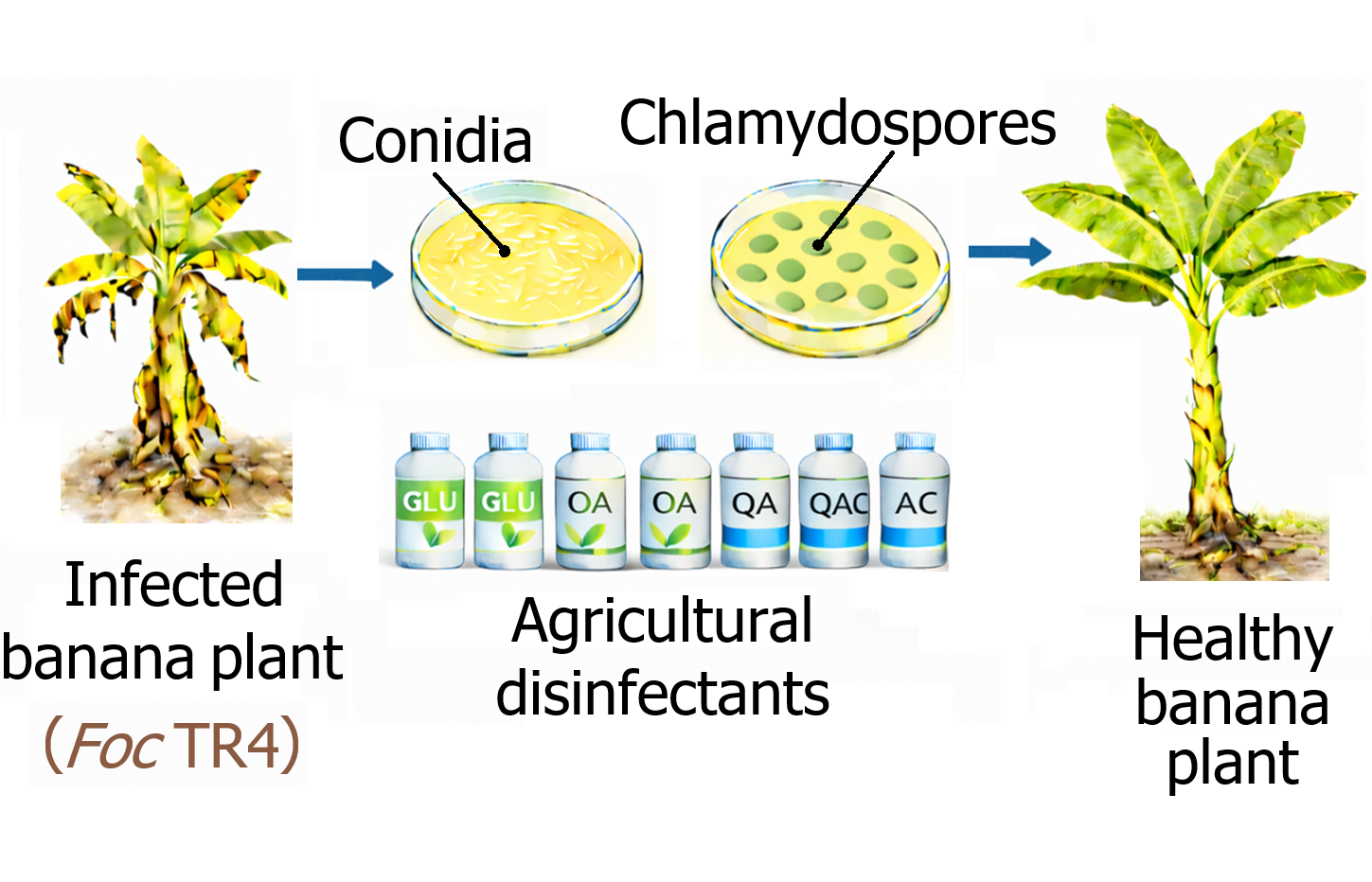
Bananas (Musa spp.), often reported together with plantains, are among the most traded fruit commodities worldwide, particularly in terms of export volume and value, with Ecuador recognized as the leading global exporter, supplying approximately one quarter of the total international trade. However, its production is increasingly threatened by climate change and fungal diseases such as Fusarium wilt, caused by Fusarium oxysporum f. sp. cubense Tropical Race 4 (Foc TR4). To support preventive management strategies against Foc TR4, this study evaluated the in vitro efficacy of nine commercial disinfectants available in Ecuador—including quaternary ammonium compounds (QACs), oxidizing agents, aldehydes, and alkaline substances—against conidia and chlamydospores of several Foc race 1 strains (VCG0120) as a model organism. Different concentrations and contact times were tested in the presence and absence of organic matter. Chlamydospores exhibited higher resistance than conidia, requiring greater concentrations for inhibition. Aldehyde formulations and QACs achieved the lowest minimum inhibitory concentrations (<1,000 ppm) and remained effective under organic load and variable contact times. These findings emphasize the need to select disinfectants with consistent efficacy under field-relevant conditions to ensure the application of proper biosecurity measures.
References
Abbott, W. S. (1925). A method of computing the effectiveness of an insecticide. Journal of Economic Entomology, 18(2), 265-267. https://doi.org/10.1093/jee/18.2.265a
Abdoussalami, A., Hu, Z., Islam, A. R. Md. T., & Wu, Z. (2023). Climate change and its impacts on banana production: A systematic analysis. Environment, Development and Sustainability, 25(11), 12217-12246. https://doi.org/10.1007/s10668-023-03168-2
Acuña, R., Rouard, M., Leiva, A. M., Marques, C., Olortegui, J. A., Ureta, C., Cabrera-Pintado, R. M., Rojas, J. C., Lopez-Alvarez, D., Cenci, A., Cuellar, W. J., & Dita, M. (2022). First Report of Fusarium oxysporum f. Sp. Cubense Tropical Race 4 Causing Fusarium Wilt in Cavendish Bananas in Peru. Plant Disease, 106(8), 2268. https://doi.org/10.1094/PDIS-09-21-1951-PDN
Arango-Palacio, L., Pinzón-Núñez, A. M., Hoyos-Carvajal, L., Ospina-Galeano, D. F., Feria-Gómez, D. F., Izquierdo-García, L. F., Betancourt-Vásquez, M., & Zapata-Henao, S. (2024). Behavior and Use of Quaternary Ammonium-Based Disinfectants in Biosafety Protocols Against Fusarium oxysporum f. Sp. Cubense Race 1 and Tropical Race 4. Plant Disease, 108(4), 971-978. https://doi.org/10.1094/PDIS-06-23-1138-RE
Bennett, R., O’Neill, W., Smith, L., & Hutmacher, R. (2011). Activity of Commercial Detergents Against Conidia and Chlamydospores of Fusarium oxysporum f. Sp. Vasinfectum. The Journal of Cotton Science, 15, 162-169.
Bennett, R. S. (2012). Survival of Fusarium oxysporum f. Sp. Vasinfectum Chlamydospores Under Solarization Temperatures. Plant Disease, 96(10), 1564-1568. https://doi.org/10.1094/PDIS-09-11-0812-RE
Brenes, M., García, A., de los Santos, B., Medina, E., Romero, C., de Castro, A., & Romero, F. (2011). Olive glutaraldehyde-like compounds against plant pathogenic bacteria and fungi. Food Chemistry, 125(4), 1262-1266. https://doi.org/10.1016/j.foodchem.2010.10.055
Carr, C., Sánchez, M., Alfaro, F., Masís, S., Conejo, A., & Guzmán, M. (2019). Cultivo in vitro de ápices: Una técnica segura para obtener plantas de banano libres de Fusarium oxysporum f. sp. cubense. Revista CORBANA, 45(65), 1–18. Corporación Bananera Nacional (CORBANA).
Chandler-Bostock, R., & Mellits, K. H. (2015). Efficacy of disinfectants against porcine rotavirus in the presence and absence of organic matter. Letters in Applied Microbiology, 61(6), 538–543. https://doi.org/10.1111/lam.12502
Chen, Y., Wei, Y., Cai, B., Zhou, D., Qi, D., Zhang, M., Zhao, Y., Li, K., Wedge, D. E., Pan, Z., Xie, J., & Wang, W. (2022). Discovery of Niphimycin C from Streptomyces yongxingensis sp. Nov. As a Promising Agrochemical Fungicide for Controlling Banana Fusarium Wilt by Destroying the Mitochondrial Structure and Function. Journal of Agricultural and Food Chemistry, 70(40), 12784-12795. https://doi.org/10.1021/acs.jafc.2c02810
Christen, V., Faltermann, S., Brun, N. R., Kunz, P. Y., & Fent, K. (2017). Cytotoxicity and molecular effects of biocidal disinfectants (quaternary ammonia, glutaraldehyde, poly(hexamethylene biguanide) hydrochloride PHMB) and their mixtures in vitro and in zebrafish eleuthero-embryos. Science of The Total Environment, 586, 1204-1218. https://doi.org/10.1016/j.scitotenv.2017.02.114
Copes, W., & Ojiambo, P. (2021). Efficacy of Hypochlorite as a disinfestant against fungal pathogens in agricultural and horticultural plant production: A systematic review and meta-analysis. Phytopathology, 111(8), 1369–1379. https://doi.org/https://doi.org/10.1094/PHYTO-05-20-0201-R
Copes, W. E., & Ojiambo, P. S. (2023). A Systematic Review and Quantitative Synthesis of the Efficacy of Quaternary Ammonium Disinfestants Against Fungal Plant Pathogens. Plant Disease, 107(2), 480-492. https://doi.org/10.1094/PDIS-09-21-2018-RE
Corporación Financiera Nacional B.P. (2024). Ficha Sectorial Banano. https://www.cfn.fin.ec/wp-content/uploads/2024/10/Ficha-Sectorial-Banano.pdf.
Croppenstedt, A. (2025). El impacto de las normas voluntarias de sostenibilidad en las exportaciones de banano. FAO ; https://openknowledge.fao.org/handle/20.500.14283/cd4325es
Delgado, R., Morillo, E., Buitrón, J., Bustamante, A., & Sotomayor, I. (2014). First report of Moko disease caused by Ralstonia solanacearum race 2 in plantain (Musa AAB) in Ecuador. New Disease Reports, 30(1), 23-23. https://doi.org/10.5197/j.2044-0588.2014.030.023
Dita, M., Barquero, M., Heck, D., Mizubuti, E. S. G., & Staver, C. P. (2018). Fusarium Wilt of Banana: Current Knowledge on Epidemiology and Research Needs Toward Sustainable Disease Management. Frontiers in Plant Science, 9. https://doi.org/10.3389/fpls.2018.01468
El Comercio. (2025, 18 de diciembre). Ecuador confirma presencia del hongo Fusarium R4T y y declara emergencia fitosanitaria en el banano. https://www.elcomercio.com/actualidad/negocios/ecuador-confirma-presencia-del-hongo-fusarium-r4t-y-y-declara-emergencia-fitosanitaria-en-el-banano/
Evans, E. A., Ballen, F. H., & Siddiq, M. (2020). Banana Production, Global Trade, Consumption Trends, Postharvest Handling, and Processing. En Handbook of Banana Production, Postharvest Science, Processing Technology, and Nutrition (pp. 1-18). John Wiley & Sons, Ltd. https://doi.org/10.1002/9781119528265.ch1
Fait, M. E., Bakas, L., Garrote, G. L., Morcelle, S. R., & Saparrat, M. C. N. (2019). Cationic surfactants as antifungal agents. Applied Microbiology and Biotechnology, 103(1), 97-112. https://doi.org/10.1007/s00253-018-9467-6
FAO. (2025). Banano Análisis del Mercado. Resultados Preliminares 2024. https://openknowledge.fao.org/items/b1912af4-cbbd-475c-bc87-c22707d8cab9
Figueroa, A., Hauck, R., Saldias-Rodriguez, J., & Gallardo, R. A. (2017). Combination of quaternary ammonia and glutaraldehyde as a disinfectant against enveloped and non-enveloped viruses. Journal of Applied Poultry Research, 26(4), 491-497. https://doi.org/10.3382/japr/pfx021
García-Bastidas, F. A., Quintero-Vargas, J. C., Ayala-Vasquez, M., Schermer, T., Seidl, M. F., Santos-Paiva, M., Noguera, A. M., Aguilera-Galvez, C., Wittenberg, A., Hofstede, R., Sørensen, A., & Kema, G. H. J. (2020). First Report of Fusarium Wilt Tropical Race 4 in Cavendish Bananas Caused by Fusarium odoratissimum in Colombia. Plant Disease, 104(3), 994-994. https://doi.org/10.1094/PDIS-09-19-1922-PDN
Gélinas, P., & Goulet, J. (1983). Neutralization of the activity of eight disinfectants by organic matter. Journal of Applied Bacteriology, 54(2), 243–247. https://doi.org/10.1111/J.1365-2672.1983.TB02613.X
Gerba, C. P. (2015). Quaternary ammonium biocides: Efficacy in application. In Applied and Environmental Microbiology (Vol. 81, Issue 2, pp. 464–469). American Society for Microbiology. https://doi.org/10.1128/AEM.02633-14
Guerra-Fuentes, N. R., Chávez-Bautista, M., Treviño-Espinosa, R. S., Garcia-Mazcorro, J. F., Torres-Castillo, J. A., Méndez-Albores, A., & Marroquín-Cardona, A. G. (2019). Effects of Neutral Electrolysed Water on tomato seeds artificially contaminated with Fusarium and Aspergillus. Seed Science and Technology. https://doi.org/10.15258/sst.2019.47.2.08
Gordon, T. R. (2017). Fusarium oxysporum and the Fusarium Wilt Syndrome. Annual Review of Phytopathology, 55(Volume 55, 2017), 23-39. https://doi.org/10.1146/annurev-phyto-080615-095919
Iñiguez-Moreno, M., Avila-Novoa, M. G., & Gutiérrez-Lomelí, M. (2018). Resistance of pathogenic and spoilage microorganisms to disinfectants in the presence of organic matter and their residual effect on stainless steel and polypropylene. Journal of Global Antimicrobial Resistance, 14, 197–201. https://doi.org/10.1016/j.jgar.2018.04.010
Izquierdo-García, L. F., Carmona, S. L., Zuluaga, P., Rodríguez, G., Dita, M., Betancourt, M., Soto-Suárez, M., & Zygadlo, J. A. (2021). Efficacy of Disinfectants against Fusarium oxysporum f. sp. cubense Tropical Race 4 Isolated from La Guajira, Colombia. Journal of Fungi, 7, 297. https://doi.org/10.3390/jof7040297
Jing, T., Zhou, D., Zhang, M., Yun, T., Qi, D., Wei, Y., Chen, Y., Zang, X., Wang, W., & Xie, J. (2020). Newly Isolated Streptomyces sp. JBS5-6 as a Potential Biocontrol Agent to Control Banana Fusarium Wilt: Genome Sequencing and Secondary Metabolite Cluster Profiles. Frontiers in Microbiology, 11. https://doi.org/10.3389/fmicb.2020.602591
Jo, H.-Y., Tango, C. N., & Oh, D.-H. (2018). Influence of different organic materials on chlorine concentration and sanitization of slightly acidic electrolyzed water. LWT, 92, 187-194. https://doi.org/10.1016/j.lwt.2018.02.028
Jones, I. A., & Joshi, L. T. (2021). Biocide use in the antimicrobial era: A review. Molecules, 26(8), 1–11. https://doi.org/10.3390/molecules26082276
Knauf, G. A., Cunningham, A. L., Kazi, M. I., Riddington, I. M., Crofts, A. A., Cattoir, V., Trent, M. S., & Davies, B. W. (2018). Exploring the Antimicrobial Action of Quaternary Amines against Acinetobacter baumannii. mBio, 9(1), 10.1128/mbio.02394-17. https://doi.org/10.1128/mbio.02394-17
Kwaśniewska, D., Chen, Y.-L., & Wieczorek, D. (2020). Biological Activity of Quaternary Ammonium Salts and Their Derivatives. Pathogens, 9(6), Article 6. https://doi.org/10.3390/pathogens9060459
Leslie, J. F., & Summerell, B. A. (2006). Techniques for Growing and Maintaining Fusarium. En The Fusarium Laboratory Manual (pp. 21-30). John Wiley & Sons, Ltd. https://doi.org/10.1002/9780470278376.ch4
Linfield, C. A. (1991). A Comparative Study of the Effects of Five Chemicals on the Survival of Chlamydospores of Fusarium oxysporum f. sp. narcissi. Journal of Phytopathology, 131(4), 297-304. https://doi.org/10.1111/j.1439-0434.1991.tb01200.x
Magdama, F., Monserrate-Maggi, L., Serrano, L., García Onofre, J., & Jiménez-Gasco, M. d. M. (2020). Genetic Diversity of Fusarium oxysporum f. sp. cubense, the Fusarium Wilt Pathogen of Banana, in Ecuador. Plants, 9(9), 1133. https://doi.org/10.3390/plants9091133
Maillard, J.-Y. (2002). Bacterial target sites for biocide action. Journal of Applied Microbiology, 92(s1), 16S-27S. https://doi.org/10.1046/j.1365-2672.92.5s1.3.x
Maillard, J.-Y. (2018). Resistance of Bacteria to Biocides. Microbiology Spectrum, 6(2), 10.1128/microbiolspec.arba-0006-2017. https://doi.org/10.1128/microbiolspec.arba-0006-2017
Maridueña-Zavala, M., Quevedo, A., Aguaguiña, K., Serrano, L., & Sosa, D. (2021). Colección de cultivos microbianos CIBE (CCM-CIBE): Una colección para la investigación. Bionatura, 6(1). https://doi.org/10.21931/RB/2021.06.01.32
Mejías Herrera, R., Hernández, Y., Magdama, F., Mostert, D., Bothma, S., Paredes Salgado, E. M., Terán, D., González, E., Angulo, R., Angel, L., Rodríguez, Y., Ortega, R., Viljoen, A., & Marys, E. E. (2023). First report of Fusarium wilt of Cavendish bananas caused by Fusarium oxysporum f. sp. cubense Tropical Race 4 in Venezuela. Plant Disease. https://doi.org/10.1094/PDIS-04-23-0781-PDN
Meldrum, R. A., Daly, A. M., Tran-Nguyen, L. T. T., & Aitken, E. A. B. (2013). The effect of surface sterilants on spore germination of Fusarium oxysporum f. sp. cubense Tropical Race 4. Crop Protection, 54, 194–198. https://doi.org/10.1016/J.CROPRO.2013.08.014
Mendoza, N. V., Yánez, P., Magdama, F., Pacheco, R., Vielma, J., Vanegas, M. E., Bogdanchikova, N., Pestryakov, A., & Chong, P. (2025). Inhibition of Fusarium oxysporum growth in banana by silver nanoparticles: In vitro and in vivo assays. PLOS ONE, 20(2), e0308200. https://doi.org/10.1371/journal.pone.0308200
Moore, N., & O’Neill, W. (2000). Detergent based degreaser for disinfecting machinery to reduce the spread of Fusarium wilt of cotton. Australian Cotton Cooperative Research Center. http://www.cottoncrc.org.au/content/Industry/Publications/ DiseaseMicrobiology/Cotton_IDM_Guidelines.aspx
Mosquera, L. E., Álvarez, D. A., Ritter, T., Mockshell, J. Y., Vera, D., & Dita, M. (2023). Banana value chain profile for Ecuador: The world’s largest exporter is at risk from Fusarium TR4. https://hdl.handle.net/10568/131762
Nasiłowska, B., Włodarski, M., Kaliszewski, M., Bogdanowicz, Z., Krzowski, Ł., Kopczyński, K., Witkowski, G., Czeczott-Urban, A., Bombalska, A., Urbańska, M., Garbat, K., Sowińska, A., Kutwin, M., Koperski, W., Woźniak, R., & Mierczyk, Z. (2024). Decontamination Effect of Hypochlorous Acid Dry Mist on Selected Bacteria, Viruses, Spores, and Fungi as Well as on Components of Electronic Systems. International Journal of Molecular Sciences, 25(13), 7198. https://doi.org/10.3390/ijms25137198
Nel, B., Steinberg, C., Labuschagne, N., & Viljoen, A. (2007). Evaluation of fungicides and sterilants for potential application in the management of Fusarium wilt of banana. Crop Protection, 26(4), 697-705. https://doi.org/10.1016/j.cropro.2006.06.008
Nguyen, T. V., Tran-Nguyen, L. T. T., Wright, C. L., Trevorrow, P., & Grice, K. (2019). Evaluation of the Efficacy of Commercial Disinfectants Against Fusarium oxysporum f. Sp. Cubense Race 1 and Tropical Race 4 Propagules. Plant Disease, 103(4), 721-728. https://doi.org/10.1094/PDIS-03-18-0453-RE
Olivares Campos, B. O. (2023). Fusarium Wilt of Bananas: A Threat to the Banana Production Systems in Venezuela. En B. O. Olivares Campos (Ed.), Banana Production in Venezuela: Novel Solutions to Productivity and Plant Health (pp. 59-93). Springer Nature Switzerland. https://doi.org/10.1007/978-3-031-34475-6_3
Ordoñez González, G. A., Toaza Mora, A. J., Yánez Altuna, J. M., Granda Moreno, E. I., & Marcial-Coba, M. S. (2021). Evaluation of the efficacy of five commercial desinfectants, applicable in the production chain of Musaceae, against five strains of Fusarium spp. Revista Ecuatoriana de Medicina y Ciencias Biológicas, 42(1). https://doi.org/DOI:10.26807/remcb.v42i1.884
Özarslandan, M., & Akgül, D. S. (2024). Fusarium wilt caused by Fusarium oxysporum f. sp. cubense Tropical Race 4 in banana plantations in Türkiye. Phytopathologia Mediterranea, 63(2), Article 2. https://doi.org/10.36253/phyto-15133
Pedreira, A., Fernandes, S., Simões, M., García, M. R., & Vázquez, J. A. (2024). Synergistic Bactericidal Effects of Quaternary Ammonium Compounds with Essential Oil Constituents. Foods, 13(12), 1831. https://doi.org/10.3390/foods13121831
Pegg, K. G., Coates, L. M., O’Neill, W. T., & Turner, D. W. (2019). The Epidemiology of Fusarium Wilt of Banana. Frontiers in Plant Science, 10. https://doi.org/10.3389/fpls.2019.01395
Rowe, L. A., Degtyareva, N., & Doetsch, P. W. (2008). DNA Damage-induced Reactive Oxygen Species (ROS) Stress Response in Saccharomyces cerevisiae. Free radical biology & medicine, 45(8), 1167-1177. https://doi.org/10.1016/j.freeradbiomed.2008.07.018
Rutala, W. A., & Weber, D. J. (2016). Disinfection and Sterilization in Health Care Facilities: An Overview and Current Issues. Infectious Disease Clinics of North America, 30(3), 609-637. https://doi.org/10.1016/j.idc.2016.04.002
Salacinas, M., Meijer, H. J. G., Mamora, S. H., Corcolon, B., Mirzadi Gohari, A., Ghimire, B., & Kema, G. H. J. (2022). Efficacy of Disinfectants Against Tropical Race 4 Causing Fusarium Wilt in Cavendish Bananas. Plant Disease, 106(3), 966-974. https://doi.org/10.1094/PDIS-08-20-1814-RE
Stewart-Wade, S. M. (2011). Plant pathogens in recycled irrigation water in commercial plant nurseries and greenhouses: Their detection and management. Irrigation Science, 29(4), 267-297. https://doi.org/10.1007/s00271-011-0285-1
Stover, R. H. (1962). Studies on Fusarium wilt of bananas: Ix. Competitive saprophytic ability of F. oxysporum f. Cubense. Canadian Journal of Botany, 40(11), 1473-1481. https://doi.org/10.1139/b62-143
Visconti, V., Coton, E., Rigalma, K., & Dantigny, P. (2021). Effects of disinfectants on inactivation of mold spores relevant to the food industry: A review. Fungal Biology Reviews, 38, 44-66. https://doi.org/10.1016/j.fbr.2021.09.004
Warman, N. M., & Aitken, E. A. B. (2018). The Movement of Fusarium oxysporum f.sp. Cubense (Sub-Tropical Race 4) in Susceptible Cultivars of Banana. Frontiers in Plant Science, 9. https://doi.org/10.3389/fpls.2018.01748
Zhang, W., Chang, Y., Zhong, W., Zhang, A., & Lin, Y. (2023). Antifungal mechanisms of polymeric quaternary ammonium salts against conidia of Fusarium oxysporum f. sp. cubense, Race 4. European Journal of Plant Pathology, 165(2), 317-331. https://doi.org/10.1007/s10658-022-02608-5
Zhang, W., Yu, J., Wu, M., Li, R., Zhang, A., & Lin, Y. (2024). Polyacrylamide quaternary ammonium salts based on stable adsorption in soil and its application on the control of soil-borne fungal disease. European Polymer Journal, 202, 112604. https://doi.org/10.1016/j.eurpolymj.2023.112604
Zou, D., Jiang, C., & Fan, Q. (2022). Present Situation of World Banana Production and Trade and Its Industrial Prospect. Asian Agricultural Research, 14(12). https://ideas.repec.org//a/ags/asagre/338344.html
Downloads
Published
How to Cite
Issue
Section
License
Copyright (c) 2026 Scientia Agropecuaria

This work is licensed under a Creative Commons Attribution-NonCommercial 4.0 International License.
The authors who publish in this journal accept the following conditions:
a. The authors retain the copyright and assign to the magazine the right of the first publication, with the work registered with the Creative Commons attribution license, which allows third parties to use the published information whenever they mention the authorship of the work and the First publication in this journal.
b. Authors may make other independent and additional contractual arrangements for non-exclusive distribution of the version of the article published in this journal (eg, include it in an institutional repository or publish it in a book) as long as it clearly indicates that the work Was first published in this journal.
c. Authors are encouraged to publish their work on the Internet (for example, on institutional or personal pages) before and during the review and publication process, as it can lead to productive exchanges and a greater and faster dissemination of work Published (see The Effect of Open Access).