
Optimización de tiempos para reducir costos en carguío y acarreo mediante un modelo de Red Neuronal Artificial
DOI:
https://doi.org/10.17268/jamm.2025.006Palabras clave:
Carguío, acarreo, costos, equipos, tiempo, vía, modeloResumen
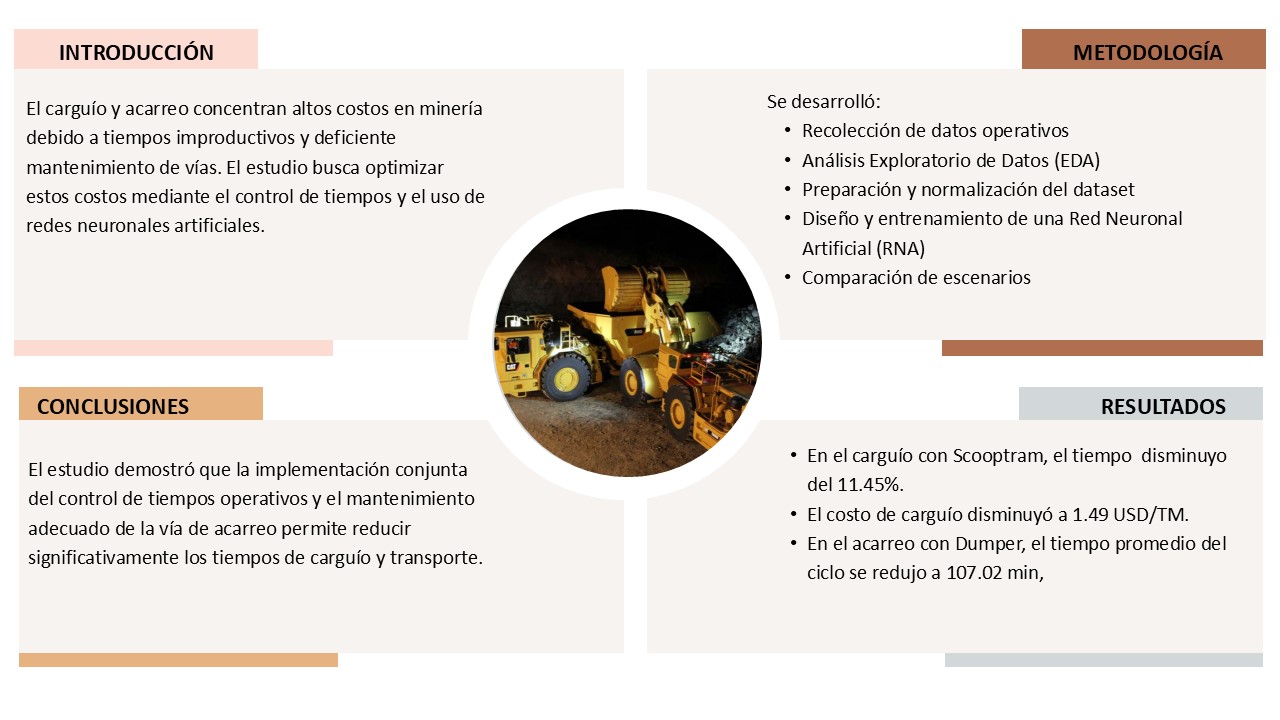
La investigación tuvo como objetivo reducir los costos mediante el control de tiempos y la mejora del mantenimiento de la ruta de acarreo. Se empleó un enfoque cuantitativo y un diseño cuasi experimental, realizando una evaluación de los procesos existentes de carguío y transporte, considerando la distancia recorrida, los equipos utilizados y los tiempos involucrados. Durante 20 guardias se monitorearon las operaciones y se implementaron controles de tiempos de carguío y acarreo, así como la programación de una red neuronal para predecir los costos asociados. Los resultados obtenidos muestran que, al verificar los tiempos y las predicciones con los promedios, existe una diferencia de $0.20 por tonelada métrica. Asimismo, al revisar los tiempos de transporte y el adecuado mantenimiento de la ruta de acarreo, los costos de soporte se redujeron de $1.04 por tonelada métrica a $0.90, logrando un ahorro adicional de $0.14. Además, se concluyó que el control del tiempo y el mantenimiento adecuado de la vía permiten reducir los tiempos de carguío en un 11.45% y los tiempos de transporte en un 12.73% dentro de la unidad minera. Se propone un modelo predictivo para próximas investigaciones basado en redes neuronales que permite optimizar los tiempos de carguío y acarreo, logrando una reducción de hasta 0.34 USD/TM en los costos operativos.
Referencias
[1] Wang, X.; Dai, Q.; Bian, Y.; Zhang, M. (2023). Real-time truck dispatching in open-pit mines. International Journal of Mining, Reclamation and Environment, 37(6), 400–420. DOI: https://doi.org/10.1080/17480930.2023.2201120
[2] Cotrina, M.A.; Vera, J.K.; Arango, S.M. (2025). An Intelligent Approach to Predicting Dilution, Overbreak and Costs in Underground Mining Using Kolmogorov-Arnold Networks. Mathematical Modelling of Engineering Problems, 12(3), 815–828. DOI: https://doi.org/10.18280/mmep.120308
[3] Baunier de Melo, W. (2021). Optimization of truck allocation in mines using differential evolution algorithm. International Journal for Innovation Education and Research, 9(8), 338–350. DOI: https://doi.org/10.31686/ijier.vol9.iss8.3303
[4] Simon, V.; Pellerin, R.; Gamache, M. (2025). Predicting Haul Truck Travel Times in Underground Mines. Mining, Metallurgy & Exploration, 42(4), 1989–2009. DOI: https://doi.org/10.1007/s42461-025-01293-2
[5] Huayanca, D.; et al. (2023). Application of Discrete-Event Simulation for Truck Fleet Management in Mining. Applied Sciences, 13(7). DOI: https://doi.org/10.3390/app13074093
[6] Kecojevic, V.; Komljenovic, D. (2005). Haul truck cycle-time prediction in open-pit mines using artificial neural networks. International Journal of Surface Mining, Reclamation and Environment, 19(1), 1–17. DOI: https://doi.org/10.1080/13895260500032564
[7] Cotrina, M.; Marquina, J.; Polo, J. (2025). Prediction of unit haulage cost in an underground mine using machine learning techniques. Journal of Sustainable Mining, 24(2), Article 9. DOI: https://doi.org/10.46873/2300-3960.1454
[8] Baek, J.; Choi, Y. (2017). A New Method for Haul Road Design in Open-Pit Mines to Support Efficient Truck Haulage Operations. Applied Sciences, 7(7), 747. DOI: https://doi.org/10.3390/app7070747
[9] Enkhchuluun, B.; Batgerel, B.-O.; Ping, C. (2023). Cycle Time Analysis Mining Dump Trucks. International Journal of Geosciences, 14, 689–709. DOI: https://doi.org/10.4236/ijg.2023.148037
[10] Cotrina, M.A.; Marquina, J.J.; Riquelme, Á.I. (2025). Comparación de técnicas de aprendizaje automático para la categorización de recursos minerales en un yacimiento de cobre en Perú. Natural Resources Research, 34, 2007–2025. DOI: https://doi.org/10.1007/s11053-025-10505-x
[11] Pathan, S.M.; et al. (2025). Simulation Optimization of Shovel-Truck System in Open-Pit Mines. Applied Technology & Research, 2025. DOI: https://doi.org/10.1155/atr/7939037
[12] Gu, Q.; Lu, C.; Li, F.; Wan, C. (2008). Monitoring Dispatch Information System of Trucks and Shovels in an Open Pit Based on GIS/GPS/GPRS. Journal of China University of Mining and Technology, 18(2), 288–292. DOI: https://doi.org/10.1016/S1006-1266(08)60061-9
[13] Cotrina, M.; Marquina, J.; Mamani, J.; Arango, S.; Gonzalez, J.; Noriega, E.; Antonio, E. (2025). Hybrid machine learning techniques to predict fuel consumption of dump trucks in an open-pit mine in Peru. International Journal of Mining and Mineral Engineering, 1–20. DOI: https://doi.org/10.1504/IJMME.2025.145583
[14] Shah, K.S.; Rehman, S.U. (2020). Modeling and Optimization of Truck–Shovel Allocation to Mining Faces in Cement Quarry. Journal of Mining and Environment, 11(1), 21–30. DOI: https://doi.org/10.22044/jme.2019.8329.1712
[15] Krause, A.; Musingwini, C. (2019). Estimating truck-shovel fleet productivity using discrete-event simulation. International Journal of Mining, Reclamation and Environment, 33(5), 299–313. DOI: https://doi.org/10.1080/17480930.2018.1438522
[16] Meneses, D.; Sepúlveda, F.D. (2023). Modeling Productivity Reduction and Fuel Consumption in Open-Pit Mining Trucks Considering Road Deterioration. Mining, 3(1), 96–105. DOI: https://doi.org/10.3390/mining3010006
[17] Baek, J.; Choi, Y. (2020). Deep neural network for predicting ore production by truck-haulage systems in open-pit mines. Applied Sciences, 10(5), 1657. DOI: https://doi.org/10.3390/app10051657
[18] Shakenov, A.; Sładkowski, A.; Stolpovskikh, I. (2022). Haul Road Condition Impact on Tire Life of Mining Dump Truck. Mining Journal (NVNGU), 2022(6), Art. 025. DOI: https://doi.org/10.33271/nvngu/2022-6/025
[19] Icarte, G.; Riveros Araya, E.; Herzog, O. (2020). An Agent-based System for Truck Dispatching in Open-pit Mines. ICAART 2020. DOI: https://doi.org/10.5220/0008961800730081
[20] Anticona, J.Y.; Noriega, E.M.; Cotrina, M.A.; Arango, M.S.M. (2024). Evaluation of Predictive Models for the Optimization of the Cost of Unit Operations in Artisanal Underground Mining. Mathematical Modelling of Engineering Problems, 11(4), 2901–2911. DOI: https://doi.org/10.18280/mmep.111103
[21] Mnzool, M.; Almujibah, H.; Bakri, M.; Gaafar, A.; Elhassan, A.A.M.; Gomaa, E. (2024). Optimization of cycle time for loading and hauling trucks in open-pit mining. Mining of Mineral Deposits, 18(1), 18–26. DOI: https://doi.org/10.33271/mining18.01.018
[22] Karikari, Y.S.; Askari Nasab, H. (2024). A Comprehensive Simulation Model for Mining Operations: Development, Implementation, and Validation Using HaulSim. Technical Report, University of Alberta. DOI: https://doi.org/10.13140/RG.2.2.33986.08649
[23] Mandal, S.K.; Dey, S.; Bhar, C. (2018). Analysis of Factors Which Influence the Cycle Time of Dumpers of Open Cast Coal Mines to Improve Production. Modelling, Measurement and Control C, 78(3), 289–302. DOI: https://doi.org/10.18280/mmc_c.780303
[24] Baek, J.; Choi, Y. (2017). A New Method for Haul Road Design in Open-Pit Mines to Support Efficient Truck Haulage Operations. Applied Sciences, 7(7), 747. DOI: https://doi.org/10.3390/app7070747
[25] Zhang, Y.; et al. (2022). Determination of Truck–Shovel Configuration of Open-Pit Mines using Simulation and Mathematical Modelling. Sustainability, 14(19), 12338. DOI: https://doi.org/10.3390/su141912338
[26] Cotrina, M.A.; Araujo, J.J.; Mamani, J.N. et al. (2025). Estimación de recursos minerales mediante cópulas espaciales y aprendizaje automático optimizado con metaheurísticas en un yacimiento de cobre. Earth Science Informatics, 18, 514. DOI: https://doi.org/10.1007/s12145-025-02009-2
[27] Cotrina, M.A.; Marquina, J.J.; Mamani, J.N. (2025). Application of artificial neural networks for the categorization of mineral resources in a copper deposit in Peru. World Journal of Engineering, ahead-of-print. DOI: https://doi.org/10.1108/WJE-01-2025-0004
[28] Krause, A.; Musingwini, C. (2019). Estimating truck-shovel fleet productivity using discrete-event simulation. International Journal of Mining, Reclamation and Environment, 33(5), 299–313. DOI: https://doi.org/10.1080/17480930.2018.1438522
Descargas
Publicado
Número
Sección
Categorías
Licencia
Derechos de autor 2025 Journal of Advanced Mining Modeling

Esta obra está bajo una licencia internacional Creative Commons Atribución 4.0.
Los autores aceptan los siguientes términos:
- Los autores conservan íntegramente sus derechos de autor, incluyendo los derechos sobre ideas, métodos, procesos, procedimientos, modelos, datos y resultados descritos en el artículo, así como cualquier derecho de marca o patente que pudiera derivarse del trabajo.
- Los autores conceden a Journal of Advanced Mining Modeling (JAMM) el derecho de primera publicación y autorización para difundir el artículo a través de su plataforma oficial, repositorios institucionales, bases de datos académicas, sistemas de indexación y otros canales de divulgación científica.
- Los autores pueden celebrar acuerdos contractuales adicionales, de manera independiente y no exclusiva, para la distribución de la versión publicada del artículo (por ejemplo, depositarlo en repositorios institucionales, publicarlo como capítulo de libro o incluirlo en compilaciones académicas), siempre que se cite de forma adecuada la publicación inicial en Journal of Advanced Mining Modeling (JAMM).
- Toda reutilización del contenido deberá incluir la referencia completa del artículo y el reconocimiento explícito de su publicación original en Journal of Advanced Mining Modeling (JAMM), indicando autores, título del trabajo, volumen, número y año de publicación.


 Todos los artículos se publican bajo la licencia