
Comparación de los efectos técnico-económicos del secado del arroz con secadoras de recirculación frente a métodos tradicionales
DOI:
https://doi.org/10.17268/agroind.sci.2026.01.14Palabras clave:
secado del arroz, secadoras de recirculación, eficiencia energética, métodos tradicionales, sostenibilidad agrícolaResumen
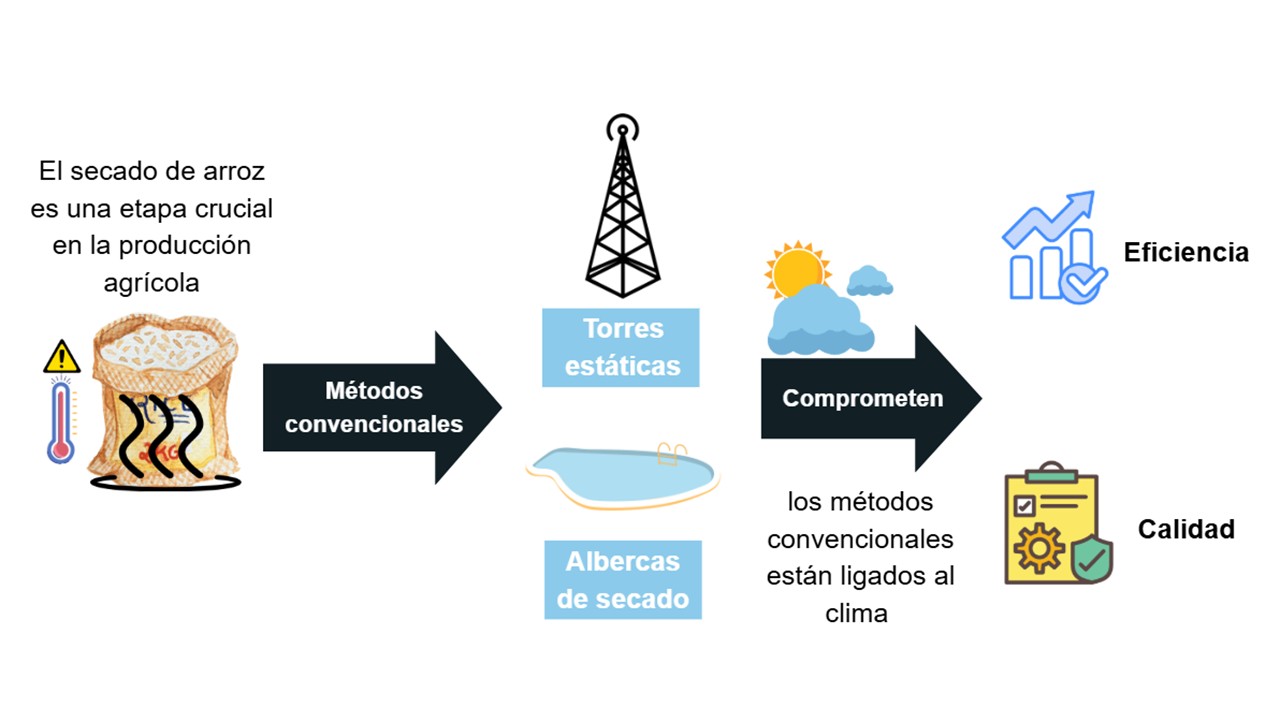
El secado del arroz es una etapa crucial en la producción agrícola, afectando directamente la calidad del grano y la rentabilidad del productor. Los métodos tradicionales, como las torres estáticas y albercas de secado, a pesar de ser de bajo costo inicial, presentan desafíos significativos debido a su dependencia de las condiciones climáticas, lo que compromete la eficiencia y calidad del arroz. El objetivo de este estudio es comparar los efectos técnicos y económicos de los métodos tradicionales de secado del arroz frente a las secadoras de recirculación, evaluando sus ventajas y desventajas en términos de eficiencia, calidad del producto final y sostenibilidad económica. La investigación se basa en una revisión documental y estudios de campo en diversas regiones productoras de arroz, donde se analiza el desempeño de los métodos tradicionales frente a las secadoras de recirculación, considerando tanto aspectos técnicos como económicos. Las secadoras de recirculación representan una solución más eficiente y sostenible para el secado del arroz, mejorando la calidad del grano y reduciendo los costos operativos. Sin embargo, la alta inversión inicial y la falta de capacitación técnica representan barreras para los pequeños y medianos productores. Se concluye que las políticas públicas que proporcionen subsidios, financiamiento accesible y capacitación son esenciales para facilitar la adopción de estas tecnologías y contribuir a una agricultura más competitiva y sostenible.
Citas
Chaves, M., Rodríguez, E., & Díaz, S. (2020). Homogeneidad en el secado del arroz: Estudio comparativo de sistemas tradicionales y modernos. Journal of Food Engineering, 29(6), 556-564.
Chavez, M., & Romero, E. (2020). Innovación en el secado de arroz: hacia la mejora de la eficiencia energética en los sistemas tradicionales. Journal of Agricultural Technology, 29(6), 890-897.
Chupawa, P., Gaewsondee, T., & Duangkhamchan, W. (2021). Drying characteristics and quality attributes affected by a fluidized-bed drying assisted with swirling compressed-air for preparing instant red jasmine rice. Processes, 9(10), 1738.
Cui, Y., Wang, X., Jiang, S., Wang, S., & Hou, L. (2023). Improving radio frequency heating uniformity in milled rice with different packaging shapes by changing temperature of forced air. Innovative Food Science & Emerging Technologies, 84, Article 103280.
Dalbhagat, C. G., & Mishra, H. N. (2021). Effect of the drying process on the color change, fissure development, and morphology of fortified rice kernels. Journal of Food Process Engineering, e13719.
Damayanti, W., Liao, M., Xu, Y., Jing, P., & Jiao, S. (2021). Pre-drying effect and quality change of rough rice under hot air-assisted radio frequency disinfestation treatment. Applied Engineering in Agriculture, 37(6), 1045–1054.
Das, H. J., Saikia, R., & Mahanta, P. (2022). Effects of spiral and cone angles on drying characteristics and energy consumption of fluidized bed paddy dryer. Drying Technology, 40(5), 852–863.
Das, H. J., Saikia, R., & Mahanta, P. (2023). Thermo-economic assessment of bubbling fluidized bed paddy dryers. Energy, 263, Article 125668.
Delfiya, D. S. A., Prashob, K., Murali, S., Alfiya, P. V., Samuel, M. P., & Pandiselvam, R. (2021). Drying kinetics of food materials in infrared radiation drying: A review. Journal of Food Process Engineering, e13810.
Ding, C., Chang, L., Luo, Y., Tao, T., Atungulu, G. G., Ding, H., Huang, L., Simelane, M. B., Zhao, S., & Liu, Q. (2023). Influence of cooking and texture attributes of far infrared radiated Japonica rice during storage. Journal of Cereal Science, 112, Article 103710.
Ding, C., Khir, R., Pan, Z., Wood, D. F., Venkitasamy, C., Tu, K., El-Mashad, H., & Berrios, J. (2018). Influence of infrared drying on storage characteristics of brown rice. Food Chemistry, 264, 149–156.
Dong, Y., Cui, Y., Xuan, X., Zhang, L., Shen, J., Ling, J., & Li, S. (2023). Improvement of protein structural and functional properties of indica-japonica hybrid rice by radio frequency treatment. Inno-vative Food Science & Emerging Technologies, 90, Art. 103516.
Du, Y., Yan, J., Wei, H., Xie, H., Wu, Y., & Zhou, J. (2023). Drying kinetics of paddy drying with graphene far-infrared drying equipment at different IR temperatures, radiation-distances, grain-flow, and dehumidifying-velocities. Case Studies in Thermal Engineering, 43, Article 102780.
Fernández, R., López, A., & Martín, J. (2022). Control automatizado en procesos de secado: Implicaciones para la calidad del arroz. International Journal of Food Science, 58(5), 462-475.
Figueroa, A., López, M., & Díaz, J. (2019). Training and adoption of emerging drying technologies in rice production. Agricultural Economics Review, 42(1), 28-35.
García, F., Ramírez, J., & López, A. (2022). Modern drying techniques for rice production: Economic and quality improvements. Rice Science, 29(4), 431-440.
García, R., Martínez, M., & Pérez, J. (2020). Impacto del secado tradicional en la calidad del arroz en zonas rurales. Revista de Agricultura Sostenible, 45(3), 203-214.
Gómez, F., & Rodríguez, P. (2021). Optimización de sistemas de secado mediante recirculación del aire en la industria arrocera. Agricultural Engineering Journal, 36(4), 234-245.
González, A., Pomares, F., & Hernández, E. (2022). Energy efficiency in rice drying: Technological advances and economic impacts. Journal of Agricultural Technology, 44(1), 78-88.
González, F., & López, P. (2021). Albercas de secado: un enfoque accesible para agricultores en desarrollo. Journal of Sustainable Agriculture, 20(2), 234-242.
Hernández, J., & Rodríguez, M. (2018). Energy efficiency and environ-mental impact of traditional and modern drying technologies for rice. Environmental Impact Review, 56(4), 125-135.
Mao, Y., & Wang, S. (2023). Recent developments in radio frequency drying for food and agricultural products using a multi-stage strategy: A review. Critical Reviews in Food Science and Nutrition, 63(16), 2654–2671.
Martínez, R., & Sánchez, L. (2022). Eficiencia de las torres de secado en la agricultura tradicional. Journal of Agricultural Engineering, 35(1), 56-65.
Mee-ngern, B., Lee, S. J., Choachamnan, J., & Boonsupthip, W. (2014). Penetration of juice into rice through vacuum drying. LWT - Food Science and Technology, 57(2), 640–647.
Mella, C., Vega-Gálvez, A., Uribe, E., Pasten, A., Mejias, N., & Quispe-Fuentes, I. (2022). Impact of vacuum drying on drying characteristics and functional properties of beetroot (Beta vulgaris). Applied Food Research, 2, Article 100120.
Mingotte, F. L. C., Hanashiro, R. K., & Filho, D. F. (2012). Características fisicoquímicas do grão de cultivares de arroz em função da adubação nitrogenada. Semina: Ciencias Agrarias, 33(SUPPL.1), 2605–2618.
Morales, J., González, F., & Pérez, A. (2020). The importance of efficient rice drying: Quality and profitability. Agricultural Review, 39(2), 215-224.
Mujumdar, A. S. (2015). Handbook of Industrial Drying. CRC Press.
Müller, A., Nunes, M. T., Maldaner, V., Coradi, P. C., de Moraes, R. S., Martens, S., Leal, A. F., Pereira, V. F., & Marin, C. K. (2022). Rice drying, storage and processing: Effects of post-Harvest operations on grain quality. Rice Science, 29(1), 16–30.
Nanvakenari, S., Movagharnejad, K., & Latifi, A. (2021). Evaluating the fluidized-bed drying of rice using response surface methodology and artificial neural network. LWT, 147, Article 111589.
Nanvakenari, S., Movagharnejad, K., & Latifi, A. (2022). Modelling and experimental analysis of rice drying in new fluidized bed assisted hybrid infrared-microwave dryer. Food Research International, 159, Article 111617.
Naveed, M., Yue, Z., Jun, Y., Yanhong, L., Naveed, M., Yue, Z., Jun, Y., & Yanhong, L. (2022). Effects of hot air assisted radio frequency intermittent drying with tempering on the physicochemical properties of rough rice. LWT, 158, 113131.
Nevame, A. Y. M., Emon, R. M., Malek, M. A., Hasan, M. M., Amirul Alam, M., Muharam, F., Aslani, F., Rafii, M. Y., & Ismail, M. R. (2018). Relationship between high temperature and formation of chalkiness and their effects on quality of rice. BioMed Research International, 2018.
Odek, Z. R., Siebenmorgen, T. J., & Mauromoustakos, A. (2018). Relative impact of kernel thickness and moisture content on rice fissuring during drying. Applied Engineering in Agriculture, 34(1), 239–246.
Ojediran, J., Adewumi, A., Oladele, S., Moses, O., Olayanju, A., & Okonkwo, C. (2021). Evaluating the drying characteristics of paddy rice using superheated steam dryer. IOP Conference Series: Materials Science and Engineering, 1107(1), Article 012044.
Pérez, J., Sánchez, L., & Ramírez, M. (2020). A review of solar drying technologies. Agricultural Engineering Journal, 37(2), 189-202.
Pomares Fiallo, F., García, S., & Hernández, E. (2023). Energy optimization in rice drying: Benefits of recirculation systems. Journal of Agricultural Technology, 44(1), 55-67.
Ramírez, J., Sánchez, L., & Torres, M. (2020). Innovations in rice drying: efficiency and sustainability. Journal of Agricultural Technology, 41(2), 188-198.
Ratseewo, J., Warren, F.J., Meeso, N., Siriamornpun, S. (2022). Effects of Far-Infrared Radiation Drying on Starch Digestibility and the Content of Bioactive Compounds in Differently Pigmented Rice Varieties. Foods, 11, 4079.
Rattanadecho, P., & Makul, N. (2016). Microwave-Assisted Drying: A Review of the State-of-the-Art. Drying Technology, 34, 1–38.
Riadh, M. H., Ahmad, S. A. B., Marhaban, M. H., & Soh, A. C. (2015). Infrared heating in food drying: An overview. Drying Technology, 33(3), 322–335.
Rumruaytum, P., Borompichaichartkul, C., & Kongpensook, V. (2014). Effect of drying involving fluidisation in superheated steam on physicochemical and antioxidant properties of Thai native rice cultivars. Journal of Food Engineering, 123, 143–147.
Salvatierra-Rojas, A., Torres-Toledo, V., & Müller, J. (2020). Influence of Surface Reflection (Albedo) in Simulating the Sun Drying of Paddy Rice. Applied Sciences, 10(15), 5092.
Saniso, E., Prachayawarakorn, S., Swasdisevi, T., & Soponronnarit, S. (2020). Parboiled rice production without steaming by microwave-assisted hot air fluidized bed drying. Food and Bioproducts Processing, 120, 8–20.
Scariot, M. A., Karlinski, L., Dionello, R. G., Radünz, A. L., & Radünz, L. L. (2020). Effect of drying air temperature and storage on industrial and chemical quality of rice grains. Journal of Stored Products Research, 89, Article 101717.
Semwal, J., & Meera, M. S. (2021). Infrared radiation: Impact on physicochemical and functional Characteristics of grain Starch. Starch/Staerke, 73(3–4).
Shen, L., Gao, M., Zhu, Y., Liu, C., Wang, L., Kamruzzaman, M., Liu, C., & Zheng, X. (2021). Microwave drying of germinated brown rice: Correlation of drying characteristics with the final quality. Innov Food Science & Emerging Technologies, 70, Article 102673.
Shen, L., Zhu, Y., Liu, C., Wang, L., Liu, H., Kamruzzaman, M., Liu, C., Zhang, Y., & Zheng, X. (2020). Modelling of moving drying process and analysis of drying characteristics for germinated brown rice under continuous microwave drying. Biosystems Engineering, 195, 64–88.
Silva, R., González, J., & Martínez, L. (2021). Influences of emerging drying technologies on rice quality. Journal of Food Science and Technology, 45(3), 375-384.
Smith, J., Chen, Y., & Foster, D. (2019). Traditional drying methods in the rice industry: a review. International Journal of Food Technology, 12(4), 345-352.
Publicado
Cómo citar
Número
Sección
Licencia
Derechos de autor 2026 Mohseni Mohammad Hossein, Elsa Beatriz Fonseca Santanilla

Esta obra está bajo una licencia internacional Creative Commons Atribución-NoComercial 4.0.
Los autores conservan sus derechos de autor sin restricciones.