
Estimación del índice de sitio como herramienta para el manejo productivo de Dipteryx ferrea y Simarouba amara
DOI:
https://doi.org/10.17268/agroind.sci.2026.01.06Palabras clave:
Índice de sitio, Dipteryx ferrea, Simarouba amara, modelos de crecimiento, curvas anamórficas, altura dominanteResumen
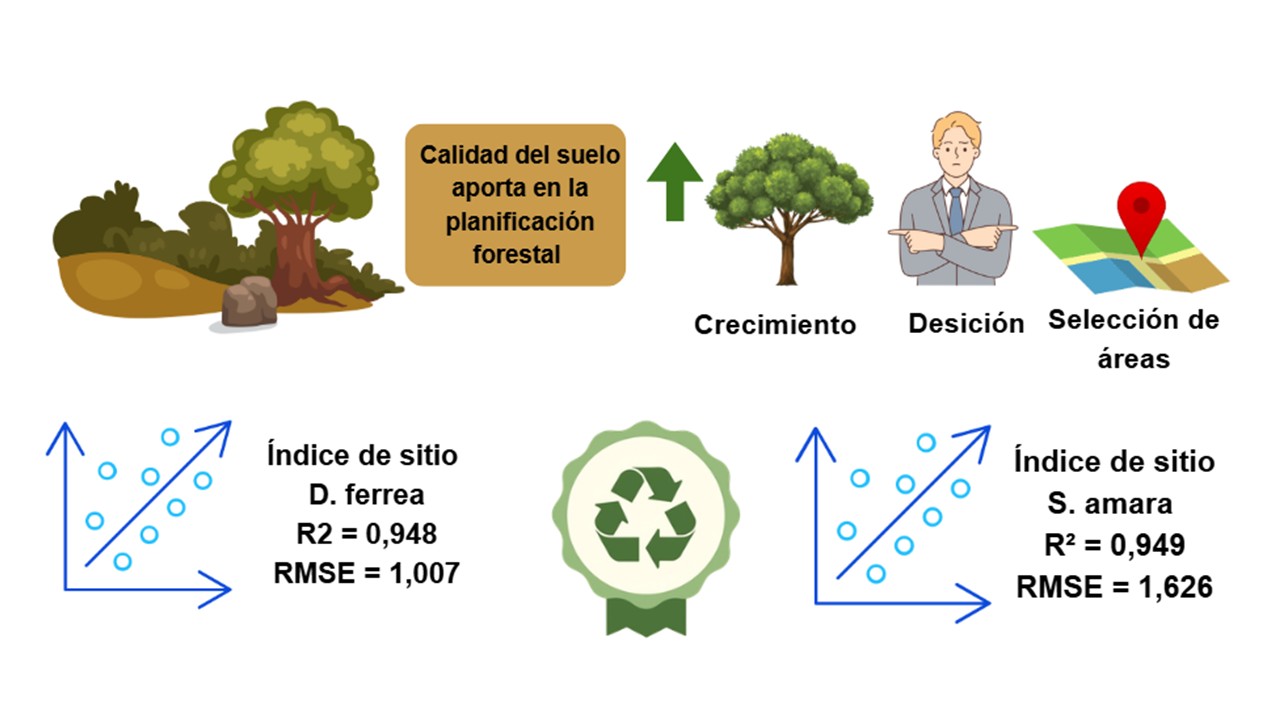
La estimación precisa de la calidad del sitio es esencial para la planificación forestal, ya que permite proyectar el crecimiento, seleccionar áreas prioritarias y optimizar decisiones de manejo. En especies tropicales nativas, la disponibilidad de modelos de índice de sitio sigue siendo limitada, lo que dificulta el desarrollo de plantaciones sostenibles. Este estudio estimó el índice de sitio (IS) para Dipteryx ferrea y Simarouba amara mediante los modelos de Schumacher y Chapman-Richards. Se analizaron 48 árboles de D. ferrea (1 – 13 años) y 113 de S. amara (1 – 12 años) provenientes de plantaciones experimentales. El modelo Chapman-Richards mostró mejor ajuste para D. ferrea (R² = 0,948; RMSE = 1,007), mientras que el modelo Schumacher fue superior para S. amara (R² = 0,949; RMSE = 1,626). Se generaron curvas anamórficas con edad base de 10 años para la estimación del IS y clasificación de sitios productivos. Los resultados revelan un crecimiento inicial notable en D. ferrea pese a su alta densidad de madera, destacando la necesidad de estudios adicionales. Este trabajo constituye la primera estimación formal del IS para D. ferrea y aporta una herramienta útil para el manejo sostenible de plantaciones tropicales.
Citas
Antón-Fernández, C., Hauglin, M., Breidenbach, J., & Astrup, R. (2023). Building a high-resolution site index map using boosted regression trees: The Norwegian case. Canadian Journal of Forest Research, 53(6), 416–429. https://doi.org/10.1139/cjfr-2022-0198
Araújo, E. J. G., Silva, E. V., Vaz, P., Monte, M. A., Morais, V. A., Curto, R. A., Ataide, D. H. S., & Rosa, T. C. (2024). Regression kriging in the productive capacity of planted forests. Floresta e Ambiente, 31(3), e20240034. https://doi.org/10.1590/2179-8087-FLORAM-2024-0034
Bentes-Brasil, N. A., Brasil, N. M. de Q. X., Andrade, P. I. L. de, Sampaio, A. C. F., Noronha, N. C., Carvalho, E. J. M., Silva, A. R. & Schwartz, G. (2021). The commercial tree species Dipteryx odorata improves soil physical and biological attributes in abandoned pastures. Ecological Engineering, 160, 106143. https://doi.org/10.1016/j.ecoleng.2020.106143
Binkley, D., & Fisher, R. F. (2019). Ecology and management of forest soils (5th ed.). Wiley.
Burkhart, H., & Tomé, M. (2012). Modeling forest trees and stands (457 pp.). Springer.
Caetano-Andrade, V., Schöngart, J., Espindola, W., Melinski, R., Silva, F., & Dobrindt, R. (2021). Advances in increment coring system for large tropical trees with high wood densities. Dendrochronologia, 68, 125860. https://doi.org/10.1016/j.dendro.2021.125860
Carvalho, C. S., Cardoso, D. B. O. S., & Lima, H. C. (2024). A taxonomic revision of Dipteryx, a Neotropical papilionoid legume genus of tonka beans and cumaru giant trees. In E. J. Tepe & T. A. Ranker (Eds.), Systematic Botany Monographs (Vol. 115, pp. 1–69). American Society of Plant Taxonomists.
Chapman, D. G. (1961). Statistical problems in dynamics of exploited fisheries populations. In J. Neyman (Ed.), Proceedings of the 4th Berkeley Symposium on Mathematical Statistics and Probability (Vol. 4, pp. 153–168). University of California Press.
Chávez, J. & Sabogal, C. (2019). Restoring Degraded Forest Land with Native Tree Species: The Experience of “Bosques Amazónicos” in Ucayali, Peru. Forests, 10(10), 851. https://doi.org/10.3390/f10100851
de Sousa, L., Pauletto, D., Gómez, E., da Silva, Á. F., de Sousa, T. G., da Silva, P., Baloneque, D. D. & Martorano, L. (2023). Dendrometric relationships and biomass in commercial plantations of Dipteryx spp. in the Eastern Amazon. Forests, 14(11), 2167. https://doi.org/10.3390/f14112167
Devecchi, M. F., Pirani, J. R. & Thomas, W. W. (2024). Simaroubaceae in Flora do Brasil 2024 (continuously updated). Jardim Botânico do Rio de Janeiro. https://floradobrasil.jbrj.gov.br/FB222
Fernández Angulo, M. C., & Limache Alonzo, A. (2024). Effect of AIB and substrates on the vegetative propagation of Dipteryx ferrea (Ducke) Ducke (shihuahuaco) in sub-irrigation chamber. Research, Society and Development, 13(12), e16131247510. https://doi.org/10.33448/rsd-v13i12.47510
Flores, Y. (2025). Crecimiento del “shihuahuaco” Dipteryx ferrea (Ducke) Ducke en plantaciones bajo diferentes espaciamientos y tipos de suelo en Ucayali, Amazonía peruana. Revista Forestal del Perú, 39(2), 238–255. https://doi.org/10.21704/rfp.v39i2.1829
Germplasm Resources Information Network (GRIN). (2024). National plant germplasm system: Taxonomy for plant resources. Information Network. Taxon: Simarouba amara Aubl. https://npgsweb.ars-grin.gov/gringlobal/taxon/taxonomydetail?id=33956
Hernández-Ramos, J., Hernández-Ramos, A., Ordaz-Ruiz, G., García-Espinoza, G. G., García-Magaña, J. J., & García-Cuevas, X. (2022). Índice de sitio para plantaciones forestales de Pinus patula en el Estado de México. Madera y Bosques, 28(2), e2822308. https://doi.org/10.21829/myb.2022.2822308
ITTO (International Tropical Timber Organization). (2023). Tropical Timber Market Report. International Tropical Timber Organization 27(3), 1-26. https://www.itto.int/files/user/mis/MIS_1-5_Feb2023.pdf.
Kazimirović, M., Stajić, B., Petrović, N., Stamenković, V., Stojanović, M., Belić, S., … & Medarević, M. (2024). Dynamic height growth models for highly productive pedunculate oak (Quercus robur L.) stands: Explicit mapping of site index classification in Serbia. Annals of Forest Science, 81, 15. https://doi.org/10.1186/s13595-024-01231-0
Kershaw, J. A., Jr., Ducey, M. J., Beers, T. W., & Husch, B. (2016). Forest mensuration (5th ed.). Wiley.
Kędziora, W., Tomusiak, R., & Borecki, T. (2020). Site index research: A literature review. Forest Research Papers, 81(2), 91–98. https://doi.org/10.2478/frp-2020-0010
Kashian, D. M., Zak, D. R., Barnes, B. V., & Spurr, S. H. (2022). Forest ecology (5th ed.). Wiley. https://doi.org/10.1002/9781119476054
Kiviste, A., Álvarez, J. G., Rojo, A., & Ruíz, A. D. (2002). Funciones de crecimiento de aplicación en el ámbito forestal. Monografías INIA: Forestal No. 4, 190 pp. INIA.
Lee, D., Siipilehto, J., Miina, J., Niemistö, P., Haapanen, M., Hynynen, J., & Huuskonen, S. (2024). Site index and stand characteristic models for silver birch plantations in southern and central Finland. Forest Ecology and Management, 563, 121998. https://doi.org/10.1016/j.foreco.2024.121998
Lumbres, R. I. C., Lee, Y. J., Seo, Y. O., Calora Jr., F. G., & Parao, M. R. (2013). Model fitting and validation of six height–DBH equations for Pinus kesiya Royle ex Gordon in Benguet Province, Philippines. Forest Science and Technology, 9(1), 45–50. https://doi.org/10.1080/21580103.2013.772542
Mason, E. G. (2019). Influences of mean top height definition and sampling method on errors of estimates in New Zealand’s forest plantations. New Zealand Journal of Forestry Science, 49, 24. https://doi.org/10.33494/nzjfs492019x24x
Mondragón, G. (2023). Respuesta silvicultural de ocho especies forestales nativas y exóticas de valor comercial instaladas en plantaciones forestales en la Amazonia peruana. (Tesis de maestría), Universidad Nacional Agraria La Molina. Repositorio Institucional UNALM.
Nakai, T., Sumida, A., Kodama, Y., Hara, T. & Ohta, T. (2010). A comparison between various definitions of forest stand height and aerodynamic canopy height. Agricultural and Forest Meteorology, 150, 1225–1233. https://doi.org/10.1016/j.agrformet.2010.05.005
Niemistö, P. (1995). Influence of initial spacing and row-to-row distance on the growth and yield of silver birch (Betula pendula). Scandinavian Journal of Forest Research, 10(1–4), 245–255. https://doi.org/10.1080/02827589509382890
Panik, M. J. (2014). Growth curve modelling. John Wiley & Sons.
Paredes, F. (2003). Estimación de la calidad de sitio de las especies Simarouba amara Aubl. (marupa) y Guatteria elata R.E. Fries (carahuasca) en plantaciones del Centro de Investigaciones de Jenaro Herrera (CIJH), Loreto – Perú. (Tesis de Ingeniería Forestal). Universidad Nacional de la Amazonia Peruana.
Pérez, R. (2023). Análisis comparativo del módulo de elasticidad y densidad básica por dos métodos de evaluación de la madera de Dipteryx ferrea (Ducke) Ducke (shihuahuaco), Pucallpa – Ucayali (Tesis de ingeniero forestal). Universidad Nacional de Ucayali.
Pinnschmidt, A., Yousefpour, R., & Nölte, A. (2023). Economic potential and management of tropical mixed-species plantations in Central America. New Forests, 54, 565–586. https://doi.org/10.1007/s11056-022-09937-7
Pinto Maldonado, E. L. (2025). Rendimiento de madera aserrada a pisos de shihuahuaco (Dipteryx ferrea (Ducke) Ducke) en dos plantas de transformación en Lima, Perú [Trabajo de suficiencia profesional, Universidad Nacional Agraria La Molina].
Pirani, J. R., Majure, L. C., & Devecchi, M. F. (2021). An updated account of Simaroubaceae with emphasis on American taxa. Brazilian Journal of Botany, 44(4), 651–669. https://doi.org/10.1007/s40415-021-00731-x
Richards, F. J. (1959). A flexible growth function for empirical use. Journal of Experimental Botany, 10(2), 290–301. https://doi.org/10.1093/jxb/10.2.290
Ritchie, M., Zhang, J. & Hamilton, T. (2012). Effects of stand density on top height estimation for ponderosa pine. Western Journal of Applied Forestry, 27(1), 18–24. https://doi.org/10.1093/wjaf/27.1.18
Rizzo-Martín, I., Hirigoyen-Domínguez, A., Arthus-Bacovich, R., Varo-Martínez, M. Á., & Navarro-Cerrillo, R. (2023). Site index estimation using airborne laser scanner data in Eucalyptus dunnii Maiden stands in Uruguay. Forests, 14(5), 933. https://doi.org/10.3390/f14050933
Román-Dañobeytia, F., Cabanillas, F., & Lefebvre, D. (2020). Survival and early growth of 51 tropical tree species in areas degraded by artisanal gold mining in the Peruvian Amazon. Ecological Engineering, 159, 106097. https://doi.org/10.1016/j.ecoleng.2020.106097
Rüger, N., Wirth, C., Wright, S., & Condit, R. (2012). Functional traits explain light and size response of growth rates in tropical tree species. Ecology, 93(12), 2626–2636. https://doi.org/10.1890/12-0622.1
Scarcelli, N., Garcia Davila, C., Couderc, M., Castro Ruiz, D., Estivals, G., Angulo Chavez, C. A. C., Acho Vasquez, H., Alvarado Reategui, J. G., Vizcarra Bentos, T., & Mariac, C. (2024). The complete chloroplast genome of marupa (Simarouba amara Aubl., Simaroubaceae). Ecology and Evolution, 14, e11688. https://doi.org/10.1002/ece3.11688
Schumacher, F. X. (1939). A new growth curve and its application to timber-yield studies. Journal of Forestry, 37, 819–820.
Selaya, N. G., Zuidema, P. A., Baraloto, C., Vos, V. A., Brienen, R. J. W., Pitman, N., Brown, F., Duchelle, A. E., Araujo-Murakami, A., Oliveira Carillo, L. A., Vasquez Colomo, G. H., Meo Chupinagua, S., Fuentes Nay, H., & Perz, S. (2017). Economically important species dominate aboveground carbon storage in forests of southwestern Amazonia. Ecology and Society, 22(2), 40. https://doi.org/10.5751/ES-09297-220240
Sharma, M., Amateis, R., & Burkhart, H. (2002). Top height definition and its effect on site index determination in thinned and unthinned loblolly pine plantations. Forest Ecology and Management, 168, 163–175. https://doi.org/10.1016/S0378-1127(01)00737-X
Sharma, R., Brunner, A., Eid, T., & Øyen, B. (2011). Modelling dominant height growth from national forest inventory individual tree data with short time series and large age errors. Forest Ecology and Management, 262, 2162–2175. https://doi.org/10.1016/j.foreco.2011.07.037
Siipilehto, J. (2011). Local prediction of stand structure using linear prediction theory in Scots pine-dominated stands in Finland. Silva Fennica, 45, 669–692. https://doi.org/10.14214/sf.99
Tymińska-Czabańska, L., Hawryło, P., & Socha, J. (2022). Assessment of the effect of stand density on the height growth of Scots pine using repeated ALS data. International Journal of Applied Earth Observation and Geoinformation, 108, 102763. https://doi.org/10.1016/j.jag.2022.102763
Ugarte-Guerra, L. J., & Domínguez-Torrejón, G. (2010). Índice de sitio (IS) de Calycophyllum spruceanum Benth. en relación con la altura dominante del rodal en ensayos de plantación en la cuenca del Aguaytía, Ucayali, Perú. Ecología Aplicada, 9(2), 101-111.
VanderSchaaf, C. (2023). Implications of incorrectly determining site index on stand-level management activities and financial returns in older generation loblolly pine plantations. Reforesta, 16, 1-15. https://doi.org/10.21750/REFOR.16.01.106
VanderSchaaf, C. L. (2024). Currently available site index equations that use on-site tree measurements for naturally regenerated longleaf pine in its historical range. Forests, 15(5), 855. https://doi.org/10.3390/f15050855
Weiskittel, A. R., Hann, D. W., Kershaw, J. A., & Vanclay, J. K. (2011). Forest growth and yield modeling. John Wiley & Sons. https://doi.org/10.1002/9781119998518
Publicado
Cómo citar
Número
Sección
Licencia
Derechos de autor 2026 Ymber Flores Bendezú

Esta obra está bajo una licencia internacional Creative Commons Atribución-NoComercial 4.0.
Los autores conservan sus derechos de autor sin restricciones.