
Antagonistic and growth-enhancing effect of native Trichoderma spp. on ‘Gros Michel’ banana under Foc R1 infection
DOI:
https://doi.org/10.17268/agroind.sci.2026.02.09Keywords:
Biological control, fungal diseases, rhizosphere microbiota, integrated disease management, MusaceaeAbstract
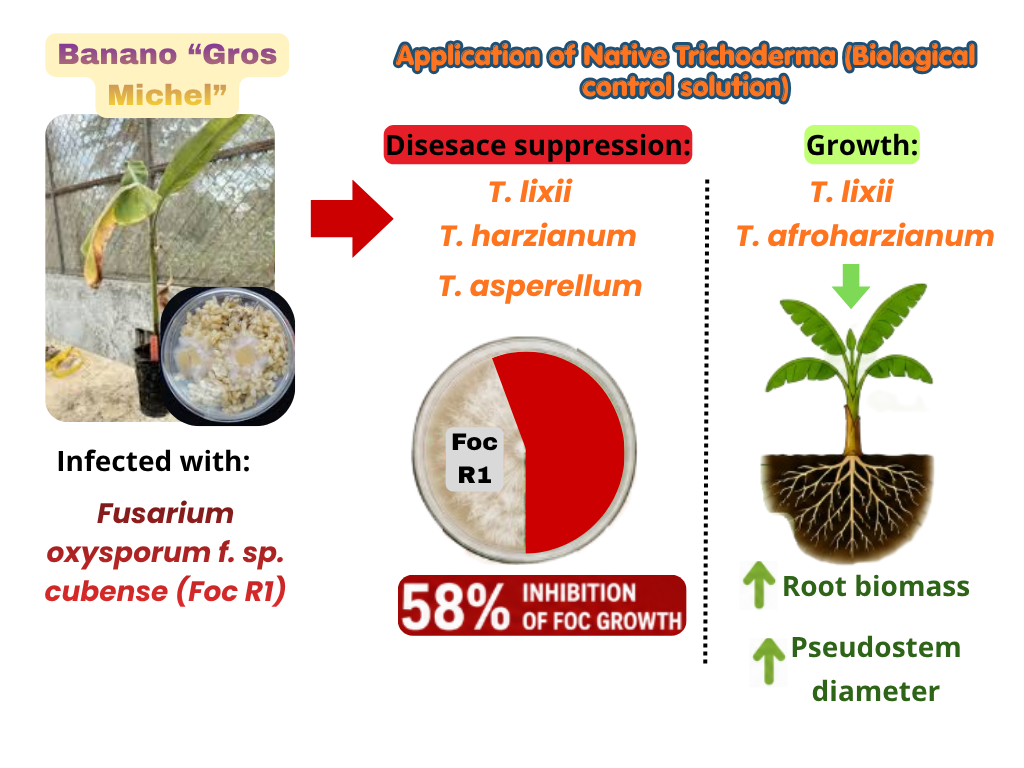
Banana production in Ecuador has been severely impacted by Fusarium wilt, caused by Fusarium oxysporum f. sp. cubense (Foc). This persistent soilborne pathogen remains viable for decades and reduces the effectiveness of conventional control strategies. Trichoderma spp. has emerged as a promising biological alternative due to its antagonistic capacity and plant-associated effects. This study evaluated the efficacy of native Trichoderma strains as biological control agents against Foc Race 1 (R1) in Musa AAA cv. Gros Michel. Dual culture assays and greenhouse experiments were conducted using a completely randomized design, with data analyzed by ANOVA and Tukey’s test (α = 0.05). In vitro, T. lixii, T. asperellum, and T. harzianum inhibited up to 58% of Foc radial growth. Under greenhouse conditions, Trichoderma application significantly reduced vascular wilt severity (p < 0.05) and was associated with increased pseudostem diameter and root biomass. T. afroharzianum and T. lixii lowered disease incidence to levels comparable to those of the healthy control. These findings support the potential use of native Trichoderma isolates in sustainable management strategies for Fusarium wilt in banana.
References
Anis Mufida, D. R., Putra, I. P., Nawangsih, A. A., Ratna Ayu Krishanti, N. P., & Wahyudi, A. T. (2024). Glucanase enzyme activity from rhizospheric Streptomyces spp. inhibits growth and damages the cell wall of Fusarium oxysporum. Rhizosphere, 32, 100991. https://doi.org/10.1016/j.rhisph.2024.100991
Chávez-Avilés, M. N., García-Álvarez, M., Ávila-Oviedo, J. L., Hernández-Hernández, I., Bautista-Ortega, P. I., & Macías-Rodríguez, L. I. (2024). Volatile organic compounds produced by Trichoderma asperellum with antifungal properties against Colletotrichum acutatum. Microorganisms, 12(10), 2007. https://doi.org/10.3390/microorganisms12102007
Chen, J., Zhang, H., Zhang, X., Tang, M., et al. (2021). Antagonistic activity of Trichoderma spp. against Fusarium oxysporum triggers host defense responses. Microorganisms, 9(4), 717.
Dita, M., Echegoyen, P., & Pérez, L. (2017). Plan de contingencia ante un brote de Raza 4 tropical de Fusarium oxysporum f. sp. cubense en un país de la región del OIRSA. Organismo Internacional Regional de Sanidad Agropecuaria (OIRSA).
Esquivel-Naranjo, E. U., Mancilla-Díaz, H., Márquez-Mazlín, R., Alizadeh, H., Kandula, D., Hampton, J., & Mendoza-Mendoza, A. (2025). Light regulates secreted metabolite production and antagonistic activity in Trichoderma. Journal of Fungi, 11(1), 9. https://doi.org/10.3390/jof11010009
Fotoohiyan, Z., Rezaee, S., Bonjar, G. H. S., Mohammadi, A. H., & Moradi, M. (2017). Biocontrol potential of Trichoderma harzianum in controlling wilt disease of pistachio caused by Verticillium dahliae. Journal of Plant Protection Research, 57(2), 185–193. https://doi.org/10.1515/jppr-2017-0025
Harman, G. E., Doni, F., Khadka, R. B., & Uphoff, N. (2021). Endophytic strains of Trichoderma increase plants’ photosynthetic capability. Journal of Applied Microbiology, 130(2), 529–546. https://doi.org/10.1111/jam.14368
Izquierdo-García, L. F., Carmona-Gutiérrez, S. L., Moreno-Velandia, C. A., Villarreal-Navarrete, A. del P., Burbano-David, D. M., Quiroga-Mateus, R. Y., Gómez-Marroquín, M. R., Rodríguez-Yzquierdo, G. A., & Betancourt-Vásquez, M. (2024). Microbial-based biofungicides mitigate the damage caused by Fusarium oxysporum f. sp. cubense Race 1 and improve the physiological performance in banana. Journal of Fungi, 10(6), 419. https://doi.org/10.3390/jof10060419
Jamil, M. (2021). Antifungal and plant growth-promoting activity of Trichoderma spp. against Fusarium oxysporum f. sp. lycopersici colonizing tomato. Journal of Plant Protection Research, 61(3), 292–301. https://doi.org/10.24425/jppr.2021.138373
Kema, G. H. J., Drenth, A., Dita, M., Jansen, K., Vellema, S., & Stoorvogel, J. J. (2021).Fusarium wilt of banana, a recurring threat to global banana production. Frontiers in Plant Science, 11, 628888. https://doi.org/10.3389/fpls.2020.628888
Khuong, N. Q., Trang, C. T. T., Xuan, D. T., Quang, L. T., Huu, T. N., Xuan, L. N. T., Sakagami, J.-I., & Thuc, L. V. (2023). Evaluation of the antagonistic potential of Trichoderma spp. against Fusarium oxysporum F.28.1A. Journal of Plant Protection Research, 63(1), 16–26. https://doi.org/10.24425/jppr.2023.145993
Kumari, R., Devi, S., et al. (2024). Screening of biocontrol efficacy of Trichoderma isolates and their antifungal metabolites. Journal of Fungi, 10(6), 408.
Luo, M., Chen, Y., Huang, Q., Huang, Z., Song, H., & Dong, Z. (2023). Trichoderma koningiopsis Tk905 induces resistance and promotes growth in banana affected by Fusarium wilt. Frontiers in Microbiology, 14, 1301062.
Natsiopoulos, D., Topalidou, E., Mantzoukas, S., & Eliopoulos, P. A. (2024). Endophytic Trichoderma: potential and prospects for plant health management. Pathogens, 13(7), 548. https://doi.org/10.3390/pathogens13070548
Nguyen Quoc Khuong, N., Pham Van Kim, P., Le Thanh, T., & Tran Thi, T. (2023). Evaluation of the antagonistic potential of Trichoderma spp. against Fusarium oxysporum. Journal of Plant Protection Research, 63(2), 203–213. https://doi.org/10.24425/jppr.2023.145874
Ploetz, R. C. (2015). Management of Fusarium wilt of banana: a review with special reference to Tropical Race 4. Crop Protection, 73, 7–15. https://doi.org/10.1016/j.cropro.2015.01.007
Rodríguez-García, D., Patiño-Ruiz, J. D., et al. (2020). In vitro effectiveness of Trichoderma spp. against Fusarium oxysporum. Agronomía Mesoamericana, 31(2), 109–123.
Sarma, M., Zorrilla-Fontanesi, Y., Uma, S., Vanderschuren, H., Swennen, R., & De Coninck, B. (2025). Suppression of Fusarium wilt and growth promotion in banana by Trichoderma asperellum is cultivar dependent. Biological Control, 194, 105318.
Sánchez-Alarcón, J., Milić, M., Kašuba, V., Tenorio-Arvide, M. G., Montiel-González, J. M. R., Bonassi, S., & Valencia-Quintana, R. (2021). A systematic review of studies on genotoxicity and related biomarkers in populations exposed to pesticides in Mexico. Toxics, 9(11), 272. https://doi.org/10.3390/toxics9110272
Silva, A. (2018). Acción in vitro de Trichoderma spp. y Bacillus spp. como controladores biológicos conjuntos contra Fusarium oxysporum en uvilla (Physalis peruviana), ecotipo colombiano, en la sierra norte y centro del Ecuador. Tesis de grado, Pontificia Universidad Católica del Ecuador, Ecuador.
Terrero Yépez, P. I., Factos, N., Rodulfo, P., Solis, K., Molina, C., & Mayorga, K. R. (2025). Trichoderma spp. y su influencia en la resiliencia de plantas de plátano ante Ralstonia solanacearum (Smith) filotipo II. Siembra, 12(1), e7943. https://doi.org/10.29166/siembra.v12i1.7943
Torres-Rodríguez, J. A., Reyes-Pérez, J. J., Adame, L. H., Llerena-Fuentes, B. L., & Hernández-Montiel, L. G. (2024). Marine actinomycetes for biocontrol of Fusarium solani in tomato plants: in vitro and in vivo studies. Notulae Botanicae Horti Agrobotanici Cluj-Napoca, 52(2), 13562. https://doi.org/10.15835/nbha52213562
Xue, C., Penton, C. R., Shen, Z., Zhang, R., Huang, Q., Li, R., & Shen, Q. (2022). Manipulating the banana rhizosphere microbiome for biological control of Panama disease. Communications Biology, 5, 259. https://doi.org/10.1038/s42003-022-03238-2
Yao, X., Chen, Z., Xu, Y., et al. (2023). Trichoderma spp. in plant disease control and growth promotion. Frontiers in Microbiology, 14, 1160551.
Zheng, R., Wang, D., Li, X., Yang, M., Kong, Q., & Ren, X. (2024). Screening of core microorganisms in healthy and diseased peaches and effect evaluation of biocontrol bacteria (Burkholderia sp.). Food Microbiology, 120, 104465. https://doi.org/10.1016/j.fm.2024.104465
Zou, Y., Liu, Z., Chen, Y., Wang, Y., & Feng, S. (2024). Crop rotation and diversification in China: enhancing sustainable agriculture and resilience. Agriculture, 14(9), 1465. https://doi.org/10.3390/agriculture14091465
Published
How to Cite
Issue
Section
License
Copyright (c) 2026 Pedro Terrero Yepez, Rafaela Mayorga Morejon, Paola Rodulfo Acuña, Arianna Mendoza Intriago, Karina Solis Hidalgo, Nicole Factos Laiño

This work is licensed under a Creative Commons Attribution-NonCommercial 4.0 International License.
Los autores conservan sus derechos de autor sin restricciones.