
Efficacy of peracetic acid in postharvest disease control and quality preservation of banana (Musa spp.)
DOI:
https://doi.org/10.17268/agroind.sci.2026.02.05Keywords:
banana, Musa, postharvest diseases, rots, disinfection, shelf, shelf life, ripening, peracetic acidAbstract
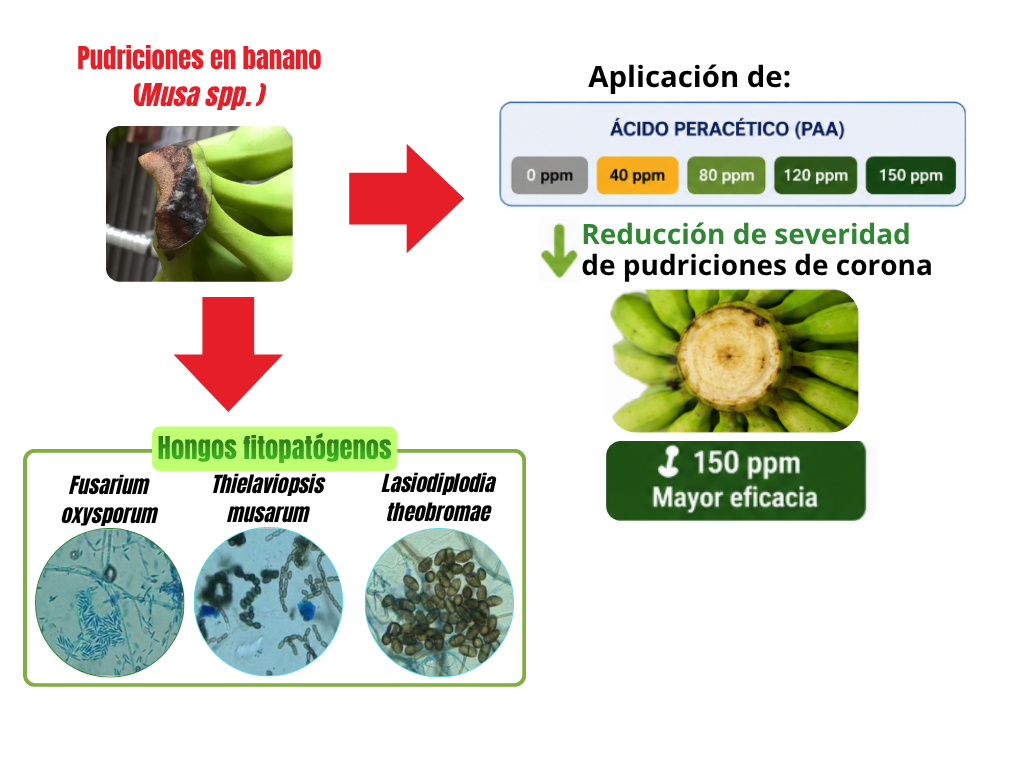
Banana (Musa spp.) can lose more than 20% postharvest due to fungal rots, creating a need for packing-friendly disinfection options. This study aimed to determine the efficacy of peracetic acid (PAA) to reduce crown-rot severity and its effect on ripening in bananas from Piura, Peru. Fruit was immersed for 10 min in 0 (control), 40, 80, 120, and 150 ppm PAA; for each concentration, 32 fruits were processed (8 from each of four sampling zones). Samples were incubated in humid chambers (22 °C; 85% – 90% RH) and disease severity was scored on an ordinal scale (1–5). Data were analyzed with Kruskal–Wallis and Dunn’s multiple comparisons (α = 0.05). Severity differed among treatments (χ² = 75.42, df = 4, p < 0.001): 80, 120 and 150 ppm significantly reduced severity versus 0 and 40 ppm, with no difference between 120 and 150 ppm. No phytotoxicity symptoms were observed during storage, and 150 ppm showed the greatest ripening delay (greener fruit by the end of the evaluation period). Fusarium oxysporum, Thielaviopsis musarum and Lasiodiplodia theobromae were isolated from controls. Overall, 120 – 150 ppm (especially 150 ppm) appears as operational doses to reduce postharvest rots and extend shelf life without compromising fruit appearance.
References
Aguilar-Anccota, R., Rafael-Rutte, R., Pasiche-Abad, L., Calle-Cheje, Y. H., Silupú-Masías, J. A., Alva, J., & Maldonado, E. (2025). Hongos asociados con la pudrición de la corona en frutos de banano orgánico: Fuentes de inóculo, monitoreo de conidias, e impacto del ozono en el control de la enfermedad. Manglar, 22(1), 33–41. https://doi.org/10.57188/manglar.2025.004
Cuggino, A., et al. (2023). Effects of peroxyacetic acid treatment on microbial load and sensorial quality of fresh-cut lettuce. Food Research International, 167, 112451. https://doi.org/10.1016/j.foodres.2023.112451
da Silva França, K. R., et al. (2024). First report of Lasiodiplodia hormozganensis and Lasiodiplodia laeliocattleyae causing crown rot disease in banana fruits in Brazil. Crop Protection, 184, 106784. https://doi.org/10.1016/j.cropro.2024.106784
da Silva França, K. R., et al. (2025). Diversity and pathogenicity of Lasiodiplodia species associated with banana crown rot in Northern and Northeastern Brazil. Scientific Reports, 15, 38802. https://doi.org/10.1038/s41598-025-22739-z
de Melo, M. P., Matos, K. S., & Pereira, O. L. (2016). Thielaviopsis musarum causes postharvest crown and fruit rot of banana in Northeastern Brazil. Tropical Plant Pathology, 41(4), 258–263. https://doi.org/10.1007/s40858-016-0094-4
Fatjó-Barboza, E., & Davidovich-Young, G. (2024). Efectividad del cloro y ácido peracético en la desinfección de repollo (Brassica oleracea) y plátano verde (Musa AAB) mínimamente procesado. Agronomía Mesoamericana, 35(Especial), Art. 59984.
Feliziani, E., Lichter, A., Smilanick, J. L., & Ippolito, A. (2016). Disinfecting agents for controlling fruit and vegetable diseases after harvest. Postharvest Biology and Technology, 122, 53–69. https://doi.org/10.1016/j.postharvbio.2016.04.016
Jaramillo-Aguilar, E. E., Peña-Zúñiga, E., Barriga-Medina, N., Rodríguez-González, D. A., Mattos-Calderón, L., León-Reyes, A., & Garcés-Fiallos, F. R. (2024). First report of Lasiodiplodia theobromae causing fruit crown rot on banana in Ecuador. Plant Disease, 108(11), 3410. https://doi.org/10.1094/PDIS-07-24-1370-PDN
Jin, Y., & Adhikari, A. (2025). Emerging and innovative technologies for the sanitization of fresh produce: Advances, mechanisms, and applications for enhancing food safety and quality. Foods, 14(11), 1924. https://doi.org/10.3390/foods14111924
Nicolau-Lapeña, I., Ortiz, J., Viñas, I., Abadias, M., Bobo, G., & Aguiló-Aguayo, I. (2024). Ultraviolet-C light and peracetic acid extend the shelf life of fresh and frozen strawberries. Horticulturae, 10(5), 452. https://doi.org/10.3390/horticulturae10050452
Saito, S., Wang, F., Obenland, D., & Xiao, C.-L. (2021). Effects of peroxyacetic acid on postharvest diseases and quality of blueberries. Plant Disease, 105(10), 3231–3237. https://doi.org/10.1094/PDIS-10-20-2310-RE
Schouten, R. E., Tijskens, L. M. M., Guo, X., van der Waal, J. W. H., & Lukasse, L. J. S. (2025). Estimating crown rot risk in reefer transported banana fruit. Postharvest Biology and Technology, 230, 113764. https://doi.org/10.1016/j.postharvbio.2025.113764
Sisquella, M., Casals, C., Viñas, I., Teixidó, N., & Usall, J. (2013). Combination of peracetic acid and hot water treatment to control postharvest brown rot on peaches and nectarines. Postharvest Biology and Technology, 83, 1–8. https://doi.org/10.1016/j.postharvbio.2013.03.003
Wang, Z., Yeo, D., Kwon, H., Zhang, Y., Yoon, D., Jung, S., Hossain, M. I., Jeong, M.-I., & Choi, C. (2024). Disinfection efficiency of chlorine dioxide and peracetic acid against MNV-1 and HAV in simulated soil-rich wash water. Food Research International, 175, 113772. https://doi.org/10.1016/j.foodres.2023.113772
Zakaria, L. (2023). Fusarium species associated with diseases of major tropical fruit crops. Horticulturae, 9(3), 322. https://doi.org/10.3390/horticulturae9030322
Published
How to Cite
Issue
Section
License
Copyright (c) 2026 Sebastian Iglesias-Osores, Cesar Figueroa-Palomino

This work is licensed under a Creative Commons Attribution-NonCommercial 4.0 International License.
Los autores conservan sus derechos de autor sin restricciones.