
Mesquite pod flour (Prosopis laevigata): Physicochemical composition, amino acid profile, water and oil absorption capacity, hemagglutinins, phenols, and flavonoids
DOI:
https://doi.org/10.17268/agroind.sci.2026.01.13Keywords:
Mesquite pod, flour mesquite, proximal composition, technological propertiesAbstract
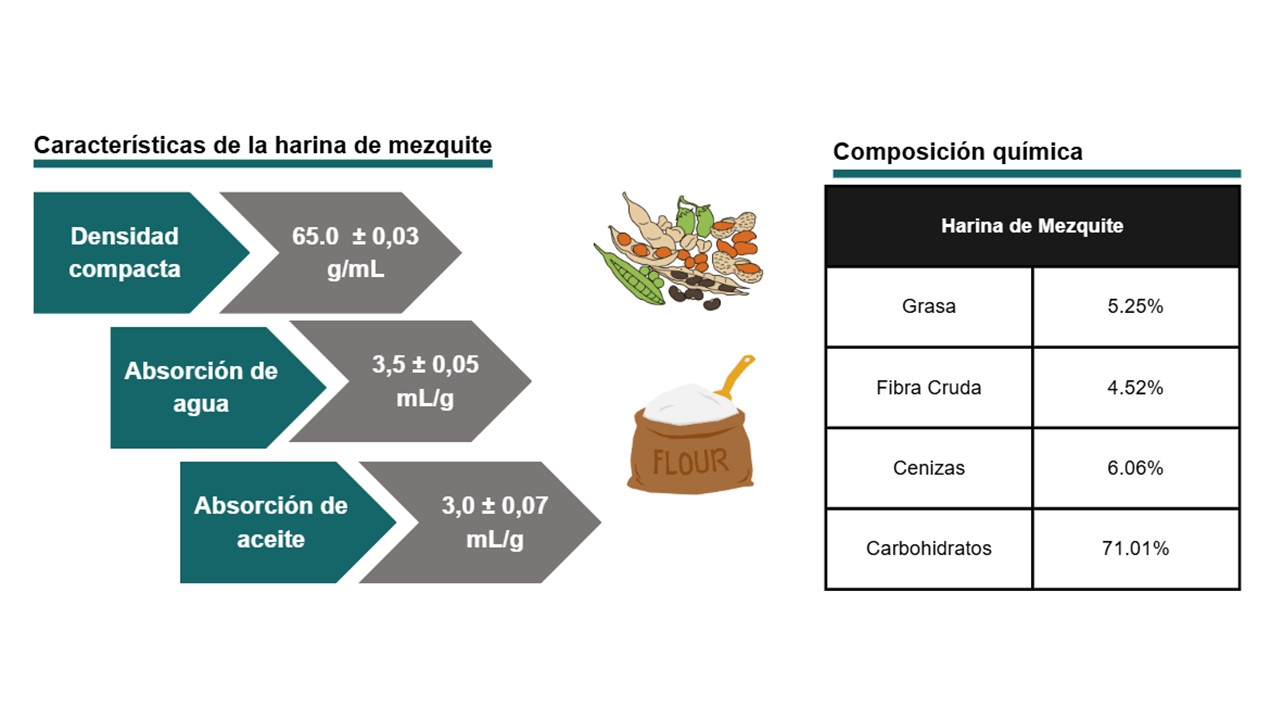
Legumes have been an essential part of the human diet for centuries and are a rich source of protein. However, their nutritional content can vary according to species and varieties. This study aimed to taxonomically identify and physicochemically characterize mesquite (Prosopis laevigata) pod flour. Proximate composition (fat: 5.25%. crude fiber: 4.52%. ash: 6.06%. carbohydrates: 71.01%) was analyzed using AOAC methods, while technological properties compacted density (65.0 ± 0.03 g/mL), water absorption capacity (3.5 ± 0.05 mL water/g sample) and oil absorption capacity (3.0 ± 0.07 mL oil/g sample) compared to wheat flour in proximate composition. Non-nutritive factors were quantified using specific assays: trypsin inhibitors (2.1 ± 0.3 TIU/mg), total phenols (1.8 ± 0.2 mg GAE/g) and flavonoids (0.9 ± 0.1 mg QE/g). Saponins (0.1%) and hemagglutinins (0.01 HU/mg) were absent. The amino acid profile analyzed by HPLC revealed higher essential amino acid content than wheat flour, particularly lysine (6.2 and 2.8 g/100 g protein). These results demonstrate that mesquite flour shares key technological properties with wheat flour, such as comparable water absorption capacity (3.5 vs 3.2 mL/g) and compacted density (65 vs 68 g/mL). Mesquite pod flour is a viable partial substitute in bakery products, enhancing nutritional value while maintaining functional performance.
References
AACC. (2000). Approved Methods of the American Association of Cereal Chemists. 10th edition. The American Association of Cereal Chemists. USA.
Achouri, A., Boye J. I., Belanger, D., Chiron, T., Yaylayan, V. A., & Yeboah, F. K. (2010). Functional and molecular properties of calcium precipitated soy glycinin and the effect of glycation with κ-carrageenan. Food Research International, 43, 5, 494-504.
Aguilera, Y. G. (2009). Harinas de leguminosas deshidratadas: caracterización nutricional y valoración de sus propiedades tecno-funcionales. Tesis Doctoral. Universidad Autónoma de Madrid, Facultad de Ciencias, Departamento de Química Agrícola. 274.
Aguirre–Loredo, R. Y. (2025). Mesquite Tree (Prosopis spp.): A Native Resource for the Potential for Human Consumption and Healthcare. Plant Foods Hum Nutr, 80, 5. https://doi.org/10.1007/s11130-024-01255-x
Alemán-Huerta, M. E., Castillo-Cázares, B. A., MárquezReyes, J. M., Báez-González, J. G., Quintero-Zapata, I., Gandarilla Pacheco, F. L., de Luna-Santillana, E. d. J., & Treviño-Garza, M. Z. (2023). Muffin-Type Bakery Product Based on Mexican Mesquite (Prosopis spp.) Flour: Texture Profile, Acceptability, and Physicochemical Properties. Foods, 12, 3587. https://doi.org/10.3390/foods12193587
Alvarado, J., & Aguilera, J. (2001). Métodos para medir propiedades físicas en industrias de alimentos. Ed. Acribia. Zaragoza, España, 15, 347-348.
Amarowicz, R., & Pegg, R. B. (2008). Legumes as a source of natural antioxidants. European Journal of Lipid Science and Technology, 110(10), 865-878.
AOAC. (2005). Official Methods of Analysis of Association of Official Analytical Chemists. 18th Ed., Washington, DC.
Bidwell, R. G. (1990). Fisiología Vegetal. México, D.F. 784: AGT Editor, S.A.
Bigne, F., Puppo, M. C., & Ferrero, C. (2018). Mesquite (Prosopis alba) flour as a novel ingredient for obtaining a “panettone-like” bread. Applicability of part-baking technology. LWT - Food Science and Technology, 89, 666–673.
Bishnoi, S., & Khetapaul, N. (1994). Protein digestibility of vegetables and field peas (Pisum sativum) Varietal differences and effect of domestic processing and cooking methods. Plant Foods for Human Nutrition, 46, 71-76.
Cartaya, O. E., & Reynaldo, I. (2001). Flavonoides: Características químicas y aplicaciones. Cultivos tropicales, 22(2), 5-14.
Cerezal-Mezquita, P. C., Barrientos, E. A., Rojas, V. G., Romero, P. N., & Arcos, Z. R. (2012). Desarrollo de una bebida proteica de alto contenido de mezquite, lupino y quinua chilenos para la dieta de preescolares. Nutrición Hospitalaria, 27(1), 232-43.
Chandra, S., Singh, S., & Kumari, D. (2015). Evaluation of functional properties of composite flours and sensorial attributes of composite flour biscuits. Journal of Food Science and Technology, 52, 3681–3688. https://doi.org/10.1007/s13197-014-1427-2
Corzo, B. D. C. (2008). Análisis y selección de diferentes métodos para eliminar las saponinas en dos variedades de Chenopodium quinoa Willd. Pérez-Arbelaezia, 19, 153-162.
Coscueta, E. R., Pintado, M. E., Picó, G. A., Knobel, G., Boschetti, C., Malpiedi, E., Pellegrini, L., & Nerli, B. B. (2017). Continuous method to determine the trypsin inhibitor activity in soybean flour. Food Chemistry. 214, 156–161. https://doi.org/10.1016/j.foodchem.2016.07.056
De Melo, C. A. M., De Melo, A. M., Ferreria da Silva, A. V., Da Silva, N. G. J., Turola, B. R. C., Benatti, S. G., Joy, S. C., & Da Silva, O. S. (2022). Mesquite (Prosopis juliflora) grain flour: New ingredient with bioactive, nutritional and physical-chemical properties for food applications. Future Foods, 5, 100114. https://doi.org/10.1016/j.fufo.2022.100114
Díaz-Batalla, L., Hernández-Uribe, J.P., Gutiérrez-Dorado, R., Téllez-Jurado, A., Castro-Rosas, J., Pérez-Cadena, R., & Gómez-Aldapa, C. A. (2018). Nutritional Characterization of Prosopis laevigata Legume Tree (Mesquite) Seed Flour and the Effect of Extrusion Cooking on its Bioactive Components. Foods, 7(8), 124. https://doi.org/10.3390/foods7080124
Felker, P., Takeoka, G., & Dao, L. (2013). Pod Mesocarp Flour of North and South American Species of Leguminous Tree Prosopis (Mesquite): Composition and Food Applications. Food Reviews International, 29(1), 49-66.
García-Azpeitia, L., Montalvo-González, E., & Loza-Cornejo, S. (2022). Nutritional and phytochemical characterization of leaves, flowers, and fruits of Prosopis laevigata. Botanical Sciences, 100, 1014-1024. https://doi.org/10.17129/botsci.3000
Genevois, C., & de Escalada Pla, M. (2021). Soybean by-products and modified cassava starch for improving alveolar structure and quality characteristics of gluten-free bread. European Food Research and Technology, 247, 1477–1488. https://doi.org/10.1007/s00217-021-03725-x
Gómez, M., Oliete, B., Rosell, C. M., Pando, V., & Fernández, E. (2008). Studies on cake quality made of wheat–chickpea flour blends. Food Science and Technology, 41(9), 1701-1709.
González-Barron, U., Dijkshoorn, R., Maloncy, M., Finimundy, T., Calhelha, R. C., Pereira, C., Stojković, D., Soković, M., Ferreira I. C. F. R., Barros, L., & Vasco, C. (2020). Nutritive and Bioactive Properties of Mesquite (Prosopis pallida) Flour and Its Technological Performance in Breadmaking. Foods, 9(5), 597. https://doi.org/10.3390/foods9050597
Grether, R., Martínez-Bernal, A., Luckow, M., & Zárate, S. (2006). Flora del Valle de Tehuacán-Cuicatlán. Mimosaceae, Tribu Mimoseae. Instituto de Biología, UNAM. México.
Grossmann, L., Tomas, J., & Csőke, B. (2004). Compressibility and flow properties of a cohesive limestone powder in a medium pressure range. Granular Matter, 6, 103-109. http://dx.doi.org/10.1021/ac60139a006
Hasmadi, M., Siti, F. A., Salwa, I., Patricia, M., Mansoor, A. H., & Ainnur Syafiqa, R. (2014). The effect of seaweed composite flour on the textural properties of dough and bread. Journal of Applied Phycology, 26, 1057–1062.
Jaimes-Morales, J., Torres, J. D., & Severiche, C. (2015). Análisis de la calidad de un producto cárnico escaldado elaborado con harina de Prosopis juliflora. Ingenium, 9(26), 21-28.
Katina, K. (2003). High-fibre baking. In S. P. Cauvain (Ed.), Bread Making (pp. 487-499). Woodhead Publishing. https://doi.org/10.1533/9781855737129.2.487
Korus, J., Witczak, M., Korus, A., & Juszczak, L. (2022). Influence of wheat- mesquite (Prosopis L.) composite flour on dough rheology and quality of bread. Food Technology, 26(2), 225-236.https://doi.org/10.2478/aucft-2022-0018
Ming-Yen, J., & Cheng-Chun, C. (2010). Enhancement of antioxidant activity, total phenolic and flavonoid content black soybeans by solid state fermentation with Bacillus subtilis BCRC14715. Food microbiology, 27(5), 586-591.
Negrete-Sánchez, L. O., J. Pinos‐Rodríguez, A. Grajales‐Lagunes, J. Morales, J., García‐López, & Lee‐Rangel, H. (2017). Effects of increasing amount of dietary Prosopis laevigata pods on performance, meat quality and fatty acid profile in growing lambs. Journal of Animal Physiology and Animal Nutrition, 101, 303- 311.
NMX-F-007-(1982). Alimento para humanos harina de trigo. Normas Mexicanas. Dirección General de Normas.
Onimawo, I. A., & Akubor, P. I. (2012) Food Chemistry (Integrated Approach with Biochemcial background). 2nd Edition, Joytal Printing Press, Agbowo.
Palacios-Romero, A., Jiménez-Muñoz, E., Rodríguez-Laguna, R., & Razo-Zárate, R. (2021). Potential distribution of Prosopis laevigata (Humb. Et Bonpl. Ex Willd.) M.C. Johnst. In the state of Hildalgo, Mexico. Rev. Mex. Cienc. For., 12(63), 71–87. https://doi.org/10.29298/rmcf.v12i63.812
Peña-Avelino, L. Y., Pinos-Rodriguez, J., Juarez-Flores, B., & Yañez-Estrada, L. (2016). Effects of Prosopis laevigata pods on growth performance, ruminal fermentation and blood meta-bolites in finishing lambs. South African Journal of Animal Science, 46, 360-365.
Pérez Lozano, A., Gallegos Infante, J. A., Chaírez Ramírez, M. H., Rocha Guzmán, N.E., Moreno Jiménez, M.R., Ochoa Martínez, L. A., Fierro, I. V., Castañeda, V. L., & Medina Torres, L. (2025). The Use of Common Bean and Mesquite Pods Flours as Partial Substitute of Semolina, Impact of Their Proteins and Polysaccharides in the Physical, Chemical, and Microstructural Characteristics of Spaghetti Pasta. Macromol, 5(8). https://doi.org/10.3390/macromol5010008
Pérez, M. J., Cuello, A. S., Zampini, I. C., Ordoñez, R. M., Alberto, M. R., Quispe, C. Schmeda-Hirschmann, G., & Isla, M. I. (2014). Polyphenolic compounds and anthocyanin content of Prosopis nigra and Prosopis alba pods flour and their antioxidant and anti-inflammatory capacities. Food Research International, 64, 762-771.
Prokopiuk, D. (2004). Sucedáneo del café a partir de algarroba (Prosopis alba Griseb). Tesis Doctoral. Universidad Politécnica de Valencia.
Prokopiuk, D., Cruz, G., Grados, N., Garro, O., & Chiralt, A. (2000). Estudio comparativo entre frutos de Prosopis alba y Prosopi spallida. Multequina, 9, 35-45.
Rodríguez, S. E. N., Rojo, M. G. E., Ramírez, V. B., Martínez, R. R. Cong, H. M. C., Medina, T. S. M., & Piña, R. H. H. (2014). Análisis técnico del árbol del mezquite (Prosopis laevigata Humb. & Bonpl. ex Willd.) en México. Ra Ximhai, 10(3), 173-193.
Sánchez-Chino, X., Jimenez-Martíınez, C., Dávila-Ortiz, G., Alvarez-González, I., & Madrigal-Bujaidar, E. (2015). Nutrient and Non nutrient Components of Legumes, and Its Chemopreventive Activity: A Review. Nutrition and Cancer, 67(3), 401-410.
Sciammaro, L. P., Ferrero, C., & Puppo, M. C. (2018). Gluten-free baked muffins developed with Prosopis alba flour. LWT - Food Science and Technology, 98, 568–576.
Singleton, V.L., & Rossi, J.A. (1965). Colorimetry of Total Phenolics with Phosphomolybdic-Phosphotungstic Acid Reagent. American Journal of Enology and Viticulture, 16, 144-158.
Spackman, D. H., Stein, W. H., & Moore, S. (1958) Automatic Recording Apparatus for Use in the Chromatography of Amino Acids. Analytical Chemistry, 30, 1190-1205.
Torres, G. M. P. (2015). Efecto de la adición de harinas de plátano y garbanzo a la harina de trigo en la elaboración y la calidad del pan de sal. Tesis de Maestría en Ciencia de Alimentos. Universidad de las Américas. Puebla.
Vegas, N. R., Zavaleta, I. A., & Vegas, P.C. (2017). Efecto del pH y cloruro de sodio sobre las propiedades funcionales de harina de semillas de Lupinus mutabilis “tarwi” variedad criolla. Agroindustrial Sciences, 7(1), 49-55.
Villalón-Mendoza, H., Hernández-Hernández, E. E., & Manzanares-Miranda, N. (2023). Presence and Importance of Mesquite Prosopis laevigata (Humb. & Bonpl. ex Willd.) M. C. Johnst in Northeastern Mexico. In: Garza-Ocañas, F. (eds) Sustainable Management of Natural Resources. Earth and Environmental Sciences Library. Springer, Cham. https://doi.org/10.1007/978-3-031-33394-1_8
Zhong, J., Lu, P., Wu, H., Liu, Z., Sharifi-Rad, J., Setzer, W. N., & Suleria, H. A. R. (2022). Current insights into phytochemistry, nutritional, and pharmacological properties of Prosopis plants. Evid. Based Complement. Altern. Med., 2218029. https://doi.org/10.1155/2022/2218029
Published
How to Cite
Issue
Section
License
Copyright (c) 2026 Victoria Guadalupe Aguilar-Raymundo, Rossana Altamirano Fortoul

This work is licensed under a Creative Commons Attribution-NonCommercial 4.0 International License.
Los autores conservan sus derechos de autor sin restricciones.