Antifungal activity of essential oils against Fusarium oxysporum associated with avocado (Persea americana Mill.)
DOI:
https://doi.org/10.17268/agroind.sci.2026.01.11%20Keywords:
Essential oils, Fusarium oxysporum, Persea americana, mycelial inhibition, TagetesAbstract
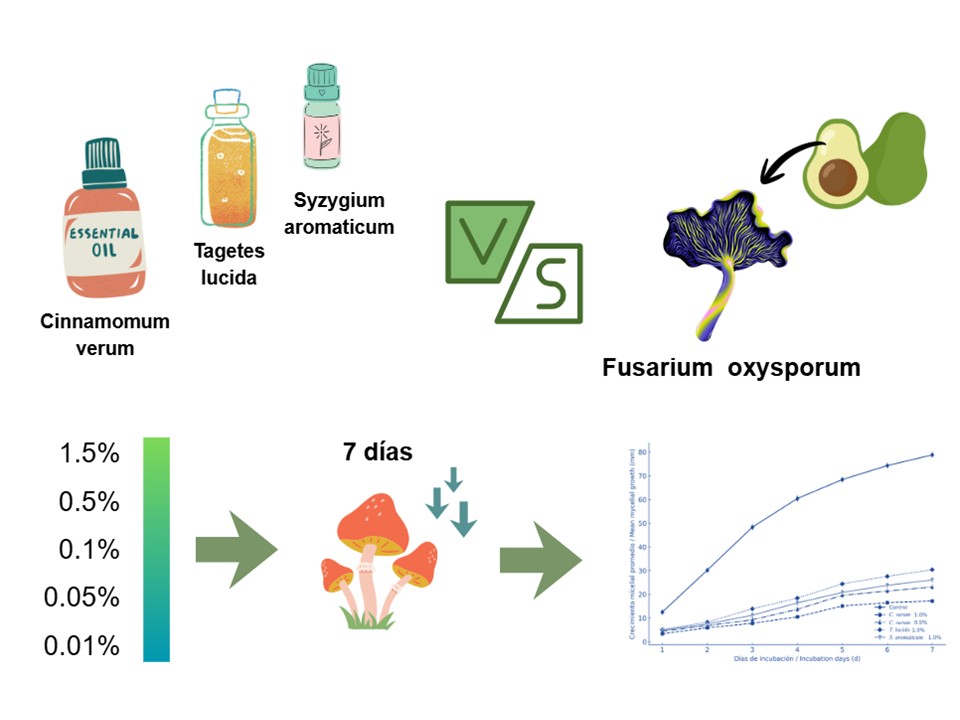
This study evaluated the antifungal activity of essential oils from Cinnamomum verum, Tagetes lucida and Syzygium aromaticum against Fusarium oxysporum isolated from avocado (Persea americana Mill.). The oils were tested at concentrations of 1.0%, 0.5%, 0.1%, 0.05% and 0.01% using the agar diffusion method, with four replicates per treatment. Mycelial growth was measured daily for seven days, and the inhibition percentage and area under the growth curve were calculated. Significant differences (p ≤ 0.05) were observed among treatments, with C. verum being the most effective, achieving over 70% inhibition at 1.0% concentration. T. lucida and S. aromaticum showed moderate antifungal effects, with mycelial growth reductions up to 60%. Phytotoxicity assays on P. americana calli revealed no visible damage, except for slight yellowing with C. verum at 1.0%. These findings highlight the potential of essential oils as sustainable biotechnological alternatives for the management of F. oxysporum in avocado cultivation
References
Acero, J., De Jesús, T., Delgado, W. A., Alcántara, J. S., Soto, M., & Gil, E. (2025). Efecto antimicrobiano de tres aceites esenciales de la familia Lamiaceae para el control Ralstonia solanacearum. Revista Tecnología en Marcha, 28(3)54-68. https://doi.org/10.18845/tm.v38i3.7511
Amoozegaran, A., Dehghan, H., Homami, S., & Hashemi, S. (2022). Efficacy of an edible coating, containing thyme essential oil, to control Fusarium oxysporum and the quality of tomato fruits. Journal of Food Measurement and Characterization, 16, 3760 - 3767. https://doi.org/10.1007/s11694-022-01424-z
Balouiri, M., Sadiki, M., & Ibnsouda, S. K. (2016). Methods for in vitro evaluating antimicrobial activity: A review. Journal of pharmaceutical analysis, 6(2), 71-79. https://doi.org/10.1016/j.jpha.2015.11.005
Behera, S. K., Kalita, H. C., Borah, S., Ram, K., & Kumar, A. (2025). Efficacy of Botanicals as Biocontrol Agents Against Leaf Spot and Blossom Blight Pathogen of Marigold: A First Report from Longleng District of Nagaland, India. Journal of Advances in Biology & Biotechnology, 28(1), 892-904. https://doi.org/10.9734/jabb/2025/v28i11945
Biernasiuk, A., Baj, T., & Malm, A. (2022). Clove Essential Oil and Its Main Constituent, Eugenol, as Potential Natural Antifungals against Candida spp. Alone or in Combination with Other Antimycotics Due to Synergistic Interactions. Molecules, 28. https://doi.org/10.3390/molecules28010215
Calo, J. R., Crandall, P. G., O'Bryan, C. A., & Ricke, S. C. (2015). Essential oils as antimicrobials in food systems–A review. Food control, 54, 111-119. https://doi.org/10.1016/j.foodcont.2014.12.040
Camargo, Y., Zambrano, G., Ortega, M., Gutierrez, D. J., & Yepes, J. A. (2021). Actividad antifúngica in vitro del aceite esencial de Swinglea glutinosa Merr sobre Colletotrichum sp. patógeno de mango (Mangifera indica L.). Revista Colombiana de Biotecnología, 23(1), 62-71. https://doi.org/10.15446/rev.colomb.biote.v23n1.88025
Cepeda, D. F., Ascari, J., De Oliveira, M. S., Antonioli, G., Barcellos, T., Anholeto, L. A., & Nunes, P. H. (2023). Effect of Tagetes minuta essential oil on the central nervous system of unfed Rhipicephalus sanguineus sensu lato ‘tropical lineage’ticks. Experimental and Applied Acarology, 91(4), 697-714. https://doi.org/10.1007/s10493-023-00867-3
Chakrapani, K., Chanu, W., Sinha, B., Thangjam, B., Hasan, W., Devi, K., Chakma, T., Phurailatpam, S., Mishra, L., Singh, G., Khoyumthem, P., & Saini, R. (2023). Deciphering growth abilities of fusarium oxysporum f. sp. pisi under variable temperature, pH and nitrogen. Frontiers in Microbiology, 14. https://doi.org/10.3389/fmicb.2023.1228442
Corona, M. D. C., Garcia, H. G., Arzate, A. M., Norman, T. H., & Lamus, V. (2025). Impacto y perspectivas de control del complejo Fusarium, asociado a la marchitez en agave y otros cultivos. Tropical and Subtropical Agroecosystems, 28(1). http://dx.doi.org/10.56369/tsaes.5564
Cruz, D. F., Caamal, I., Pat, V. G., Gómez, A. A., & Espinoza, L. E. (2020). Posicionamiento internacional del aguacate (Persea americana) producido en México. Revista Mexicana de Agronegocios, 47, 561-570. https://doi.org/10.22004/ag.econ.308712
Hernandez, A., González, M., Narváez, F., Pérez, G., Rivero, F., & Aguilar, M. (2020). Role of β-Caryophyllene in the Antinociceptive and Anti-Inflammatory Effects of Tagetes lucida Cav. Essential Oil. Molecules, 25. https://doi.org/10.3390/molecules25030675
Herrera, J., Ramos, S., Bautista, S., Velázquez, R., Rayón, E., Martínez, E., & Gutiérrez, P. (2024). Chitosan and GRAS substances: An alternative for the control of neofusicoccum parvum in vitro, elicitor and maintenance of the postharvest quality of avocado fruits. Horticulturae, 10(7), 687. https://doi.org/10.3390/horticulturae10070687
Hong, Z., Talib, K., Mujtaba, K., Dabin, H., Yahya, F., Congying, Z., & Fukai, W. (2021). Antifungal potential of cinnamon essential oils against Phytophthora colocasiae causing taro leaf blight. Chemical and Biological Technologies in Agriculture, 8. https://doi.org/10.1186/s40538-021-00238-3
Hurtado, G., Arroyo, W., Lema, Á., Cho, K., Pazos, A., & Flor, F. (2021). Colonization of Fusarium oxysporum transformed with the red fluorescence protein gene (tdTomato) mediated by Agrobacterium tumefaciens in roots of two avocado cultivars. Research, Society and Development, 10(2), e22010212554. https://doi.org/10.33448/rsd-v10i2.12554
Islam, T., Danishuddin, Tamanna, N. T., Matin, M. N., Barai, H. R., & Haque, M. A. (2024). Resistance mechanisms of plant pathogenic fungi to fungicide, environmental impacts of fungicides, and sustainable solutions. Plants, 13(19), 2737. https://doi.org/10.3390/plants13192737
Jeger, M. J. & Viljanen-Rollinson, S. L. H. (2001). The use of the area under the disease-progress curve (AUDPC) to assess quantitative disease resistance in crop cultivars. Theoretical and Applied Genetics, 102(1), 32-40. https://doi.org/10.1007/s001220051615
Lee, J., Seo, S., Huh, M., Lee, S., & Park, I. (2020). Reactive oxygen species mediated-antifungal activity of cinnamon bark (Cinnamomum verum) and lemongrass (Cymbopogon citratus) essential oils and their constituents against two phytopathogenic fungi. Pesticide biochemistry and physiology, 168, 104644. https://doi.org/10.1016/j.pestbp.2020.104644
Leslie, J. F., & Summerell, B. A. (2006). The Fusarium laboratory manual. John Wiley & Sons.
Liu, W., Wang, T. & Su, E. (2024). Insights into the antifungal activity and mechanisms of cinnamon components against Aspergillus flavus and Penicillium citrinum. Food research international, 197, 115291 . https://doi.org/10.1016/j.foodres.2024.115291
Monzote, L., Gutiérrez, Y., Machín, L., Staniek, K., Scull, R., Satyal, P., Gille, L., & Setzer, W. (2020). Antileishmanial Activity and Influence on Mitochondria of the Essential Oil from Tagetes lucida Cav. and Its Main Component. Scientia Pharmaceutica, 88(3), 31. https://doi.org/10.3390/scipharm88030031
Pavela, R., & Benelli, G. (2016). Essential oils as ecofriendly biopesticides? Challenges and constraints. Trends in plant science, 21(12), 1000-1007. https://doi.org/10.1016/j.tplants.2016.10.005
Rodríguez, A., Torres, S., Domínguez, A., Romero, A., & Silva, M. (2020). Extractos vegetales para el control de Fusarium oxysporum, Fusarium solani y Rhizoctonia solani, una alternativa sostenible para la agricultura. Abanico agroforestal, 2, 1-13. https://doi.org/10.37114/abaagrof/2020.7
Salazar, E., Hernández, R., Tapia, A., & Gómez, L. (2012). Identificación molecular del hongo Colletotrichum spp., aislado de banano (Musa spp) de la altura en la zona de Turrialba y determinación de su sensibilidad a fungicidas poscosecha. Agronomía Costarricense, 36(1), 53-68. https://doi.org/10.15517/rac.v36i1.9964
Torres, R., Moreno, A., García, Y., Hernandez, T., Delgado, G., & Espinosa, F. (2022). Tagetes lucida Cav. essential oil and the mixture of its main compounds are antibacterial and modulate antibiotic resistance in multi‐resistant pathogenic bacteria. Letters in Applied Microbiology, 75. https://doi.org/10.1111/lam.13721
Wu, T., Zhang, B., Luo, X., Li, A., Zhang, S., An, J., Zhang, Z., & Liu, Y. (2023). Antifungal efficacy of sixty essential oils and mechanism of oregano essential oil against Rhizoctonia solani. Industrial Crops and Products, 191(Part A), 115975. https://doi.org/10.1016/j.indcrop.2022.115975
Yuan, X., Cao, D., Xiang, Y., Jiang, X., Liu, J., Bi, K., Dong, X., Wu, T., & Zhang, Y. (2024). Antifungal activity of essential oils and their potential synergistic effect with amphotericin B. Scientific Reports, 14. https://doi.org/10.1038/s41598-024-82380-0
Zakaria, L. (2023). Fusarium species associated with diseases of major tropical fruit crops. Horticulturae, 9(3), 322. https://doi.org/10.3390/horticulturae9030322
Published
How to Cite
Issue
Section
License
Copyright (c) 2026 Edgar López López, Evelyn Alessandra Vázquez Ballesteros, Ana Pamela Fuerte Aguilar, Blanca Estela Gómez Luna, Reyna Nallely Sánchez González, Manuel Alejandro Cano Domínguez, Anareli Quintero Jiménez

This work is licensed under a Creative Commons Attribution-NonCommercial 4.0 International License.
Los autores conservan sus derechos de autor sin restricciones.