
Morphological and cultural characterization and distribution of fungi associated with cocoa beans
DOI:
https://doi.org/10.17268/agroind.sci.2026.01.09Keywords:
cocoa, Ochratoxin A, Aspergillus, Fermentation, Morphological characterization, Cultural characterizationAbstract
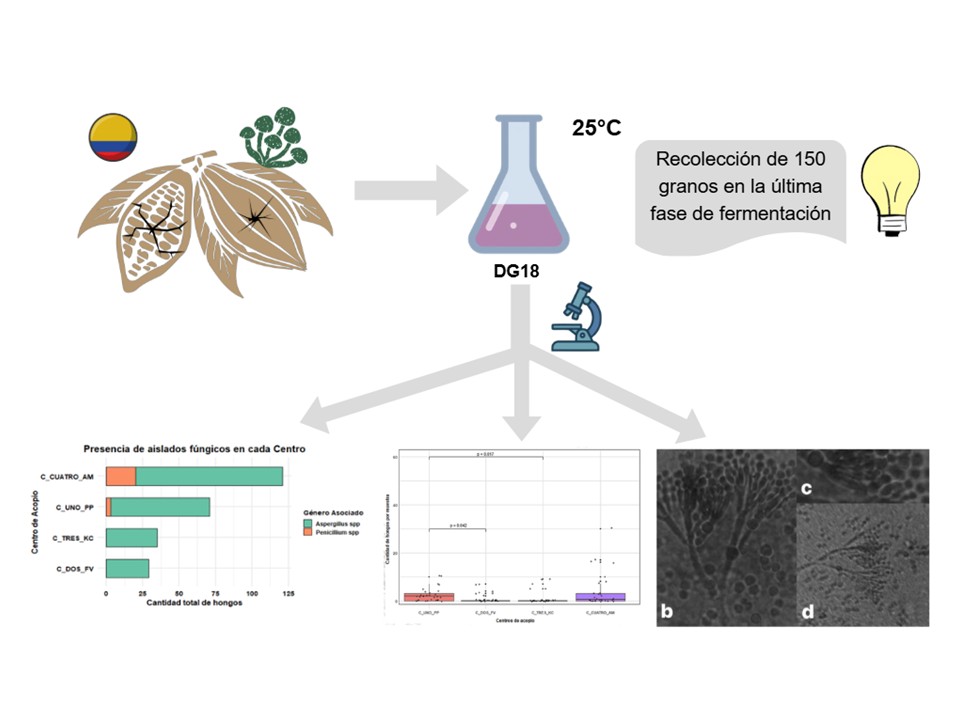
Ecuadorian cocoa is a pillar of the national economy, although its quality can be compromised by the presence of mycotoxin-producing fungi during fermentation and storage. The main objective of this study was to identify the fungal strains present in fermented cocoa beans using morphological markers in four collection centers in the Bolívar canton. One hundred and fifty beans per center were collected in the last phase of fermentation, which were seeded in DG18 medium and incubated at 25°C. The developed colonies were evaluated by macroscopic and microscopic observations, supported by taxonomic keys. Sixty-four fungal strains with wide variability in texture, coloration, and exudate were isolated and characterized. Microscopic analysis identified two predominant genera: Aspergillus spp. and Penicillium spp., with Aspergillus being the most abundant in all collection centers. Statistical analysis showed significant differences in fungal load between centers (p < 0.05), reflecting the influence of fermentation and storage practices on microbial diversity. Ultimately, the identification of these genera highlights the need to implement rigorous controls in post-harvest management, given that species of the Aspergillus Nigri section can produce ochratoxin A, compromising the safety of cocoa.
References
Alvarez-Romero, P., Román-Robalino, D., Salazar-Castañeda, E., Suárez-Cedillo, S., Hinojosa-Sánchez, L., Ferreira, A., & Guallpa-Calva, M. (2025). Diversity and composition of endophytic fungal communities associated with cocoa (Theobroma cacao L.) fruits in the northern Ecuadorian Amazon. International Journal of Plant Biology, 16(1). https://doi.org/10.3390/ijpb16010017
Ariza Aguayo, A. (2021). Evaluación del nivel de ocratoxina A en las fases de post cosecha de Theobroma cacao L. “cacao trinitario” y chocolates artesanales en el distrito de Pisana – San Martín, 2018. [Tesis de grado, Universidad Norbert Wiener].
Baca-Maldonado, D. (2022). Aislamiento e identificación de hongos con potencial micotoxigénico en granos de cacao. [Tesis de grado, Universidad Nacional Toribio Rodríguez de Mendoza de Amazonas].
Cedeño Alcívar, D., Cedeño Guzmán, W., Vera Macías, L., & Vélez Zambrano, S. (2023). Inhibición del crecimiento in vitro de Bacillus spp sobre hongos asociados al proceso de fermentación en cacao. Manglar (Tumbes), 20(3), 233-238. https://doi.org/10.57188/manglar.2023.026
Cedeño-Alcívar, D. y Vera-Macías, L. (2019). Efecto antagonista in vitro de Bacillus spp sobre hongos filamentosos asociados a la fermentación del cacao (Theobroma cacao L.). [Tesis de posgrado, ESPAM MFL].
Contreras Altahona, F., Jaimes Méndez, N., Gil Durán3, M. y Rojas Contreras, O. (2023). Citotoxicidad de la ocratoxina A sobre la propagación celular de HepG2. [Tesis de grado, Universidad de Pamplona].
Delgado-Ospina, J., Molina-Hernández, J., Chaves-López, C., Romanazzi, G., & Paparella, A. (2021). The role of fungi in the cocoa production chain and the challenge of climate change. Journal of Fungi, 7(3). https://doi.org/10.3390/jof7030202
Delgado-Ospina, J., Molina-Hernandez, J., Viteritti, E., Maggio, F., Fernández-Daza, F., Sciarra, P., Serio, A., Rossi, C., Paparella, A., & Chaves-López, C. (2022). Advances in understanding the enzymatic potential and production of ochratoxin A of filamentous fungi isolated from cocoa fermented beans. Food Microbiology, 104. https://doi.org/10.1016/j.fm.2022.103990
Elías Silupu, J. W., García Rivas, C. E., Pérez Salcedo, R., & Yauris Silvera, C. R. (2021). Identificación de Ocratoxina A en vinos artesanales. SENDAS, 2(3), 1-13. https://doi.org/10.47192/rcs.v2i3.65
Erazo Solórzano, C. Y., Bravo Franco, K. J., Tuárez García, D. A., Fernández Escobar, Ángel O., Torres Navarrete, Y. G. y Vera Chang, J. F. (2021). Efecto de la fermentación de cacao (theobroma cacao L.), variedad nacional y trinitario, en cajas de maderas no convencionales sobre la calidad física y sensorial del licor de cacao. Revista De Investigación Talentos, 8(2), 42-55.
Falconí, C., Yánez-Mendizábal, V., Haro, R., & Claudio, D. (2023). Inoculum of a native microbial starter cocktail to optimize fine-aroma cocoa (Theobroma cacao) bean fermentation. Agronomy, 13(10). https://doi.org/10.3390/agronomy13102572
Ghisolfi, R., Bandini, F., Vaccari, F., Bellotti, G., Bortolini, C., Patrone, E. y Morelli, L. (2023). Bacterial and fungal communities are specifically modulated by the cocoa bean fermentation method. Foods, 12(10). https://doi.org/10.3390/foods12102024
Gonzalez, H. H. L., Pacin, A., Resnik, S. L., Martinez, E. J. (1996). Deoxynivalenol and contaminant mycoflora in freshly harvested argentinian wheat in 1993. Mycopathologia, 135, 129-134.
Guzmán-Armenteros, T., Ramos-Guerrero, L., Guerra, L., Weckx, S., & Ruales, J. (2023). Optimization of cacao beans fermentation by native species and electromagnetic fields. Heliyon, 9(4). https://doi.org/10.1016/j.heliyon.2023.e15065
Kadjo, A., Beugre, G., Sess-Tchotch, D., Kedjebo, K., Mounjouenpou, P., Durand, N Fontana, A., & Guehi, S. (2023). Screening of anti-fungal Bacillus strains and influence of their application on cocoa beans fermentation and final bean quality. Journal of Advances in Microbiology, 8-17. https://doi.org/10.9734/jamb/2023/v23i1700
Konan, K., Coulibaly, I., Kouassi, K., Sthéphane, F., Coulibaly, A., & Konaté, I. (2024). Impact of new fermentation systems on the health quality of cocoa beans (Theobroma cacao L. 1753) in the main cocoa-growing regions of Côte d’ivoire: Nawa, Bas-sassandra and haut-sassandra. Journal of Advances in Microbiology, 24(8), 35-51. https://doi.org/10.9734/jamb/2024/v24i8845
Laranjo, M. (2021). Fermentation: Processes, Benefits and Risks. INTECHOPEN LIMITED.
Marwati, T., Purwaningsih, Djaafar, T., Sari, A., & Hernani. (2021). Inhibition the growth of fungi and improving the quality of cocoa beans through fermentation using lactic acid bacteria. IOP Conf. Series: Earth and Environmental Science, 807. https://doi.org/10.1088/1755-1315/807/2/022048
Matute-Pinos, J. (2021). Aislamiento e identificación molecular de levaduras a partir de la fermentación de una mezcla de pulpa de frutas y granos de cacao de la variedad CCN-51. [Tesis de grado, Universidad del Azuay].
Mendoza Salazar, M., & Lizarazo-Medina, P. (2021). Assessment of the fungal community associated with cocoa bean fermentation from two regions in Colombia. Food Research International (Ottawa, Ont.), 149. https://doi.org/10.1016/j.foodres.2021.110670
Nguyen, T. C., Hoang, T. T., & Nguyen, H. H. (2025). Evaluation of anti-Aspergillus flavus activity of lactic acid bacteria isolated from Vietnamese fermented cocoa beans. Microbiology Research, 16(6), 111. https://doi.org/10.3390/microbiolres16060111
Oduro-Mensah, D., Lowor, S. T., Bukari, Y., Donkor, J. K., Minnah, B., Nuhu, A. H., Dontoh, D., Amadu, A. A., & Ocloo, A. (2023). Cocoa-associated filamentous fungi for the biocontrol of aflatoxigenic Aspergillus flavus. Journal of Basic Microbiology, 63(11), 1279–1292. https://doi.org/10.1002/jobm.202300163
Pitt, J. I., y Hocking, A.D. (2009). Fungi and food spoilage (Vol. 519, p. 388). New York: Springer. https://link.springer.com/book/10.1007/978-0-387-92207-2
Prendes, L. P. (2016). “Hongos filamentosos de uvas Malbec de la DOC San Rafael: potencial biocontrol de los productores de micotoxinas con levaduras del mismo ecosistema”. [Tesis de Doctorado, Universidad Nacional de Cuyo].
Rahayu, E., Triyadi, R., Khusna, R., Djaafar, T., Utami, T., Marwati, T., & Hatmi, R. (2021). Indigenous yeast, lactic acid bacteria, and acetic acid bacteria from cocoa bean fermentation in Indonesia can inhibit fungal-growth-producing mycotoxins. Fermentation, 7(3). https://doi.org/10.3390/fermentation7030192
Revista Gestión Digital. (2024). El cacao en su pico histórico de precio: ¿eso es bueno o malo para el Ecuador?. https://revistagestion.ec/analisis-economia-y-finanzas/el-cacao-en-su-pico-historico-de-precio-eso-es-bueno-o-malo-para-el/
Subroto, E., Djali, M., Indiarto, R., Lembong, E., & Baiti, N. (2023). Microbiological Activity Affects Post-Harvest Quality of Cocoa (Theobroma cacao L.). Horticulturae, 9(7), 805. https://doi.org/10.3390/horticulturae9070805
Tigrero Vaca, J., Maridueña-Zavala, M., Liao, H., Prado-Lince, M., Zambrano-Vera, C., Monserrate-Maggi, B., & Cevallos-Cevallos, J. (2022). Microbial diversity and contribution to the formation of volatile compounds during fine-flavor cacao bean fermentation. Foods, 11(7). https://doi.org/10.3390/foods11070915
Viesser, J. A., de Melo Pereira, G. V., de Carvalho Neto, D. P., Favero, G. R., de Carvalho, J. C., Goés-Neto, A., Rogez, H., & Soccol, C. R. (2021). Global cocoa fermentation microbiome: revealing new taxa and microbial functions by next generation sequencing technologies. World Journal of Microbiology and Biotechnology, 37(7), 118. https://doi.org/10.1007/s11274-021-03079-2
Published
How to Cite
Issue
Section
License
Copyright (c) 2026 Bryan Delgado-Ruiz, Rachel Carranza-Chávez, Diana Cedeño-Alcívar

This work is licensed under a Creative Commons Attribution-NonCommercial 4.0 International License.
Los autores conservan sus derechos de autor sin restricciones.