
Quantification of carbon stock in aboveground biomass of Suchiche Park, Tarapoto, Peru
DOI:
https://doi.org/10.17268/agroind.sci.2026.01.03Keywords:
Urban carbon capture, local climate mitigation, urban green infrastructureAbstract
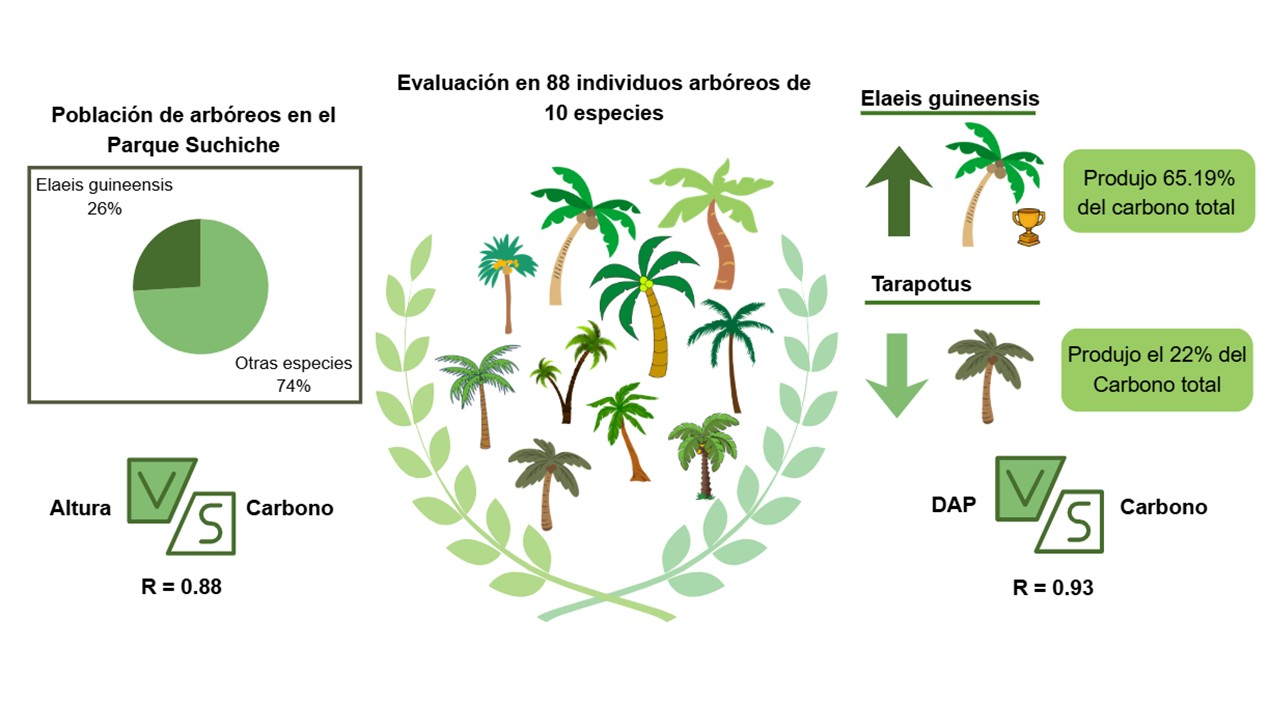
This study quantified the carbon stock in the aboveground biomass of Suchiche Park (Tarapoto, Peru), a 0.265 ha urban green space. Using systematic sampling across 8 circular plots (100 m² each), 88 trees (DBH ≥ 10 cm) from 10 species were evaluated through non-destructive methods and validated allometric equations for tropical forests. Results revealed Elaeis guineensis (African Oil Palm) as the most efficient species, storing 10.76 Mg C (65.19% of the total) despite comprising only 26% of individuals. Its superiority was attributed to large size (mean DBH: 51.71 cm; height: 13.35 m) and high wood density, capturing 0.47 Mg C/tree (17× more than the second-most efficient species). The native Tarapotus Palm, while the most abundant (25 individuals), showed lower individual capture (0.15 Mg C/tree), contributing 22.2% of total carbon. Species like Ficus benjamina (17 individuals) had low efficiency (0.03 Mg C/tree) due to frequent pruning and reduced height (4.51 m). Significant correlations were found between dasometric variables and carbon: DBH vs. carbon (r = 0.93) and height vs. carbon (r = 0.88), confirming that each additional cm of DBH increases ~0.02 Mg C/tree. The park stores 16.51 Mg C (equivalent to 60.57 Mg CO₂), with a density of 62.2 Mg C/ha, surpassing urban areas like Northern Lima but still below primary Amazonian forests.
References
Agbelade, A. D., & Onyekwelu, J. C. (2020). Tree species diversity, volume yield, biomass and carbon sequestration in urban forests in two Nigerian cities. Urban Ecosystems. https://link.springer.com/article/10.1007/s11252-020-00994-4
Aranda-Arguello, R., Coss, A. L., Arce-Espino, C., Pinto-Ruiz, R., Guevara-Hernández, F., & Raj-Aryal, D. (2018). Captura de carbono en la biomasa aérea de la palma de aceite en Chiapas, México. Agronomía Mesoamericana, 29(3), 629-637.
Baccini, A., Walker, W., Carvalho, L., Farina, M., Sulla-Menashe, D., & Houghton, R. A. (2017). Tropical forests are a net carbon source based on aboveground measurements of gain and loss. Science, 358(6360), 230-234. https://doi.org/10.1126/science.aam5962
Bastin, J. -F., Finegold, Y., Garcia, C., Mollicone, D., Rezende, M., Routh, D., Zohner, C. M., & Crowther, T. W. (2019). The global tree restoration potential. Science, 365(6448), 76-79. https://doi.org/10.1126/science.aax0848
Cardoso, A. C. D., Miranda, T. B., Lima, J. J. F., & Brazil, E. T. A. (2022). Chapter 13 - Beyond formal urban policies: Resilient periurban alternative practices in the Amazon. En A. Colucci & G. Pesaro (Eds.), ECO systems of Resilience Practices (pp. 229-248). Elsevier. https://doi.org/10.1016/B978-0-12-819198-9.00018-1
Chave, J., Réjou-Méchain, M., Búrquez, A., Chidumayo, E., Colgan, M. S., Delitti, W. B. C., Duque, A., Eid, T., Fearnside, P. M., Goodman, R. C., Henry, M., Martínez-Yrízar, A., Mugasha, W. A., Muller-Landau, H. C., Mencuccini, M., Nelson, B. W., Ngomanda, A., Nogueira, E. M., Ortiz-Malavassi, E., … Vieilledent, G. (2014). Improved allometric models to estimate the aboveground biomass of tropical trees. Global Change Biology, 20(10), 3177-3190. https://doi.org/10.1111/gcb.12629
Escobedo, F. J., Kroeger, T., & Wagner, J. E. (2011). Urban forests and pollution mitigation: Analyzing ecosystem services and disservices. Environmental Pollution, 159(8), 2078-2087. https://doi.org/10.1016/j.envpol.2011.01.010
Fonseca, W. (2017). Revisión de métodos para el monitoreo de biomasa y carbono vegetal en ecosistemas forestales tropicales. Revista de Ciencias Ambientales, 51(2), 91. https://doi.org/10.15359/rca.51-2.5
Gallardo, J., & Tasilla, F. (2020). Pérdida de cobertura vegetal en el distrito de Morales, San Martin, Perú (periodo 1987 – 2017). Revista de Investigación Ciencia, Tecnología y Desarrollo, 6. https://doi.org/10.17162/rictd.v6i1.1400
IPCC. (2022). Climate Change 2022: Mitigation of Climate Change. Working Group III contribution to the Sixth Assessment Report. Cambridge University Press. https://www.ipcc.ch/report/ar6/wg3/
Leite-Filho, A. T., Soares-Filho, B. S., Davis, J. L., Abrahão, G. M., & Börner, J. (2021). Deforestation reduces rainfall and agricultural revenues in the Brazilian Amazon. Nature Communications, 12(1), 2591. https://doi.org/10.1038/s41467-021-22840-7
Lewis, K., Rumpang, E., Kho, L. K., McCalmont, J., Teh, Y. A., Gallego-Sala, A., & Hill, T. C. (2020). An assessment of oil palm plantation aboveground biomass stocks on tropical peat using destructive and non-destructive methods. Scientific Reports, 10(1), 2230. https://doi.org/10.1038/s41598-020-58982-9
Moreno, R., Nery, A., Zamora, R., Lora, Á., & Galán, C. (2024). Contribution of urban trees to carbon sequestration and reduction of air pollutants in Lima, Peru. Ecosystem Services, 67, 101618. https://doi.org/10.1016/j.ecoser.2024.101618
Muñoz-Pacheco, C. B., & Villaseñor, N. R. (2022). Urban Ecosystem Services in South America: A Systematic Review. Sustainability, 14(17), Article 17. https://doi.org/10.3390/su141710751
Nowak, D. J., Hirabayashi, S., Bodine, A., & Greenfield, E. (2014). Tree and forest effects on air quality and human health in the United States. Environmental Pollution, 193, 119-129. https://doi.org/10.1016/j.envpol.2014.05.028
Publications—IPCC-TFI. (2022). https://www.ipcc-nggip.iges.or.jp/public/2006gl/vol4.html
Reynolds, C. C., Escobedo, F. J., Clerici, N., & Zea-Camaño, J. (2017). Does “Greening” of Neotropical Cities Considerably Mitigate Carbon Dioxide Emissions? The Case of Medellin, Colombia. Sustainability, 9(5), Article 5. https://doi.org/10.3390/su9050785
Seddon, N., Smith, A., Smith, P., Key, I., Chausson, A., Girardin, C., House, J., Srivastava, S., & Turner, B. (2021). Getting the message right on nature-based solutions to climate change. Global Change Biology, 27(8), 1518-1546. https://doi.org/10.1111/gcb.15513
Speak, A. F., & Salbitano, F. (2023). The impact of pruning and mortality on urban tree canopy volume. Urban Forestry & Urban Greening, 79, 127810. https://doi.org/10.1016/j.ufug.2022.127810
Ugle Pimpalkhute, P., Rao, S., & Ramachandra, T. V. (2010). Carbon sequestration potential of urban trees in Pune, India. Journal of Environmental Management, 91(12), 2507–2515.
Published
How to Cite
Issue
Section
License
Copyright (c) 2026 Joselyn Caballero Solier, Jina Chávez Vásquez, Ceila Lao

This work is licensed under a Creative Commons Attribution-NonCommercial 4.0 International License.
Los autores conservan sus derechos de autor sin restricciones.