
Proximal composition and nutritional differentiation of commercially important hydrobiological species from Peru using multivariate analysis
DOI:
https://doi.org/10.17268/agroind.sci.2026.03.06Keywords:
Proximate composition, marine species, nutritional value, fish processing industry, PeruAbstract
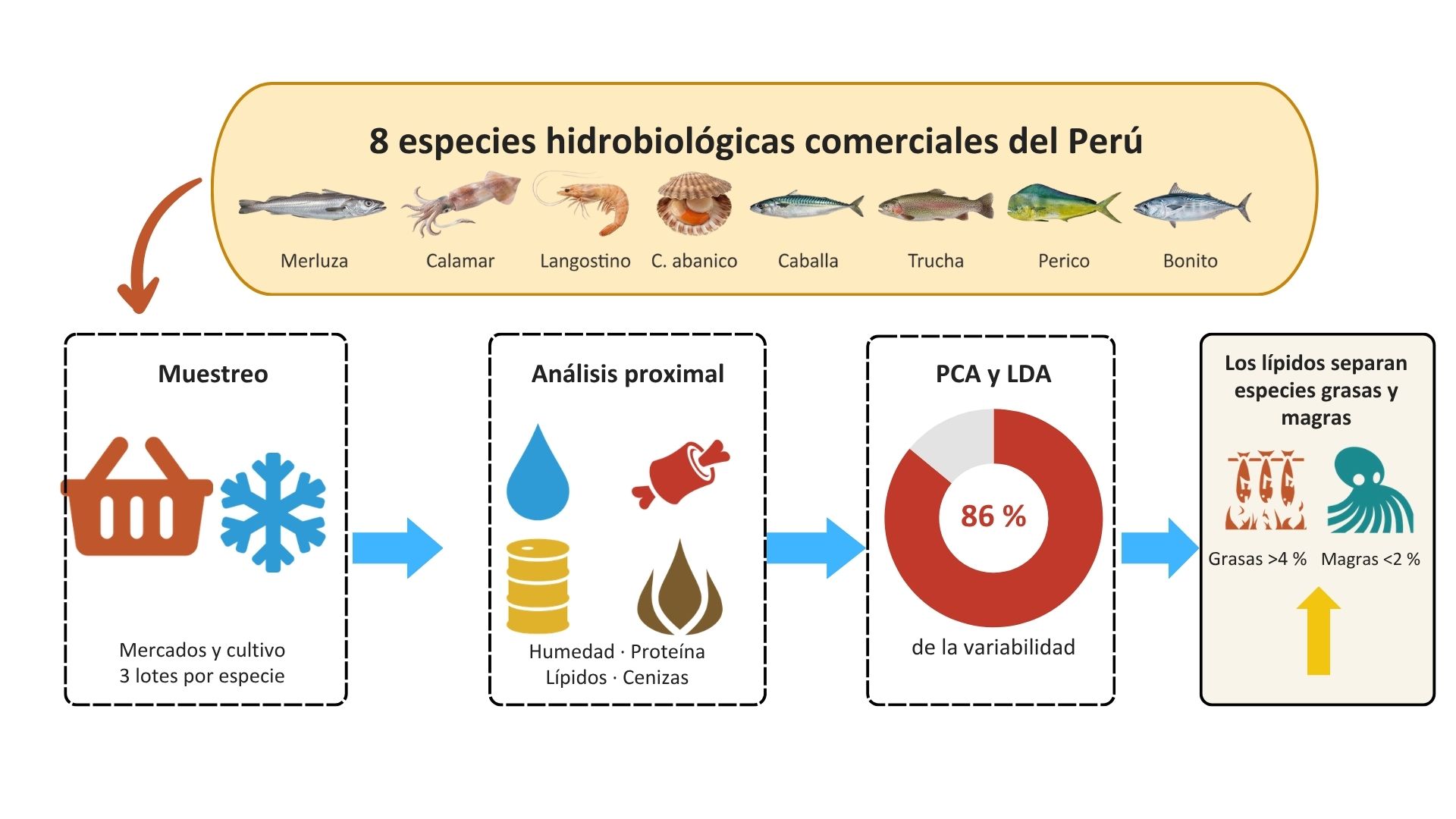
Hydrobiological resources represent an important source of high biological value proteins and essential fatty acids; however, the nutritional variability among commercial Peruvian species has been scarcely studied in a comparative manner. The aim of this study was to evaluate and differentiate the proximate chemical composition of eight hydrobiological species from Peru using univariate and multivariate analyses. Samples of hake (Merluccius merluccius), jumbo squid (Dosidicus gigas), shrimp (Penaeus vannamei), scallop (Argopecten purpuratus), mackerel (Scomber scombrus), trout (Oncorhynchus mykiss), dolphinfish (Coryphaena hippurus), and bonito (Sarda chiliensis chiliensis) were analyzed to determine moisture, protein, lipids, and ash content following AOAC methods. Data were evaluated using ANOVA (p<0.05), principal component analysis (PCA), and linear discriminant analysis (LDA). Moisture was the predominant component (69.85–81.15%), while protein ranged from 15.83% to 22.14%. Lipids showed the highest variability (0.54–6.12%), allowing classification into lean and fatty groups. PCA indicated that lipids explained 86% of the total variability, and LDA confirmed their role as the main discriminator. It is concluded that lipid content is the primary axis of nutritional differentiation among species.
References
Abraha, B., Admassu, H., Mahmud, A., Tsighe, N., Shui, X. W., & Fang, Y. (2018). Effect of processing methods on nutritional and physico-chemical composition of fish: a review. MOJ Food Processing & Technology, 6(4), 376-382, DOI: 10.15406/mojfpt.2018.06.00191
Ahmed, I., Jan, K., Fatma, S., & Dawood, M. A. (2022). Muscle proximate composition of various food fish species and their nutritional significance: A review. Journal of Animal Physiology and Animal Nutrition, 106(3), 690-719. https://doi.org/10.1111/jpn.13711
Ahmed, M., Liaquat, M., Shah, A. S., et al. (2020). Proximate Composition and Fatty Acid Profiles of Selected Fish Species from Pakistan. August https://doi.org/10.36899/JAPS.2020.4.0102
Al Solami, L., & Korish, M. (2024). Proximate composition, fatty acid characteristics, amino acid profile and mineral content of fish Acanthurus sohal. Heliyon, 10(16). https://doi.org/10.1016/j.heliyon.2024.e36474
AOAC. (2016). Official methods of analysis (20th ed.). Association of Official Analytical Chemists.
Barriga, M., Salas, A., Aranda, D., Castro, C., Albrecht, M., Solari, A., & Arpi, E. (2012). Información nutricional sobre algunas especies comerciales del mar peruano. Boletín de Investigación del Instituto Tecnológico Pesquero del Perú, 10, 1–32. https://hdl.handle.net/20.500.14523/37
Boițeanu, C. N., Karl, M. M., Karl, H., Meyer, C., & Savu, C. (2014). Proximate composition, microbiological quality and sensory attributes of mahi-mahi (Coryphaena hippurus). Bulletin of University of Agricultural Sciences and Veterinary Medicine Cluj-Napoca. Food Science and Technology, 71(2), 89–95. https://doi.org/10.15835/buasvmen-fst:10540
Byrd, K. A., Thilsted, S. H., & Fiorella, K. J. (2021). Fish nutrient composition: a review of global data from poorly assessed inland and marine species. Public health nutrition, 24(3), 476-486. https://doi.org/10.1017/S1368980020003857
Callet, A., Hurtado, M., & Crispín, F. (2017). Evaluación nutricional de productos pesqueros procesados. Revista Peruana de Agroindustria, 7(1), 45–54.
Centeno-Chaves, A., Marrari, M., Arias-Zumbado, F., García-Rojas, A., Mug-Villanueva, M. (2025). Composition of pelagic fish in commercial landings of the longline fishery in the Costa Rica Pacific during 2015-2021. Frontiers in Marine Science. https://doi.org/10.3389/fmars.2024.1490883
Collazos, C. (1993). La composición de alimentos de mayor consumo en el Perú. Instituto Nacional de Nutrición. https://doi.org/10.15381/anales.v40i1.10737
De Graeve, M., Birse, N., Hong, Y., Elliott, C., Hemeryck, L., & Vanhaecke, L. (2022). Multivariate versus machine learning-based classification of rapid evaporative Ionisation mass spectrometry spectra towards industry-based large-scale fish speciation. Food Chemistry, 404 Pt B, 134632. https://doi.org/10.1016/j.foodchem.2022.134632
Durmuş, M. (2019). Fish oil for human health: omega-3 fatty acid profiles of marine seafood species. Food Science and Technology, 39, 454-461. https://doi.org/10.1590/fst.21318
Egerton, S., Mannion, D., Culloty, S., et al. (2020). The proximate composition of three marine pelagic fish: blue whiting (Micromesistius poutassou), boarfish (Capros aper), and Atlantic herring (Clupea harengus). Irish Journal of Agricultural and Food Research. 59(1), 185–200. https://www.jstor.org/stable/27041765.
FAO (2025) Fishery and Aquaculture Statistics – Yearbook 2022. FAO Yearbook of Fishery and Aquaculture Statistics. Rome. https://doi.org/10.4060/cd4312en
Figueroa-Muñoz, G., Ríos-Escalante, P., Dantagnan, P., et al. (2020). Proximal composition and fatty acid profile of Hemigrapsus crenulatus. Brazilian Journal of Biology https://doi.org/10.1590/1519-6984.231834
Fujii, T. (2016). Potential influence of offshore oil and gas platforms on the feeding ecology of fish assemblages in the North Sea. Marine Ecology Progress Series, 542, 167-186. https://doi.org/10.3354/meps11534
IMARPE. (1970). Informe técnico sobre especies hidrobiológicas de importancia comercial. Instituto del Mar del Perú.
INS. (2017). Tablas peruanas de composición de alimentos (8.ª ed.). Instituto Nacional de Salud. https://www.gob.pe/institucion/ins/informes-publicaciones/4231115-tablas-peruanas-de-composicion-de-alimentos-tpca
Jolliffe, I. T., & Cadima, J. (2016). Principal component analysis: A review and recent developments. Philosophical Transactions of the Royal Society A: Mathematical, Physical and Engineering Sciences, 374(2065), 20150202. https://doi.org/10.1098/rsta.2015.0202
Lal, V., & Naeem, M. (2021). Proximate Composition Analysis of Marine Fish, Terapon jarbua, from Pakistan. Sarhad Journal of Agriculture. http://dx.doi.org/10.17582/journal.sja/2021/37.1.290.295
Omote, R., & Molleda, A. (2018). Elaboración y caracterización de un producto preformado congelado a base de músculo de bonito (Sarda chiliensis). Anales Científicos, 79(2), 526–533. https://doi.org/10.21704/ac.v79i2.1234
Oroian, I., Bulete, B. I., Matei, E., Odagiu, A., Burduhos, P., Oroian, C. F., Ștefan, O. D., & Bordea, D. (2025). Assessment of Heavy Metal Contamination, Bioaccumulation, and Nutritional Quality in Fish from the Babina–Cernovca Romanian Sector of the Danube River. Foods. https://doi.org/10.3390/foods14193419
Porturas Olaechea, R., Ramírez Palomino, D., Crispín Sánchez, F., Vásquez Quispesivana, W., Sánchez Amado, D., & Rivera Rojas, H. (2023). Elaboración de conservas de pasta untable ahumada a partir de recortes de filetes de trucha Oncorhynchus mykiss. Agroindustrial Science, 13(2), 83-91. https://doi.org/10.17268/agroind.sci.2023.02.04
Porturas, R., Hurtado, M., & Crispín, F. (2019). Elaboración de pasta untable a partir de recortes de pota (Dosidicus gigas) en envase ¼ club. Agroindustrial Science, 9(2), 145-153. https://doi.org/10.17268/agroind.sci.2019.02.07
Rencher, A. C. (2002). Methods of Multivariate Analysis (2nd ed.). Wiley-Interscience.
Rodríguez, L., Cervantes, E., & Ortiz, R. (2017). Malnutrition and fish consumption: Role of fish in a balanced diet. Nutrients, 9(6), 562. https://doi.org/10.3390/nu9060562
Silva, E. F. R., Santos, B., Brandão, G., Silva, M., Erik G. P. Silva, W. P. C. Santos, & Santos, A. M. P. (2020). Screening of minerals, proximate composition, and physico-chemical characteristics in the discrimination of Oiti. Brazilian Journal of Development, 6(4), 21576-21597. https://doi.org/10.34117/bjdv6n4-360
Valenzuela, A., Yáñez, C. G., & Golusda, C. (2011). Argopecten purpuratus, un alimento de alto valor nutricional. Revista Chilena de Nutrición, 38(4), 485–493. https://doi.org/10.4067/S0717-75182011000400010
Weber, J., Bochi, V. C., Ribeiro, C. P., Victório, A. D. M., & Emanuelli, T. (2008). Effect of different cooking methods on the oxidation, proximate and fatty acid composition of silver catfish (Rhamdia quelen) fillets. Food chemistry, 106(1), 140-146. https://doi.org/10.1016/j.foodchem.2007.05.052
Zlatanos, S., Laskaridis, K., & Sagredos, A. (2009). Determination of proximate composition, fatty acid content and amino acid profile of five lesser-common sea organisms from the Mediterranean Sea. International Journal of Food Science and Technology, 44(8), 1590-1594. https://doi.org/10.1111/j.1365-2621.2008.01870.x
Downloads
Published
Issue
Section
License
Copyright (c) 2026 Fredy Crispin-Sanchez, Fabiola Olivares-Ponce, Raúl Porturas-Olaechea, Tatiana Vergara Miranda, Rodrigo Gamarra Navarrete, Dalia Gallardo Ramirez, Oscar Amado Crisóstomo Gordillo

This work is licensed under a Creative Commons Attribution-NonCommercial 4.0 International License.
The author does not retain copyright or publication rights indefinitely. The author retains all moral rights, particularly the right of authorship and the right to the integrity of the article.