
Impacto del cambio climático sobre el rendimiento de papa en el Altiplano Peruano: Un estudio experimental, con modelado en AquaCrop y generación de escenarios al 2050
DOI:
https://doi.org/10.17268/sci.agropecu.2026.038Palabras clave:
papa, cambio climático, AquaCrop, escenarios RCP, adaptaciónResumen
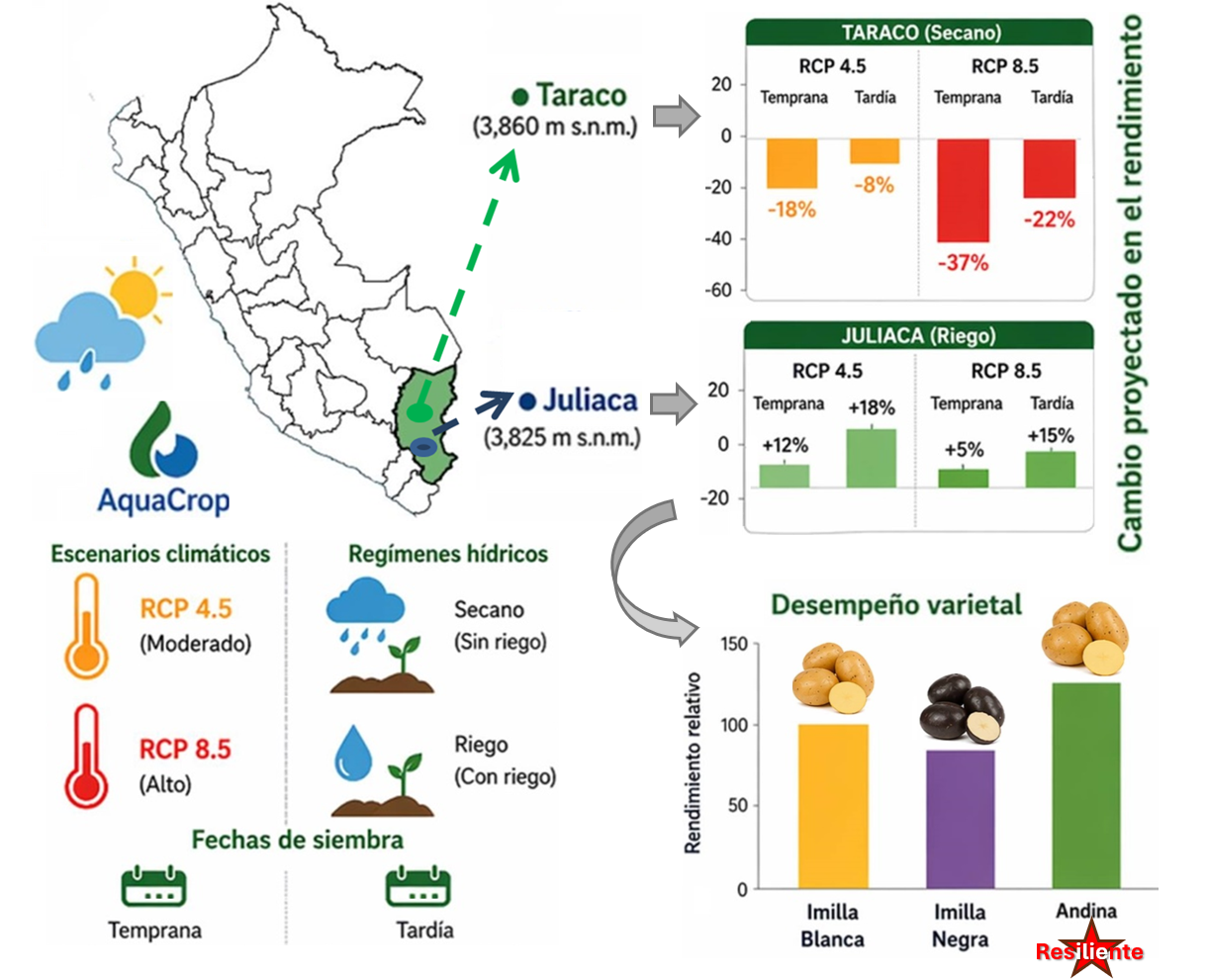
El cambio climático es una amenaza crítica para la seguridad alimentaria en regiones altoandinas, donde la papa (Solanum tuberosum L.) es un cultivo estratégico. En el Altiplano Peruano, se proyectan aumentos de temperatura y reducciones de precipitación que elevan la vulnerabilidad de los sistemas agrícolas de secano. En este contexto, los modelos de simulación son esenciales para anticipar impactos y diseñar medidas de adaptación. Este estudio evaluó los efectos del cambio climático sobre el rendimiento de tres variedades de papa (Imilla Blanca, Imilla Negra y Andina) en Taraco y Juliaca, usando el modelo AquaCrop calibrado y validado con datos experimentales entre 2018 y 2021. Los ensayos se realizaron bajo un diseño de bloques completos al azar, con tres fechas de siembra. La calibración empleó información fenológica, biomasa y rendimiento, evaluada mediante indicadores estadísticos (r, RMSE, d y EF), mostrando un ajuste robusto. Con el modelo validado se simularon rendimientos hacia 2050 bajo escenarios RCP4.5 y RCP8.5 en condiciones de secano y riego. Los resultados mostraron reducciones significativas en Taraco, especialmente en secano y siembras tempranas, mientras que en Juliaca se proyectaron incrementos bajo riego, aunque con alta variabilidad entre modelos. La variedad Andina evidenció mayor resiliencia frente al estrés hídrico, mientras que Imilla Negra fue la más vulnerable en secano. Estos hallazgos destacan que el acceso al riego, la selección de variedades resilientes y el ajuste del calendario de siembra son estrategias clave para mitigar impactos y fortalecer la seguridad alimentaria en el Altiplano peruano.
Citas
Adeboye, O. B., Schultz, B., Adeboye, A. P., Chukalla, A., & Shittu, K. A. (2024). Assessment of the AquaCrop model to simulate the impact of soil fertility management on evapotranspiration, yield, and water productivity of maize (Zea mays L.) in the sub-humid agro-ecology of Nigeria. Discover Agriculture, 2(1), Article 28. https://doi.org/10.1007/s44279-024-00030-5
Ahmadi, M., Etedali, H., Salem, A., Al-Mukhtar, M., & Elbeltagi, A. (2024). Simulation of wheat water footprint using AquaCrop model under the climate change, case study in Qazvin plain. Applied Water Science. https://doi.org/10.1007/s13201-024-02305-0
Arcos, J., & Cahuana, R. (2002). Variedades nativas y mejoradas de papa en Puno. Instituto Nacional de Investigación Agraria – INIA.
Aybar, C., Fernández, C., Huerta, A., Lavado, W., Vega, F., & Felipe-Obando, O. (2019). Construction of a high-resolution gridded rainfall dataset for Peru from 1981 to the present day. Hydrological Sciences Journal, 65(5), 770–785. https://doi.org/10.1080/02626667.2019.1649411
Birhan, T., Beyene, T., Alemu, G., & Reta, B. (2025). Evaluation of the AquaCrop Model for Simulating Yield and Water Productivity of Maize (Zea mays L.) in Semi‐Arid Ethiopia. Irrigation and Drainage, 74, 2241-2256. https://doi.org/10.1002/ird.70019
Cruz-González, A., Arteaga-Ramírez, R., Monterroso-Rivas, A. I., Soria-Ruiz, J., Sánchez-Cohen, I., & Rojas-López, A. (2025). Assessment of the Effect of Climate Change on the Productivity of Rainfed Maize (Zea mays L.) Using Crop Growth Model AquaCrop in Central Mexico. Water, 17(13), 1867. https://doi.org/10.3390/w17131867
Deressa, T. C., Chalchissa, F. B., & Gemeda, D. O. (2025). Rainfall and temperature variability and trend in the Horro Guduru Wallaga Zone, Northwestern Ethiopia. Environmental Monitoring and Assessment, 197(7), 759. https://doi.org/10.1007/s10661-025-14195-z
Dommo, A., Leasor, Z., Lupo, A., Hunt, S., & Aloysius, N. (2025). Assessment of Anticipated Changes in Extreme Temperature and Precipitation Under 1.5 °C and 2 °C Warming Over the Mississippi River Basin. International Journal of Climatology, 45(15), e70135. https://doi.org/10.1002/joc.70135
Dlamini, L., Crespo, O., van Dam, J., Gaso, D. V., & de Wit, A. (2026). Climate change impacts on rainfed maize production of small-scale cropping systems in Eastern Cape, South Africa. Agricultural Systems, 233, 104627. https://doi.org/10.1016/j.agsy.2025.104627
Feng, Z., Miao, Q., Shi, H., Gonçalves, J., Li, X., Feng, W., Yan, J., Yu, D., & Yan, Y. (2025). AquaCrop model-based sensitivity analysis of soil salinity dynamics and productivity under climate change in sandy-layered farmland. Agricultural Water Management, 307, 109244. https://doi.org/10.1016/j.agwat.2024.109244
Gastelo, M., Bastos, C., Ortiz, R., & Blas, R. (2025). Environmental impact and phenotypic stability in potato clones resistant to late blight Phytophthora infestans (Mont) de Bary, resilient to climate change in Peru. PloS one, 20(2), e0318255. https://doi.org/10.1371/journal.pone.0318255
Huerta, A., Aybar, C., Imfeld, N., Correa, K., Felipe, O., Rau, P., Drenkhan, F., & Lavado, W. (2023) High-resolution grids of daily air temperature for Peru - the new PISCOt v1.2 dataset. Scientific Data, 10, 847. https://doi.org/10.1038/s41597-023-02777-w
Kibebew, S., Dechassa, N., Alemayehu, Y., Merga, F., & Megersa, G. (2026). Analysis of historical climate change and its impacts on bread wheat (Triticum aestivum L.) production in Central Oromia, Ethiopia. Agrosystems, Geosciences & Environment, 9(1), e70317. https://doi.org/10.1002/agg2.70317
Li, N., Li, Y., Yang, Q., Biswas, A., & Dong, H. (2024). Simulating climate change impacts on cotton using AquaCrop model in China. Agricultural Systems. https://doi.org/10.1016/j.agsy.2024.103897
Llacza, A., Acuña, D., Jácome, G., De la Cruz, G., Paredes, J., Bruno, J., Alvarez, E., Flores, W., Urdanivia, F., & Sulca, B. (2021). Escenarios climáticos al 2050 en el Perú: Cambios en el clima promedio. Servicio Nacional de Meteorología e Hidrología del Perú.
Lozano-Povis, A., Alvarez-Montalván, C., & Moggiano, N. (2021). Climate change in the Andes and its impact on agriculture: a systematic review. Scientia Agropecuaria, 12(1), 101-108. https://doi.org/10.17268/sci.agropecu.2021.012
Lakatos, L., Misik, T., Csabai, E. K., & Cs, P. (2023). Climate Change and Potato Cultivation: A Geographical Shift and Its Implications. IOP Conference Series: Earth and Environmental Science, 1242(1), 012003. https://doi.org/10.1088/1755-1315/1242/1/012003
Misgina, N. A., Beshir, H. M., Yohannes, D. B., & Gebreyohanes, G. H. (2024). Growth, Yield, and Water Productivity of Potato Genotypes Under Supplemental and Non-Supplemental Irrigation in Semi-Arid Areas of Northern Ethiopia. Agronomy, 15(1), 72. https://doi.org/10.3390/agronomy15010072
Nazrul, F. B., Karim, M. R., Pavan, W., & Kamruzzaman, M. (2026). Future climate extremes in Bangladesh: insights from a multi-model ensemble of CMIP6 simulations. Earth Systems and Environment, 10, 1369–1388. https://doi.org/10.1007/s41748-025-00681-4
Phung, T. D., Kieu Tram Thi Huynh, Van Tuan Phan, & Dang Truong An. (2025). Crop Calendar Adjustments for Enhanced Rainwater Harvesting in Rice Cultivation of the Plain of Reeds Under Climate Variability. Research in Ecology, 7(2), 239–250. https://doi.org/10.30564/re.v7i2.10067
Pinheiro, A. G., Alves, C. P., de Souza, C. A. A., Júnior, G. D. N. A., Jardim, A. M. D. R. F., de Morais, J. E. F., ... & da Silva, T. G. F. (2024). Calibration and validation of the AquaCrop model for production arrangements of forage cactus and grass in a semi-arid environment. Ecological Modelling, 488, 110606. https://doi.org/10.1016/j.ecolmodel.2023.110606
Poma-Chamana, R., Flores-Marquez, R., Cordova-Tadeo, J., Quello, A., Arapa-Quispe, J., & Solórzano-Acosta, R. (2025). Transformation of Terraces with Irrigation Systems: Profitability and Water Savings in Potato Crop (Solanum tuberosum L.). Water, 17(5), 668. https://doi.org/10.3390/w17050668
Puma-Cahua, J., Belizario, G., Laqui, W., Alfaro, R., Huaquisto, E., & Calizaya, E. (2024). Evaluating the Yields of the Rainfed Potato Crop under Climate Change Scenarios Using the AquaCrop Model in the Peruvian Altiplano. Sustainability, 16(1), 71. https://doi.org/10.3390/su16010071
Proyecto Gestión Integrada de los Recursos Hídricos en el Sistema GIRH-TDPS. (2021). Escenarios climáticos en el sistema hídrico del lago Titicaca, río Desaguadero, lago Poopó y salar de Coipasa.
SENAMHI (2025). Escenarios de cambio climático al 2050 en el Perú: Clima medio e índice multipeligro. Servicio Nacional de Meteorología e Hidrología del Perú.
Skamarock, W. C., Klemp, J. B., Dudhia, J., Gill, D. O., Liu, Z., Berner, J., Wang, W., Powers, J. G., Duda, M. G., Barker, D. M., Huang, X.-Y. (2021). A Description of the Advanced Research WRF Model Version 4. NCAR Technical Note NCAR/TN-556+STR. 73 pp. https://doi.org/10.5065/1dfh-6p97
Southern, M. D., Kumar, M. G., & Blauer, J. M. (2025). Cultivars and Their Developmental Phases Interact with Temperature Fluctuations to Modulate Growth, Productivity and Seed Tuber Physiology of Potatoes (Solanum tuberosum L.). Plants, 14(5), 750. https://doi.org/10.3390/plants14050750
Tasneem, K. T., Shahzad, M. U., Rashid, J., Othman, K. M., Zafar, T., & Faheem, M. (2025). Predicting rice yield and impact of climate change on rice production using machine learning models. Theoretical and Applied Climatology, 156(12), 665. https://doi.org/10.1007/s00704-025-05912-2
TDPS (2021). Escenarios climáticos en el sistema hídrico del lago Titicaca, río Desaguadero, lago Poopó y salar de Coipasa. Proyecto Gestión Integrada de los Recursos Hídricos en el Sistema. https://girh-tdps.com/cambio-climatico/
Tran, B., Tseng, W., & Chen, C. (2025). Climate change impacts on crop yields across temperature rise thresholds and climate zones. Scientific Reports, 15, 23424. https://doi.org/10.1038/s41598-025-07405-8
Zevallos, E., Marmolejo, K., Alvarez, F., Paitan, R., Viza, I., Becerra, D., Rixi, G., Silva-Díaz, C., & Inga, J. (2023). Screening Potato Landraces to Cope with Climate Change in the Central Andes of Peru. International Journal of Plant Biology, 14(4), 1167-1179. https://doi.org/10.3390/ijpb14040085
Visscher, A. M., Vanek, S., Huaraca, J., Mendoza, J., Ccanto, R., Meza, K., ... & Fonte, S. J. (2024). Traditional soil fertility management ameliorates climate change impacts on traditional Andean crops within smallholder farming systems. Science of the Total Environment, 912, 168725. https://doi.org/10.1016/j.scitotenv.2023.168725
Wang, H., Cheng, M., Liao, Z., Guo, J., Zhang, F., Fan, J., ... & Wang, X. (2023). Performance evaluation of AquaCrop and DSSAT-SUBSTOR-Potato models in simulating potato growth, yield and water productivity under various drip fertigation regimes. Agricultural Water Management, 276, 108076. https://doi.org/10.1016/j.agwat.2022.108076
Xiao, W., Boucher, S. R., & Sexton, R. J. (2025). Local conditions matter: Climate change and coffee production in Brazil. Climatic Change, 178(10), 1-23. https://doi.org/10.1007/s10584-025-04037-9
Descargas
Publicado
Cómo citar
Número
Sección
Licencia
Derechos de autor 2026 Scientia Agropecuaria

Esta obra está bajo una licencia internacional Creative Commons Atribución-NoComercial 4.0.
Los autores que publican en esta revista aceptan los siguientes términos:
a. Los autores conservan los derechos de autor y conceden a la revista el derecho publicación, simultáneamente licenciada bajo una licencia de Creative Commons que permite a otros compartir el trabajo, pero citando la publicación inicial en esta revista.
b. Los autores pueden celebrar acuerdos contractuales adicionales separados para la distribución no exclusiva de la versión publicada de la obra de la revista (por ejemplo, publicarla en un repositorio institucional o publicarla en un libro), pero citando la publicación inicial en esta revista.
c. Se permite y anima a los autores a publicar su trabajo en línea (por ejemplo, en repositorios institucionales o en su sitio web) antes y durante el proceso de presentación, ya que puede conducir a intercambios productivos, así como una mayor citación del trabajo publicado (ver efecto del acceso abierto).