
Modelado espacial de propiedades fisicoquímicas y fertilidad del suelo en sistemas agrícolas tropicales bajo distinta heterogeneidad estructural mediante UAV multiespectral y geoestadística
DOI:
https://doi.org/10.17268/sci.agropecu.2026.035Palabras clave:
agricultura de precisión, interpolación espacial, índices de vegetación, teledetección con UAV, geoestadística, sensores multiespectralesResumen
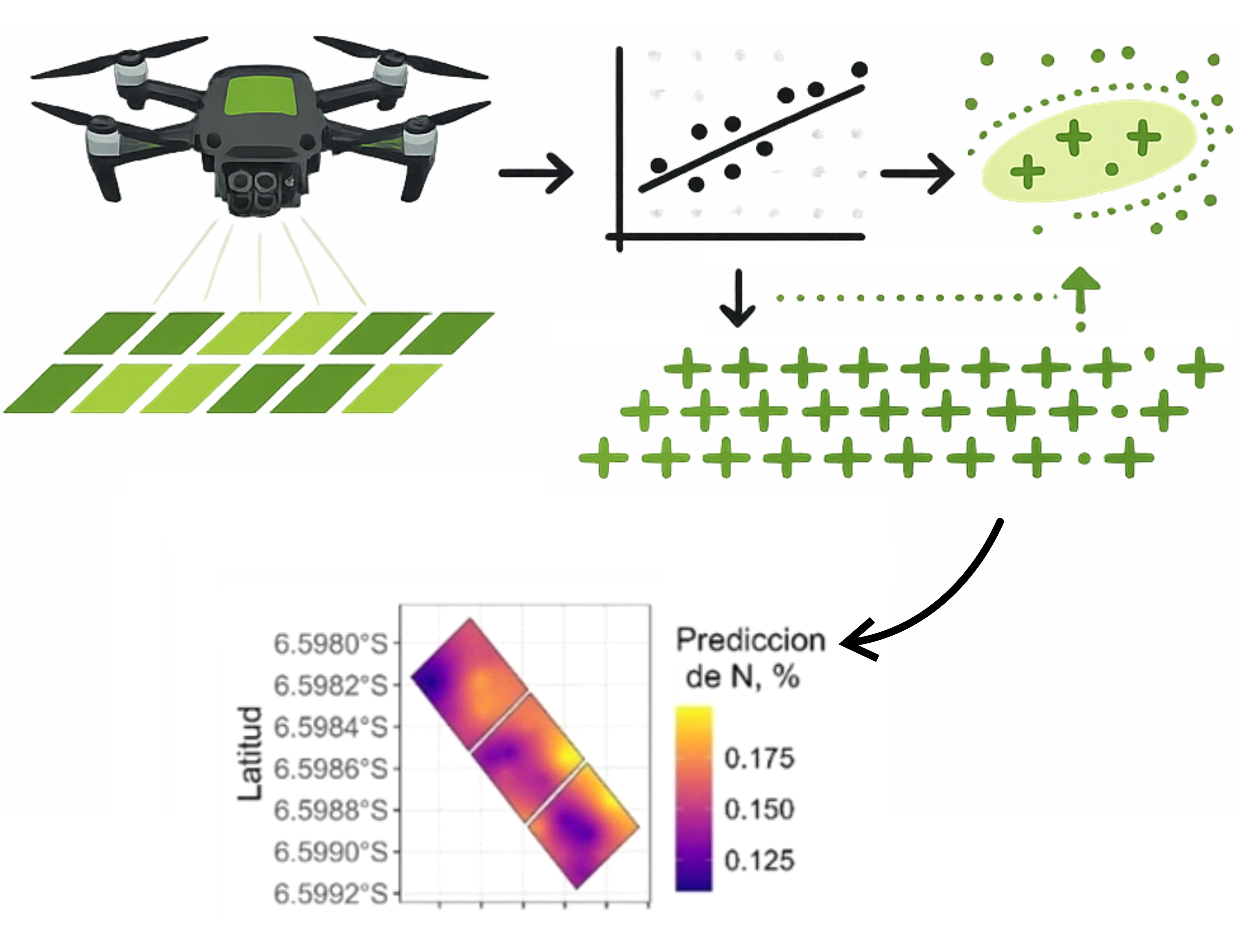
La variabilidad espacial del suelo condiciona la eficiencia productiva, la gestión de nutrientes y la sostenibilidad de los sistemas agrícolas tropicales, especialmente en contextos donde la heterogeneidad limita la implementación de estrategias de manejo sitio-específico. En este estudio se comparó el desempeño de un flujo analítico basado en imágenes UAV multiespectrales, regresión lineal múltiple (MLR) e interpolación geoestadística en dos sistemas agrícolas con distinta heterogeneidad, un sistema multicultivo a escala de estación y un sistema arrocero con diferentes densidades de siembra, ambos ubicados en la Estación Experimental Agraria El Porvenir (San Martín, Perú). Se analizaron 60 muestras en el componente multicultivo y 27 en el sistema arrocero, georreferenciadas a 30 cm de profundidad, evaluando pH, conductividad eléctrica, nitrógeno, fósforo, potasio, carbono orgánico del suelo y textura. Se aplicó un flujo analítico homogéneo en ambos sistemas (correlación de Spearman, MLR stepwise y kriging ordinario). Los resultados evidenciaron diferencias marcadas en el desempeño predictivo, en el sistema arrocero se alcanzaron valores de R² de prueba de 0,93 para nitrógeno y 0,88 para fósforo, mientras que en el sistema multicultivo los mayores R² fueron 0,42 para conductividad eléctrica y 0,37 para limo. Asimismo, los índices espectrales basados en NIR y red edge mostraron mayor asociación con los atributos edáficos evaluados. Los resultados demuestran que el desempeño depende de la heterogeneidad estructural del sistema, donde entornos más homogéneos favorecen la predicción puntual, mientras que sistemas más heterogéneos potencian la zonificación y delimitación de unidades de manejo.
Citas
Caroppo, A., Diraco, G., & Leone, A. (2026). A Systematic Review of Available Multispectral UAV Image Datasets for Precision Agriculture Applications. Remote Sensing, 18(4), 659. https://doi.org/10.3390/rs18040659
Chen, Y., Shi, T., Li, Q., Yang, C., Wang, Z., Chen, Z., & Pan, X. (2024). Mapping Soil Properties in Tropical Rainforest Regions Using Integrated UAV-Based Hyperspectral Images and LiDAR Points. Forests, 15(12), 2222. https://doi.org/10.3390/f15122222
EPA. (2004). Method 9045D: Soil and Waste pH. United States Environmental Protection Agency.
Flores, R., Bahia, R. de C., Arévalo, Y., Torres, E. E., Guevara, J., Antezana, A., Carranza, A., Lao, C., & Solórzano-Acosta, R. (2025). Intermittent Rainfed Rice var. INIA 516 LM1: A Sustainable Alternative for the Huallaga River Basin. Water, 17(9), 1262. https://doi.org/10.3390/w17091262
Gade, S. A., Madolli, M. J., García‐Caparrós, P., Ullah, H., Cha-um, S., Datta, A., & Himanshu, S. K. (2025). Advancements in UAV remote sensing for agricultural yield estimation: A systematic comprehensive review of platforms, sensors, and data analytics. Remote Sensing Applications: Society and Environment, 37, 101418. https://doi.org/10.1016/j.rsase.2024.101418
Gee, G. W., & Or, D. (2002). Particle Size Analysis. In: Dane, J.H. and Topp, G.C., Eds., Methods of Soil Analysis, Part 4, Physical Methods, Soils Science Society of America, Book Series No. 5, Madison. Soils Science Society of America.
ISO 11265. (1994). Soil quality - Determination of the specific electrical conductivity. International Organization for Standardization.
Jhajharia, K., Sharma, N. V., & Mathur, P. (2025). A Machine Learning Model for Crop Yield Prediction Using Remote Sensing Data. International Research Journal of Multidisciplinary Scope. https://doi.org/10.47857/irjms.2025.v06i02.03182
Liang, Z., Fu, Z., Kiplagat, D., Wang, W., Yang, J., Li, Z., & , Qiang Cao, Yongchao Tian, Yan Zhu, Weixing Cao, X. L. (2025). Rice yield prediction base on UAV multispectral imagery using machine learning methods. Smart Agricultural Technology, 12, 101549. https://doi.org/10.1016/j.atech.2025.101549
Ma, Z. ., Xu, D. ., Qiu, Z. ., Fang, L. ., Wang, M. ., Wang, Z. ., Bao, R. ., Tang, Q. ., Song, X. ., Tan, C. ., & Li, Z. (2026). Integrating UAV, environmental, and management data to improve rice nitrogen nutrition index prediction using an ensemble learning algorithm. BMC Plant Biology. https://doi.org/10.1186/s12870-026-08602-x
Mena, F., Pathak, D., Najjar, H., Sanchez, C., Helber, P., Bischke, B., Habelitz, P., Miranda, M., Siddamsetty, J., Nuske, M., Charfuelan, M., Arenas, D., Vollmer, M., & Dengel, A. (2025). Adaptive fusion of multi-modal remote sensing data for optimal sub-field crop yield prediction. Remote Sensing of Environment, 318, 114547. https://doi.org/10.1016/j.rse.2024.114547
MIDAGRI. (2025). Observatorio de commodities arroz N.° 01 2025. https://repositorio.midagri.gob.pe/bitstream/20.500.13036/1984/1/Observatorio de commodities-arroz-n-01-2025.pdf
Mulvaney, R. L. (1996). Part 3. Chemical methods. Nitrogen- Inorganic forms. Methods of Soil Analysis.
Nelson, D. W., & Sommers, L. E. (2018). Total carbon, organic carbon, and organic matter. In Methods of Soil Analysis, Part 3: Chemical Methods. https://doi.org/10.2136/sssabookser5.3.c34
Novais, J. J. M., Melo, B. M. D., Neves Junior, A. F., Lima, R. H. C., de Souza, R. E., Melo, V. F., do Amaral, E. F., Tziolas, N., & Demattê, J. A. M. (2025). Online analysis of Amazon’s soils through reflectance spectroscopy and cloud computing can support policies and the sustainable development. Journal of Environmental Management, 375, 124155. https://doi.org/10.1016/j.jenvman.2025.124155
Olsen, S. R., Cole, C. V, Watandbe, F., & Dean, L. (1954). Estimation of Available Phosphorus in Soil by Extraction with sodium Bicarbonate. Circular no. 939. Washington, D. C.
Peticilă, A., Iliescu, P. G., Dinca, L., Popa, A. S., & Murariu, G. (2025). Vegetation Indices from UAV Imagery: Emerging Tools for Precision Agriculture and Forest Management. In AgriEngineering, 7(12), 431. https://doi.org/10.3390/agriengineering7120431
Quille, J., Ramos, L., Huanuqueño, J., Quispe, D., Cruz, L., Pino, E., Flores, L., Heros, E., & Ruiz, L. (2025). Rice Yield Prediction Using Spectral and Textural Indices Derived from UAV Imagery and Machine Learning Models in Lambayeque, Peru. Remote Sensing, 17(4), 632. https://doi.org/10.3390/rs17040632
Rhoades, J. D. (2018). Salinity: Electrical conductivity and total dissolved solids. In Methods of Soil Analysis, Part 3: Chemical Methods. https://doi.org/10.2136/sssabookser5.3.c14
Saha, S., Kucher, O. D., Utkina, A. O., & Rebouh, N. Y. (2025). Precision agriculture for improving crop yield predictions: a literature review. Frontiers in Agronomy, 7, 1566201 https://doi.org/10.3389/fagro.2025.1566201
SEMARNAT. (2002). Norma Oficial Mexicana NOM-021-RECNAT-2000, Que establece las especificaciones de fertilidad, salinidad y clasificación de suelos. Estudios, muestreo y análisis. Diario Oficial de La Federación.
Solórzano, R. ., Cruz, J. ., Chuchon, R. ., Romero, L. E. ., Lozano, A.., Gaona, N. ., & Vallejos, G. (2025). The conversion of forests to agricultural croplands significantly depletes soil organic carbon reserves, total nitrogen, and available potassium, reaching critical thresholds in the Peruvian Amazon. Frontiers in Soil Science, 5, 1662180. https://doi.org/10.3389/fsoil.2025.1662180
Sparks D. L. (1996). Methods of soil analysis. Part 3-Chemical Methods. In Soil Science Society of America Inc., American Society of Agronomy Inc.
Suleymanov, A., Komissarov, Mikhail Aivazyan, M., Suleymanov, R., & Bikbaev, I. (2025). Unmanned Aerial Vehicles Applicability to Mapping Soil Properties Under Homogeneous Steppe Vegetation. Land, 14, 5. https://doi.org/10.3390/land14050931
Tripathi, R., Gouda, A. K., Jena, S. S., Mohapatra, R. R., Lal, M. K., Dash, S. K., Sahoo, R. N., & Nayak, A. K. (2025). Rice yield prediction using UAV-mounted RGB sensors and machine learning algorithms. Proceedings of the Indian National Science Academy. https://doi.org/10.1007/s43538-025-00479-y
USDA. (2025). Grain and feed annual: Peru, report PE2025 0008. In Grain and feed annual: Peru, report PE2025 0008.
Vullaganti, N., Ram, B., & Sun, X. (2025). Precision agriculture technologies for soil site-specific nutrient management: A comprehensive review. Artificial Intelligence in Agriculture, 15(2), 147-161. https://doi.org/10.1016/j.aiia.2025.02.001
Zhang, L., Liang, X., Li, X., Zeng, K., Chen, Q., & Zhao, Z. (2025a). Machine Learning Models for Yield Estimation of Hybrid and Conventional Japonica Rice Cultivars Using UAV Imagery. Sustainability, 17(18), 8515. https://doi.org/10.3390/su17188515
Zhang, S., Wang, X., Lin, H., Dong, Y., & Qiang, Z. (2025b). A review of the application of UAV multispectral remote sensing technology in precision agriculture. Smart Agricultural Technology, 12, 101406 https://doi.org/10.1016/j.atech.2025.101406
Žydelis, R. ., Weihermüller, L. ., Gomes, L. C. ., Møller, A. B. ., Castaldi, F. ., et al. (2026). Comparison of soil property predictions in Lithuanian croplands using UAV, satellite, EMI data and machine learning. Computers and Electronics in Agriculture, 244(15), 111543. https://doi.org/10.1016/j.compag.2026.111543
Descargas
Publicado
Cómo citar
Número
Sección
Licencia
Derechos de autor 2026 Scientia Agropecuaria

Esta obra está bajo una licencia internacional Creative Commons Atribución-NoComercial 4.0.
Los autores que publican en esta revista aceptan los siguientes términos:
a. Los autores conservan los derechos de autor y conceden a la revista el derecho publicación, simultáneamente licenciada bajo una licencia de Creative Commons que permite a otros compartir el trabajo, pero citando la publicación inicial en esta revista.
b. Los autores pueden celebrar acuerdos contractuales adicionales separados para la distribución no exclusiva de la versión publicada de la obra de la revista (por ejemplo, publicarla en un repositorio institucional o publicarla en un libro), pero citando la publicación inicial en esta revista.
c. Se permite y anima a los autores a publicar su trabajo en línea (por ejemplo, en repositorios institucionales o en su sitio web) antes y durante el proceso de presentación, ya que puede conducir a intercambios productivos, así como una mayor citación del trabajo publicado (ver efecto del acceso abierto).