Agro-morphological characterization of tarwi (Lupinus mutabilis Sweet) accessions using descriptors and spectral metrics derived from UAVs
DOI:
https://doi.org/10.17268/sci.agropecu.2026.016Palabras clave:
cultivars, conservation, germplasm, variability, photogrammetry, UAVsResumen
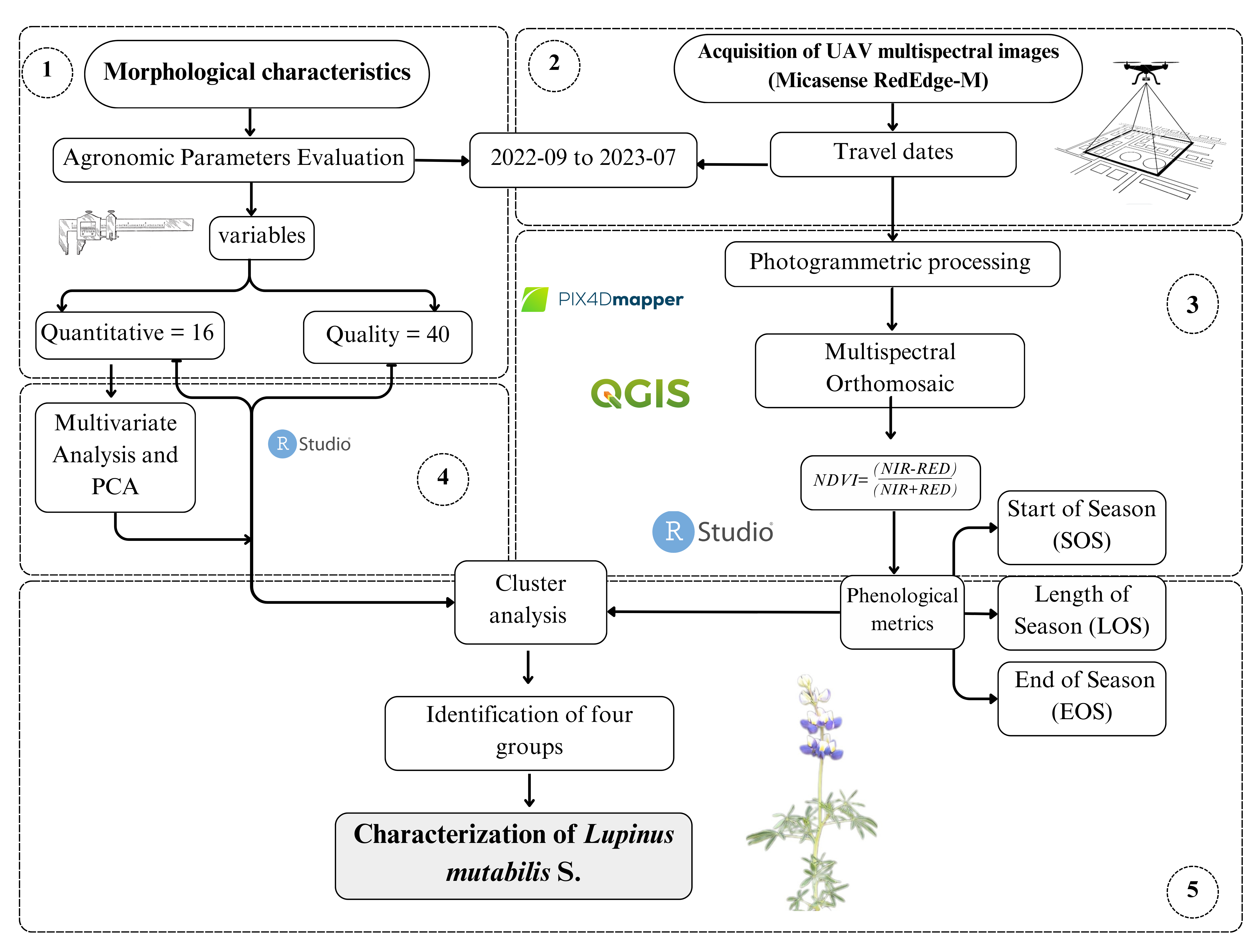
Tarwi (Lupinus mutabilis S.) is a legume native to the Andes, recognized for its high nutritional value, which gives it great potential in food security programs. Therefore, understanding and advancing the conservation of its morphological diversity is essential. In this study, 140 accessions from the national germplasm collection of the National Institute of Agrarian Innovation of Peru were evaluated, along with two cultivars ("INIA 445 Masacanchino" and "Andenes 90"). A traditional agro-morphological characterization was conducted using 16 quantitative and 40 qualitative descriptors, complemented by phenological data obtained from time series of reflectance indices generated by Unmanned Aerial Vehicles (UAVs). Additionally, a principal component analysis (PCA) was applied to select the most relevant variables, and a clustering analysis along with a dendrogram was developed to classify the accessions. The results revealed significant differences between groups (p < 0.05) in terms of inflorescence length, number of pods on the main axis, number of primary branches, and yield per plant. Likewise, the morphological groups exhibited variations in phenophases derived from the Normalized Difference Vegetation Index (NDVI). Four morphological groups were identified: group 3 (G3) showed the highest growth rate followed by a decline, while group 4 (G4) stood out for its highest initial growth rate. Furthermore, the observed homogeneous phenological conditions indicated that groups 1 (G1) and 4 (G4) matured earlier, making them promising candidates for selection. These findings demonstrate the wide genetic variability of tarwi, which can be exploited in breeding programs for the development of new cultivars. Thus, the study highlights the importance of morphological characterization in understanding the variability of an understudied crop such as tarwi, contributing to conservation and promoting its protection and sustainability.
Citas
Annicchiarico, P., Arnoldi, A., Duranti, M., Gandarillas, A., Pedro Macedonio García López, N., Mazón, McNaughton, D., Rey Navarro, L., Tapia, M., von Baer Semillas Baer, E., Michael Wink, C., & Wolko, B. (2019). XV Conferencia Internacional de Lupino 2019. Crop Into a Modern and Sustainable Food and Feed Source, 1–178.
Asma, Hussain, M., Ali, N., Masood, R., Akbar, N., Shafqat, N., & Shad, N. (2022). Agro-morphological characterization of Pakistani maize accessions using qualitative and quantitative traits. Brazilian Journal of Biology, 84, e259729. https://doi.org/10.1590/1519-6984.259729
Bao, G., Chen, J., Chopping, M., Bao, Y., Bayarsaikhan, S., Dorjsuren, A., Tuya, A., Jirigala, B., & Qin, Z. (2019). Dynamics of net primary productivity on the Mongolian Plateau: Joint regulations of phenology and drought. International Journal of Applied Earth Observation and Geoinformation, 81, 85–97. https://doi.org/10.1016/J.JAG.2019.05.009
Breman, E., Ballesteros, D., Castillo-Lorenzo, E., Cockel, C., Dickie, J., Faruk, A., O’donnell, K., Offord, C. A., Pironon, S., Sharrock, S., & Ulian, T. (2021). Plant Diversity Conservation Challenges and Prospects—The Perspective of Botanic Gardens and the Millennium Seed Bank. Plants, 10(11), 2371. https://doi.org/10.3390/PLANTS10112371
Camarena Mayta, F., Huaringa Joaquín, A., Jiménez Dávalos, J., & Mostacero Neyra, E. (2012). Revaloración de un cultivo subutilizado :chocho o tarwi (lupinus mutabilis Sweet) (Vol. 1). CONCYTEC.
Cano, A. F. S., Dávalos, J. J., Bonilla, C. F. L., Espinoza, E. R., & Oblitas, Y. F. A. (2022). Caracterización Intragenotípica de Siete Accesiones de Tarwi (Lupinus mutabilis Sweet) Usando Marcadores Moleculares ISSR. Hatun Yachay Wasi, 1(2), 69–82. https://doi.org/10.57107/HYW.V1I2.25
Ccopi, D., Ortega, K., Castañeda, I., Rios, C., Enriquez, L., Patricio, S., Ore, Z., Casanova, D., Agurto, A., Zuñiga, N., & Urquizo, J. (2024). Using UAV Images and Phenotypic Traits to Predict Potato Morphology and Yield in Peru. Agriculture, 14(11), 1876. https://doi.org/10.3390/AGRICULTURE14111876
Chalampuente-Flores, D., Mosquera-Losada, M. R., Ron, A. M. D., Tapia Bastidas, C., & Sørensen, M. (2023). Morphological and ecogeographical diversity of the andean lupine (Lupinus mutabilis Sweet) in the High Andean Region of Ecuador. Agronomy, 13(8), 2064. https://doi.org/10.3390/AGRONOMY13082064
Chirinos, R., Villasante-Bravo, N., Aguilar-Galvez, A., Figueroa-Merma, A., Carpentier, S., Pedreschi, R., & Campos, D. (2022). Antioxidant, antihypertensive and antidiabetic potential of peptidic fractions obtained from tarwi (Lupinus mutabilis) protein hydrolysate and identification of promising multifunctional bioactive peptides. International Journal of Food Science & Technology, 57(11), 7402–7411. https://doi.org/10.1111/IJFS.16100
De la Cruz, N. J. (2018). Caracterización fenotípica y de rendimiento preliminar de ecotipos de tarwi (Lupinus mutabilis Sweet), bajo condiciones del Callejón de Huaylas - Ancash. Tesis Ingeniero Agrónomo. UNALM, Perú.
Díaz, V. D. G., Piñero, L. G., & Fernández, E. Q. (2002). Caracterización de la variabilidad morfológica de un genotipo local de maíz y dos de sus selecciones. IáN 0253-5785.
Fernández-García, N., Román-García, I., & Olmos, E. (2023). The Outlook for Latin- American Crops: Challenges and Opportunities. Latin-American Seeds: Agronomic, Processing and Health Aspects, 91–118. https://doi.org/10.1201/9781003088424-3
Fiaz, S., Uzair, M., & Zhang, B. (2024). Modern Plant Breeding for Achieving Global Food Security. Physiologia Plantarum, 176(6), e70014. https://doi.org/10.1111/PPL.70014;ISSUE:ISSUE:DOI
Flores, L. A. M., Ruivenkamp, G., & Jongerden, J. (2016). Fitomejoramiento y racionalidad social: los efectos no intencionales de la liberación de una semilla de lupino (Lupinus mutabilis Sweet) en Ecuador. Antipoda. Revista de Antropología y Arqueología, 2016(26), 71–91. https://doi.org/10.7440/ANTIPODA26.2016.03
Forkel, M., Carvalhais, N., Verbesselt, J., Mahecha, M. D., Neigh, C. S. R., & Reichstein, M. (2013). Trend Change Detection in NDVI Time Series: Effects of Inter-Annual Variability and Methodology. Remote Sensing, 5(5), 2113–2144. https://doi.org/10.3390/RS5052113
Forkel, M., Migliavacca, M., Thonicke, K., Reichstein, M., Schaphoff, S., Weber, U., & Carvalhais, N. (2015). Codominant water control on global interannual variability and trends in land surface phenology and greenness. Global Change Biology, 21(9), 3414–3435. https://doi.org/10.1111/GCB.12950
Gabur, I., & Simioniuc, D. P. (2023). Pearl lupin (Lupinus mutabilis): a neglected high protein and oil content crop. Neglected and Underutilized Crops: Future Smart Food, 413–436. https://doi.org/10.1016/B978-0-323-90537-4.00015-6
Ge, Q., Dai, J., Cui, H., & Wang, H. (2016). Spatiotemporal Variability in Start and End of Growing Season in China Related to Climate Variability. Remote Sensing, 8(5), 433. https://doi.org/10.3390/RS8050433
González, A. R. M., Viera, P., Gimenez, N. B., & Pintos, W. (2025). Diversidad morfológica del germoplasma de habilla (Phaseolus vulgaris L.) disponible en el Centro de Investigación para Agricultura Familiar de Choré, San Pedro, Paraguay. Investigación Agraria, 27(1), e2701800. https://doi.org/10.18004/investig.agrar.2025.e2701800
Guaytarilla, P., & Falconí, C. (2014). Selección por arquitectura de la planta y resistencia a la Antracnosis de 7 Genotipos de Chocho (Lupinus mutabilis). IX Congreso de Ciencia y Tecnología ESPE 2014, 1–8.
Guilengue, N., Alves, S., Talhinhas, P., & Neves-Martins, J. (2019). Genetic and Genomic Diversity in a Tarwi (Lupinus mutabilis Sweet) Germplasm Collection and Adaptability to Mediterranean Climate Conditions. Agronomy, 10, 21. https://doi.org/10.3390/AGRONOMY10010021
Hafner, A., Deleo, V., Deng, C. H., Elsik, C. G., S Fleming, D., Harrison, P. W., Kalbfleisch, T. S., Petry, B., Pucker, B., Quezada-Rodríguez, E. H., Tuggle, C. K., & Koltes, J. E. (2025). Data reuse in agricultural genomics research: challenges and recommendations. GigaScience, 14. https://doi.org/10.1093/GIGASCIENCE/GIAE106
Huaringa-Joaquin, A., Saldaña, C. L., Saravia, D., García-Bendezú, S., Rodriguez-Grados, P., et al. (2023). Assessment of the Genetic Diversity and Population Structure of the Peruvian Andean Legume, Tarwi (Lupinus mutabilis), with High Quality SNPs. Diversity, 15(3), 437. https://doi.org/10.3390/D15030437/S1
IBPGR. (1981). Lupin Descriptors (Vol. 1). International Board for Plant Genetic Resources, 68 p.
INIA. (2021). Resolución Jefatural N° 0076-2021-INIA. Instituto Nacional de Innovación Agraria. Perú.
Itoh, J. I., & Sato, Y. (2023). Understanding plant development for plant breeding. Breeding Science, 73(1), 1–2. https://doi.org/10.1270/JSBBS.73.1
Jin, X., Yang, W., Doonan, J. H., & Atzberger, C. (2022). Crop phenotyping studies with application to crop monitoring. The Crop Journal, 10, 1221–1223. https://doi.org/10.1016/j.cj.2022.09.001
Joshi, B. K., Ghimire, K. H., Neupane, S. P., Gauchan, D., & Mengistu, D. K. (2023). Approaches and Advantages of Increased Crop Genetic Diversity in the Fields. Diversity, 15(5). MDPI. https://doi.org/10.3390/d15050603
Meghraoui, K., Sebari, I., Pilz, J., Ait El Kadi, K., & Bensiali, S. (2024). Applied Deep Learning-Based Crop Yield Prediction: A Systematic Analysis of Current Developments and Potential Challenges. Technologies, 12(4), 43. https://doi.org/10.3390/TECHNOLOGIES12040043
Monroy-Guerrero, M., Memenza-Zegarra, M., Taco, N., Mostacero, E., Ogata-Gutiérrez, K., Huaringa-Joaquín, A., Camarena, F., & Zúñiga-Dávila, D. (2022). Co-Inoculation of Bradyrhizobium spp. and Bacillus sp. on Tarwi (Lupinus mutabilis Sweet) in the High Andean Region of Peru. Agronomy, 12(9), 2132. https://doi.org/10.3390/AGRONOMY12092132/S1
Peng, Q., Li, X., Shen, R., He, B., Chen, X., Peng, Y., & Yuan, W. (2022). How well can we predict vegetation growth through the coming growing season? Science of Remote Sensing, 5, 100043. https://doi.org/10.1016/J.SRS.2022.100043
Peralta, I., E., Murillo, I., A., Mazón, N., Villacrés, E., & Rivera M., M. (2013). Catálogo de variedades mejoradas de granos andinos: Chocho, quinua y amaranto, para la sierra de Ecuador. Quito, INIAP, Programa Nacional de Leguminosas y Granos Andinos. Investigaciones EESC.
Perez, L., Castañon, G., Moises, R., & Mayek, N. (2015). Avances y perspectivas sobre el estudio del origen y la diversidad genética de Capsicum spp. Ecosistemas y Recursos Agropecuarios, 2, 117–128.
Pizarro, S., Pricope, N. G., Figueroa, D., Carbajal, C., Quispe, M., Vera, J., Alejandro, L., Achallma, L., Gonzalez, I., Salazar, W., Loayza, H., Cruz, J., & Arbizu, C. I. (2023). Implementing cloud computing for the digital mapping of agricultural soil properties from high resolution UAV multispectral imagery. Remote Sensing, 15(12), 3203. https://doi.org/10.3390/RS15123203
Prodhan, F. A., Zhang, J., Yao, F., Shi, L., Sharma, T. P. P., Zhang, D., Cao, D., Zheng, M., Ahmed, N., & Mohana, H. P. (2021). Deep Learning for Monitoring Agricultural Drought in South Asia Using Remote Sensing Data. Remote Sensing, 13(9), 1715. https://doi.org/10.3390/RS13091715
The R Foundation (2025). The R Project for Statistical Computing. https://www.r-project.org/
Rodene, E., Xu, G., Palali Delen, S., Zhao, X., Smith, C., Ge, Y., Schnable, J., & Yang, J. (2022). A UAV-based high-throughput phenotyping approach to assess time-series nitrogen responses and identify trait-associated genetic components in maize. The Plant Phenome Journal, 5(1), e20030. https://doi.org/10.1002/PPJ2.20030
Rodríguez-Ortega, D., Zambrano, J. L., Pereira-Lorenzo, S., Torres, A., & Murillo, Á. (2023). Lupinus mutabilis Breeding in the Andes of Ecuador, Peru, and Bolivia: A Review. Agronomy, 14(1), 94. https://doi.org/10.3390/AGRONOMY14010094
Salgotra, R. K., & Chauhan, B. S. (2023). Genetic Diversity, Conservation, and Utilization of Plant Genetic Resources. Genes, 14(1), 174. https://doi.org/10.3390/GENES14010174
Schneider, H. (2023). Integrating genomics and conservation to safeguard plant diversity. Integrative Conservation, 2(1), 10–18. https://doi.org/10.1002/INC3.15
Sierra y Selva Exportadora. (2020). Análisis de Mercado: Tarwi. Sierra y Selva Exportadora, Unidad de Inteligencia Comercial. Ministerio de Desarrollo Agrario y Riego. Perú.
Tapia, M. (2015). El Tarwi, Lupino Andino. In FIP. Fondo Ítalo Peruano.
Tello, F. T. (1976). Lupinus mutabilis sweet: a potent food source from the Andean region. The American Journal of Clinical Nutrition, 29(9), 933. https://doi.org/10.1093/AJCN/29.9.933
Velazques Carrera, J. (1993). Evaluación agronómica y morfológica de 283 entradas de lupinos (Lupinus spp.) del Banco de Germoplasma del INIAP - E [Tesis]. Universidad de Cuenca.
Wu, W., & Xin, Q. (2023). Characterizing Spring Phenological Changes of the Land Surface across the Conterminous United States from 2001 to 2021. Remote Sensing, 15(3), 737. https://doi.org/10.3390/RS15030737
Yela, R. V. M., Albiño, J. A., Bastidas, C. T., Zambrano, S. T., Hidalgo, G. L., & Zambrano, K. M. (2025). Caracterización Morfológica de la Colección de Aguacate (Persea americana) de la Estación Experimental Tropical Pichilingue, Ecuador. Chone, Ciencia y Tecnología, 3(1), 2960–8228. https://doi.org/10.56124/CCT.V3I1.011
Yuke, Z., & Yuke, Z. (2020). Analysis of controlling factors for vegetation productivity in Northeast China. Acta Geographica Sinica, 75(1), 53–67. https://doi.org/10.11821/DLXB202001005
Zhang, H., Wang, L., Jin, X., Bian, L., & Ge, Y. (2023). High-throughput phenotyping of plant leaf morphological, physiological, and biochemical traits on multiple scales using optical sensing. The Crop Journal, 11(5), 1303–1318. https://doi.org/10.1016/J.CJ.2023.04.014
Descargas
Archivos adicionales
Publicado
Cómo citar
Número
Sección
Licencia
Derechos de autor 2025 Scientia Agropecuaria

Esta obra está bajo una licencia internacional Creative Commons Atribución-NoComercial 4.0.
Los autores que publican en esta revista aceptan los siguientes términos:
a. Los autores conservan los derechos de autor y conceden a la revista el derecho publicación, simultáneamente licenciada bajo una licencia de Creative Commons que permite a otros compartir el trabajo, pero citando la publicación inicial en esta revista.
b. Los autores pueden celebrar acuerdos contractuales adicionales separados para la distribución no exclusiva de la versión publicada de la obra de la revista (por ejemplo, publicarla en un repositorio institucional o publicarla en un libro), pero citando la publicación inicial en esta revista.
c. Se permite y anima a los autores a publicar su trabajo en línea (por ejemplo, en repositorios institucionales o en su sitio web) antes y durante el proceso de presentación, ya que puede conducir a intercambios productivos, así como una mayor citación del trabajo publicado (ver efecto del acceso abierto).