
Partial replacement of Artemia sp. by Moina sp. as live feed and early weaning onto a commercial diet: effects on growth, survival, and digestive histology of paiche (Arapaima sp.) juveniles
DOI:
https://doi.org/10.17268/sci.agropecu.2026.022Keywords:
Amazonian aquaculture, early nutrition, growth and survival, digestive system, weaningAbstract
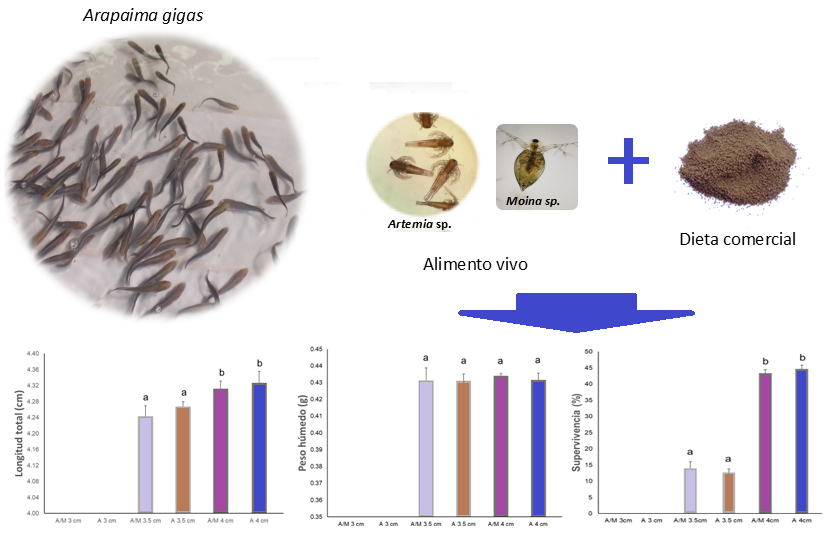
Paiche (Arapaima sp.) is an emblematic species of the Peruvian Amazon, yet sustainable production remains constrained by the limited availability of fry in captivity. This study aimed to evaluate the partial replacement of Artemia sp. by Moina sp. during the live-feeding phase and the effect of early weaning onto a commercial trout diet on growth, survival, and digestive system histology. The 37-day feeding trial was conducted with six treatments in triplicate, defined by three weaning sizes (3, 3.5, and 4 cm total length) and two live-feed regimes (100% Artemia sp. or 50% Artemia sp. + 50% Moina sp.). All groups were weaned onto the same commercial diet. Results showed that replacing 50% of Artemia sp. with Moina sp. did not compromise initial performance. However, fry assigned to weaning at 4 cm showed reduced growth while remaining exclusively on live feed, suggesting limitations of the live-feeding protocol at that size. Weaning at 4 cm was associated with better growth and survival indicators than weaning at 3 and 3.5 cm. Nonetheless, the commercial trout diet was unsuitable for early weaning, as evidenced at the histological level by alterations such as lumen obstruction, villi deterioration, and intestinal epithelial hyperplasia. Overall, these results highlight the need to develop paiche-specific starter diets tailored to the requirements of early life stages.
References
Berra, T. (2007). Freshwater Fish Distribution. The University of Chicago Press. Chicago, USA. 606 p.
Castello, L., Stewart, D. J., & Arantes, C. C. (2011). Modeling population dynamics and conservation of arapaima in the Amazon. Reviews in Fish Biology and Fisheries, 21(3), 623-640. https://doi.org/10.1007/s11160-010-9197-z
Castello, L., & Stewart, J. (2010). Assessing CITES non-detriment findings procedures for Arapaima in Brazil. Journal of Applied Ichthyology, 26(1), 49–56. https://doi.org/10.1111/j.1439-0426.2009.01355.x
Castro-Ruiz, D., Andree, B., Magris, J., Fernández-Méndez, C., García-Dávila, C., Gisbert, E., & Darias, M. J. (2022). DHA-enrichment of live and compound feeds influences the incidence of cannibalism, digestive function, and growth in the neotropical catfish Pseudoplatystoma punctifer (Castelnau, 1855) during early life stages. Aquaculture, 561, 738667. https://doi.org/10.1016/j.aquaculture.2022.738667
Carvalho, F., Power, M., Forsberg, B. R., Castello, L., Martins, E. G., & Freitas, C. E. C. (2018). Trophic Ecology of Arapaima sp. in a ria lake—river–floodplain transition zone of the Amazon. Ecology of Freshwater Fish, 27(1), 237–46. https://doi.org/10.1111/eff.12341
Cavero, B., Ituassú, D., Pereira-Filhio, M., Roubach, R., Moreira, A., da Fonseca, F., & Akifumi, E. (2004). Uso de alimento vivo como dieta inicial no treinamento alimentar de juvenis de pirarucu. Pesquisa agropecuaria brasileira, 38(8), 1011–1015. https://doi.org/10.1590/s0100-204x2003000800015
Cortegano, C. A. A., Godoy, L. C., Petenuci, M. E., Visentainer, J. V., Gusmão, E., & Gonçalves, L. (2017). Nutritional and lipid profles of the dorsal and ventral muscles of wild pirarucu. Pesquisa Agropecuária Brasileira, 52, 271–276. https://doi.org/10.1590/S0100-204X2017000400007
Chu Koo, F., Fernández-Mendez, C., Alfaro, C., Darias, M.J., García-Dávila, C., Garcia, A., Martín, S., Campos, L., Alvan-Aguilar, M., Rengifo, J., Llerena, L., Renno, J. F., & Arbildo- Ortiz, H. (2017). El cultivo del paiche: biología, procesos productivos, tecnologías y estadísticas. Primera edición. Instituto de Investigaciones de la Amazonía Peruana – IIAP y Gobierno Regional de Loreto. Iquitos, Loreto, Perú. 110 p.
Dantas, F. M., Santana, T. M., Kojima, J. T., Fonseca, F. A. L., Lopes, A. C. C., Carvalho, T. B., & Gonçalves, L. U. (2022). Pirarucu larviculture in green water provides heavier fish and modulates locomotor activity. Acta Amazonica, 52, 114-121. https://doi.org/10.1590/1809-4392202100932
Darias, M. J., Estivals, G., Andree, K., Fernández, C., Bazán, R., Cahu, C., Gisbert, E., Castro-Ruiz, D. (2025) Histological and molecular characterization of the digestive system of early weaned juveniles of Arapaima sp. reared in a recirculating aquaculture system. PLoS One, 20(5), e0323012. https://doi.org/10.1371/journal.pone.0323012
Darias, M. J., Castro-Ruiz, D., Estivals, G., Quazuguel, P., Fernández-Méndez, C., Núñez, J., Clota, F., Guilles, S., García- Dávila, C., Gisbert, E., & Cahu, (2015). Influence of dietary protein and lipid levels on growth performance and the incidence of cannibalism in Pseudoplatystoma punctifer (Castelnau, 1855) larvae and early juveniles. Journal of Applied Ichthyology, 31, 74-82. https://doi.org/10.1111/jai.12978
de Alcântara, A. M., da Fonseca, F. A., Araújo‐Dairiki, T., Faccioli, C., Vicentini, C., da Conceição, L., & Gonçalves, L.U. (2019). Ontogeny of the digestive tract of Arapaima gigas (Schinz, 1822) (Osteoglossiformes: Arapaimidae) larvae. Journal of the World Aquaculture Society, 50(1), 231-241. https://doi.org/10.1111/jwas.12545
Ferraris, R., Tan, J., & De La Cruz, M. (1987) Development of the digestive tract of milkfish, Chanos chanos (Forsskal): Histology and histochemistry. Aquaculture, 61(3–4), 241–257. https://doi.org/10.1016/0044-8486(87)90153-0
Fernández-Méndez, C., Castro-Ruiz, D., García-Dávila, C., Duponchelle, F., Renno, J. F., & Nuñez, J. (2012). Adaptación, crecimiento y supervivencia de alevines de doncella Pseudoplatystoma punctifer al consumo de alimento balanceado. Folia Amazónica, 21(1-2). https://doi.org/10.24841/fa.v21i1-2.33
Fernández-Méndez, C., Gómez, A., Bayeto, S., Gonzales-Flores, A., Marichin, J., & Ramírez-Chirinos, C. (2017). Artemia en la adaptación al consumo de alimento balanceado de paiche Arapaima gigas. Folia Amazónica, 26(2), 187–194. https://doi.org/10.24841/fa.v26i2.439
Gonçalves, L. U., França, L. A., Epifanio, C. M., da Fonseca, F. A. L., de Alcátara, A. M., do Nascimento, R. G., Silva, E. N. S, & Conceição, L. E. C. (2019). Ostracoda impairs growth and survival of Arapaima gigas larvae. Aquaculture SOS, 505, 344-350 https://doi.org/10.1016/j.aquaculture.2019.02.012
Gurdak, D., Stewart, D., Castello, L., & Arantes, C. (2019) Diversity in reproductive traits of arapaima (Arapaima spp., Müller, 1843) in Amazonian várzea floodplains: Conservation implications. Aquatic Conservation, 29(2), 245–57. https://doi.org/10.1002/aqc.3030
Ismiño, R., Araujo, J., Vargas, S., Ruiz, K., Arbildo, H., & Alvan-Aguilar, M. (2020). Desarrollo del cladócero nativo Ceriodaphnia sp con clorofitas (Scenedesmus sp y Chlorella sp) en condiciones de laboratorio. Revista de Investigaciones Veterinarias del Perú, 31(1), e17555 http://dx.doi.org/10.15381/rivep.v31i1.17555
Jacobi, C., Villamain, F., Campos-Silva, J. V., Jardine, T., & Magnusson, W. E. (2020). Feeding of Arapaima sp.: integrating stomach contents and local ecological knowledge. Journal of Fish Biology, 97(1), 265-272. https://doi.org/10.1111/jfb.14372
Nelson, J., Grande, T., & Wilson, M. (2016). Fishes of the World. 5th Edition. Hoboken, New Jersey: John Wiley & Sons.
Palomino Ramos, A. R., & Moyano López, F. J. (2024). Digestive Physiology, Nutrition and Feeding of Arapaima gigas: A Review. Fishes, 9, 507. https://doi.org/10.3390/fishes9120507
Ruiz-Tafur, K., Dávila-Panduro, L., Palomino-Trigoso, V. Y., Yahuarcani-Tamiche, C., Alván-Aguilar, M. A., Ayarza-Rengifo, J., & Chu koo, F. W. (2017). Desarrollo larval del paiche o pirarucu Arapaima gigas (Schinz, 1822). Folia Amazónica, 26(1),59–74. https://doi.org/10.24841/fa.v26i1.419
Schneider, C. A., Rasband, W. S., & Eliceiri, K. W. (2012). NIH Image to ImageJ: 25 years of image analysis. Nat Methods, 9(7), 671–675. https://doi.org/10.1038/nmeth.2089
Stewart, D. (2013a). A New Species of Arapaima (Osteoglossomorpha: Osteoglossidae) from the Solimões River, Amazonas State, Brazil. Copeia. 2013(3), 470–476. https://doi.org/10.1643/CI-12-017
Stewart D. (2013b). Re-description of Arapaima agassizii (Valenciennes), a Rare Fish from Brazil (Osteoglossomorpha: Osteoglossidae). Copeia, 2013(1), 38–51. https://doi.org/10.1643/ci-12-013
Saint-Paul, U. (1986). Potential for aquaculture of South American freshwater fishes: A review. Aquaculture, 54(3), 205–240. https://doi.org/10.1016/0044-8486(86)90329-7
Trejo-Albarrán, R., Gómez-Márquez, J. L., Granados Ramírez, J. G., Trujillo Jiménez, P., Castro Franco, R., Bustos Zagal, G., & Granjeno Colín, A. E. (2024). Cladóceros presentes en ecosistemas acuáticos de Morelos, México, con posibilidad de uso como alimento vivo. Acta universitaria, 34, 1-18. http://doi.org/10.15174/au.2024.4026
Yúfera, M., & Darias, M. J. (2007). The onset of exogenous feeding in marine fish larvae. Aquaculture, 268(1-4), 53-63. https://doi.org/10.1016/j.aquaculture.2007.04.050
Downloads
Published
How to Cite
Issue
Section
License
Copyright (c) 2026 Scientia Agropecuaria

This work is licensed under a Creative Commons Attribution-NonCommercial 4.0 International License.
The authors who publish in this journal accept the following conditions:
a. The authors retain the copyright and assign to the magazine the right of the first publication, with the work registered with the Creative Commons attribution license, which allows third parties to use the published information whenever they mention the authorship of the work and the First publication in this journal.
b. Authors may make other independent and additional contractual arrangements for non-exclusive distribution of the version of the article published in this journal (eg, include it in an institutional repository or publish it in a book) as long as it clearly indicates that the work Was first published in this journal.
c. Authors are encouraged to publish their work on the Internet (for example, on institutional or personal pages) before and during the review and publication process, as it can lead to productive exchanges and a greater and faster dissemination of work Published (see The Effect of Open Access).