Composting in agroecology: Effects on soil structure, nutrient availability and beneficial microorganisms
DOI:
https://doi.org/10.17268/sci.agropecu.2026.015Keywords:
Nutrient cycling, Organic matter, Crop resilience, Sustainable managementAbstract
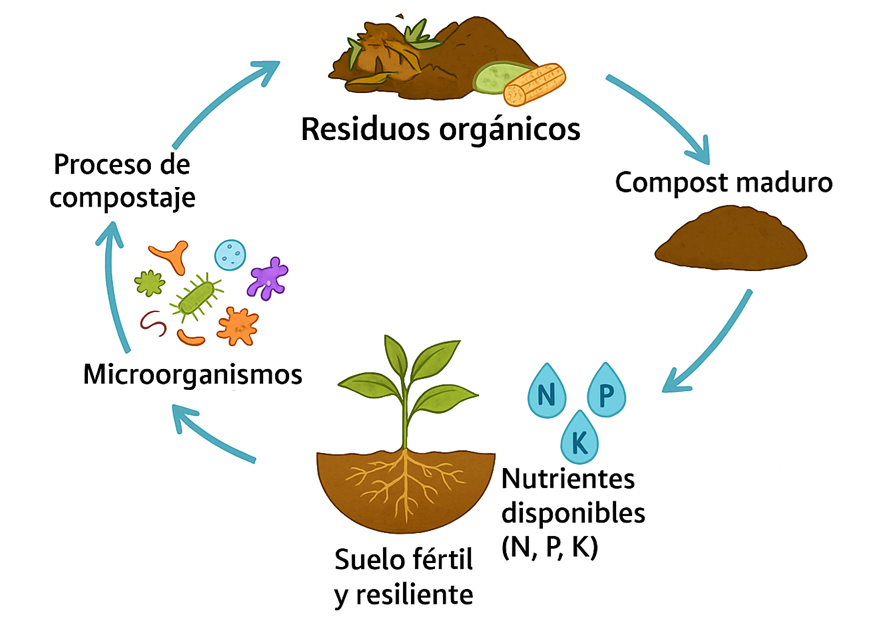
Composting is a key strategy in agroecology that improves soil fertility without causing negative environmental effects. Unlike synthetic fertilizers, compost promotes soil regeneration by increasing its organic matter content, enhancing its structure, and stimulating beneficial microbial activity. This review article examines how composting optimizes the physical, chemical, and biological properties of the soil, increasing its water retention capacity, the availability of essential nutrients such as nitrogen, phosphorus, and potassium, and strengthening crop resilience against diseases and environmental stress. Different composting methods, such as vermicomposting, windrow composting, and Bokashi, are compared, demonstrating that regardless of the method used, compost does not contribute to soil degradation but instead enriches it in a sustainable manner. Additionally, the role of key microorganisms in nutrient mineralization and the improvement of the soil microbiome is highlighted, ensuring a balanced and slow-release supply for plants. Finally, innovative strategies to optimize compost quality using microbial inoculants and natural amendments are discussed, consolidating their role as a sustainable alternative for efficient and environmentally responsible agricultural production.
References
Andreote, F. D., Gumiere, T., & Durrer, A. (2014). Exploring interactions of plant microbiomes. Scientia Agricola, 71(6), 528–539. https://doi.org/10.1590/0103-9016-2014-0195
Ahmed, T., Noman, M., Qi, Y., Shahid, M., Hussain, S., et al. (2023). Fertilization of microbial composts: a technology for improving stress resilience in plants. Plants, 12(20), 3550. https://doi.org/10.3390/plants12203550
Ali, A., Jabeen, N., Chachar, Z., Chachar, S., Ahmed, S., Ahmed, N., Laghari, A. A., et al. (2025). The role of biochar in enhancing soil health and interactions with rhizosphere properties and enzyme activities in organic fertilizer substitution. Frontiers in Plant Science, 16, 1595208. https://doi.org/10.3389/fpls.2025.1595208
Azim, K., Soudi, B., Boukhari, S., Perissol, C., Roussos, S., & Thami Alami, I. (2018). Composting parameters and compost quality: a literature review. Organic Agriculture, 8(2), 141–158. https://doi.org/10.1007/s13165-017-0180-z
Naveen, M. (2025). The role of organic matter in soil for improving crop productivity and soil health. Journal of Experimental Agriculture International, 47(2), 367–375. https://doi.org/10.9734/jeai/2025/v47i23296
Castaño, R., Borrero, C., & Avilés, M. (2011). Organic matter fractions by SP-MAS 13C NMR and microbial communities involved in the suppression of Fusarium wilt in organic growth media. Biological Control, 58(3), 286–293. https://doi.org/10.1016/j.biocontrol.2011.05.011
Dentel, S. K., & Qi, Y. (2013). Management of sludges, biosolids, and residuals. In Comprehensive Water Quality and Purification (pp. 223–243). Elsevier. https://doi.org/10.1016/B978-0-12-382182-9.00049-9
El-Ghamry, A. M., El-Sherpiny, M. A., Alkharpotly, A. A., Ghazi, D. A., Helmy, A. A., et al. (2024). The synergistic effects of organic composts and micronutrients on potato growth and productivity under salinity stress. Heliyon, 10(13), e33404. https://doi.org/10.1016/j.heliyon.2024.e33404
Essel, B., Abaidoo, R. C., Opoku, A., & Ewusi-Mensah, N. (2021). Mechanisms underlying nutrient interaction of compost and mineral fertilizer application in maize (Zea mays L.) cropping system in Ghana. Frontiers in Soil Science, 1, 630851. https://doi.org/10.3389/fsoil.2021.630851
Farooq, M. S., Majeed, A., Ghazy, A., Khan, N., Ullah, A., Rehman, A., & Alharby, H. F. (2024). Partial replacement of inorganic fertilizer with organic inputs for enhanced nitrogen use efficiency, grain yield, and decreased nitrogen losses under rice-based systems of mid-latitudes. BMC Plant Biology, 24, 919. https://doi.org/10.1186/s12870-024-05629-w
Figiel, S., Rusek, P., Ryszko, U., & Brodowska, M. S. (2025). Microbially enhanced biofertilizers: technologies, mechanisms of action, and agricultural applications. Agronomy, 15(5), 1191. https://doi.org/10.3390/agronomy15051191
Goldan, E., Nedeff, V., Barsan, N., Culea, M., Panainte-Lehadus, M., Mosnegutu, E., Tomozei, C., Chitimus, D., & Irimia, O. (2023). Assessment of manure compost used as soil amendment—A review. Processes, 11(4), 1167. https://doi.org/10.3390/pr11041167
Gomiero, T., Pimentel, D., & Paoletti, M. G. (2011). Environmental impact of different agricultural management practices: Conventional vs. organic agriculture. Critical Reviews in Plant Sciences, 30(1–2), 95–124. https://doi.org/10.1080/07352689.2011.554355
Hazman, M., Fawzy, S., Hamdy, A., Abdelkader, A., El-Sayed, A., & Mahmoud, A. (2023). Enhancing rice resilience to drought by applying biochar–compost mixture in low-fertile sandy soil. Beni-Suef University Journal of Basic and Applied Sciences, 12, 74. https://doi.org/10.1186/s43088-023-00411-7
Ho, T. T. K., Tra, V. T., Le, T. H., Nguyen, N. K. Q., Tran, C. S., et al. (2022). Compost to improve sustainable soil cultivation and crop productivity. Case Studies in Chemical and Environmental Engineering, 6. https://doi.org/10.1016/j.cscee.2022.100211
Huang, X., Wang, H., Zou, Y., Qiao, C., Hao, B., Shao, Q., Wu, W., Wu, H., Zhao, J., & Ren, L. (2023). Rice straw composting improves the microbial diversity of paddy soils to stimulate the growth, yield, and grain quality of rice. Sustainability, 15(2), 932. https://doi.org/10.3390/su15020932
Kausar, S., Muhsin, S., Khyber, B., & Azeem, M. (2021). Role of soil microbes in soil health and crop production-a review. Current Research in Agriculture and Farming, 2(5), 1–8. https://doi.org/10.18782/2582-7146.159
Khanyile, N., Dlamini, N., Masenya, A., Madlala, N. C., & Shezi, S. (2024). Preparation of biofertilizers from banana peels: their impact on soil and crop enhancement. Agriculture, 14(11), 1894. https://doi.org/10.3390/agriculture14111894
Khan, M. S., Zaidi, A., & Ahmad, E. (2014). Mechanism of phosphate solubilization and physiological functions of phosphate-solubilizing microorganisms. In M. S. Khan, A. Zaidi, & J. Musarrat (Eds.), Phosphate solubilizing microorganisms (pp. 31–62). Springer, Cham. https://doi.org/10.1007/978-3-319-08216-5_2
Kumari, S., Debbarma, R., Habibi, M., Haque, S., & Suprasanna, P. (2025). Banana waste valorisation and the development of biodegradable biofilms. Waste Management Bulletin, 3(3), 100213. https://doi.org/10.1016/j.wmb.2025.100213
Lerma-Moliz, R., López-González, J. A., Suárez-Estrella, F., Martínez-Gallardo, M. R., Jurado, M. M., et al. (2023). Mitigation of phytotoxic effect of compost by application of optimized aqueous extraction protocols. Science of the Total Environment, 873, 162288. https://doi.org/10.1016/j.scitotenv.2023.162288
Mago, M., Yadav, A., & Garg, V. K. (2021). Management of banana crop waste biomass using vermicomposting technology. Bioresource Technology, 326, 124742. https://doi.org/10.1016/j.biortech.2021.124742
Martínez-Blanco, J., Lazcano, C., Christensen, T. H., Muñoz, P., Rieradevall, J., Møller, J., Antón, A., & Boldrin, A. (2013). Compost benefits for agriculture evaluated by life cycle assessment: A review. Agronomy for Sustainable Development, 33(4), 721–732. https://doi.org/10.1007/s13593-013-0148-7
Mehta, C. M., Palni, U., Franke-Whittle, I. H., & Sharma, A. K. (2014). Compost: Its role, mechanism and impact on reducing soil-borne plant diseases. Waste Management, 34(3), 607–622. https://doi.org/10.1016/j.wasman.2013.11.012
Mekkaoui, F., Ait-El-Mokhtar, M., Zaari Jabri, N., Amghar, I., Essadssi, S., & Hmyene, A. (2024). The Use of Compost and Arbuscular Mycorrhizal Fungi and Their Combination to Improve Tomato Tolerance to Salt Stress. Plants, 13(16), 2225. https://doi.org/10.3390/plants13162225
Mendes, G. O., Dias, C. S., Silva, I. R., Júnior, J. I. R., Pereira, O. L., & Costa, M. D. (2013). Fungal rock phosphate solubilization using sugarcane bagasse. World Journal of Microbiology and Biotechnology, 29(1), 43–50. https://doi.org/10.1007/s11274-012-1156-5
Michel, F., O’Neill, T., Rynk, R., Gilbert, J., Smith, M., Aber, J., & Keener, H. (2022). Forced aeration composting, aerated static pile, and similar methods. In The Composting Handbook (pp. 197–269). Elsevier. https://doi.org/10.1016/B978-0-323-85602-7.00007-8
Nemet, F., Perić, K., & Lončarić, Z. (2021). Microbiological activities in the composting process: A review. Columella: Journal of Agricultural and Environmental Sciences, 8(2), 41–53. https://doi.org/10.18380/szie.colum.2021.8.2.41
Nguyen, M. K., Lin, C., Hoang, H. G., Sanderson, P., Dang, B. T., Bui, X. T., Nguyen, N. S. H., Vo, D. V. N., & Tran, H. T. (2022). Evaluate the role of biochar during the organic waste composting process: A critical review. Chemosphere, 299. https://doi.org/10.1016/j.chemosphere.2022.134488
Ortega-Ramírez, A. T., García Moreno, D., & Reyes Tovar, M. (2024). Composting as a Cleaner Production Strategy for the Soil Resource of Potato Crops in Choconta, Colombia. Resources, 13(10), 137. https://doi.org/10.3390/resources13100137
Oueld Lhaj, M., Moussadek, R., Zouahri, A., Sanad, H., Saafadi, L., Mdarhri Alaoui, M., & Mouhir, L. (2024). Sustainable agriculture through agricultural waste management: a comprehensive review of composting’s impact on soil health in moroccan agricultural ecosystems. Agriculture, 14(12), 2356. https://doi.org/10.3390/agriculture14122356
Pepe, O., Ventorino, V., & Blaiotta, G. (2013). Dynamic of functional microbial groups during mesophilic composting of agro-industrial wastes and free-living (N2)-fixing bacteria application. Waste Management, 33(7), 1616–1625. https://doi.org/10.1016/j.wasman.2013.03.025
Rehman, S., De Castro, F., Aprile, A., Benedetti, M., & Fanizzi, F. P. (2023). Vermicompost: Enhancing plant growth and combating abiotic and biotic stress. Agronomy, 13(4), 1134. https://doi.org/10.3390/agronomy13041134
Rittl, T. F., Grønmyr, F., Bakken, I., & Løes, A. K. (2023). Effects of organic amendments and cover crops on soil characteristics and potato yields. Acta Agriculturae Scandinavica, Section B — Soil & Plant Science, 73(1), 13–26. https://doi.org/10.1080/09064710.2023.2165963
Sánchez, O. J., Ospina, D. A., & Montoya, S. (2017). Compost supplementation with nutrients and microorganisms in composting process. Waste Management, 69, 136–153. https://doi.org/10.1016/j.wasman.2017.08.012
Singh, S., & Nain, L. (2014). Microorganisms in the conversion of agricultural wastes to compost. Proceedings of the Indian National Science Academy, 80(2), 473. https://doi.org/10.16943/ptinsa/2014/v80i2/4
Soobhany, N. (2018). Preliminary evaluation of pathogenic bacteria loading on organic Municipal Solid Waste compost and vermicompost. Journal of Environmental Management, 206, 763–767. https://doi.org/10.1016/j.jenvman.2017.11.029
Soobhany, N., Mohee, R., & Garg, V. K. (2015). Experimental process monitoring and potential of Eudrilus eugeniae in the vermicomposting of organic solid waste in Mauritius. Ecological Engineering, 84, 149–158. https://doi.org/10.1016/j.ecoleng.2015.08.003
Sreevidya, M., Gopalakrishnan, S., Kudapa, H., & Varshney, R. K. (2016). Exploring plant growth-promotion actinomycetes from vermicompost and rhizosphere soil for yield enhancement in chickpea. Brazilian Journal of Microbiology, 47(1), 85–95. https://doi.org/10.1016/j.bjm.2015.11.030
Suvendran, S., Acevedo, M. F., Smithers, B., Walker, S. J., & Xu, P. (2025). Soil fertility and plant growth enhancement through compost treatments under varied irrigation conditions. Agriculture, 15(7), 734. https://doi.org/10.3390/agriculture15070734
Wang, P., Han, S., & Lin, Y. (2022). Role of microbes and microbial dynamics during composting. In Current Developments in Biotechnology and Bioengineering: Advances in Composting and Vermicomposting Technology (pp. 169–220). Elsevier. https://doi.org/10.1016/B978-0-323-91874-9.00011-5
Xu, P., Shu, L., Yang, Y., Kumar, S., Tripathi, P., et al. (2024). Microbial agents obtained from tomato straw composting effectively promote tomato straw compost maturation and improve compost quality. Ecotoxicology and Environmental Safety, 270, 115884. https://doi.org/10.1016/j.ecoenv.2023.115884
Yao, X., Guo, H., Zhang, K., Zhao, M., Ruan, J., & Chen, J. (2023). Trichoderma and its role in biological control of plant fungal and nematode diseases. Frontiers in Microbiology, 14, 1160551. https://doi.org/10.3389/fmicb.2023.1160551
Zapałowska, A., & Jarecki, W. (2024). The impact of using different types of compost on the growth and yield of corn. Sustainability, 16(2), 511. https://doi.org/10.3390/su16020511
Downloads
Published
How to Cite
Issue
Section
License
Copyright (c) 2025 Scientia Agropecuaria

This work is licensed under a Creative Commons Attribution-NonCommercial 4.0 International License.
The authors who publish in this journal accept the following conditions:
a. The authors retain the copyright and assign to the magazine the right of the first publication, with the work registered with the Creative Commons attribution license, which allows third parties to use the published information whenever they mention the authorship of the work and the First publication in this journal.
b. Authors may make other independent and additional contractual arrangements for non-exclusive distribution of the version of the article published in this journal (eg, include it in an institutional repository or publish it in a book) as long as it clearly indicates that the work Was first published in this journal.
c. Authors are encouraged to publish their work on the Internet (for example, on institutional or personal pages) before and during the review and publication process, as it can lead to productive exchanges and a greater and faster dissemination of work Published (see The Effect of Open Access).