
Evaluation of substrates and enzymatic pretreatment to optimize Pleurotus ostreatus production
DOI:
https://doi.org/10.17268/agroind.sci.2026.03.05Keywords:
Bioconversion, mycelium, cellulose, hemicellulose, ligninAbstract
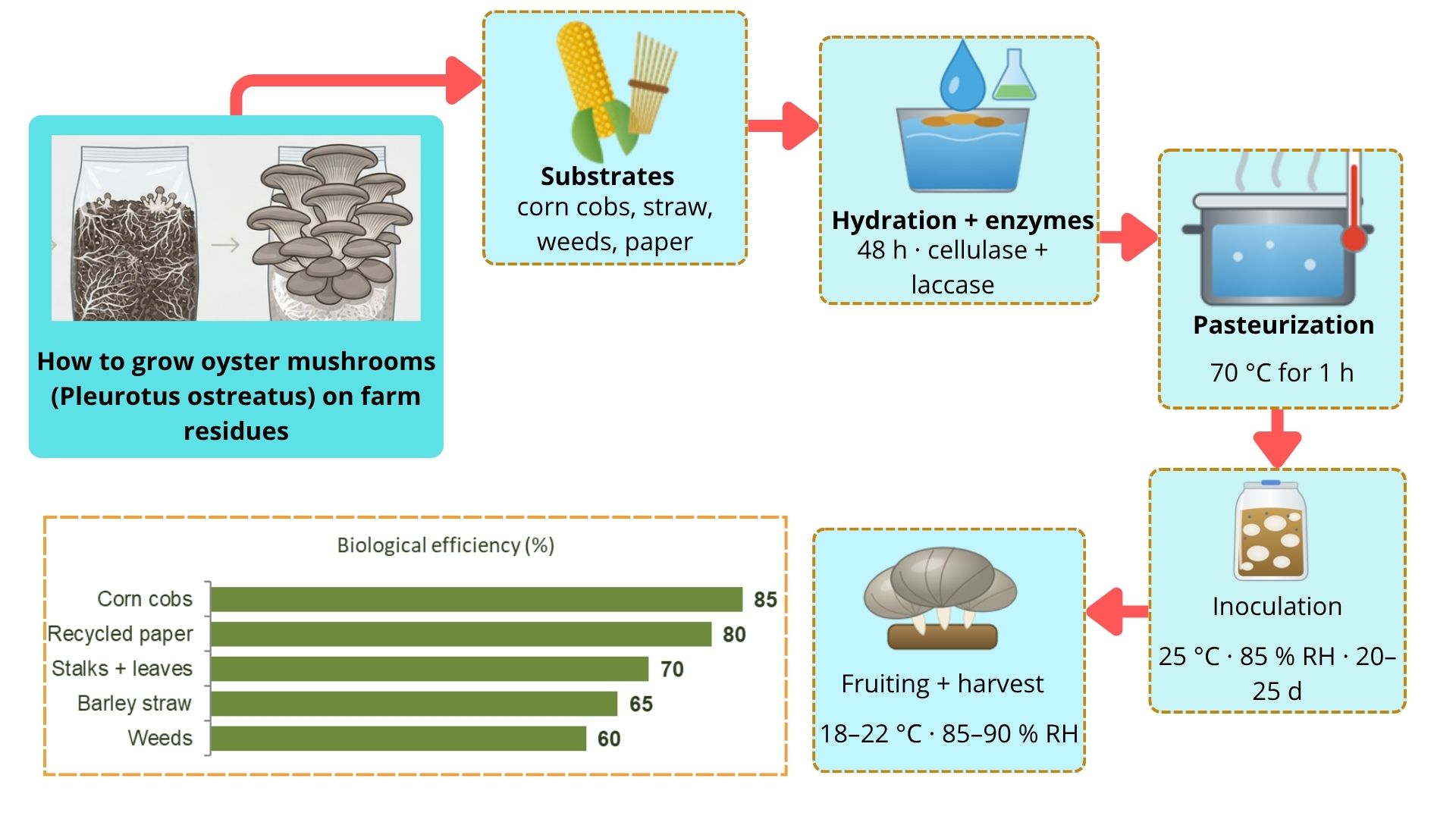
Several agricultural substrates, including barley straw, corn cobs, corn stalks and leaves, weeds, and recycled paper, were evaluated to determine their potential for Pleurotus ostreatus production by analyzing their physicochemical composition and efficiency in fungal growth. Corn cobs, with 35% cellulose and only 4% lignin, achieved the highest biological efficiency at 85% and enabled harvesting in 19 days, outperforming other substrates in productivity and speed. Barley straw, with a higher lignin content (7%), showed limitations, achieving a biological efficiency of 65% and extending the time to harvest to 26 days. The analyses indicated that protein content in fruiting bodies varied depending on the substrate, reaching 26% in corn cobs compared to 21% in barley straw, suggesting that the initial composition of the substrate influences the mushroom’s nutritional value. The potential of certain agricultural residues as efficient and sustainable substrates for P. ostreatus cultivation is demonstrated by their contribution to a viable alternative for waste valorization and circular economy in agriculture.
References
Abed, I., Hamad, H., Owaid, M., Hamdan, N., Lafi, A., & Mutlaq, H. (2021). Effect of using desert weeds (Chenopodiaceae) as supplements in substrates of Pleurotus ostreatus (oyster mushroom) production. Current Research in Environmental & Applied Mycology 11(1), 185–196. https://doi.org/10.5943/cream/11/1/14
Agustinho, B., Daniel, J., Zeoula, L., Alcalde, C., Machado, E., Bragatto, J., Schneider, C., Santos, N., Matumoto‐Pintro, P., Saraiva, B., Osório, J. & Faciola, A. (2021). Enzymatic effects of Pleurotus ostreatus spent substrate on whole-plant corn silage and performance of lactating goats. Journal of Dairy Science, 104(11), 11660-11672. https://doi.org/10.3168/jds.2021-20775
Bao, W., Shen, L., Xia, S., & Yang, X. (2024). Effect of pH on the growth and competition of Trichoderma spp. and Fusarium spp. The journal of applied ecology, 35, 2535-2542. https://doi.org/10.13287/j.1001-9332.202409.032
Bellettini, M. B., Fiorda, F. A., Maieves, H. A., Teixeira, G. L., Ávila, S., Hornung, P. S., Júnior, A. M. & Ribani, R. H. (2019). Factors affecting mushroom Pleurotus spp. Saudi Journal of Biological Sciences, 26(4), 633-646. https://doi.org/10.1016/j.sjbs.2016.12.005
Chen, F., Martín, C., Lestander, T., Grimm, A., & Xiong, S. (2021). Shiitake cultivation as biological preprocessing of lignocellulosic feedstocks - substrate changes in crystallinity, syringyl/guaiacyl lignin and degradation-derived by-products. Bioresource technology, 2021, 126256. https://doi.org/10.1016/j.biortech.2021.126256
Dhiman, S., Kaur, P., Narang, J., Mukherjee, G., Thakur, B., Kaur, S., & Tripathi, M. (2024). Fungal bioprocessing for circular bioeconomy: Exploring lignocellulosic waste valorization. Mycology, 15, 538-563. https://doi.org/10.1080/21501203.2024.2316824
Díaz, R., & Díaz-Godínez, G. (2019). Intracellular isoforms of laccases produce by Pleurotus ostreatus grown in liquid fermentation at different initial pH of the culture medium. Mexican Journal of Biotechnology, 4(1), 38-50. https://doi.org/10.29267/mxjb.2019.4.1.38
Hawrot-Paw, M., & Stańczuk, A. (2022). From Waste Biomass to Cellulosic Ethanol by Separate Hydrolysis and Fermentation (SHF) with Trichoderma viride. Sustainability, 15(1), 168. https://doi.org/10.3390/su15010168
Kuhad, R., Rapoport, A., Kumar, V., Singh, D., Kumar, V., Tiwari, S., Ahlawat, S., Singh, B., Kumar, V., & Q., L. (2023). Biological pretreatment of lignocellulosic biomass: An environment-benign and sustainable approach for conversion of solid waste into value-added products. Critical Reviews in Environmental Science and Technology, 54, 771-796. https://doi.org/10.1080/10643389.2023.2277670
Li, W., Li, M., Xu, S., Dai, Y., Shao, Y., Li, Z., Zhang, G., Li, C., & Li, Y. (2025). The effects of hypoxic stress on the growth and lignocellulose-degrading capacity of Pleurotus ostreatus. Horticulturae, 11(11), 1298. https://doi.org/10.3390/horticulturae11111298
Machado, E., Pintro, P., Ítavo, L., Agustinho, B., Daniel, J., Santos, N., Bragatto, J., Ribeiro, M., & Zeoula, L. (2020). Reduction in lignin content and increase in the antioxidant capacity of corn and sugarcane silages treated with an enzymatic complex produced by white rot fungus. PLoS ONE, 15(2), e0229141. https://doi.org/10.1371/journal.pone.0229141
Nsude, C., Ujah, I., & Nsude, H. (2025). Comprehensive analysis of vitamins, phytochemicals, and antioxidant properties of Pleurotus ostreatus (Oyster Mushroom) using GC-FID. Asian Journal of Applied Chemistry Research, 16(4), 192-206. https://doi.org/10.9734/ajacr/2025/v16i4367
Ogundele, G., & Bamidele, O. (2020). Physicochemical properties and storage stability of mushrooms (Pleurotus ostreatus) cultivated on single (sawdust) and mixed substrates (sawdust and oil palm fibre). Croatian journal of food science and technology, 12(2), 146-155. https://doi.org/10.17508/CJFST.2020.12.2.01
Otsuka, Y., Kawauchi, M., Elisashvili, V., Endo, S., Tsuji, K., Yoshimi, A., Tanaka, C., Nakazawa, T., Irie, T., & Honda, Y. (2025). High productivity of cellulase and xylanase enzymes in the mycelial-dispersed Pleurotus ostreatus Δpkac2 strain. Journal of bioscience and bioengineering, 140(5), 277-283. https://doi.org/10.1016/j.jbiosc.2025.08.001
Öztürk, C., & Atila, F. (2021). Changes in lignocellulosic fractions of growing substrates during the cultivation of Hypsizygus ulmarius mushroom and its effects on mushroom productivity. Scientia Horticulturae, 288, 110403. https://doi.org/10.1016/j.scienta.2021.110403
Petković, A., Klaus, A., Vunduk, J., Cvetković, S., Nikolić, B., Rabrenović, B., Tomašević, I., & Djekic, I. (2025). Pleurotus ostreatus cultivation for more sustainable soybean and sunflower seed waste management. Scientia Horticulturae, 339, 113866. https://doi.org/10.1016/j.scienta.2024.113866
Ren, F., Wu, F., Wu, X., Bao, T., Jie, Y., & Gao, L. (2024). Fungal systems for lignocellulose deconstruction: From enzymatic mechanisms to hydrolysis optimization. GCB Bioenergy, 16(5), e13130. https://doi.org/10.1111/gcbb.13130
Schütte, L., Hausmann, K., Schwarz, C., Ersoy, F., & Berger, R. (2024). The Nitrogen Content in the Fruiting Body and Mycelium of Pleurotus Ostreatus and Its Utilization as a Medium Component in Thraustochytrid Fermentation. Bioengineering, 11(3), 284. https://doi.org/10.3390/bioengineering11030284
Sufyan, A., Ahmad, N., Shahzad, F., Embaby, M., AbuGhazaleh, A., & Khan, N. (2021). Improving the nutritional value and digestibility of wheat straw, rice straw and corn cob through solid state fermentation using different Pleurotus species. Journal of the Science of Food and Agriculture, 102(6), 2445-2453. https://doi.org/10.1002/jsfa.11584
Published
Issue
Section
License
Copyright (c) 2026 Claudia Alondra López-López, Laura Sofía Castillo-Ortega, Manuel Alejandro Cano-Domínguez, Edgar Pascual Bustos-Vargas, Edgar López-López

This work is licensed under a Creative Commons Attribution-NonCommercial 4.0 International License.
The author does not retain copyright or publication rights indefinitely. The author retains all moral rights, particularly the right of authorship and the right to the integrity of the article.