
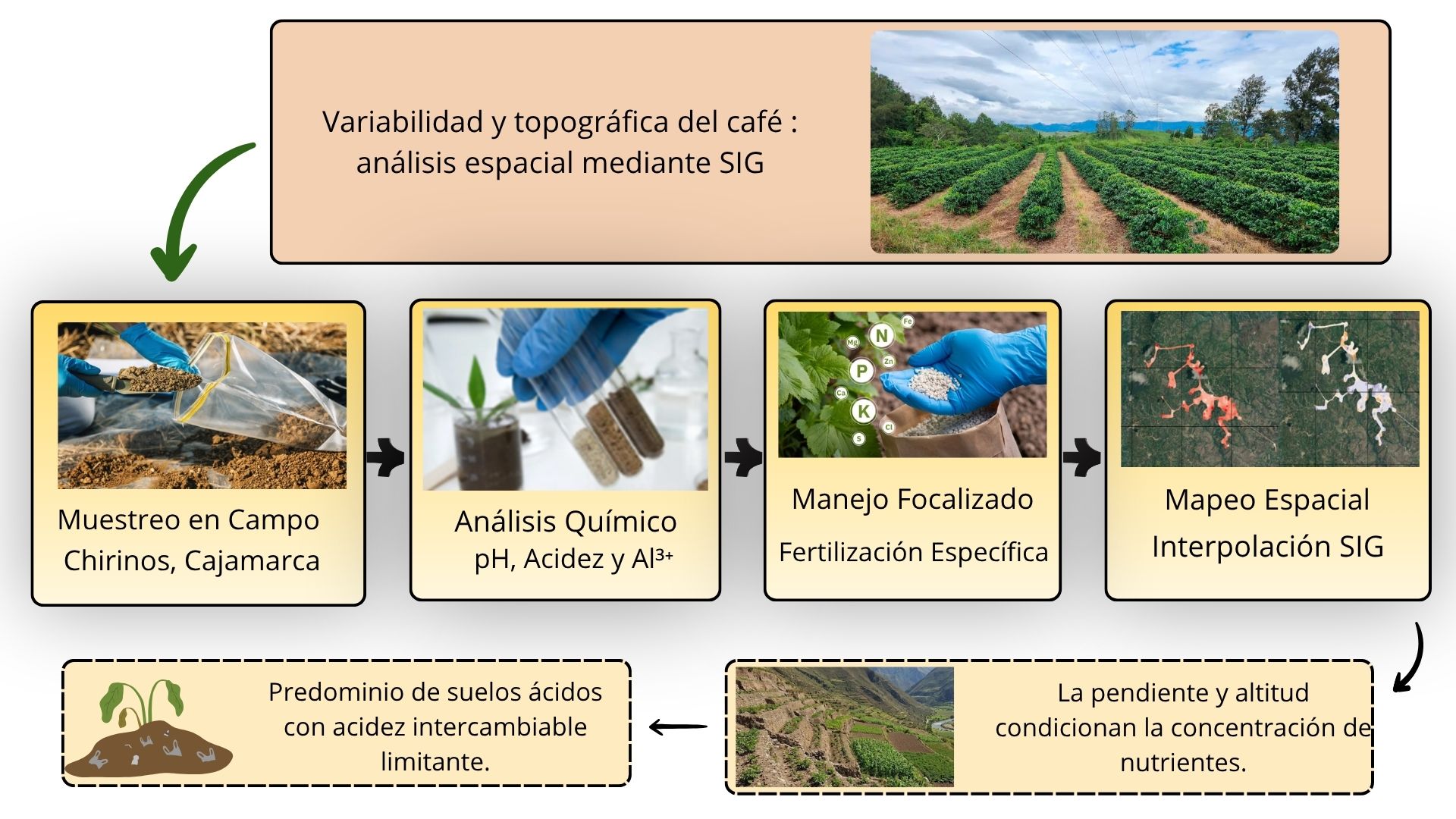
Variabilidad edáfica y topográfica del café orgánico en Chirinos, Cajamarca: análisis espacial mediante SIG
DOI:
https://doi.org/10.17268/agroind.sci.2026.03.04Palabras clave:
Sistemas de información geográfica, café, agricultura orgánica, geoestadística, suelos ácidosResumen
Se implementó un sistema de información geográfica para analizar la variabilidad espacial del suelo en cafetales orgánicos de Chirinos, Cajamarca, Perú, a partir de 130 parcelas georreferenciadas de pequeños productores. Se integraron análisis físico-químicos del suelo con variables topográficas derivadas del relieve, con énfasis en materia orgánica, densidad aparente, pH, acidez intercambiable y aluminio cambiable. La metodología combinó estadística descriptiva, ajuste de relaciones funcionales entre variables críticas, comparación de métodos de interpolación e interpolación geoestadística mediante kriging ordinario. Los resultados evidenciaron una marcada heterogeneidad edáfica y topográfica, incompatible con un manejo uniforme por parcela. Se observó una relación inversa entre materia orgánica y densidad aparente (R² = 0,4775), así como una asociación más fuerte entre pendiente y aluminio cambiable (R² = 0,7055). La cartografía generada permitió identificar sectores con mayor riesgo de acidez y otros con mejor condición física del suelo, mostrando el valor del análisis espacial para sustentar decisiones diferenciadas de manejo en cafetales orgánicos de ladera. El estudio aporta una metodología reproducible para el análisis predial del suelo en sistemas cafetaleros andinos.
Referencias
Arévalo-Luna, O. J., Vásquez-Ruiz, J. M., & Chávarry-Rodríguez, J. E. (2020). Land suitability for coffee (Coffea arabica) growing in Amazonas, Peru: Integrated use of AHP, GIS and RS. ISPRS International Journal of Geo-Information, 9(11), 673. https://doi.org/10.3390/ijgi9110673
Bazzi, C. L., Uribe-Opazo, M. A., Liska, G. R., & Rocha, W. D. (2017). Methodology to determine the soil sampling grid for precision agriculture in a coffee field. Revista Brasileira de Ciência do Solo, 41, e0160057. https://doi.org/10.1590/18069657rbcs20160057
Burak, D. L., Passos, R. R., & Vaz Andrade, F. V. (2012). Spatial variability of soil chemical attributes in Conilon coffee plantation: Relationships with soil texture, organic matter and relief. Bragantia, 71(4), 538-547. https://doi.org/10.1590/S0006-87052012000400012
da Silva, A. F., de Souza Lima, J. S., & de Oliveira, R. B. (2010b). Methods of interpolation for estimating the pH in soil under two management systems of Arabica coffee. Idesia, 28(2), 61-66.
da Silva, A. F., de Souza Lima, J. S., de Souza, G. S., & de Oliveira, R. B. (2010a). Spatial variability of soil chemical attributes in arabica coffee (Coffea arabica L.) fields under different management systems. Coffee Science, 5(2), 173-182.
Ferraz, G. A., Ferraz, P. F. P., Martins, F. B. S., da Silva, F. M., Damasceno, F. A., & Barbari, M. (2019). Principal components in the study of soil and plant properties in precision coffee farming. Agronomy Research, 17(2), 418-429. https://doi.org/10.15159/AR.19.114
Figueroa-Saavedra, H. F., Barbaru-Grajales, A. D., Zapata-Mayorga, H. A., Herrera-Ocaña, H. R., & Moya, W. (2024). Physio-edaphoclimatic factors show optimal soil suitability for three tropical crops in the Ecuadorian Amazon. Scientia Agricola, 81, e20220214. https://doi.org/10.1590/1678-992X-2022-0214
Hossain, M. Z., Islam, M. M., Hoque, T. S., & Islam, M. S. (2023). Soil organic matter and its relationship with physical and chemical properties in different land uses. Sustainability, 15(2), 1640. https://doi.org/10.3390/su15021640
Kouadio, A. L., Deo, R. C., Byrareddy, V. M., Adamowski, J. F., Mushtaq, S., & Phuong Nguyen, V. (2018). Artificial intelligence approach for the prediction of Robusta coffee yield using soil fertility properties. Computers and Electronics in Agriculture, 155, 324-338. https://doi.org/10.1016/j.compag.2018.10.014
Lense, G. H. E., Parreiras, T. C., Servidoni, L. E., & Mincato, R. L. (2022). Impacts of reforestation on soil and soil organic carbon losses. Ciencia e Agrotecnologia, 46, e002622. https://doi.org/10.1590/1413-7054202246002622
Li, J., & Heap, A. D. (2011). A review of comparative studies of spatial interpolation methods in environmental sciences: Performance and impact factors. Ecological Informatics, 6(3-4), 228-241. https://doi.org/10.1016/j.ecoinf.2010.12.003
Liu, X., Tan, Y., Dong, J., Wu, J., Wang, X., & Sun, Z. (2025). Assessing habitat selection parameters of Arabica coffee using BWM and BCM methods based on GIS. Scientific Reports, 15(1), 8. https://doi.org/10.1038/s41598-024-84073-0
Mwendwa, S. M., Mbuvi, J. P., Kironchi, G., & Gachene, C. K. K. (2022). Assessing spatial variability of selected soil properties in Upper Kabete Campus coffee farm, University of Nairobi, Kenya. Heliyon, 8(8), e10190. https://doi.org/10.1016/j.heliyon.2022.e10190
Nigussie, W., Al-Najjar, H. A., Zhang, W. C., Yirsaw, E., Nega, W., & Zhang, Z. (2024). Enhancing coffee agroforestry systems suitability using geospatial analysis and Sentinel satellite data in Gedeo Zone, Ethiopia. Sensors, 24(19), 6287. https://doi.org/10.3390/s24196287
Omon, E. A., Abiodun, B. J., & Olaiya, O. B. (2025). A global meta-analysis of soil carbon stock in agroforestry coffee cultivation. Agronomy, 15(2), 480. https://doi.org/10.3390/agronomy15020480
Quispe, K. R., Hermoza, N., Mejía, S., Romero-Chavez, L. E., Ottos, E., Arce, A., & Solórzano Acosta, R. A. (2025). Spatial analysis of soil acidity and available phosphorus in coffee-growing areas of Pichanaqui: Implications for liming and site-specific fertilization. Agriculture (Switzerland), 15(15), 1632. https://doi.org/10.3390/agriculture15151632
Sadeghi, S., Gizachew, B., Yadeta, B., & Tulu, B. (2025). GIS and parametric based coffee site suitability zonation in North Shewa zone of Oromia region, central Ethiopia. Environmental and Sustainability Indicators, 25, 100674. https://doi.org/10.1016/j.indic.2025.100674
Silva, C. D. O. F., Grego, C. R., Manzione, R. L., Oliveira, S. R. D. M., Rodrigues, G. C., & Rodrigues, C. A. G. (2024). Summarizing soil chemical variables into homogeneous management zones – case study in a specialty coffee crop. Smart Agricultural Technology, 7, 100418. https://doi.org/10.1016/j.atech.2024.100418
Wang, S., Liu, Q., Liu, Z., Chen, W., Zhao, X., Zhang, J., Bao, L., & Zhang, N. (2024). Distribution and soil threshold of selenium in the cropland of southwest mountainous areas in China. Scientific Reports, 14, 67450. https://doi.org/10.1038/s41598-024-67450-7
Publicado
Número
Sección
Licencia
Derechos de autor 2026 Delvis Sánchez-Díaz, Henry Jesús Carrillo-Leonardo, Eleazar Manuel Rufasto-Campos, José Wilson Gómez-Cumpa

Esta obra está bajo una licencia internacional Creative Commons Atribución-NoComercial 4.0.
El autor no conserva los derechos de autor ni los derechos de publicación de forma ilimitada. El autor conserva la totalidad de sus derechos morales, en particular el de paternidad y el de integridad del artículo.