
Distribución espacial de Trichogramma spp. en cultivos de la Región Lambayeque, Perú
DOI:
https://doi.org/10.17268/agroind.sci.2026.01.01Palabras clave:
Trichogramma, Control biológico, Lepidópteros, Lambayeque, Parasitismo, AgroecosistemasResumen
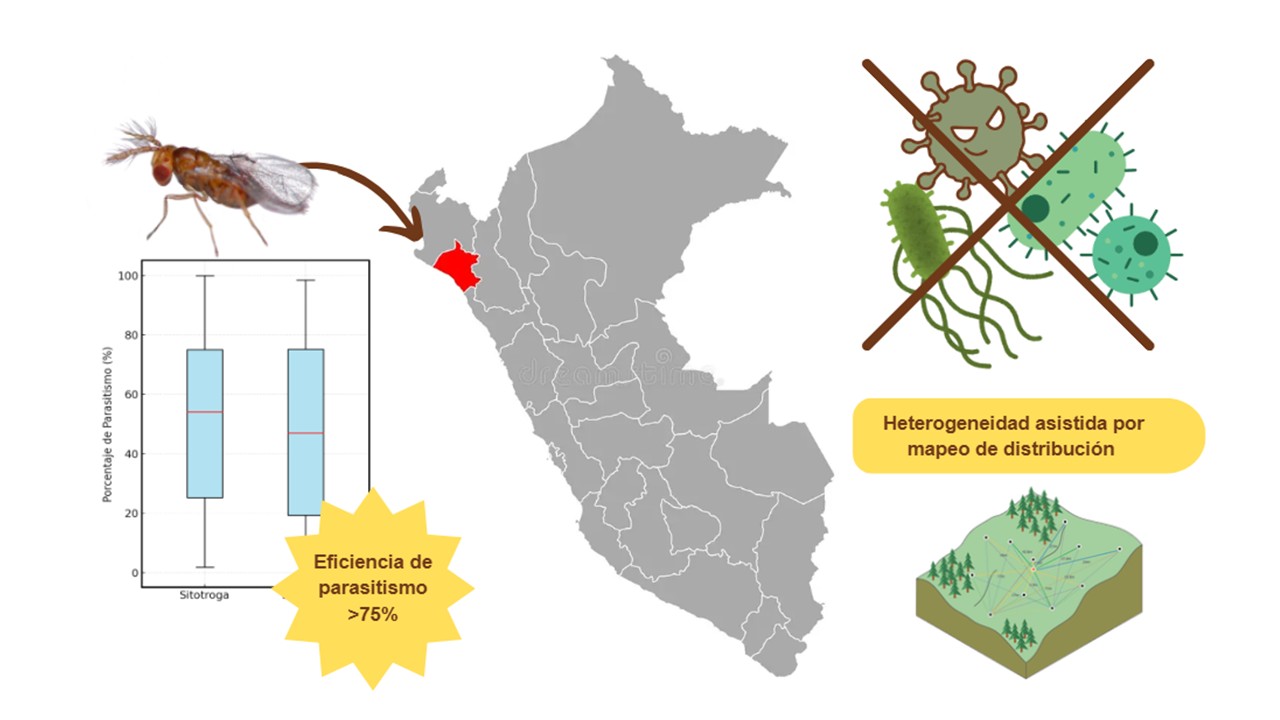
Se investiga la distribución espacial de Trichogramma spp. en la región Lambayeque, Perú, evaluando su potencial como agente de control biológico de plagas lepidópteras en agroecosistemas. Se recolectaron datos entre enero y junio de 2024 en distritos clave como Lambayeque, Ferreñafe y Chiclayo, utilizando trampas centinela con huevos de Sitotroga cerealella. Los resultados revelan una alta eficacia de parasitismo (>75%) en áreas como Lambayeque, Motupe y Salas, mientras que sitios como Cayaltí y Chilcal no registraron actividad parasítica. La distribución observada sugiere la influencia de factores como la densidad de huevos y el microclima. Sin embargo, el análisis se vio limitado por un tamaño de muestra reducido (14 registros válidos), lo que afectó la potencia estadística para comparar especies hospedadoras y ubicaciones. Las pruebas de Kruskal-Wallis no encontraron diferencias significativas (p > 0,05), y los modelos de regresión explicaron solo el 59,7% de la varianza, restringidos por la ausencia de datos ambientales como temperatura y tipo de cultivo. Se empleó la herramienta geoespacial Kriging para mapear la distribución, revelando patrones heterogéneos que establecen una base crucial para futuras investigaciones. El estudio concluye que Trichogramma spp. tiene potencial para el control de plagas en ciertas áreas de Lambayeque, pero recomienda ampliar el muestreo, incluir variables climáticas y realizar identificaciones moleculares de especies. Futuras investigaciones deberían explorar enfoques integrados con hongos entomopatógenos para optimizar las estrategias de liberación dirigida y promover la agricultura sostenible en la región.
Referencias
Abbas, A., Ullah, F., Hafeez, M., Han, X., Dara, M. Z. N., Gul, H., & Zhao, C. R. (2022). Biological Control of Fall Armyworm, Spodoptera frugiperda. Agronomy, 12(11), 2704. https://doi.org/10.3390/agronomy12112704
Abdel Halim, E. M., Ahmed, S. S., El-Mandarawy, M. B. R., & Naroz, M. H. (2025). Impact of gamma irradiation alone or in combination with Trichogramma spp. on the life stages of Sitotroga cerealella (Olivier) (Lepidoptera: Gelechiidae). Egyptian Journal of Biological Pest Control, 35(1). https://doi.org/10.1186/s41938-025-00855-2
Agboyi, L. K., Mensah, S. A., Clottey, V. A., & Kenis, M. (2020). Biological control of lepidopteran pests in African agricultural landscapes: Current status and future perspectives. Biological Control, 141, 104141. https://doi.org/10.1016/j.biocontrol.2019.104141
Araujo, E. S., Poltronieri, A. S., Poitevin, C. G., Mirás-Avalos, J. M., Zawadneak, M. A. C., & Pimentel, I. C. (2020). Compatibility between entomopathogenic fungi and egg parasitoids (Trichogrammatidae): A laboratory study for their combined use to control Duponchelia fovealis. Insects, 11(9), 630. https://doi.org/10.3390/insects11090630
Azevedo, K. E. X., Magalhães, D. M., de Andrade Moral, R., & Bento, J. M. S. (2023). Weathering the hunt: The role of barometric pressure in predator insects’ foraging behaviour. Ecology and Evolution, 13(8). https://doi.org/10.1002/ece3.10416
Bográn, C. E., Heinz, K. M., & Ciomperlik, M. A. (2002). Interspecific competition among insect parasitoids: Field experiments with whiteflies as hosts in cotton. Ecology, 83(3), 653-668. https://doi.org/10.1890/0012-9658(2002)083[0653:ICAIPF]2.0.CO;2
Burte, V., Cointe, M., Perez, G., Mailleret, L., & Calcagno, V. (2023a). When complex movement yields simple dispersal: Behavioural heterogeneity, spatial spread and parasitism in groups of micro-wasps. Movement Ecology, 11(1). https://doi.org/10.1186/s40462-023-00371-8
Burte, V., Perez, G., & Amat, I. (2023b). Spatial ecology of biological control agents: Towards more effective release strategies. Biological Control, 178, 105143. https://doi.org/10.1016/j.biocontrol.2022.105143
Bzowska-Bakalarz, M., Bulak, P., Bereś, P. K., Czarnigowska, A., Czarnigowski, J., Karamon, B., Pniak, M., & Bieganowski, A. (2020). Using gyroplane for application of Trichogramma spp. against the European corn borer in maize. Pest Management Science, 76(6), 2243–2250. https://doi.org/10.1002/ps.5762
Castex, V., García, M., & Rojas, R. (2020). Multivariate analysis of environmental factors affecting parasitoid distribution. Ecological Entomology, 45(3), 567–576. https://doi.org/10.1111/een.12845
Gardner, J., Wright, M. G., Kuhar, T. P., Pitcher, S. A., & Hoffmann, M. P. (2012). Dispersal of Trichogramma ostriniae in field corn. Biocontrol Science and Technology, 22(10), 1221-1233. https://doi.org/10.1080/09583157.2012.723676
He et al. (2025). Mitogenomic characterization and comparative analysis of three egg parasitoid wasps parasitizing nilaparvata lugens (Stål). Insects, 16(5), 054. https://doi.org/10.3390/insects1605054
Hengl, T., & de Jesus, J. M. (2021). Advances in geostatistical modeling for ecological applications: A review of recent developments. Ecological Modelling, 440, 109403. https://doi.org/10.1016/j.ecolmodel.2020.109403
Kot, M., & Lewis, M. A. (1997). Dispersal and spatial ecology of parasitoids: Models and applications. Theoretical Population Biology, 52(2), 101–115. https://doi.org/10.1006/tpbi.1997.1322
Li, H., & Heap, A. D. (2014). A review of spatial interpolation methods for environmental scientists. Geoscience Australia, Record 2008/23, 137 pp.
Li, J., & Heap, A. D. (2014). Spatial interpolation methods applied in the environmental sciences: A review. Environmental Modelling & Software, 53, 103-120. https://doi.org/10.1016/j.envsoft.2013.09.007
Li, J., & Wang, Y. (2022). Spatial interpolation techniques for pest distribution mapping: A case study in agricultural landscapes. International Journal of Applied Earth Observation and Geoinformation, 106, 102669. https://doi.org/10.1016/j.jag.2021.102669
Lopes, P. C., Souza, P. G. C., Santos, J. C. B., Borges, C. E., Araújo, F. H. V., Martins, J. C., Picanço, M. C., Soares, M. A., Veloso, R. V. S., Oliveira, J. R., Rossini, L. C., Siqueira, F. C., & da Silva, R. C. (2024). Spatiotemporal distribution of Schizaphis graminum (Rondani) and its natural enemy Coccinella septempunctata (Linnaeus) in graniferous sorghum crops. Brazilian Journal of Biology, 84. https://doi.org/10.1590/1519-6984.261972
Mahendran, B., Gopi, R., Mahesh, P., Chandran, K., & Nisha, M. (2024). Field Dynamics of Entomopathogenic Fungi Attacking Sugarcane Planthopper, Pyrilla Perpusilla (Lophopidae: Hemiptera) in a Managed Agro-Ecosystem Comprising Sugarcane Germplasm. Sugar Tech, 26(6), 1760-1770. https://doi.org/10.1007/s12355-024-01410-3
Morales, J., Díaz, M., & Fernández, M. (2023). Geospatial analysis of parasitoid distribution in tropical agroecosystems. Journal of Insect Conservation, 27(2), 189–201. https://doi.org/10.1007/s10841-022-00425-3
Nurindah, Sunarto, D. A., & Sujak. (2020). Overview of the use of biocontrol agents in the control of Indonesian sugarcane borers. IOP Conference Series: Earth and Environmental Science, 418(1), 012061. https://doi.org/10.1088/1755-1315/418/1/012061
Parra, J. R. P., & Coelho, A. (2022). Trichogramma: Biology and applications in biological control. Annual Review of Entomology, 67, 451–470. https://doi.org/10.1146/annurev-ento-082021-074231
Santos, M. P. D., Santos Neto, B. D. M., Araújo, L. R., Cardoso, A. C. P., Coelho, B. S., Leite, S. A., Moreira, A. A., Fernandes, D. R. R., Carvalho, G. A., & Castellani, M. A. (2024a). Landscape and insecticide use affecting the Leucoptera coffeella infestation and the natural parasitism spatiotemporal distribution in brazilian coffee agroecosystems. Crop Protection, 185. https://doi.org/10.1016/j.cropro.2024.106908
Santos, M. P. D., Santos Neto, B. D. M., Araújo, L. R., Cardoso, A. C. P., Coelho, B. S., Leite, S. A., Moreira, A. A., Fernandes, D. R. R., Carvalho, G. A., & Castellani, M. A. (2024b). Landscape and insecticide use affecting the Leucoptera coffeella infestation and the natural parasitism spatiotemporal distribution in brazilian coffee agroecosystems. Crop Protection, 185, 106908. https://doi.org/10.1016/j.cropro.2024.106908
SENASA. (2022). Reporte Anual de Plagas Agrícolas en la Región Lambayeque. Servicio Nacional de Sanidad Agraria del Perú.
Smith, S. M., & Tabashnik, B. E. (2023). Enhancing biological control with Trichogramma: Recent insights into spatial dynamics and host-parasitoid interactions. Biological Control, 177, 105112. https://doi.org/10.1016/j.biocontrol.2022.105112
Sivinski, J., Piñero, J., & Aluja, M. (2000). The distributions of parasitoids (Hymenoptera) of Anastrepha fruit flies (Diptera: Tephritidae) along an altitudinal gradient in Veracruz, Mexico. Biological Control, 18(3), 258-269. https://doi.org/10.1006/bcon.2000.0836
Thorbek, P., & Topping, C. J. (2005). The influence of landscape diversity and heterogeneity on spatial dynamics of agrobiont linyphiid spiders: An individual-based model. BioControl, 50(1), 1-33. https://doi.org/10.1007/s10526-004-1114-8
Tyagi, K., & Kumar, V. (2024). Advances in entomological dispersion modeling for integrated pest management. Journal of Economic Entomology, 117(3), 789-801. https://doi.org/10.1093/jee/toad223
Zang, L.-S., Wang, S., Zhang, F., & Desneux, N. (2021). Biological control with Trichogramma in China: History, present status, and perspectives. Annual Review of Entomology, 66, 463–484. https://doi.org/10.1146/annurev-ento-060120-091620
Zhou, J.-C., Liu, Q.-Q., Wang, Q.-R., Ning, S.-F., Che, W.-N., & Dong, H. (2020). Optimal clutch size for quality control of bisexual and Wolbachia-infected thelytokous lines of Trichogramma dendrolimi Matsumura (Hymenoptera: Trichogrammatidae) mass reared on eggs of a substitutive host, Antheraea pernyi Guérin-Méneville (Lepidoptera: Saturniidae). Pest Management Science, 76(8), 2635–2644. https://doi.org/10.1002/ps.5805
Zhu et al. (2025). Comprehensive assessment of the acute lethal, risk level, and sub-lethal effects of four insecticides on Trichogramma ostriniae. PLoS ONE, 20(3), e0325733. https://doi.org/10.1371/journal.pone.0325733
Publicado
Número
Sección
Licencia
Derechos de autor 2026 Eleazar Manuel Rufasto-Campos, José Wilson Gómez-Cumpa, Jorge Luis Saavedra-Díaz, Delvis Sánchez Díaz, Angel Larry Acuña Tullume

Esta obra está bajo una licencia internacional Creative Commons Atribución-NoComercial 4.0.
El autor no conserva los derechos de autor ni los derechos de publicación de forma ilimitada. El autor conserva la totalidad de sus derechos morales, en particular el de paternidad y el de integridad del artículo.