
Application of Mucuna pruriens pellets, organominerals and Trichoderma harzianum agents in coffee seed beds (Coffea arabica)
DOI:
https://doi.org/10.17268/agroind.sci.2026.01.12Keywords:
pellets, Mucuna pruriens, organominerals, nutrients, microbial biomassAbstract
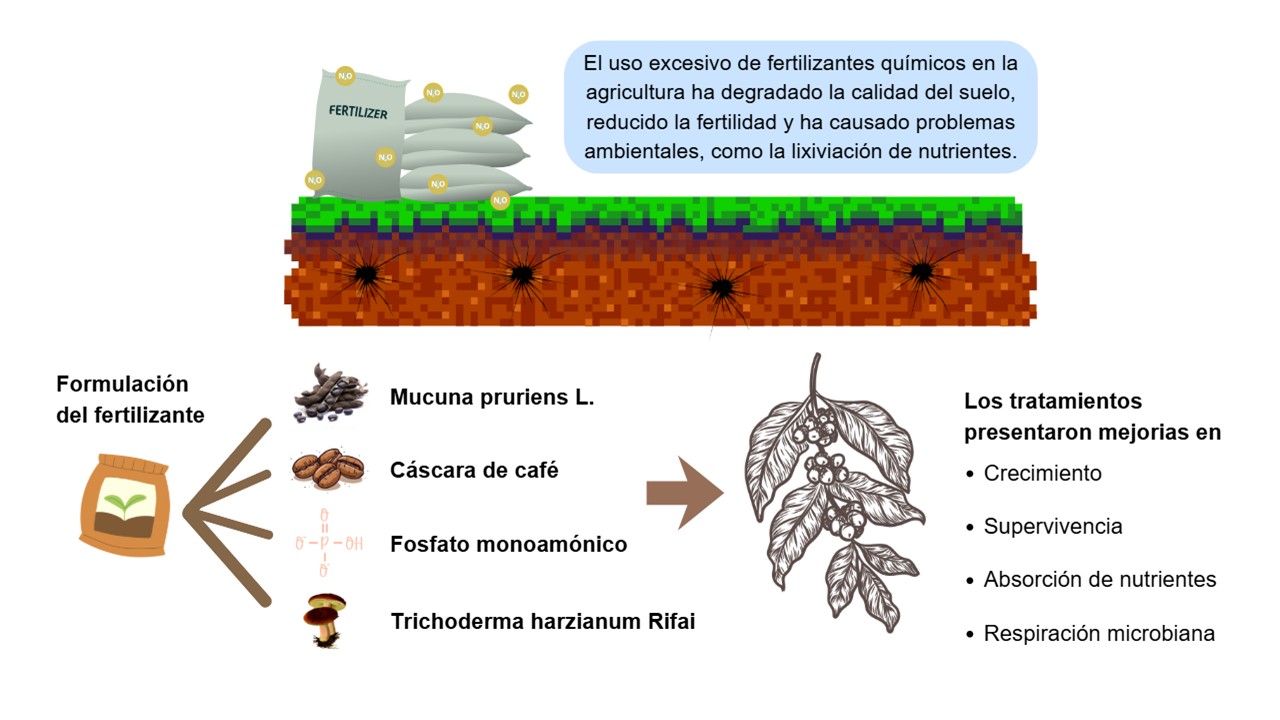
The excessive use of chemical fertilizers in agriculture has degraded soil quality, reduced fertility and caused environmental problems such as nutrient leaching. In response, regenerative practices are being explored to restore soil health and promote sustainable farming. This study evaluated the effects of nutrient-rich pellets made from Mucuna pruriens L., coffee husk-derived organominerals, monoammonium phosphate (MAP), and the biocontrol fungus Trichoderma harzianum Rifai on coffee seedlings (Coffea arabica). Conducted in a greenhouse in Tarrazu, Costa Rica, the experiment used eight treatments with twenty replicates each. The most effective formulation, 60% M. pruriens, 20% organominerals, and 20% MAP, applied at 100 – 150 g per plant, significantly improved seedling growth, nutrient uptake, microbial respiration, and plant survival. This mix also showed favorable chemical properties, including high nitrogen and phosphorus levels, near-neutral pH, and a low carbon-to-nitrogen ratio, enhancing nutrient availability. The addition of T. harzianum contributed to effective root disease control and was compatible with organic matter. Overall, the study highlights these pellets as a sustainable, multifunctional solution for plant nutrition and disease management in coffee nurseries, with potential applications in other crops. Further research is needed to evaluate their economic viability and potential for commercial use.
References
Arias, A., Brenes, P., Sánchez, L., & Peña, W. (2018). Mineralization of Mucuna pruriens and Crotalaria juncea in two soil orders in Costa Rica. Repertorio Científico, 20(2), 91-96. https://doi.org/10.22458/rc.v20i2.2391
Brunner, B., Beaver, J., & Flores, L. (2011). Informative Sheet. Mucuna pruriens. Department of Crops and Agro-Environmental Sciences, Lajas Agricultural Experiment Station, Puerto Rico. Yumpu, 1, 1-5.
Cardoso, R. G. S., Pedrosa, A. W., Rodrigues, M. C., Santos, R. H. S., Martinez, H. E. P., & Cecon, P. R. (2018). Intercropping period between species of green manures and organically-fertilized coffee plantation. Coffee Science, 13, 9-22. https://doi.org/10.25186/cs.v13i1.1332
Carvalho, F. F., Barreto-García, P. A. B., Pérez-Maluf, R., Marques, P. E., Rodriguez, F., Chaves, T., & Nunes, M. (2024). Effects of Coffea arabica cultivation systems on tropical soil microbial biomass and activity in the northeast region of Brazil. Agroforestry Systems, 98, 2397-2410. https://doi.org/10.1007/s10457-024-01026-2
Céspedes, S., Zuñiga, A., Mendoza, A., Peña, W., Montero, K., & Chaves, M. (2020). Evaluation of the incorporation of Mucuna pruriens (L.) DC and Crotalaria spectabilis Roth, on the contribution and absorption of nutrients in rice cultivation (Oryza sativa). Repertorio Científico, 22(1), 29-37. https://doi.org/10.22458/rc.v22i1.2285
Doran, J. W., & Parkin, T. B. (1996). Quantitative indicators of soil quality: A minimum data set. En J. W. Doran & A. J. Jones (Eds.), Methods for assessing soil quality (pp. 25–38). Madison: Soil Science Society of America.
Garro, J. E. (2016). Soil and organic fertilizers (106 pp.). San José, Costa Rica: INTA.
Gatsios, A., Ntatsi, G., Celi, L., Said-Pullicino, D., Tampakaki, A., & Savvas, D. (2021). Legume-based mobile green manure can increase soil nitrogen availability and yield of organic greenhouse tomatoes. Plants, 10(11), 2419. https://doi.org/10.3390/plants10112419
Hammed, T., Oloruntoba, E., & Ana, G. R. E. E. (2019). Enhancing growth and yield of crops with nutrient enriched organic fertilizer at wet and dry seasons in ensuring climate smart agriculture. International Journal of Recycling of Organic Waste in Agriculture, 8(1), 81-92. https://doi.org/10.1007/s40093-019-0274-6
Havlin, J. L., Tisdale, S. L., Nelson, W. L., & Beaton, J. D. (2013). Soil Fertility and Fertilizers: An Introduction to Nutrient Management (516 pp.). New Jersey: Pearson.
Kaniszewski, S., Babik, I., & Babik, J. (2019). New pelleted plant-based fertilizers for sustainable onion production. Universal Journal of Agricultural Research, 7(6), 210-220. https://doi.org/10.13189/ujar.2019.070603
Klassen, W., Codallo, M., Zasada, I., & Abdul, A. (2006). Characterization of velvetbean (Mucuna pruriens) lines for cover crop use. Proceedings of the Florida State Horticultural Society, 119, 258-262.
Liu, Z., Howe, J., Wang, X., Liang, X., & Runge, T. (2019). Use of dry dairy manure pellets as nutrient source for tomato (Solanum lycopersicum L. var. cerasiforme) growth in soilless media. Sustainability, 11(3), 811. https://doi.org/10.3390/su11030811
Martinez, H. E. P., de Andrade, S. A. L., Santos, R. H. S., Baptistella, J. L. C., & Mazzafera, P. (2024). Agronomic practices toward coffee sustainability: A review. Scientia Agricola, 81, 2022-2077. https://doi.org/10.1590/1678-992X-2022-0277
Martínez-Alfaro, A., & Zuñiga-Orozco, A. (2024). Pelletized Mucuna pruriens (L) DC. and Trichoderma harzianum Rifai applied on tomato (Solanum lycopersicum L.) as an amendment and biocontrol agent. Agronomía Mesoamericana, 35, 55389. https://doi.org/10.15517/am.2024.55389
Matos, E. S., Mendonça, E. S., Cardoso, I. M., Lima, P. C., & Freese, D. (2011). Decomposition and nutrient release of leguminous plants in coffee agroforestry systems. Revista Brasileira de Ciência do Solo, 35, 141-149. https://doi.org/10.1590/S0100-06832011000100013
Melendez, G., & Molina, E. (2002). Foliar analysis interpretation table in coffee (52 pp.). San José, Costa Rica: CIA-UCR.
Mendez, J. C., & Bertsch, F. (2012). Guide to the interpretation of soil fertility in Costa Rica (78 pp.). San José, Costa Rica: CIA-UCR.
Niguse, G., Iticha, B., Kebede, G., & Chimdi, A. (2022). Contribution of coffee plants to carbon sequestration in agroforestry systems of southwestern Ethiopia. Journal of Agricultural Science, 160, 440-447. https://doi.org/10.1017/S0021859622000624
Organo, N. D., Granada, S. M. J. M., Pineda, H. G. S., Sandro, J. M., Nguyen, V. H., & Gummert, M. (2022). Assessing the potential of a Trichoderma-based compost activator to hasten the decomposition of incorporated rice straw. Scientific Reports, 12, 448. https://doi.org/10.1038/s41598-021-03828-1
Paolini, J. E. (2018). Actividad microbiológica y biomasa microbiana en suelos cafetaleros de los Andes venezolanos. Terra Latinoamericana, 36(1), 13-22. https://doi.org/10.28940/terra.v36i1.257
Pardo-Plaza, Y. J., Paolini-Gómez, J. E., & Cantero-Guevara, M. E. (2019). Biomasa microbiana y respiración basal del suelo bajo sistemas agroforestales con cultivos de café. Revista U.D.C.A Acta Científica, 22(1), e1144. https://doi.org/10.31910/rudca.v22.n1.2019.1144
Ravi, C., Hadapad, B., Shetty, R., Shrivaprasad, M., Bindu, H., & Prasad, M. (2018). Evaluation of velvet bean (Mucuna pruriens L.) genotypes for growth, yield, L-dopa content and soil nitrogen fixation in rubber plantation under hill zone of Karnataka. Journal of Pharmacognosy and Phytochemistry, 7(3S), 26-29.
Rojas, M., Rodríguez, J., Alcalá, J., Díaz, P., & Carballo, E. (2020). Ensayo en invernadero de abonos verdes sobre las propiedades del suelo, producción de acelga e implicaciones ambientales. Revista Mexicana de Ciencias Agrícolas, 11(4), 945-951. https://doi.org/10.29312/remexca.v11i4.2104
Rojas-Chacón, J. A., Echeverría-Beirute, F., Jiménez, J. P., & Gatica-Arias, A. (2024). Microorganismos de suelo y su relación con la calidad de la bebida de café: Una revisión. Agronomía Mesoamericana, 35(1), 57260. https://doi.org/10.15517/am.2024.57260
Wen, Y., Liu, W., Deng, W., He, X., & Yu, G. (2018). Impact of agricultural fertilization practices on organo-mineral associations in four long-term field experiments: Implications for soil C sequestration. Science of the Total Environment, 651, 591-600. https://doi.org/10.1016/j.scitotenv.2018.09.233
Xu, J., Si, L., Zhang, X., Cao, K., & Wang, J. (2023). Various green manure-fertilizer combinations affect the soil microbial community and function in immature red soil. Frontiers in Microbiology, 14, 1255056. https://doi.org/10.3389/fmicb.2023.1255056
Published
Issue
Section
License
Copyright (c) 2026 Omar Porras Chacón, Jimmy Porras Barrantes, Roberto Naranjo Zuñiga, Andres Zuñiga Orozco

This work is licensed under a Creative Commons Attribution-NonCommercial 4.0 International License.
The author does not retain copyright or publication rights indefinitely. The author retains all moral rights, particularly the right of authorship and the right to the integrity of the article.