
Morphological and multilocus molecular characterization of Neocosmospora solani and Fusarium oxysporum associated with gummosis in Citrus sinensis in Veracruz, Mexico
DOI:
https://doi.org/10.17268/sci.agropecu.2026.032Palabras clave:
Citrus spp, Hongos patógenos, Cancro del tronco, Análisis filogenético, Decoloración vascularResumen
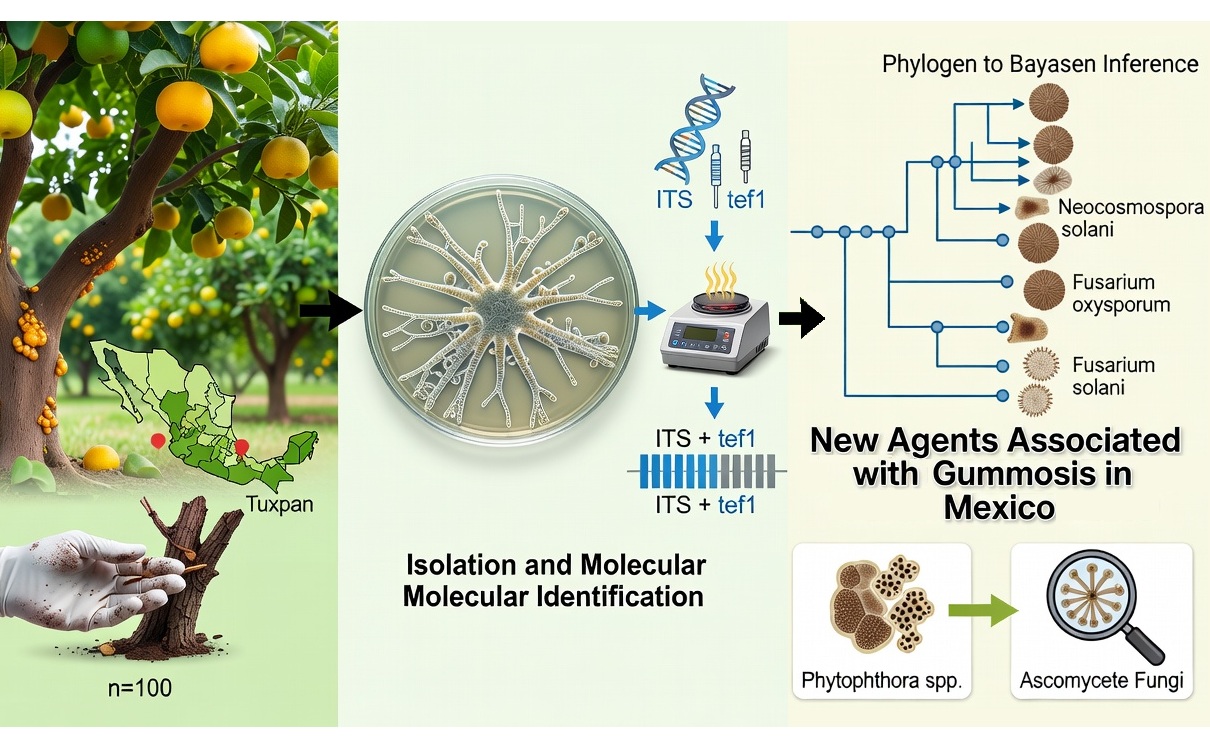
Citrus gummosis is a complex disease primarily associated with Phytophthora spp. in Mexico, particularly P. nicotianae (syn. P. parasitica) and P. citrophthora, which have historically been recognized as the main causal agents in the country’s citrus-growing regions. However, several studies have reported additional fungal pathogens, such as Lasiodiplodia spp., involved in gummosis-like symptoms. The objective of this research was to identify phytopathogenic fungi associated with gummosis symptoms in orange orchards in Tuxpan, Veracruz. A total of 100 bark samples were collected from symptomatic trees across five representative zones of the municipality. Fungal isolation was performed on potato dextrose agar (PDA), yielding 25 isolates, from which five were selected based on morphological characteristics. Molecular identification was conducted through PCR amplification and concatenated sequencing of the internal transcribed spacer (ITS) region and the translation elongation factor 1-α (tef1) gene. The sequences were compared with reference data in the NCBI and Fusarium MLST databases. Phylogenetic analysis using Bayesian inference revealed that the isolates corresponded to Neocosmospora solani (2 isolates), Fusarium oxysporum (2 isolates), and an undescribed Fusarium species (1 isolate). The presence of N. solani and F. oxysporum as dominant species (99% sequence identity) suggests their potential role in the etiology of citrus gummosis. These findings expand the current understanding of citrus gummosis etiology in Mexico and underscore the importance of considering alternative fungal pathogens in diagnostic and management strategies.
Citas
Acosta-Pérez, J. A., Ortiz-García, C. F., Zaldívar-Cruz, J. M., Rodríguez-Cuevas, M., Bautista-Muñoz, C. C., & De la Cruz Castillo-Aguilar, C. (2012). Identificación del agente causal e importancia de la gomosis en la zona citrícola de Huimanguillo, Tabasco, México. Universidad y Ciencia, 28(3), 245-258.
Aloi, F., Riolo, M., Parlascino, R., Pane, A., & Cacciola, S. O. (2021). Bot Gummosis of Lemon (Citrus × limon) Caused by Neofusicoccum parvum. Journal of fungi, 7(4), 294. https://doi.org/10.3390/jof7040294
Barnett, H. L., & Hunter, B. B. (1998). Illustrated Genera of Imperfect Fungi (4th ed.). Burgess Publishing Company.
Dann, E., & McLeod, A. (2021). Phosphonic acid: A long-standing and versatile crop protectant. Pest Management Science, 77(5), 2197–2208. https://doi.org/10.1002/ps.6156
Darriba, D., Taboada, G. L., Doallo, R., & Posada, D. (2012). jModelTest 2: more models, new heuristics and parallel computing. Nat Meth, 9, 772. Go to original source. https://doi.org/10.1038/nmeth.2109
Doyle, J. J., & Doyle, J. L. (1990). Isolation of plant DNA from fresh tissue. Focus, 12, 13–15.
Garzón-Nivia, M.A., Mártiz Mártiz, J., Moya-Elizondo, E. A., Ruiz, B., Cornejo, J. C., &, Valdés-Gómez, H. A. (2025). Characterization and identification of Neocosmospora solani and Fusarium oxysporum causing root necrosis and wilting of orange trees in Chile. Plants, 14, 376. https://doi.org/10.3390/plants14030376
Geiser, D. M., Jiménez-Gasco, M. M., Kang, S., Makalowska, I., Veeraraghavan, N., et al. (2004). FUSARIUM-ID v1.0: A DNA sequence database for identifying Fusarium. European Journal of Plant Pathology, 110(5–6), 473–479. https://doi.org/10.1023/B:EJPP.0000032386.75915.a0
Guillén-Sánchez, D., Gijón-Hernández, A. R., Alía-Tejacal, I., López-Martínez, V., Juárez-López, P., Martínez-Fernández, E., ... & Valle-de la Paz, M. (2019). Species of Lasiodiplodia in lima ‘Persa’ (Citrus latifolia Tanaka) in Morelos, México. Revista Bio ciencias, 6. https://doi.org/10.15741/revbio.06.e595
Hall, T. A. (1999). BioEdit: A user-friendly biological sequence alignment editor and analysis program for Windows 95/98/NT. Nucleic Acids Symposium Series, 41, 95–98.
Hannachi, I., Rezgui, S., & Cherif, M. (2014). First report of mature citrus trees being affected by Fusarium wilt in Tunisia. Plant Disease, 98(4), 566-566.
Hernández-Castillo, C. A., Rivas-Valencia, R., Robles-Yerena, L., Sánchez-Alonso, M. G., & Loeza-Kuk, E. (2024). Control biológico y químico in vitro de hongos asociados a la gomosis en cítricos en Yucatán, México. Revista Mexicana de Fitopatología, 42(4), 38. https://doi.org/10.18781/R.MEX.FIT.2024-03
Kurt, Ş., Uysal, A., Soylu, E. M., Kara, M., & Soylu, S. (2020). Characterization and pathogenicity of Fusarium solani associated with dry root rot of citrus in the eastern Mediterranean region of Turkey. Journal of General Plant Pathology, 86, 326-332.
Leslie, J. F., & Summerell, B. A. (2006). The Fusarium Laboratory Manual. Blackwell Publishing.
Maddison, W. P., & Maddison, D. R. (2025). Mesquite: a modular system for evolutionary analysis. Version 4.01. https://www.mesquiteproject.org
Montealegre, J., Herrera, R., Pérez, C., & Sepúlveda, C. (2003). Identificación de especies de Fusarium patógenas en cultivo de maíz mediante análisis morfológico y genético. Fitopatología, 38(2), 106–112.
Polizzi, G., Aiello, D., Vitale, A., Giuffrida, F., Groenewald, J. Z., & Crous, P. W. (2009). First report of shoot blight, canker, and gummosis caused by Neoscytalidium dimidiatum on citrus in Italy. Plant Disease, 93(11), 1215. https://doi.org/10.1094/PDIS-93-11-1215A
Ramos-Hernández, C., Alvarado-Huallanca, A., & Medina-Moreno, S. (2024). Identificación molecular y caracterización morfológica de Fusarium spp. asociadas a cultivos hortícolas en la región andina del Perú. Scientia Agropecuaria, 15(2), 259–269. https://doi.org/10.17268/sci.agropecu.2024.040
Ronquist, F., & Huelsenbeck, J. P. (2003). MRBAYES 3: Bayesian phylogenetic inference under mixed models. Bioinformatics, 19(12), 1572–1574. https://doi.org/10.1093/bioinformatics/btg180
Sardooei, S., Bolboli, Z., Jafari, M., & Mostowfizadeh-Ghalamfarsa, R. (2026). Fusarium decemcellulare and F. annulatum, two emerging canker pathogens of fig trees and their potential pathogenicity on some fruit trees. Journal of Plant Diseases and Protection, 133(2), 45. https://doi.org/10.1007/s41348-026-01243-0
Silvestro, D., & Michalak, I. (2012). raxmlGUI: a graphical front-end for RAxML. Organisms Diversity & Evolution, 12(4), 335-337. https://doi.org/10.1007/s13127-011-0056-0
Theron, E., van Niekerk, J., & van der Waals, J. (2025). A review of the use of phosphonates in the management of Phytophthora nicotianae in citrus in South Africa. Phytoparasitica, 53(1), 1-26. https://doi.org/10.1007/s12600-024-01234-7
Tran, Q. V., Ha, C. V., Vvedensky, V. V., Le, T. T. L., & Han, V.-C. (2023). Pathogenicity and fungicide sensitivity of Phytophthora parvispora, a new pathogen causing gummosis and root rot disease on citrus trees. Microbial Pathogenesis, 175, 105986. https://doi.org/10.1016/j.micpath.2023.105986
Wang, J., Wang, Y., Wang, Y., Li, Y., Yang, L., Lu, B., ... & Gao, J. (2026). Species and Distribution of Fusarium Causing Ginseng Root Rot and Antifungal Efficacy of Captan and Hymexazol Against Fusarium spp. in China. Plant Disease, 110(2), 404-417. https://doi.org/10.1094/PDIS-03-25-0491-RE
White, T. J., Bruns, T., Lee, S., & Taylor, J. (1990). Amplification and direct sequencing of fungal ribosomal RNA genes for phylogenetics. In M. A. Innis, D. H. Gelfand, J. J. Sninsky, & T. J. White (Eds.), PCR protocols: A guide to methods and applications (pp. 315–322). Academic Press. https://doi.org/10.1016/B978-0-12-372180-8.50042-1
Xiao, X. E., Cheng, M. J., Zheng, F., Ao, Y. J., Deng, J. R., Crous, P. W., Jiao, C., & Li, H. Y. (2025). Species of Fusarium and Neocosmospora associated with citrus branch diseases in China. Persoonia, 55, 477–525. https://doi.org/10.3114/persoonia.2025.55.12
Yaseen, T., & D'Onghia, A. M. (2010). Fusarium spp. associated with citrus dry root rot: An emerging issue for Mediterranean citriculture. Acta Horticulturae, 940, 647–655. https://doi.org/10.17660/ActaHortic.2012.940.94
Zhu, L., Chen, G. Q., Zhao, X. L., Deng, C. L., Hyde, K. D., & Li, H. Y. (2013). Fusarium spp. are responsible for shoot canker of kumquat in China. Journal of Phytopathology, 161(1), 59–62. https://doi.org/10.1111/jph.12019
Zúñiga-Torres, C., Chávez-Guerrero, C., & Montesinos-Molina, J. (2025). Diversidad genética de Fusarium oxysporum en sistemas de producción hortícola de la costa norte peruana. Scientia Agropecuaria, 16(1), 45–54. https://doi.org/10.17268/sci.agropecu.2025.013
Descargas
Publicado
Cómo citar
Número
Sección
Licencia
Derechos de autor 2026 Scientia Agropecuaria

Esta obra está bajo una licencia internacional Creative Commons Atribución-NoComercial 4.0.
Los autores que publican en esta revista aceptan los siguientes términos:
a. Los autores conservan los derechos de autor y conceden a la revista el derecho publicación, simultáneamente licenciada bajo una licencia de Creative Commons que permite a otros compartir el trabajo, pero citando la publicación inicial en esta revista.
b. Los autores pueden celebrar acuerdos contractuales adicionales separados para la distribución no exclusiva de la versión publicada de la obra de la revista (por ejemplo, publicarla en un repositorio institucional o publicarla en un libro), pero citando la publicación inicial en esta revista.
c. Se permite y anima a los autores a publicar su trabajo en línea (por ejemplo, en repositorios institucionales o en su sitio web) antes y durante el proceso de presentación, ya que puede conducir a intercambios productivos, así como una mayor citación del trabajo publicado (ver efecto del acceso abierto).