
Elite Stevia rebaudiana clones for sustainable tropical highland cultivation: Agronomic traits and glycoside profiles
DOI:
https://doi.org/10.17268/sci.agropecu.2026.023Palabras clave:
Stevia rebaudiana , tropical highland, sustainability, genotype evaluation, steviol glycosides, yield stabilityResumen
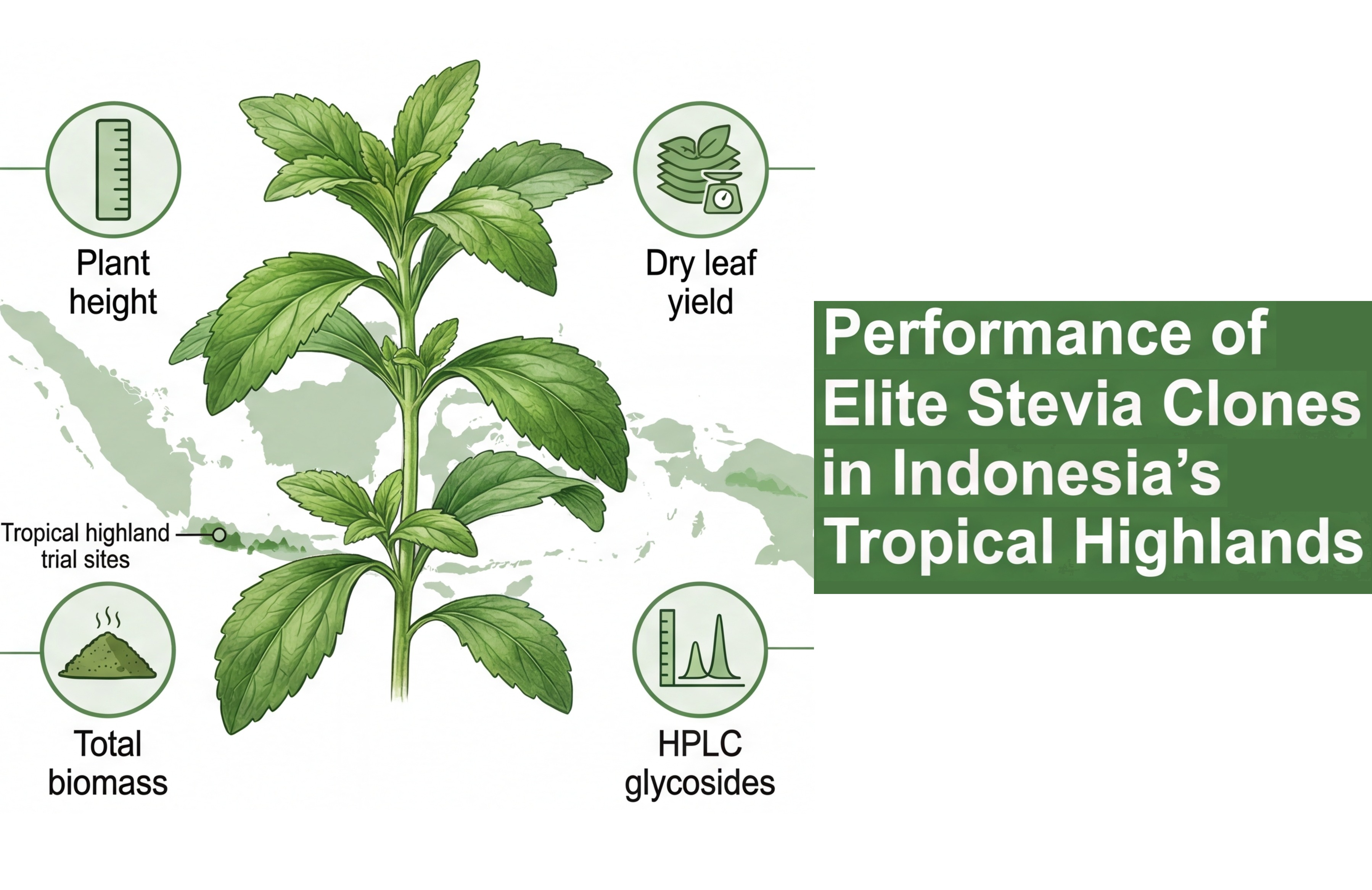
Stevia rebaudiana Bertoni (Bertoni) is a high-value source of non-caloric sweeteners, yet its genotype-specific performance under tropical highland conditions remains insufficiently documented. Eleven elite stevia clones grown in the tropical highlands of Indonesia were evaluated, integrating agronomic performance with the steviol glycoside profile. A random block design with four replicates was implemented across three harvests. Majalengka exhibited the greatest plant height (45.06 cm) and total biomass (21.32 g plant⁻¹), while Karang Anyar and Garut also exceeded 20 g plant⁻¹, indicating robust vegetative growth. Dry leaf yield ranged from 4.98 to 14.00 g plant⁻¹, with Majalengka, Karang Anyar, and TIA-001A among the highest-yielding genotypes. High-performance liquid chromatography (HPLC) identified Garut as the leading clone in total glycoside content (346.78 mg g⁻¹), with the highest concentrations of stevioside (75.91 mg g⁻¹, 7.59%) and rebaudioside A (26.40 mg g⁻¹, 2.64%). However, its Reb A/stevioside ratio (0.35) was lower than that of TIA-006 (0.74), TIA-003 (0.54), and Karang Anyar (0.52), which exhibited more favorable sweetness profiles. TIA-003 combined high glycoside content (286.58 mg g⁻¹, 28.66%) with environmental stability, despite moderate leaf yield. Pujon and TIA-002A showed consistent glycoside profiles suitable for herbal and blended extract applications, while Karang Anyar demonstrated dual potential for leaf yield and sweetener quality. These findings identify Garut, TIA-003, and Karang Anyar as priority genotypes for glycoside extraction and agro-industrial scaling, while Majalengka and TIA-001A offer biomass advantages for whole-plant utilization. These findings offer genotype-specific insights to guide breeding programs and facilitate agro-industrial deployment in tropical highland stevia systems.
Citas
Abouelela, M. B., Eid, M., Ali, F. M., et al. (2025). Optimizing a rapid tissue culture method for steviol glycoside production from Stevia rebaudiana to address Egypt’s sugar deficit. Sci Rep, 15, 25495. https://doi.org/10.1038/s41598-025-10491-3
Adabiyah, R., Ratnadewi, D., & Ermayanti, T. M. (2019). Growth evaluation of Stevia rebaudiana Bert. tetraploid in vitro and in the field for stevioside and Reb-A production. J. Biol. Indones, 15(2), 153–165.
Ahmadirad, S., Tavakoli, A., Mokhtassi-Bidgoli, A. et al. (2024). Optimizing Biomass and Steviol Glycoside Yield in Hydroponically Grown Stevia (Stevia rebaudiana Bertoni) with Ammonium Nitrate and 6-Benzylaminopurine Concentrations. Sugar Tech, 26, 595–607. https://doi.org/10.1007/s12355-024-01365-5
Alves, N. B., Balestre, M., Pennacchi, J. P., Fernandes, M. C. N., Castro, D. G., & Botelho, F. B. S. (2020). Genetic progress of upland rice (Oryza sativa L.) lines for disease resistance. Plant Breed., 139(5), 853–861. https://doi.org/10.1111/pbr.12829
Amarakoon, S. (2021). Stevia rebaudiana–A review on agricultural, chemical and industrial applications. J. Nat. Appl. Res., 1(1), 14–27.
Amien, S., Maulana, H., Ruswandi, D., & Nurjanah, S. (2021). Genetic gain and relationship of yield and yield attributes of mutant and cross-bred stevia (Stevia rebaudiana) genotypes. Biodiversitas, 22(8), 3119–3126. https://doi.org/10.13057/biodiv/d220805
Amien, S., Maulana, H., Ruswandi, D., & Nurjanah, S. (2022). Stevia (Stevia rebaudiana B.) genotypes assessment for leaf yield stability through genotype by environment interactions, AMMI, and GGE biplot analyses. SABRAO J. Breed. Genet., 54(4), 1001–1010.
Andrade, M. I., Naico, A., Ricardo, J., Eyzaguirre, R., Makunde, G. S., Ortiz, R., & Grüneberg, W. J. (2016). Genotype × environment interaction and selection for drought adaptation in sweet potato (Ipomoea batatas L.) in Mozambique. Euphytica, 209, 261–280. https://doi.org/10.1007/s10681-016-1684-4
Arumugam, B., Subramaniam, A., & Alagaraj, P. (2020). Stevia rebaudiana as a natural sweetener: a review. Cardiovasc. Hematol. Agents Med. Chem, 18(2), 94–103.
Benhmimou, A., Ibriz, M., Faiz, C. A., Gaboun, F., Douaik, A., Amchra, F. Z., & Khiraoui, A. (2017). Effects of planting density and harvesting time on productivity of natural sweetener plant (Stevia rebaudiana Bertoni) in Larache Region, Morocco. Int. J. Plant Res, 7(4), 83–89.
Bhasker, R., Prasad, S. V., & Sherlin, D. M. (2015). Pharmacological properties of Stevia rebaudiana Bertoni. J. Med. Plant Res., 9(3), 89–96.
Bundgaard Anker, C. C., Rafiq, S., & Jeppesen, P. B. (2019). Effect of steviol glycosides on human health with emphasis on type 2 diabetic biomarkers: A systematic review and meta-analysis of randomized controlled trials. Nutrients, 11(9), 1965.
Burgess, A. J., Retkute, R., Herman, T., & Murchie, E. H. (2017). Exploring relationships between canopy architecture, light distribution, and photosynthesis in contrasting rice genotypes using 3D canopy reconstruction. Front. Plant Sci., 8, 1316.
Castro, F. C. D., Faleiro, F. G., Amabile, R. F., Oliveira, J. D. S., Melo, J. V. P., & Santos, M. A. (2025). Selection and genetic characterization of Stevia genotypes based on the rebaudioside A and total steviol glycosides for Brazilian Savanna. Int. J. Agron., 2025(1), 6630489.
Chou, C.-T., Christabel, V., Le, M. A., Tsai, M.-L., & Wang, S.-T. (2025). Effects of Light Conditions on the Leaf Growth and Steviol Glycoside Yields of Hydroponically Cultivated Stevia Across Growth Stages. Horticulturae, 11(3), 316. https://doi.org/10.3390/horticulturae11030316
Cho, J., Park, H.-J., Yun, C.-I., & Kim, Y.-J. (2025). Validation and determination of steviol glycosides in processed food products. Food Sci. Biotechnol., 34(4), 1123–1135.
Duan, M., Zhang, X., Wei, Z., Zhang, B., & Liu, Y. (2024). Effect of maize canopy structure on light interception and radiation use efficiency at different canopy layers. Agronomy, 14(7), 1511. https://doi.org/10.3390/agronomy14071511
Gardana, C., Scaglianti, M., & Simonetti, P. (2010). Evaluation of steviol and its glycosides in Stevia rebaudiana leaves and commercial sweetener by ultra-high-performance liquid chromatography–mass spectrometry. J. Chromatogr. A, 1217(9), 1463–1470.
Hashem, M. M., Ashry, H. A., ElShahed, E. S. et al. (2024). Differential expression of steviol glycoside pathway genes in NaCl-treated stevia genotypes with varied SG contents. Discov. Plants, 1, 42. https://doi.org/10.1007/s44372-024-00045-8
Heliyanto, B., Djumali, Abdurrakhman, Syakir, M., Sugiyarta, E., & Cholid, M. (2020). Development of high yielding sugarcane varieties for rainfed areas: yield multilocation trial of promising sugarcane clones. IOP Conf. Ser.: Earth Environ. Sci, 1302, 012005. https://doi.org/10.1088/1755-1315/1302/1/012005
Heliyanto, B., Murianingrum, M., Hartati, S., Hapsari, B. W., Purwati, R. D., Suhara, C., & Amien, S. M. (2024). Observation on local high-yielding stevia (Stevia rebaudiana Bertoni L.) clone specific to Bandung District, West Java. IOP Conf. Ser.: Earth Environ. Sci., 1302, 012065. https://doi.org/10.1088/1755-1315/1302/1/012005
Huber, B. M., & Wehner, T. C. (2023). Heritability and genetic variance estimates for agronomic traits and glycoside yield in four elite stevia breeding populations. Crop Sci., 63(3), 1234–1245. https://doi.org/10.1002/csc2.20940
Joshi, J., Gautam, S., & Gautam, A. (2024). Optimization of parameters for extraction and isolation of steviol glycosides (SGs) from Stevia rebaudiana leaves using water. Indian Journal of Environmental Protection, 44(14), 1268–1276.
Li, R., Xu, C., Wu, Z., Xu, Y., Sun, S., Song, W., & Wu, C. (2025). Optimizing canopy-spacing configuration increases soybean yield under high planting density. Crop J., 13(1), 233–245. https://doi.org/10.1016/j.cj.2024.12.005
Libik-Konieczny, M., Capecka, E., Kąkol, E., Dziurka, M., Grabowska-Joachimiak, A., Sliwinska, E., & Pistelli, L. (2018). Growth, development and steviol glycosides content in relation to photosynthetic activity of several Stevia rebaudiana Bertoni strains cultivated under temperate climate conditions. Sci. Hortic., 234, 10–18. https://doi.org/10.1016/j.scienta.2018.02.015
Martini, R. E., Tavares, M. C. H., & Silva, J. A. G. (2015). Vegetative propagation of Stevia rebaudiana Bertoni using stem cuttings. Rev. Bras. Plantas Med., 17(2), 295–301.
Martono, Y., Riyanto, S., Rohman, A., & Martono, S. (2016). Improvement method of fast and isocratic RP-HPLC analysis of major diterpene glycoside from Stevia rebaudiana leaves. AIP Conf. Proc., 1755, 080001.
Myint, K. Z., Chen, J., Zhou, Z., Xia, Y., Lin, J., & Zhang, J. (2020). Structural dependence of antidiabetic effect of steviol glycosides and their metabolites on streptozotocin-induced diabetic mice. J. Sci. Food Agric., 100(10), 3841–3849. https://doi.org/10.1002/jsfa.10421
Pal, P. K., Kumar, R., Guleria, V., Mahajan, M., Prasad, R., Pathania, V., & Ahuja, P. S. (2015). Crop ecology and nutritional variability influence growth and secondary metabolites of Stevia rebaudiana Bertoni. BMC Plant Biology, 15, 1–16. https://doi.org/10.1186/s12870-015-0457-x
Parris, C. A., Shock, C. C., & Qian, M. (2016). Dry leaf and steviol glycoside productivity of Stevia rebaudiana in the Western United States. HortScience, 51(10), 1220–1227. https://doi.org/10.21273/hortsci11149-16
Ribeiro, M. M., Diamantino, T., Domingues, J., Montanari, Í., Alves, M. N., & Gonçalves, J. C. (2021). Stevia rebaudiana germplasm characterization using microsatellite markers and steviol glycosides quantification by HPLC. Mol. Biol. Rep., 48(3), 2573–2582. https://doi.org/10.1007/s11033-021-06308-x
Sowmya, H. H., Kamatar, M. Y., Shanthakumar, G., Brunda, S. M., Shadakshari, T. V., Showkath Babu, B. M., & Rajput, S. S. (2018). Stability analysis of maize hybrids using Eberhart and Russell model. Int. J. Curr. Microbiol. Appl. Sci., 7(7), 963–970.
Sinta, M. M., & Sumaryono. (2019). Growth, biomass production and steviol glycoside content of five stevia clones in Bogor, Indonesia. J. Agron. Indones., 47(1), 105–110.
Tao, R., & Cho, S. (2020). Consumer-based sensory characterization of steviol glycosides (Rebaudioside A, D, and M). Foods, 9(8), 1026. https://doi.org/10.3390/foods9081026
Tian, X., Zhong, F., & Xia, Y. (2022). Dynamic characteristics of sweetness and bitterness and their correlation with chemical structures for six steviol glycosides. Food Res. Int., 151, 110848. https://doi.org/10.1016/j.foodres.2021.110848
Uçar, E., Turgut, K., Özyiğit, Y., Özek, T., & Özek, G. (2018). The effect of different nitrogen levels on yield and quality of stevia (Stevia rebaudiana Bertoni). J. Plant Nutr., 41(9), 1130–1137. https://doi.org/10.1080/01904167.2018.1431673
Xu, X., Wei, Q., Guo, J., Zhang, J., Yang, Y., Wang, L., & Dong, C. (2024). Identification of geographic, climatic, and soil factors dominating Stevia rebaudiana yield and quality. Ind. Crops Prod., 214, 118556.
Zaman, M. M. (2015). Growth parameters and leaf biomass yield of stevia (Stevia rebaudiana Bertoni) as influenced by different soil types of Bangladesh. J. Bangladesh Agric. Univ., 13(1), 25–31. https://doi.org/10.22004/ag.econ.211173
Zhou, X., Gong, M., Lv, X., Liu, Y., Li, J., Du, G., Liu, L. (2021) Metabolic engineering for the synthesis of steviol glycosides: current status and future prospects. Appl Microbiol Biotechnol, 105(13), 5367-5381.
Descargas
Publicado
Cómo citar
Número
Sección
Licencia
Derechos de autor 2026 Scientia Agropecuaria

Esta obra está bajo una licencia internacional Creative Commons Atribución-NoComercial 4.0.
Los autores que publican en esta revista aceptan los siguientes términos:
a. Los autores conservan los derechos de autor y conceden a la revista el derecho publicación, simultáneamente licenciada bajo una licencia de Creative Commons que permite a otros compartir el trabajo, pero citando la publicación inicial en esta revista.
b. Los autores pueden celebrar acuerdos contractuales adicionales separados para la distribución no exclusiva de la versión publicada de la obra de la revista (por ejemplo, publicarla en un repositorio institucional o publicarla en un libro), pero citando la publicación inicial en esta revista.
c. Se permite y anima a los autores a publicar su trabajo en línea (por ejemplo, en repositorios institucionales o en su sitio web) antes y durante el proceso de presentación, ya que puede conducir a intercambios productivos, así como una mayor citación del trabajo publicado (ver efecto del acceso abierto).