
Remote sensing of rice yield using UAV-derived SAVI and supervised machine learning models in Tropical Lowlands
DOI:
https://doi.org/10.17268/sci.agropecu.2026.034Keywords:
precision agriculture, UAV multispectral imagery, rice yield estimation, SAVI index, supervised classification, logistic regression, support vector machinesAbstract
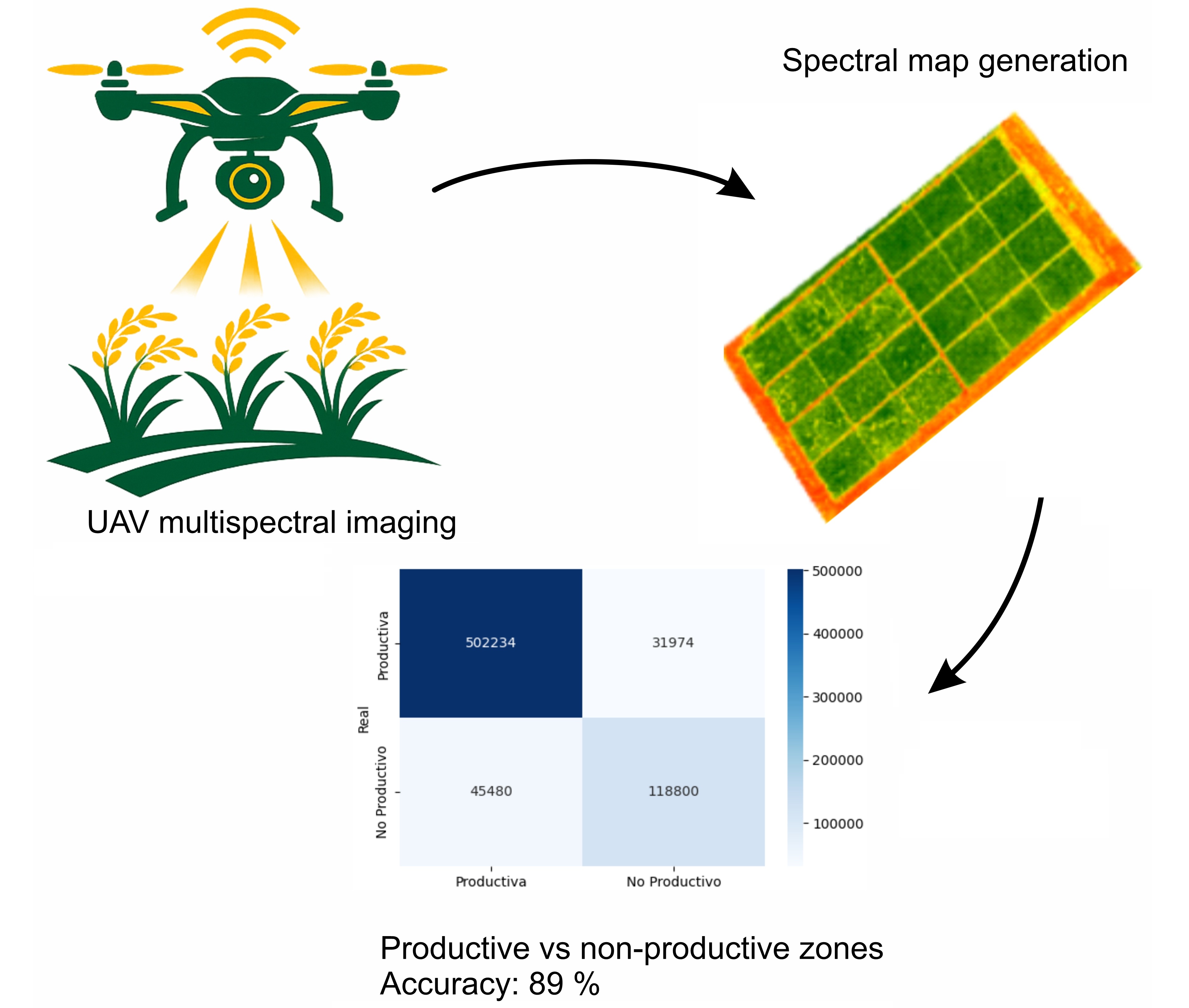
Accurate estimation of rice productivity at the sub-field level is still a major challenge in tropical agroecosystems, mainly because of the high spatial variability and the limits of traditional monitoring methods. This study looked at how well the soil-adjusted vegetation index (SAVI), pulled from multispectral images taken by UAVs, could separate productive and non-productive zones in rice fields under tropical lowland conditions in San Martín, Peru. We used a randomized complete block design across two locations with three rice varieties and captured multispectral images at key phenological stages using UAV platforms. Field yield came from georeferenced destructive sampling—we adjusted grain weight to standard moisture and expressed everything in t ha⁻¹. Based on those actual measurements, we set threshold criteria to classify zones as either productive or non-productive. SAVI values were then extracted and fed into supervised classification models: logistic regression, support vector machine (SVM), k-nearest neighbors (KNN), random forest, and decision tree. The results showed that SAVI values between 0.50 and 0.70, typically lined up with productive zones, while 0.30 to 0.50 corresponded to non-productive areas. Logistic regression and SVM came out on top with overall accuracy around 88.9%, F1-scores above 92%, and pretty balanced sensitivity and specificity. These findings suggest that combining SAVI with supervised machine learning offers a solid, practical way to map rice productivity spatially. The approach looks promising for supporting intra-field monitoring and helping make better agronomic decisions in tropical rice systems.
References
Aman, M., Abdul Sattar, M., Mansoor, J., Ziqi, H., Fuzhong, L., Sanaullah, J., & Syed Aziz, S. (2026). A review of remote sensing-based crop yield estimation: machine learning techniques and environmental, algorithmic, and hardware limitations. Frontiers, 17. https://doi.org/10.3389/fpls.2026.1742689
Avtar, R., Suab, S. A., Syukur, M. S., Korom, A., Umarhadi, D. A., & Yunus, A. P. (2020). Assessing the influence of UAV altitude on extracted biophysical parameters of young oil palm. Remote Sensing, 12(18), 3030. https://doi.org/10.3390/RS12183030
Barjaktarovic, M., Santoni, M., & Bruzzone, L. (2024). Design and Verification of a Low-Cost Multispectral Camera for Precision Agriculture Application. IEEE Journal of Selected Topics in Applied Earth Observations and Remote Sensing, 17, 6945-6957. https://doi.org/10.1109/JSTARS.2024.3377104
Bellis, E. S., Hashem, A. A., Causey, J. L., Runkle, B. R. K., Moreno-García, B., Burns, B. W., Green, V. S., Burcham, T. N., Reba, M. L., & Huang, X. (2022). Detecting Intra-Field Variation in Rice Yield With Unmanned Aerial Vehicle Imagery and Deep Learning. Frontiers in Plant Science, 13. https://doi.org/10.3389/fpls.2022.716506
Castilho Silva, D., Madari, B. E., Santana Carvalho, M. da C., Costa, J. V. S., & Ferreira, M. E. (2025). Planning and optimization of nitrogen fertilization in corn based on multispectral images and leaf nitrogen content using unmanned aerial vehicle (UAV). Precision Agriculture, 26, 30. https://doi.org/10.1007/s11119-025-10221-9
Fukagawa, N. K., & Ziska, L. H. (2019). Rice: importance for global nutrition. Journal of Nutritional Science and Vitaminology, 65, S2-S3. https://doi.org/10.3177/jnsv.65.S2
Gade, S. A., Madolli, M. J., García‐Caparrós, P., Ullah, H., Cha-um, S., Datta, A., & Himanshu, S. K. (2025). Advancements in UAV remote sensing for agricultural yield estimation: A systematic comprehensive review of platforms, sensors, and data analytics. In Remote Sensing Applications: Society and Environment, 37, 101418. https://doi.org/10.1016/j.rsase.2024.101418
Haseeb, M., Tahir, Z., Mahmood, S. A., & Tariq, A. (2025). Winter wheat yield prediction using linear and nonlinear machine learning algorithms based on climatological and remote sensing data. Information Processing in Agriculture, 12(4), 431-444 https://doi.org/10.1016/j.inpa.2025.02.004
INIA. (2010). Arroz INIA 509 “La Esperanza.”
Jhajharia, K., Sharma, N. V., & Mathur, P. (2025). A Machine Learning Model for Crop Yield Prediction Using Remote Sensing Data. International Research Journal of Multidisciplinary Scope, 6(2), 577-590 https://doi.org/10.47857/irjms.2025.v06i02.03182
Liang, Z., Fu, Z., Kiplagat, D., Wang, W., Yang, J., Li, Z., Cao, Q., Tian, Y., Zhu, Y., Cao, W., & Liu, X. (2025). Rice yield prediction base on UAV multispectral imagery using machine learning methods. Smart Agricultural Technology, 12, 101549. https://doi.org/10.1016/j.atech.2025.101549
Luo, S., Jiang, X., Jiao, W., Yang, K., Li, Y., & Fang, S. (2022). Remotely Sensed Prediction of Rice Yield at Different Growth Durations Using UAV Multispectral Imagery. Agriculture, 12(9), 1447. https://doi.org/10.3390/agriculture12091447
Mena, F., Pathak, D., Najjar, H., Sanchez, C., Helber, P., Bischke, B., Habelitz, P., Miranda, M., Siddamsetty, J., Nuske, M., Charfuelan, M., Arenas, D., Vollmer, M., & Dengel, A. (2025). Adaptive fusion of multi-modal remote sensing data for optimal sub-field crop yield prediction. Remote Sensing of Environment, 318, 114547. https://doi.org/10.1016/j.rse.2024.114547
Miftahushudur, T., Sahin, H. M., Grieve, B., & Yin, H. (2025). A Survey of Methods for Addressing Imbalance Data Problems in Agriculture Applications. Remote Sensing, 17(3), 454. https://doi.org/10.3390/rs17030454
MINAGRI. (2025). Observatorio de Commodities : Arroz. Ministerio de Agricultura y Riego.
Neupane, K., & Baysal-Gurel, F. (2021). Automatic identification and monitoring of plant diseases using unmanned aerial vehicles: A review. Remote Sensing, 13(19), 3841. https://doi.org/10.3390/rs13193841
Peticilă, A., Iliescu, P. G., Dinca, L., Popa, A. S., & Murariu, G. (2025). Vegetation indices from UAV imagery: Emerging tools for precision agriculture and forest management. AgriEngineering, 7(12), 43. 1https://doi.org/10.3390/agriengineering7120431
Quille, J., Ramos, L., Huanuqueño, J., Quispe, D., Cruz, L., Pino, E., Flores, L., Heros, E., & Ángel, L. (2025). Rice Yield Prediction Using Spectral and Textural Indices Derived from UAV Imagery and Machine Learning Models in Lambayeque, Peru. Remote Sensing, 17(4), 632. https://doi.org/10.3390/rs17040632
Saha, S., Kucher, O. D., Utkina, A. O., & Rebouh, N. Y. (2025). Precision agriculture for improving crop yield predictions: a literature review. Frontiers in Agronomy, 7, 1566201. https://doi.org/10.3389/fagro.2025.1566201
Senamhi. (2025). Datos Meteorológicos en San Martín. Descarga de Datos Meteorológicos. https://www.senamhi.gob.pe/site/descarga-datos/
Tripathi, R., Gouda, A. K., Jena, S. S., Mohapatra, R. R., Lal, M. K., Dash, S. K., Sahoo, R. N., & Nayak, A. K. (2025). Rice yield prediction using UAV-mounted RGB sensors and machine learning algorithms. Proceedings of the Indian National Science Academy. https://doi.org/10.1007/s43538-025-00479-y
Wan, L., Cen, H., Zhu, J., Zhang, J., Zhu, Y., Sun, D., Du, X., Zhai, L., Weng, H., Li, Y., Li, X., Bao, Y., Shou, J., & He, Y. (2020). Grain yield prediction of rice using multi-temporal UAV-based RGB and multispectral images and model transfer – a case study of small farmlands in the South of China. Agricultural and Forest Meteorology, 291, 108096. https://doi.org/10.1016/j.agrformet.2020.108096
Yang, Q., Shi, L., Han, J., Zha, Y., & Zhu, P. (2019). Deep convolutional neural networks for rice grain yield estimation at the ripening stage using UAV-based remotely sensed images. Field Crops Research, 235, 142-153. https://doi.org/10.1016/j.fcr.2019.02.022
Yu, J., Dong, L., Zeng, W., & Lei, G. (2025). Rice yield predictions from remote sensing inputs in machine learning models. Agronomy Journal, 117(6), e70254. https://doi.org/10.1002/agj2.70254
Zhang, L., Liang, X., Li, X., Zeng, K., Chen, Q., & Zhao, Z. (2025). Machine learning models for yield estimation of hybrid and conventional japonica rice cultivars using UAV imagery. Sustainability, 17(18), 8515. https://doi.org/10.3390/su17188515
Zhang, S., Wang, X., Lin, H., Dong, Y., & Qiang, Z. (2025). A review of the application of UAV multispectral remote sensing technology in precision agriculture. Smart Agricultural Technology, 12, 101406. https://doi.org/10.1016/j.atech.2025.101406
Zhou, H., Huang, F., Lou, W., Gu, Q., Ye, Z., Hu, H., & Zhang, X. (2025). Yield prediction through UAV-based multispectral imaging and deep learning in rice breeding trials. Agricultural Systems, 223, 104214. https://doi.org/10.1016/j.agsy.2024.104214
Zhou, X., Zheng, H. B., Xu, X. Q., He, J. Y., Ge, X. K., Yao, X., Cheng, T., Zhu, Y., Cao, W. X., & Tian, Y. C. (2017). Predicting grain yield in rice using multi-temporal vegetation indices from UAV-based multispectral and digital imagery. ISPRS Journal of Photogrammetry and Remote Sensing, 130, 246-255. https://doi.org/10.1016/j.isprsjprs.2017.05.003
Downloads
Published
How to Cite
Issue
Section
License
Copyright (c) 2026 Scientia Agropecuaria

This work is licensed under a Creative Commons Attribution-NonCommercial 4.0 International License.
The authors who publish in this journal accept the following conditions:
a. The authors retain the copyright and assign to the magazine the right of the first publication, with the work registered with the Creative Commons attribution license, which allows third parties to use the published information whenever they mention the authorship of the work and the First publication in this journal.
b. Authors may make other independent and additional contractual arrangements for non-exclusive distribution of the version of the article published in this journal (eg, include it in an institutional repository or publish it in a book) as long as it clearly indicates that the work Was first published in this journal.
c. Authors are encouraged to publish their work on the Internet (for example, on institutional or personal pages) before and during the review and publication process, as it can lead to productive exchanges and a greater and faster dissemination of work Published (see The Effect of Open Access).