
Residuality of imidacloprid in flowers of soursop (Annona muricata L.), papaya (Carica papaya Linnaeus) and Persian lemon (Citrus X latifolia Tanaka)
DOI:
https://doi.org/10.17268/sci.agropecu.2026.033Keywords:
Tropical fruit trees, neonicotinoids, contamination, pollinators, floweringAbstract
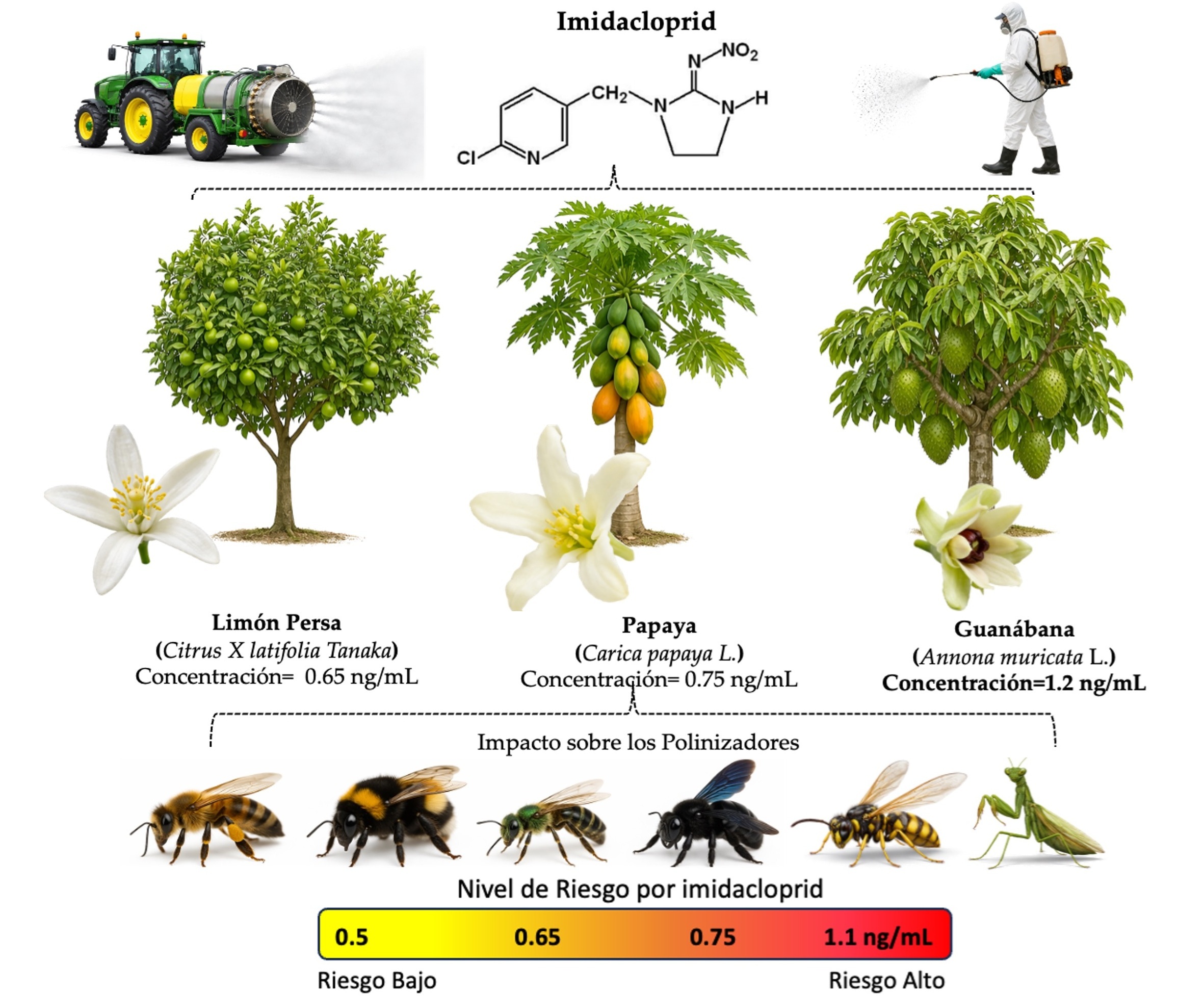
The intensification of agriculture generates environmental pollution and affects the biodiversity of ecosystems. The use of imidacloprid is impacting the main natural pollinators of soursop, papaya, and lime crops. There are no records of the quantification and residual levels of imidacloprid in flowers, which is important for pollinating insects. The objective of this study was to determine the residual levels of imidacloprid in soursop, papaya, and Persian lime flowers in commercial, productive, and backyard orchards in central Veracruz, Mexico. Sampling was carried out in the tropical agroecosystem of central Veracruz, in the municipalities of Cotaxtla, Tlalixcoyan, and Medellín de Bravo; soursop flowers were sampled from backyard orchards, as well as open flowers in papaya and Persian lime orchards. For the determination and quantification of imidacloprid, the ELISA method was used with the imidacloprid detection kit. Concentrations in soursop flowers were 1.2 ng/ml, papaya 0.75 ng/ml, and Persian lime 0.65 ng/ml; high values of 0.85 ng/ml were found in flowers collected from orchards under conventional management. Imidacloprid concentrations in Persian lime, papaya, and soursop flowers pose a potential risk to natural pollinators. Exposure to imidacloprid can lead to mortality in the larvae and adults of species such as wild bees, which are important for crop production.
References
Abdel, M. A., Abd El-H., R. M., & Sayed, S. S. M. (2025). Biological diversity associated with pesticides residues in certain Egyptian watercourses. Archives of Environmental Contamination and Toxicology, 88, 419–436. https://doi.org/10.1007/s00244-025-01129-6
Ahsan, Z., Wu, Z., Lin, Z., Ji, T., & Wang, K. (2025). Efectos subletales de los neonicotinoides en las abejas. Biology, 14(8), 1076. https://doi.org/10.3390/biology14081076
Al Dhafar, Z. M., Abdel, R. M. A. A., Osman, M. A., & Sweelam, M. E. (2024). Efficacy of selected pesticides on citrus brown mite, Eutetranychus orientalis (Acari: Tetranychidae) and the side effects on three predatory mites under citrus orchard conditions. Brazilian Journal of Biology, 84, e282436. https://doi.org/10.1590/1519-6984.282436
Bodescu, D., Fătu, V., Şapcaliu, A., Bădic, E. L., Zaharia, R., Tăpăloagă, D., Robu, A.-D., & Moraru, R.-A. (2025). Análisis comparativo de residuos de pesticidas en productos de colmena de colza (Brassica napus subsp. napus) y girasol (Helianthus annuus) bajo diversas prácticas agrícolas en Rumanía durante las temporadas apícolas 2020-2021. Agriculture, 15(15), 1648. https://doi.org/10.3390/agriculture15151648
Botías, C., & Sánchez, B. F. (2018). Papel de los plaguicidas en la pérdida de los polinizadores. Ecosistemas, 27(2), 34–41. https://doi.org/10.7818/ECOS.1314
Calvo-Agudo, M., González-Cabrera, J., Picó, Y., Urbaneja-Bernat, P., Jacas, J. A., Dolk, M., & Urbaneja, A. (2019). Neonicotinoids in excretion product of phloem-feeding insects kill beneficial insects. Proceedings of the National Academy of Sciences, 116(39), 19656–19661. https://doi.org/10.1073/pnas.1904298116
Chen, J., Zhang, Y., Guo, Y., Jiang, K., Li, D., & Zheng, T. (2025). Interacciones moleculares diferenciales del imidacloprid con materia orgánica disuelta en suelos cítricos con diversas edades de siembra. Agriculture, 15(9), 997. https://doi.org/10.3390/agriculture15090997
Chen, Y.-R., Tzeng, D. T. W., & Yang, E.-C. (2021). Efectos crónicos del imidacloprid en el desarrollo de las abejas obreras: perspectivas de las vías moleculares. International Journal of Molecular Sciences, 22(21), 11835. https://doi.org/10.3390/ijms222111835
Colgan, T. J., Fletcher, I. K., Arce, A. N., Gill, R. J., Ramos, R. A., Stolle, E., Chittka, L., & Wurm, Y. (2019). Caste- and pesticide-specific effects of neonicotinoid pesticide exposure on gene expression in bumblebees. Molecular Ecology, 28(8), 1848–1863. https://doi.org/10.1111/mec.15047
Da Silva Sá, F. V., Torres, S. B., Oliveira, F. d. C. d., Santos, A. S. d., Souza, A. A. T., Pereira, K. T. O., Peixoto, T. D. C., de Andrade Silva, L., Moreira, R. C. L., Paiva, E. P. d., Almeida, H. A. d., Melo, A. S. d., Ferreira Neto, M., Fernández, P. D., & Dias, N. d. S. (2024). Ecofisiología de plántulas de guanábana regadas con efluentes de piscicultura bajo dosis de NPK. Sustainability, 16(11), 4674. https://doi.org/10.3390/su16114674
Environmental Protection Agency. (2026). Code of Federal Regulations (40 CFR 180.472). https://www.ecfr.gov/current/title-40/chapter-I/subchapter-E/part-180/subpart-C/section-180.472
Food and Agriculture Organization of the United Nations. (2022). Pesticide residues in food: Imidacloprid. https://www.fao.org/fao-who-codexalimentarius/codex-texts/dbs/pestres/pesticide-detail/en/?p_id=206
Food and Agriculture Organization of the United Nations. (2023). Pesticide residues in food: Imidacloprid. Recuperado el 24 de octubre de 2024, de https://www.fao.org/fao-who-codexalimentarius/codex-texts/dbs/pestres/pesticide-detail/en/?p_id=206
Food and Agriculture Organization of the United Nations. (2025). Codex pesticide residues database: Commodities. https://www.fao.org/fao-who-codexalimentarius/codex-texts/dbs/pestres/commodities-detail/en/?c_id=135
Fouad, M. R., & Abdel-Raheem, S. A. A. (2024). Panorama general del destino y el comportamiento del imidacloprid en entornos agrícolas. Environmental Science and Pollution Research, 31, 61345–61355. https://doi.org/10.1007/s11356-024-35178-6
Frank, S. D., & Tooker, J. F. (2020). Neonicotinoids pose undocumented threats to food webs. Proceedings of the National Academy of Sciences, 117(38), 23572–23574. https://doi.org/10.1073/pnas.2017221117
Gómez, M. L. D. (2021). Abejas y otros insectos frente al uso indiscriminado de neonicotinoides y fipronil en Colombia. Comentarios a la sentencia del 12 de diciembre de 2019 del Tribunal Administrativo de Cundinamarca. dA. Derecho Animal (Forum of Animal Law Studies), 12(2). https://doi.org/10.5565/rev/da.57
Lázaro, A., & Tur, C. (2018). Los cambios de uso de suelo como responsables del declive de polinizadores. Ecosistemas, 27(2), 23–33. https://doi.org/10.7818/ECOS.1378
Li, K., Fu, M., Lei, B., Shen, X., Zhang, X., Xu, J., & Zhang, X. (2025). Características de los neonicotinoides en el calostro de Shanghái, China (2007-2019): niveles de concentración, tendencias temporales y riesgo potencial para la salud. Toxics, 13(5), 366. https://doi.org/10.3390/toxics13050366
López, D. E., Houbraken, M., Gil, U. Z., Romero, R. O., Du, L. G., & Spanoghe, P. (2020). ELISA, a feasible technique to monitor organophosphate, carbamate, and pyrethroid residues in local vegetables: Cuban case study. SN Applied Sciences, 2, 1487. https://doi.org/10.1007/s42452-020-03303-y
Martelli, F., Zhogyuan, Z., Wang, J., Wong, C., Karagas, N. E., Roessner, U., Rupasinghe, T., Venkatachalam, K., Perry, T., Bellen, H. J., & Batterham, P. (2020). Low doses of the neonicotinoid insecticide imidacloprid induce ROS triggering neurological and metabolic impairments in Drosophila. Proceedings of the National Academy of Sciences, 117(41), 25840–25850. https://doi.org/10.1073/pnas.2011828117
Megchun, G. J. V., Castañeda, C. Ma. del R., Rodríguez, L. D. A., Murguía, G. J., Lango, R. F., & Leyva, O. O. R. (2019). Impact of thiamethoxam in papaya cultivation (Carica papaya Linnaeus) in rotation with watermelon (Citrullus lanatus) crops. Agriculture, 9(6), 129. https://doi.org/10.3390/agriculture9060129
Megchun, G. J. V., Castañeda, C. Ma. del R., Rodríguez, L. D. A., Lango, R. F., & Amaro, E. I. A. (2024). Thiamethoxam residuality in papaya plant and fruit (Carica papaya Linnaeus) cultivated in rotation with watermelon (Citrullus lanatus). Enfoque UTE, 15(3), 18–24. https://doi.org/10.29019/enfoqueute.1037
Megchun, G. J. V., Amaro, E. I. A., Zuñiga, R. P., & Castañeda, C. Ma. del R. (2025). Perception of the use of neonicotinoids, spinosad, and nereistoxin in insects pollinating papaya (Carica papaya Linnaeus), persian lemon (Citrus × latifolia Tanaka), and soursop (Annona muricata L.) in Veracruz, Mexico. Agrociencia, 59(7), 1–12. https://doi.org/10.47163/agrociencia.v59i7.3513
Miñarro, M., García, D., & Martínez-Sastre, R. (2018). Los insectos polinizadores en la agricultura: importancia y gestión de su biodiversidad. Ecosistemas, 27(2), 81–90. https://doi.org/10.7818/ECOS.1394
Naumchik, M., & Youngsteadt, E. (2023). Larger pollen loads increase risk of heat stress in foraging bumblebees. Biology Letters, 19(5), 20220581. https://doi.org/10.1098/rsbl.2022.0581
Nicholson, C. C., Knapp, J., Kiljanek, T., Lüdicke, L., Albrecht, M., Bartomeus, I., & Woodcock, B. A. (2024). Pesticide use negatively affects bumble bees across European landscapes. Nature, 628, 355–358. https://doi.org/10.1038/s41586-023-06773-3
Orús, A. (2024). Principales países productores de limones y limas en el mundo en 2022. Statista. https://es.statista.com/estadisticas/613493/principales-paises-productores-de-limon-en-el-mundo/
Raine, N. E., & Rundlöf, M. (2024). Pesticide exposure and effects on non-Apis bees. Annual Review of Entomology, 69, 551–576. https://doi.org/10.1146/annurev-ento-040323-020625
Rasool, S., Rasool, T., & Gani, K. M. (2022). A review of interactions of pesticides within various interfaces of intrinsic and organic residue amended soil environment. Chemical Engineering Journal Advances, 11, 100301. https://doi.org/10.1016/j.ceja.2022.100301
Somogyvári, D., Mörtl, M., Farkas, A., Székács, A., & Gyori, J. (2025). Respuestas bioquímicas y conductuales en el camarón asesino Dikerogammarus villosus tras la exposición aguda a tiacloprid y Calypso®. Archives of Environmental Contamination and Toxicology, 88, 407–418. https://doi.org/10.1007/s00244-025-01130-z
Uthman, Q. O., Kadyampakeni, D. M., Leiva, J. A., Judy, J. D., & Nkedi-Kizza, P. (2024). Procesos de sorción y degradación de imidacloprid en suelos de Florida. PLoS ONE, 19(9), e0305006. https://doi.org/10.1371/journal.pone.0305006
Voigt, M., Langerbein, V., & Jaeger, M. (2022). Evaluación in silico de la ecotoxicidad de la degradación fotoinducida de imidacloprid mediante HPLC-HRMS, QSAR y equivalentes de ecotoxicidad. Environmental Sciences Europe, 34, 47. https://doi.org/10.1186/s12302-022-00616-0
Zaller, J. G., Kruse-Plass, M., Schlechtriemen, U., Gruber, E., Peer, M., Nadeem, I., Formayer, H., Hutter, H.-P., & Landler, L. (2022). Pesticides in ambient air, influenced by surrounding land use and weather, pose a potential threat to biodiversity and humans. Science of the Total Environment, 838, 156012. https://doi.org/10.1016/j.scitotenv.2022.156012
Zhang, C., Wang, X., Kaur, P., & Gan, J. (2023). A critical review on the accumulation of neonicotinoid insecticides in pollen and nectar: influencing factors and implications for pollinator exposure. Science of the Total Environment, 899, 165670. https://doi.org/10.1016/j.scitotenv.2023.165670
Zhang, S. (2025). Límites máximos de residuos y comercio agrícola: evidencia de China. Sustainability, 17(8), 3435. https://doi.org/10.3390/su17083435
Downloads
Published
How to Cite
Issue
Section
License
Copyright (c) 2026 Scientia Agropecuaria

This work is licensed under a Creative Commons Attribution-NonCommercial 4.0 International License.
The authors who publish in this journal accept the following conditions:
a. The authors retain the copyright and assign to the magazine the right of the first publication, with the work registered with the Creative Commons attribution license, which allows third parties to use the published information whenever they mention the authorship of the work and the First publication in this journal.
b. Authors may make other independent and additional contractual arrangements for non-exclusive distribution of the version of the article published in this journal (eg, include it in an institutional repository or publish it in a book) as long as it clearly indicates that the work Was first published in this journal.
c. Authors are encouraged to publish their work on the Internet (for example, on institutional or personal pages) before and during the review and publication process, as it can lead to productive exchanges and a greater and faster dissemination of work Published (see The Effect of Open Access).