
Biogeography and climate change threats of supersect. Tacsonia (subgenus Passiflora), in Peru
DOI:
https://doi.org/10.17268/sci.agropecu.2026.028Keywords:
commercialization, fruit, ethnobotany, Andes, plant genetic resourceAbstract
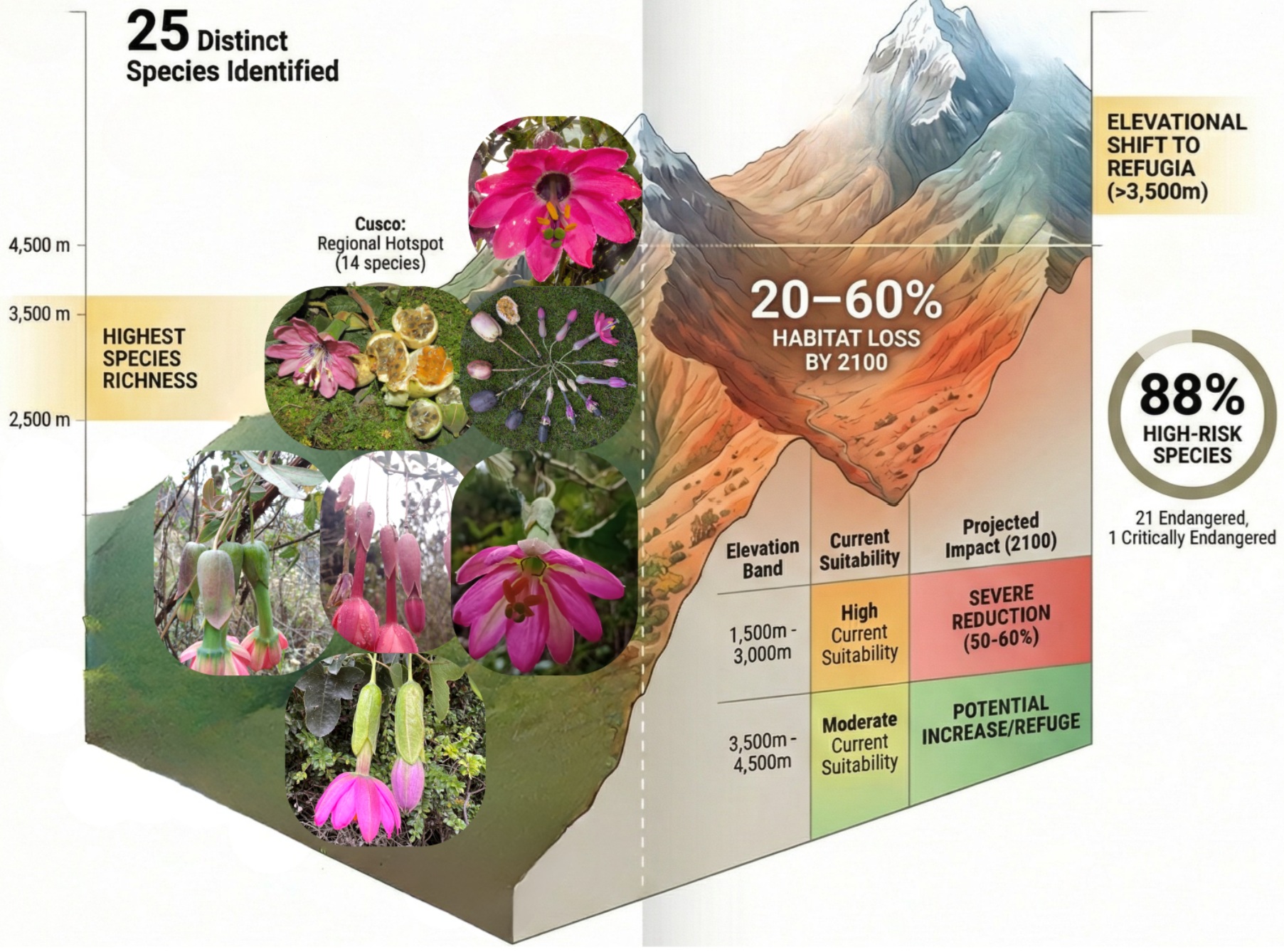
Supersection Tacsonia (Passiflora L.) is a high-Andean lineage whose geographic restriction and environmental specialization make it particularly vulnerable to ongoing climate change. However, broad-scale evidence integrating distribution patterns, endemism, protection coverage, and future habitat stability remains limited for the Peruvian Andes. Here, we assessed the spatial distribution, richness patterns, habitat associations, and climate-driven vulnerability of Tacsonia species in Peru. We compiled 1,758 georeferenced occurrence records for 25 Tacsonia species (including one unidentified taxon) spanning elevations of 1,500–4,500 m and summarized richness across administrative regions, elevation bands, and latitudinal/longitudinal gradients. We also evaluated protection coverage by intersecting records with the national protected-area system and developed ecological niche models to estimate current suitability and potential losses under climate-change scenarios. Most records occurred between 3,000 and 3,500 m, and 23 species were found between 2,500 and 3,000 m. Cusco concentrated the highest number of observations (543) and species richness (14), followed by Cajamarca (226 records; 11 species). Richness peaks were detected around 6°, 7°, and 13°S and 72°, 75°, and 77°W. Thirteen species are endemic to the Peruvian Andes, including five restricted to Cusco, La Libertad, and Amazonas. Tacsonia species occupy multiple Andean ecosystems (Tropical Dry Forest, Páramo, Puna, Yungas, and Andean Dry Forest), with P. tripartita occurring across all habitat types. Occurrences were recorded within several protected areas (Alto Mayo, Pui Pui, Manu, Río Abiseo, Huascarán, Yanachaga-Chemillén, Calipuy, Cotahuasi, Pampa de Ayacucho, Machu Picchu, and Ampay), including endemic taxa such as P. amazonica, P. huamachucoensis, P. parvifolia, P. peduncularis, P. trifoliata, P. trisecta, and P. weigendii. Niche models indicated high current suitability along northern slopes and across the central and southern eastern Andes (AUC = 0.94), but projected climate change could reduce suitable habitat by ~20%–60% by 2100.
References
Abrahamczyk, S., & Kessler, M. (2015). Morphological and behavioural adaptations to feed on nectar: how feeding ecology determines the diversity and composition of hummingbird assemblages. Journal of Ornithology, 156(2), 333-347. https://doi.org/10.1007/s10336-014-1146-5
Abrahamczyk, S., Souto-Vilarós, D., & Renner, S. S. (2014). Escape from extreme specialization: Passionflowers, bats and the sword-billed hummingbird. Proceedings of the Royal Society B: Biological Sciences, 281(1795). https://doi.org/10.1098/rspb.2014.0888
Aliaga, F., Zapata-Cruz, M., & Valverde-Zavaleta, S. A. (2023). Plastid genome of Passiflora tripartita var. mollissima (poro-poro) from Huánuco, Peru. F1000Research, 12. https://doi.org/10.12688/F1000RESEARCH.138150.3
Allen, M. R., Shine, K. P., Fuglestvedt, J. S., et al. (2018). A solution to the misrepresentations of CO2-equivalent emissions of short-lived climate pollutants under ambitious mitigation. Npj Climate and Atmospheric Science, 1(1), 1-8. https://doi.org/10.1038/s41612-018-0026-8
Araújo, M. B., Pearson, R. G., Thuiller, W., & Erhard, M. (2005). Validation of species-climate impact models under climate change. Global Change Biology, 11(9), 1504-1513. https://doi.org/10.1111/J.1365-2486.2005.01000.X
Austin, M. (2007). Species distribution models and ecological theory: A critical assessment and some possible new approaches. Ecological Modelling, 200(1-2), 1-19. https://doi.org/10.1016/J.ECOLMODEL.2006.07.005
Bachman, S., Moat, J., Hill, A. W., de laTorre, J., & Scott, B. (2011). Supporting red list threat assessments with GeoCAT: Geospatial conservation assessment tool. ZooKeys, 150, 117-126. https://doi.org/10.3897/ZOOKEYS.150.2109
Balogun, I., Eluyeba, O., Adedoja, O., Samways, M. J., Polašek, O., & Kehinde, T. (2022). Open habitats in a tropical biodiversity hotspot support pollinator diversity in both protected and unprotected areas. Biotropica, 54(4), 947-957. https://doi.org/10.1111/BTP.13118
Barbet-Massin, M., Jiguet, F., Albert, C. H., & Thuiller, W. (2012). Selecting pseudo-absences for species distribution models: how, where and how many? Methods in Ecology and Evolution, 3(2), 327-338. https://doi.org/10.1111/J.2041-210X.2011.00172.X
Beaumont, L. J., Hughes, L., & Poulsen, M. (2005). Predicting species distributions: use of climatic parameters in BIOCLIM and its impact on predictions of species’ current and future distributions. Ecological Modelling, 186(2), 251-270. https://doi.org/10.1016/J.ECOLMODEL.2005.01.030
Beaumont, L. J., Pitman, A., Perkins, S., Zimmermann, N. E., Yoccoz, N. G., & Thuiller, W. (2011). Impacts of climate change on the world’s most exceptional ecoregions. Proceedings of the National Academy of Sciences of the United States of America, 108(6), 2306-2311. https://doi.org/10.1073/pnas.1007217108
Beraún Chaca, J. J., & Villanueva Fernández, H. S. (2016). Clasificación de las regiones naturales del Perú. Boletín Del Colegion de Geógrafos Del Perú, 166-177.
Berger, J., Abbo, S., & Turner, N. C. (2003). Ecogeography of Annual Wild Cicer Species. Crop Science, 43(3), 1076-1090. https://doi.org/10.2135/CROPSCI2003.1076
Bezerra, A. D. M., Pacheco Filho, A. J. S., Bomfim, I. G. A., Smagghe, G., & Freitas, B. M. (2019a). Agricultural area losses and pollinator mismatch due to climate changes endanger passion fruit production in the Neotropics. Agricultural Systems, 169, 49-57. https://doi.org/10.1016/J.AGSY.2018.12.002
Bezerra, A. D. M., Pacheco Filho, A. J. S., Bomfim, I. G. A., Smagghe, G., & Freitas, B. M. (2019b). Data relating to threats to passion fruit production in the Neotropics due to agricultural area loss and pollinator mismatch as consequence of climate changes. Data in Brief, 23, 103802. https://doi.org/10.1016/J.DIB.2019.103802
Birdernaturalist. (2011). Passiflora lanceolata (iNaturalist observation 196295458) [Photograph]. iNaturalist. https://www.inaturalist.org/observations/196295458
Bonilla, M. M. (2014). Biogeografía y morfología de las Passifloraceae (subg. Tacsonia, Rathea y Manicata) del trópico andino como estrategia de conservación. (Tesis de maestría). Universidad Nacional de Colombia Sede Palmira. Colombia. https://repositorio.unal.edu.co/handle/unal/52979
Brack, A., & Mendiola, C. (2000). Ecología del Perú. Parte II. Las regiones naturales del Perú. Editorial Bruño.
Brako, L., & Zarucchi, J. L. (1993). Catalogue of the flowering plants and gymnosperms of Peru. Catálogo de las angiospermas y gimnospermas del Perú. Monographs in Systematic Botany from the Missouri Botanical Garden, 45, 1-1286.
Britto, B. (2017). Actualización de las Ecorregiones Terrestres de Perú propuestas en el Libro Rojo de Plantas Endémicas del Perú. Gayana. Botánica, 74(1), 15-29. https://doi.org/10.4067/S0717-66432017005000318
Brock, G., Pihur, V., Datta, S., & Datta, S. (2008). clValid: An R Package for Cluster Validation. Journal of Statistical Software, 25(4), 1-22. https://doi.org/10.18637/JSS.V025.I04
Broennimann, O., Thuiller, W., Hughes, G., Midgley, G. F., Alkemade, J. M. R., & Guisan, A. (2006). Do geographic distribution, niche property and life form explain plants’ vulnerability to global change? Global Change Biology, 12(6), 1079-1093. https://doi.org/10.1111/J.1365-2486.2006.01157.X
Buitrago A., M. A., Macdougal, J. M., & Coca, L. F. (2018). Passiflora kumandayi (Passifloraceae), a new species from the colombian andes in a new section within subgenus Decaloba. Phytotaxa, 344(1), 13-23. https://doi.org/10.11646/phytotaxa.344.1.2
Bunn, C., Läderach, P., Jimenez, J. G. P., Montagnon, C., & Schilling, T. (2015). Multiclass Classification of Agro-Ecological Zones for Arabica Coffee: An Improved Understanding of the Impacts of Climate Change. Plos One, 10(10), e0140490. https://doi.org/10.1371/journal.pone.0140490
Busby, J. R., Margules, C. R., & Austin, M. P. (1991). Nature conservation: cost effective biological surveys and data analysis. In BIOCLIM a bioclimatic analysis and prediction system (pp. 64-68). CSIRO Melbourne.
Bystriakova, N., Kapos, V., Lysenko, I., & Stapleton, C. M. A. (2003). Distribution and conservation status of forest bamboo biodiversity in the Asia-Pacific Region. Biodiversity & Conservation 2003 12:9, 12(9), 1833-1841. https://doi.org/10.1023/A:1024139813651
Cabrera, A., & Willink, A. (1973). Biogeografía de América latina (2nd ed.). Secretaría General de la Organización de los Estados Americanos.
Caicedo, M. A. (2021). Diversidad y distribución de la supersección Tacsonia del género Passiflora L. en el Perú (Tesis de pregrado). Universidad Nacional de Trujillo. Perú.
Callaghan, C. T., Mesaglio, T., Ascher, J. S., Brooks, T. M., Cabras, A. A., Chandler, M., Cornwell, W. K., Ríos-Málaver, I. C., Dankowicz, E., Dhiya’Ulhaq, N. U., Fuller, R. A., Galindo-Leal, C., Grattarola, F., Hewitt, S., Higgins, L., Hitchcock, C., Hung, K. L. J., Iwane, T., Kahumbu, P., Young, A. N. (2022). The benefits of contributing to the citizen science platform iNaturalist as an identifier. Plos Biology, 20(11), e3001843. https://doi.org/10.1371/journal.pbio.3001843
Castañeda, R., Gutiérrez, H., Chávez, G., & Villanueva, R. (2019). Ethnobotany of passion flowers (Passiflora) in the Andean province of Angaraes (Huancavelica, Perú). Boletin Latinoamericano y Del Caribe de Plantas Medicinales y Aromaticas, 18(1), 27-41.
Castro-Llanos, F., Hyman, G., Rubiano, J., Ramirez-Villegas, J., & Achicanoy, H. (2019). Climate change favors rice production at higher elevations in Colombia. Mitigation and Adaptation Strategies for Global Change, 24(8), 1401-1430. https://doi.org/10.1007/s11027-019-09852-x
Chañi-Paucar, L. O., Chagua-Rodríguez, P., Cuadrado-Campó, W. J., Lobato Calderón, G. R., Maceda Santivañez, J. C., Figueiredo Angolini, C. F., & Meireles, M. A. A. (2024). Tumbo, an Andean fruit: Uses, nutrition, processing, and biomolecules. Heliyon, 10(9), 30327. https://doi.org/10.1016/j.heliyon.2024.e30327
Chase, M. W., Christenhusz, M. J. M., Fay, M. F., Byng, J. W., Judd, W. S., Soltis, D. E., Mabberley, D. J., Sennikov, A. N., Soltis, P. S., Stevens, P. F., Briggs, B., Brockington, S., Chautems, A., Clark, J. C., Conran, J., Haston, E., Möller, M., Moore, M., Olmstead, R., Weber, A. (2016). An update of the Angiosperm Phylogeny Group classification for the orders and families of flowering plants: APG IV. Botanical Journal of the Linnean Society, 181(1), 1-20. https://doi.org/10.1111/BOJ.12385
Chávez-Corcuera, G., & Fernandez-Hilario, R. (2019). Rediscovery of Passiflora lanceolata (Mast.) Harms (Passifloraceae) in Peru. Check List, 15, 1037. https://doi.org/10.15560/15.6.1037
Chávez-Corcuera, G., Torres-Chacón, R., Fernandez, E., Elías, R. A., & Gutiérrez, D. L. (2023). Uso de maracuyá (Passiflora edulis f. flavicarpa) como portainjerto para la propagación de especies de Passiflora supersect. Tacsonia colectadas en Perú. Revista Forestal Del Perú, 38(2), 305-315. https://doi.org/10.21704/RFP.V38I2.2079
Chefaoui, R. M., & Lobo, J. M. (2008). Assessing the effects of pseudo-absences on predictive distribution model performance. Ecological Modelling, 210(4), 478-486. https://doi.org/10.1016/J.ECOLMODEL.2007.08.010
Coppens d’Eeckenbrugge, G., Barney, V. E., Jørgensen, P. M., & Macdougal, J. M. (2001). Passiflora tarminiana, a new cultivated species of passiflora subgenus tacsonia (Passifloraceae). Novon, 11(1), 8-15. https://doi.org/10.2307/3393199
Córdova-Ramos, J. S., Pihue, S., Ruiz, A., Ore, F., Aguirre, L., & Olivera-Montenegro, L. (2023). Physicochemical and Rheolo-gical Characterization and Antioxidant Activity of the Juice of “Puro Puro” (Passiflora pinnatistipula). Engineering Procee-dings, 42(1). https://doi.org/10.3390/ENGPROC2023042006
Cristina Giannini, T., Acosta, A. L., Silva, C. I. da, de Oliveira, P. E. A. M., Imperatriz-Fonseca, V. L., & Saraiva, A. M. (2013). Identifying the areas to preserve passion fruit pollination service in Brazilian Tropical Savannas under climate change. Agriculture, Ecosystems & Environment, 171, 39-46. https://doi.org/10.1016/J.AGEE.2013.03.003
De Giovanni, R., & Bernacci, L. C. (2015). Progressively approaching the distribution of Passiflora ischnoclada (Passifloraceae) from a single occurrence record. Check List, 11(4), 1-6. https://doi.org/10.15560/11.4.1717
Delascio-Chitty, F. (2006). El género Passiflora L. en el Hato Piñero, Estado Cojedes, Venezuela. Acta Botánica Venezuelica, 29(1), 27-38.
Deutsch, C. A., Tewksbury, J. J., Huey, R. B., Sheldon, K. S., Ghalambor, C. K., Haak, D. C., & Martin, P. R. (2008). Impacts of climate warming on terrestrial ectotherms across latitude. Proceedings of the National Academy of Sciences of the United States of America, 105(18), 6668-6672. https://doi.org/10.1073/pnas.0709472105
Dhawan, K., Dhawan, S., & Sharma, A. (2004). Passiflora: a review update. Journal of Ethnopharmacology, 94(1), 1-23. https://doi.org/10.1016/J.JEP.2004.02.023
Díaz, S., Settele, J., Brondízio, E. S., Ngo, H. T., Agard, J., Arneth, A., Balvanera, P., Brauman, K. A., Butchart, S. H. M., Chan, K. M. A., Lucas, A. G., Ichii, K., Liu, J., Subramanian, S. M., Midgley, G. F., Miloslavich, P., Molnár, Z., Obura, D., Pfaff, A., Zayas, C. N. (2019). Pervasive human-driven decline of life on Earth points to the need for transformative change. Science, 366(6471). https://doi.org/10.1126/science.aax3100
Dudík, M., Schapire, R. E., & Phillips, S. J. (2005). Correcting sample selection bias in maximum entropy density estimation. Advances in Neural Information Processing Systems, 18.
Elith, J., Graham, C. H., Anderson, R. P., Dudík, M., Ferrier, S., Guisan, A., Hijmans, R. J., Huettmann, F., Leathwick, J. R., Lehmann, A., Li, J., Lohmann, L. G., Loiselle, B. A., Manion, G., Moritz, C., Nakamura, M., Nakazawa, Y., Overton, J. McC. M., Peterson, A. T., Zimmermann, N. E. (2006). Novel methods improve prediction of species’ distributions from occurrence data. Ecography, 29(2), 129-151. https://doi.org/10.1111/J.2006.0906-7590.04596.X
Elith, J., Phillips, S. J., Hastie, T., Dudík, M., Chee, Y. E., & Yates, C. J. (2011). A statistical explanation of MaxEnt for ecologists. Diversity and Distributions, 17(1), 43-57. https://doi.org/10.1111/J.1472-4642.2010.00725.X
Escobar, L. K. (1980). Interrelationships of the Edible Species of Passiflora Centering Around Passiflora mollissima (H.B.K.) Bailey Subgenus Tacsonia. (PhD thesis). University of Texas. EE.UU.
Escobar, L. K. (1986). New Species and Varieties of Passiflora (Passifloraceae) from the Andes of South America. Systematic Botany, 11(1), 88. https://doi.org/10.2307/2418948
Escobar, L. K. (1987). A taxonomic revision of the varieties of Passiflora cumbalensis (Passifloraceae). Systematic Botany, 238-250. https://doi.org/10.2307/2419318
Escobar, L. K. (1988). Passifloraceae. Flora de Colombia. Universidad Nacional de Colombia. Instituto de Ciencias Naturales. Bogotá, Colombia. 1-138 pp.
Espinoza, T. E. B. (2014). Two new species of Passiflora subg. Decaloba (Passifloraceae) from Peru and Bolivia. Novon, 23(3), 263-267. https://doi.org/10.3417/2012066
Esquerre-Ibanez, B. (2015). A new species of Passiflora supersect. Tacsonia (Passifloraceae) from Amazonas, Northern Peru. Phytotaxa, 202(4), 266-272. https://doi.org/10.11646/phytotaxa.202.4.4
Fajardo, J., Lessmann, J., Bonaccorso, E., Devenish, C., & Muñoz, J. (2014). Combined Use of Systematic Conservation Planning, Species Distribution Modelling, and Connectivity Analysis Reveals Severe Conservation Gaps in a Megadiverse Country (Peru). Plos One, 9(12), e114367. https://doi.org/10.1371/journal.pone.0114367
FAO. 2019. The State of the World’s Biodiversity for Food and Agriculture, J. Bélanger & D. Pilling (eds.). FAO Commission on Genetic Resources for Food and Agriculture Assessments. Rome. 572 pp.
Feeley, K. J., Stroud, J. T., & Perez, T. M. (2017). Most ‘global’ reviews of species’ responses to climate change are not truly global. Diversity and Distributions, 23(3), 231-234. https://doi.org/10.1111/ddi.12517
Ferrier, S., Watson, G., Pearce, J., & Drielsma, M. (2002). Extended statistical approaches to modelling spatial pattern in biodiversity in northeast New South Wales. I. Species-level modelling. Biodiversity and Conservation, 11, 2275–2307. https://doi.org/10.1023/A:1021302930424
Ferrier, S., & Watson, G. (1997). An evaluation of the effectiveness of environmental surrogates and modelling techniques in predicting the distribution of biological diversity. Environment Australia. Biodiversity Group, 193.
Feuillet, C., & MacDougal, J. M. (2003a). A new infrageneric classification of Passiflora L. Passifloraceae). Passiflora, 13(2), 34-38.
Feuillet, C., & MacDougal, J. M. (2003b). Checklist of recognized species names of passion flowers. Passiflora, 12(2), 41-43.
Fick, S. E., & Hijmans, R. J. (2017). WorldClim 2: new 1-km spatial resolution climate surfaces for global land areas. International Journal of Climatology, 37(12), 4302-4315. https://doi.org/10.1002/JOC.5086
Fielding, A. H., & Bell, J. F. (1997). A review of methods for the assessment of prediction errors in conservation presence/absence models. Environmental Conservation, 24(1), 38-49. https://doi.org/10.1017/S0376892997000088
Forero-Medina, G., Terborgh, J., Socolar, S. J., & Pimm, S. L. (2011). Elevational Ranges of Birds on a Tropical Montane Gradient Lag behind Warming Temperatures. Plos One, 6(12), e28535. https://doi.org/10.1371/journal.pone.0028535
Forister, M. L., Novotny, V., Panorska, A. K., Baje, L., Basset, Y., Butterill, P. T., Cizek, L., Coley, P. D., Dem, F., Diniz, I. R., Drozd, P., Fox, M., Glassmire, A. E., Hazen, R., Hrcek, J., Jahner, J. P., Kaman, O., Kozubowski, T. J., Kursar, T. A., … Dyer, L. A. (2015). The global distribution of diet breadth in insect herbivores. Proceedings of the National Academy of Sciences of the United States of America, 112(2), 442-447. https://doi.org/10.1073/pnas.1423042112
Freeman, B. G., Scholer, M. N., Ruiz-Gutierrez, V., & Fitzpatrick, J. W. (2018). Climate change causes upslope shifts and mountaintop extirpations in a tropical bird community. Proceedings of the National Academy of Sciences of the United States of America, 115(47), 11982-11987. https://doi.org/10.1073/pnas.1804224115
Fuertes, C., Rojas, C., & Ocampo, J. (2019). Diversidad, distribución y uso del género Vasconcellea (Caricaceae) en el sur de los Andes colombianos. (Tesis pregrado). Universidad del Cauca. Colombia.
Funk, V. A., Zermoglio, M. F., & Nasir, N. (1999). Testing the use of specimen collection data and GIS in biodiversity exploration and conservation decision making in Guyana. Biodiversity & Conservation, 8(6), 727-751. https://doi.org/10.1023/A:1008877222842
Garreaud, R. D. (2009). The Andes climate and weather. Advances in Geosciences, 22, 3-11. https://doi.org/10.5194/ADGEO-22-3-2009
González, S. L., & Evangelista, F. T. (2015). Passiflora salpoense (Passifloraceae), una nueva especie del Norte de Perú. Arnaldoa, 22(1), 35-48. http://dx.doi.org/10.22497/arnaldoa.261.26104
Google. (2022). Google Earth Pro (7.3.4.8642 (64-bit)). https://www.google.com/intl/es-419/earth/versions/
Graham, C. H., Elith, J., Hijmans, R. J., Guisan, A., Townsend Peterson, A., Loiselle, B. A., Anderson, R. P., Dudk, M., Ferrier, S., Huettmann, F., Leathwick, J., Lehmann, A., Li, J., Lohmann, L., Loiselle, B., Manion, G., Moritz, C., Nakamura, M., Nakazawa, Y., … Zimmermann, N. (2008). The influence of spatial errors in species occurrence data used in distribution models. Journal of Applied Ecology, 45(1), 239-247. https://doi.org/10.1111/J.1365-2664.2007.01408.X
Graham, C. H., Ferrier, S., Huettman, F., Moritz, C., & Peterson, A. T. (2004). New developments in museum-based informatics and applications in biodiversity analysis. Trends in Ecology and Evolution, 19(9), 497-503. https://doi.org/10.1016/j.tree.2004.07.006
Greene, S. L., Hart, T. C., & Afonin, A. (1999). Using Geographic Information to Acquire Wild Crop Germplasm for Ex Situ Collections: I. Map Development and Field Use. Crop Science, 39(3), 836-842. https://doi.org/10.2135/CROPSCI1999.0011183X003900030037X
Guarino, L., Jarvis, A., Hijmans, R. J., & Maxted, N. (2009). Geographic information systems (GIS) and the conservation and use of plant genetic resources. Managing Plant Genetic Diversity. Proceedings of an International Conference, Kuala Lumpur, Malaysia, 12-16, 387-404. https://doi.org/10.1079/9780851995229.0387
Guarino, L.; Ramanatha Rao, V.; Reid, R. (eds.) (1995) Collecting plant genetic diversity. n. 748 p. ISBN: 978-0-85198-964-8, ISBN: 0-85198-964-0.
Halsch, C. A., Shapiro, A. M., Thorne, J. H., Waetjen, D. P., & Forister, M. L. (2020). A winner in the Anthropocene: changing host plant distribution explains geographical range expansion in the gulf fritillary butterfly. Ecological Entomology, 45(3), 652-662. https://doi.org/10.1111/EEN.12845
Hand, D. J., & Till, R. J. (2001). A Simple Generalisation of the Area Under the ROC Curve for Multiple Class Classification Problems. Machine Learning, 45(2), 171-186. https://doi.org/10.1023/A:1010920819831
Hazzi, N. A., Moreno, J. S., Ortiz-Movliav, C., & Palacio, R. D. (2018). Biogeographic regions and events of isolation and diversification of the endemic biota of the tropical Andes. Proceedings of the National Academy of Sciences of the United States of America, 115(31), 7985-7990. https://doi.org/10.1073/pnas.1803908115
Hernández-Camacho, J., Hurtado-Guerra, A., Ortiz-Quijano, R., & Walschburger, T. (1992). Unidades biogeográficas de Colombia. In G. Halffter (Ed.), La diversidad biológica de Iberoamérica (pp. 105-151). Acta Zoológica Mexicana.
Herzog, S. K. (2023). Passiflora mandonii (iNaturalist observation 172435511) [Photograph]. iNaturalist. https://www.inaturalist.org/observations/172435511
Hijmans, R. J., Cameron, S. E., Parra, J. L., Jones, P. G., & Jarvis, A. (2005). Very high resolution interpolated climate surfaces for global land areas. International Journal of Climatology, 25(15), 1965-1978. https://doi.org/10.1002/JOC.1276
Hijmans, R. J., & Graham, C. H. (2006). The ability of climate envelope models to predict the effect of climate change on species distributions. Global Change Biology, 12(12), 2272-2281. https://doi.org/10.1111/J.1365-2486.2006.01256.X
Hijmans, R. J., Guarino, L., Bussink, C., Mathur, P., Cruz, M., Barrentes, I., & Rojas, E. (2012). DIVA-GIS 7.5. A Geographic Information System for the Analysis of Species Distribution Data.
Hijmans, R. J., Phillips, S., Leathwick, J., & Elith, J. (2022). Dismo: Species Distribution Modeling. CRAN.
Hijmans, R. J., & Spooner, D. M. (2001). Geographic distribution of wild potato species. American Journal of Botany, 88(11), 2101-2112. https://doi.org/10.2307/3558435
Holm-Nielsen, L. B., Jørgensen, P. M., & Lawesson, J. E. (1988). Flora of Ecuador: 126. Passifloraceae (Vol. 94). Balogh Scientific Books.
IPCC. (1990). Policymaker summary of Working Group II (potential impacts of climate change).
IPCC. (2021). Climate Change 2021: The Physical Science Basis. Contribution of Working Group I to the Sixth Assessment Report of the Intergovernmental Panel on Climate Change.
Iqbal, Z., Shahid, S., Ahmed, K., Ismail, T., Ziarh, G. F., Chung, E. S., & Wang, X. (2021). Evaluation of CMIP6 GCM rainfall in mainland Southeast Asia. Atmospheric Research, 254, 105525. https://doi.org/10.1016/J.ATMOSRES.2021.105525
IUCN Species Survival Commission. (2003). Guidelines for application of IUCN Red List criteria at regional levels: V. 3.0.
Janzen, D. H. (1967). Why Mountain Passes are Higher in the Tropics. The American Naturalist, 101(919), 233–249.
Jarvis, A., Guarino, L., Williams, D., Williams, K., Vargas, I., & Hyman, G. (2002). Spatial analysis of wild peanut distributions and the implications for plant genetic resources conservation. Plant Genetic Resources Newsletter, 131, 28-34.
Jiménez-Valverde, A., Nakazawa, Y., Lira-Noriega, A., & Peterson, A. T. (2009). environmental correlation structure and ecological niche model projections. Biodiversity Informatics, 6(1), 28-35. https://doi.org/10.17161/BI.V6I1.1634
Jones, P. G., Beebe, S. E., Tohme, J., & Galwey, N. W. (1997). The use of geographical information systems in biodiversity exploration and conservation. Biodiversity & Conservation, 6(7), 947-958. https://doi.org/10.1023/A:1018311513176
Jorgensen, P. M., & Vasquez, R. (2009). A revision of Passiflora sections Insignes and xInkea (Passifloraceae). Anales del Jardin Botanico de Madrid, 66(1), 35-53. https://doi.org/10.3989/ajbm.2204
Jrkuethe. (2025). Passiflora runa (iNaturalist observation 313371873) [Photograph]. iNaturalist. https://www.inaturalist.org/observations/313371873
Justiniano Suárez, H. (2019). Guía de identificación del Género passiflora en Bolivia. 211.
Killip, E. P. (1938). The American species of Passifloraceae. The American Species of Passifloraceae., 407. https://doi.org/10.5962/bhl.title.2269
Kress, W. J., Heyer, W. R., Acevedo, P., Coddington, J., Cole, D., Erwin, T. L., Meggers, B. J., Pogue, M., Thorington, R. W., Vari, R. P., Weitzman, M. J., & Weitzman, S. H. (1998). Amazonian biodiversity: assessing conservation priorities with taxonomic data. Biodiversity & Conservation, 7(12), 1577-1587. https://doi.org/10.1023/A:1008889803319
Krosnick, S. E., Ford, A. J., & Freudenstein, J. V. (2009). Taxonomic revision of Passiflora subgenus Tetrapathea including the monotypic genera Hollrungia and Tetrapathea (Passifloraceae), and a new species of Passiflora. Systematic Botany, 34(2), 375-385. https://doi.org/10.1600/036364409788606343
Kuethe, J. R., & Bernal, H. D. (2020). Passiflora calypilosa, a new species of Passiflora sect. Elkea (Passifloraceae) from the Andes of Colombia. Phytotaxa, 450(3), 293–300. https://doi.org/10.11646/phytotaxa.450.3.5
Kuethe, J. R., Wettges, M., Garzón-Suárez, H. X., Magdalena, C., Torres, A., Jiménez, M. M., & Cornejo, X. (2025). Passiflora nosferatu sp. nov., the second exclusively unipetalous species within Passiflora supersect. Tacsonia (Passifloraceae); including notes on P. brachyantha from central-southern Ecuador. Phytotaxa, 714(4), 270–280. https://doi.org/10.11646/phytotaxa.714.4.2
Lê, S., Josse, J., & Husson, F. (2008). FactoMineR: An R Package for Multivariate Analysis. Journal of Statistical Software, 25(1), 1-18. https://doi.org/10.18637/JSS.V025.I01
León, B., & Jørgensen, P. M. (2006). Passifloraceae endémicas del Perú. Revista Peruana de Biología, 13(2), 487-491.
León, B., Pitman, N., & Roque, J. (2006). Introducción a las plantas endémicas del Perú. Revista Peruana de Biología, 13(2), 9-22.
León, B., Roque, J., Ulloa Ulloa, C., JØrgensen, P. M., Pitman, N., & Cano, A. (2007). Libro Rojo de las Plantas endémicas del Perú (diciembre 2006). Revista Peruana de Biología, 13(2), 690-697.
Loehle, C., & LeBlanc, D. (1996). Model-based assessments of climate change effects on forests: a critical review. Ecological Modelling, 90(1), 1-31. https://doi.org/10.1016/0304-3800(96)83709-4
Lutz, A. F., ter Maat, H. W., Biemans, H., Shrestha, A. B., Wester, P., & Immerzeel, W. W. (2016). Selecting representative climate models for climate change impact studies: an advanced envelope-based selection approach. International Journal of Climatology, 36(12), 3988-4005. https://doi.org/10.1002/JOC.4608
Maintainer, P., & Phillips, S. (2022). Package “maxnet” Type Package Title Fitting “Maxent” Species Distribution Models with “glmnet.” http://biodiversityinformatics.amnh.org/open_source/maxent
Manly, B. F., McDonald, L., Thomas, D. L., McDonald, T. L., & Erickson, W. P. (2002). Resource Selection by Animals: Statistical Design and Analysis for Field Studies. In Resource Selection by Animals: Statistical Design and Analysis for Field Studies (2nd ed.). Kluwer Academic Publishers.
Manuelroncal. (2012). Passiflora salpoensis (iNaturalist observation 76583119) [Photograph]. iNaturalist. https://www.inaturalist.org/observations/76583119
Martinwettges. (2022). Passiflora glaberrima (iNaturalist observation 144834122) [Photograph]. iNaturalist. https://www.inaturalist.org/observations/144834122
Mayorga, M., Fischer, G., Melgarejo, L. M., & Parra-Coronado, A. (2020). Growth, development and quality of Passiflora tripartita var. mollissima fruits under two environmental tropical conditions. Journal of Applied Botany and Food Quality, 93. https://doi.org/10.5073/JABFQ.2020.093.009
Merow, C., Smith, M. J., & Silander, J. A. (2013). A practical guide to MaxEnt for modeling species’ distributions: what it does, and why inputs and settings matter. Ecography, 36(10), 1058-1069. https://doi.org/10.1111/J.1600-0587.2013.07872.X
MINAM. (2015). Mapa nacional de cobertura vegetal: memoria descriptiva. Ministerio del Ambiente, Dirección General de Evaluación, Valoración y Financiamiento del Patrimonio Natural.
MINAM. (2018). Mapa nacional de ecosistemas del Perú: Memoria descriptiva. Ministerio del Ambiente.
Moraes, A. M., Milward-de-Azevedo, M. A., Neto, L. M., & de Faria, A. P. G. (2020). Distribution patterns of Passiflora L. (Passifloraceae s.s.) in the Serra da Mantiqueira, Southeast Brazil. Revista Brasileira de Botanica, 43(4), 999-1012. https://doi.org/10.1007/s40415-020-00665-w
Morrone, J. J. (2001). Biogeografía de América Latina y el Caribe. Manuales & Tesis SEA 3.
Muschner, V. C., Lorenz, A. P., Cervi, A. C., Bonatto, S. L., Souza-Chies, T. T., Salzano, F. M., & Freitas, L. B. (2003). A first molecular phylogenetic analysis of Passiflora (Passifloraceae). American Journal of Botany, 90(8), 1229-1238. https://doi.org/10.3732/AJB.90.8.1229
Nashwan, M. S., & Shahid, S. (2020). A novel framework for selecting general circulation models based on the spatial patterns of climate. International Journal of Climatology, 40(10), 4422-4443. https://doi.org/10.1002/JOC.6465
Newbold, T. (2010). Applications and limitations of museum data for conservation and ecology, with particular attention to species distribution models. Progress in Physical Geography: Earth and Environment, 34(1), 3-22. https://doi.org/10.1177/0309133309355630
Ocampo, J. (2007). Study of the genetic diversity of genus Passiflora L. (Passifloraceae) and its distribution in Colombia. (PhD thesis). Ecole Nationale Supérieure Agronomique de Montpellier, Montpellier Supagro. France. https://doi.org/10.13140/RG.2.1.1073.7126
Ocampo, J., & Coppens d’Eeckenbrugge, G. (2017). Morphological characterization in the genus Passiflora L.: an approach to understanding its complex variability. Plant Systematics and Evolution, 303(4), 531-558. https://doi.org/10.1007/s00606-017-1390-2
Ocampo, J., Coppens d’Eeckenbrugge, G., & Jarvis, A. (2010). Distribution of the Genus Passiflora L. Diversity in Colombia and Its Potential as an Indicator for Biodiversity Management in the Coffee Growing Zone. Diversity, 2(11), 1158-1180. https://doi.org/10.3390/D2111158
Ocampo, J., Coppens d’Eeckenbrugge, G., Restrepo, M., Salazar, M., Jarvis, A., & Caetano, C. (2007). Diversity of Colombian Passifloraceae: biogeography and an updated list for conservation. Biota Colombiana, 8(1), 1-45.
Ocampo, J., Hurtado-Salazar, A., & López, W. R. (2021). Genetic resources and breeding prospects in Passiflora species. In Passiflora: Genetic, Grafting and Biotechnology Approaches.
Olson, D. M., Dinerstein, D., Wikramanayake, E. D., Burgess, N. D., Powell, V. N., Underwood, E. C., D’Amico, J. A., Itoua, I., Strand, H. E., Morrison, J. C., Loucks, C. J., Allnut, T. F., Ricketts, T. H., Kura, Y., Lamoreux, J. F., Wettengel, W. W., Hedao, P., & Kassem, K. R. (2001). Terrestrial Ecoregions of the World: A New Map of Life on Earth: A new global map of terrestrial ecoregions provides an innovative tool for conserving biodiversity. BioScience, 51(11), 933-938. https://doi.org/10.1641/0006-3568(2001)051[0933:TEOTWA]2.0.CO;2
Parmesan, C. (2006). Ecological and evolutionary responses to recent climate change. Annual Review of Ecology, Evolution, and Systematics, 37, 637-669. https://doi.org/10.1146/annurev.ecolsys.37.091305.110100
Pearce, J., & Boyce, M. S. (2006). Modelling distribution and abundance with presence-only data. Journal of Applied Ecology, 43(3), 405-412. https://doi.org/10.1111/J.1365-2664.2005.01112.X
Pearce, J., & Ferrier, S. (2000). Evaluating the predictive performance of habitat models developed using logistic regression. Ecological Modelling, 133(3), 225-245. https://doi.org/10.1016/S0304-3800(00)00322-7
Pearson, D. L. (1994). Selecting indicator taxa for the quantitative assessment of biodiversity. Philosophical Transactions of the Royal Society of London. Series B: Biological Sciences, 345(1311), 75-79. https://doi.org/10.1098/RSTB.1994.0088
Pease García Yrigoyen, F. (1984). Cieza De León Pedro, Crónica del Perú. Fondo Editorial PUCP.
Pecl, G. T., Araújo, M. B., Bell, J. D., Blanchard, J., Bonebrake, T. C., Chen, I. C., Clark, T. D., Colwell, R. K., Danielsen, F., Evengård, B., Falconi, L., Ferrier, S., Frusher, S., Garcia, R. A., Griffis, R. B., Hobday, A. J., Janion-Scheepers, C., Jarzyna, M. A., Jennings, S., Williams, S. E. (2017). Biodiversity redistribution under climate change: Impacts on ecosystems and human well-being. Science, 355(6332). https://doi.org/10.1126/science.aai9214
Pérez-Cortéz, S. (2007). Atlas Morfológico de Semillas en las Especies del Género Passiflora L. Presentes en Venezuela. Fundación Instituto Botánico de Venezuela Dr. Tobıas Lasser, Caracas.
Pérez-Escobar, O. A., Zizka, A., Bermúdez, M. A., Meseguer, A. S., Condamine, F. L., Hoorn, C., Hooghiemstra, H., Pu, Y., Bogarín, D., Boschman, L. M., Pennington, R. T., Antonelli, A., & Chomicki, G. (2022). The Andes through time: evolution and distribution of Andean floras. Trends in Plant Science, 27(4), 364-378. https://doi.org/10.1016/j.tplants.2021.09.010
Peterson, A. T., Sánchez-Cordero, V., Soberón, J., Bartley, J., Buddemeier, R. W., & Navarro-Sigüenza, A. G. (2001). Effects of global climate change on geographic distributions of Mexican Cracidae. Ecological Modelling, 144(1), 21-30. https://doi.org/10.1016/S0304-3800(01)00345-3
Peterson, A. T., Soberón, J., Pearson, R. G., Anderson, R. P., Martínez-Meyer, E., Nakamura, M., & Araújo, M. B. (2011). Ecological niches and geographic distributions (MPB-49). In Ecological Niches and Geographic Distributions (MPB-49). Princeton University Press.
Phillips, S. B., Aneja, V. P., Kang, D., & Arya, S. P. (2006). Maximum entropy modeling of species geographic distributions. Ecological Modelling, 190(3-4), 231-259. https://doi.org/10.1016/J.ECOLMODEL.2005.03.026
Pliscoff, P., Luebert, F., Hilger, H. H., & Guisan, A. (2014). Effects of alternative sets of climatic predictors on species distribution models and associated estimates of extinction risk: A test with plants in an arid environment. Ecological Modelling, 288, 166-177. https://doi.org/10.1016/J.ECOLMODEL.2014.06.003
Potts, S. G., Biesmeijer, J. C., Kremen, C., Neumann, P., Schweiger, O., & Kunin, W. E. (2010). Global pollinator declines: Trends, impacts and drivers. Trends in Ecology and Evolution, 25(6), 345-353. https://doi.org/10.1016/j.tree.2010.01.007
Posit team. (2025). RStudio: Integrated Development Environment for R [Computer software]. Posit Software, PBC.
Pulgar Vidal, J. (2014). Las ocho regiones naturales del Perú. Terra Brasilis, 3. https://doi.org/10.4000/TERRABRASILIS.1027
Radosavljevic, A., & Anderson, R. P. (2014). Making better Maxent models of species distributions: complexity, overfitting and evaluation. Journal of Biogeography, 41(4), 629-643. https://doi.org/10.1111/JBI.12227
Ramírez‐Barahona, S., Cuervo‐Robayo, A. P., & Magallón, S. (2023). Assessing digital accessible botanical knowledge and priorities for exploration and discovery of plant diversity across Mesoamerica. New Phytologist. https://doi.org/10.1111/NPH.19190
Ramirez-Villegas, J., Cuesta, F., Devenish, C., Peralvo, M., Jarvis, A., & Arnillas, C. A. (2014). Using species distributions models for designing conservation strategies of Tropical Andean biodiversity under climate change. Journal for Nature Conservation, 22(5), 391-404. https://doi.org/10.1016/J.JNC.2014.03.007
Reddy, S., & Dávalos, L. M. (2003). Geographical sampling bias and its implications for conservation priorities in Africa. Journal of Biogeography, 30(11), 1719-1727. https://doi.org/10.1046/J.1365-2699.2003.00946.X
Riahi, K., Grübler, A., & Nakicenovic, N. (2007). Scenarios of long-term socio-economic and environmental development under climate stabilization. Technological Forecasting and Social Change, 74(7), 887-935. https://doi.org/10.1016/J.TECHFORE.2006.05.026
Riahi, K., Rao, S., Krey, V., Cho, C., Chirkov, V., Fischer, G., Kindermann, G., Nakicenovic, N., & Rafaj, P. (2011). RCP 8.5-A scenario of comparatively high greenhouse gas emissions. Climatic Change, 109(1), 33-57. https://doi.org/10.1007/s10584-011-0149-y
Rivas-Martinez, S., & Tovar, O. (1983). Síntesis biogeográfca de los Andes. Collectana Botanica, 15, 515-522.
Roa Delgado, S., Lozada García, B., & Barrera Avendaño, H. (2009). Riqueza de especies de pasifloras (passifloraceace). Distribución geográfica en zonas altas de los estados andinos, Venezuela.
Robert, M., & Hijmans, J. (2024). Package “terra” Type Package Title Spatial Data Analysis.
Rodríguez, D., Marín, C., Quecan, H., & Ortiz, R. (2005). Áreas potenciales para colectas del Género Vasconcellea Badillo en Venezuela. Bioagro, 17, 3-10.
R Core Team. (2023). R: A language and environment for statistical computing (Version 4.3.2) [Computer software]. R Foundation for Statistical Computing.
Sarmiento, G. (1975). The Dry Plant Formations of South America and Their Floristic Connections. Journal of Biogeography, 2(4), 233. https://doi.org/10.2307/3037998
Scheldeman, X., Willemen, L., d’Eeckenbrugge, G. C., Romeijn-Peeters, E., Restrepo, M. T., Motoche, J. R., Jiménez, D., Lobo, M., Medina, C. I., Reyes, C., Rodríguez, D., Ocampo, J. A., Damme, P. Van, & Goetgebeur, P. (2006). Distribution, diversity and environmental adaptation of highland papayas (Vasconcellea spp.) in tropical and subtropical America. In: Hawksworth, D.L., Bull, A.T. (eds) Plant Conservation and Biodiversity. Topics in Biodiversity and Conservation, vol 6. Springer, Dordrecht. https://doi.org/10.1007/978-1-4020-6444-9_19
Scrucca, L., Fraley, C., Murphy, T. B., & Raftery, A. E. (2023). Model-Based Clustering, Classification, and Density Estimation Using mclust in R. In Model-Based Clustering, Classification, and Density Estimation Using mclust in R. CRC Press. https://doi.org/10.1201/9781003277965
Segura, S., Coppens d’Eeckenbrugge, G., Lopez, L., Grum, M., & Guarino, L. (2003). Mapping the potential distribution of five species of Passiflora in Andean countries. Genetic Resources and Crop Evolution, 50(6), 555-566. https://doi.org/10.1023/A:1024424012134
Segura, S., d’Eeckenbrugge, G. C., Bohorquez, A., Ollitrault, P., & Tohme, J. (2002). An AFLP diversity study of the genus Passiflora focusing on subgenus Tacsonia. Genetic Resources and Crop Evolution, 49(2), 111-123. https://doi.org/10.1023/A:1014731922490
Segura, S., d’Eeckenbrugge, G. C., Ocampo, C. H., & Ollitrault, P. (2005). Isozyme variation in Passiflora subgenus Tacsonia: Geographic and interspecific differentiation among the three most common species. Genetic Resources and Crop Evolution, 52(4), 455-463. https://doi.org/10.1007/s10722-005-2255-z
SERNANP. (2012). Áreas naturales protegidas del Perú. Ministerio del Ambiente.
Sheldon, K. S. (2019). Climate Change in the Tropics: Ecological and Evolutionary Responses at Low Latitudes. Annual Review of Ecology, Evolution, and Systematics, 50, 303-333. https://doi.org/10.1146/annurev-ecolsys-110218-025005
Smith, A. B., Santos, M. J., Koo, M. S., Rowe, K. M. C., Rowe, K. C., Patton, J. L., Perrine, J. D., Beissinger, S. R., & Moritz, C. (2013). Evaluation of species distribution models by resampling of sites surveyed a century ago by Joseph Grinnell. Ecography, 36(9), 1017-1031. https://doi.org/10.1111/J.1600-0587.2013.00107.X
Soberón, J. (2007). Grinnellian and Eltonian niches and geographic distributions of species. Ecology Letters, 10(12), 1115-1123. https://doi.org/10.1111/J.1461-0248.2007.01107.X
Soberón, J., & Peterson, A. T. (2004). Biodiversity informatics: managing and applying primary biodiversity data. Philosophical Transactions of the Royal Society of London. Series B: Biological Sciences, 359(1444), 689-698. https://doi.org/10.1098/RSTB.2003.1439
Song, X. P., Hansen, M. C., Stehman, S. V., Potapov, P. V., Tyukavina, A., Vermote, E. F., & Townshend, J. R. (2018). Global land change from 1982 to 2016. Nature, 560(7720), 639-643. https://doi.org/10.1038/S41586-018-0411-9
Stockwell, D. R. B. (1999). Genetic Algorithms II. In: Fielding, A.H. (eds) Machine Learning Methods for Ecological Applications. Springer, Boston, MA. https://doi.org/10.1007/978-1-4615-5289-5_5
Stockwell, D., & Peters, D. (1999). The GARP modelling system: problems and solutions to automated spatial prediction. International Journal of Geographical Information Science, 13(2), 143-158. https://doi.org/10.1080/136588199241391
Stockwell, D., & Peterson, A. T. (2002). Effects of sample size on accuracy of species distribution models. Ecological Modelling, 148(1), 1-13. https://doi.org/10.1016/S0304-3800(01)00388-X
Swets, J. A. (1988). Measuring the Accuracy of Diagnostic Systems. Science, 240(4857), 1285-1293. https://doi.org/10.1126/SCIENCE.3287615
Teixeira, M. C., Mäder, G., Silva-Arias, G. A., Bonatto, S. L., & Freitas, L. B. (2016). Effects of past climate on Passiflora actinia (Passifloraceae) populations and insights into future species management in the Brazilian Atlantic forest. Botanical Journal of the Linnean Society, 180(3), 348-364. https://doi.org/10.1111/BOJ.12375
Thuiller, W. (2004). Patterns and uncertainties of species’ range shifts under climate change. Global Change Biology, 10(12), 2020-2027. https://doi.org/10.1111/J.1365-2486.2004.00859.X
Thuiller, W. (2007). Climate change and the ecologist. Nature, 448(7153), 550-552. https://doi.org/10.1038/448550a
Thuiller, W., Brotons, L., Araújo, M. B., & Lavorel, S. (2004). Effects of restricting environmental range of data to project current and future species distributions. Ecography, 27(2), 165-172. https://doi.org/10.1111/J.0906-7590.2004.03673.X
Titeux, N., Henle, K., Mihoub, J. B., Regos, A., Geijzendorffer, I. R., Cramer, W., Verburg, P. H., & Brotons, L. (2017). Global scenarios for biodiversity need to better integrate climate and land use change. Diversity and Distributions, 23(11), 1231-1234. https://doi.org/10.1111/DDI.12624
Tokarska, K. B., Stolpe, M. B., Sippel, S., Fischer, E. M., Smith, C. J., Lehner, F., & Knutti, R. (2020). Past warming trend constrains future warming in CMIP6 models. Science Advances, 6(12), 9549-9567. https://doi.org/10.1126/sciadv.aaz9549
Tovar, C., Carril, A. F., Gutiérrez, A. G., Ahrends, A., Fita, L., Zaninelli, P., Flombaum, P., Abarzúa, A. M., Alarcón, D., Aschero, V., Báez, S., Barros, A., Carilla, J., Ferrero, M. E., Flantua, S. G. A., Gonzáles, P., Menéndez, C. G., Pérez-Escobar, O. A., Pauchard, A., Hollingsworth, P. M. (2022). Understanding climate change impacts on biome and plant distributions in the Andes: Challenges and opportunities. Journal of Biogeography, 00, 1-23. https://doi.org/10.1111/JBI.14389
Ulloa Ulloa, C., Zarucchi, J. L., & León, B. (2004). Diez años de adiciones a la flora del Perú: 1993-2003. Arnaldoa, Edición Especial. 7-242.
Ulmer, T. (1999). Passiflora formosa sp. nov., a hitherto misunderstood taxon in Passiflora subgenus Tacsonia (Passifloraceae) from Colombia. Edinburgh Journal of Botany, 56(2), 195-198. https://doi.org/10.1017/S0960428600001074
Ulmer, T., & MacDougal, J. M. (2004). Passiflora: passionflowers of the world. Timber Press (OR).
Ulmer, T., & Schwerdtfeger, M. (2000). A new species of Passiflora subgenus Tacsonia (Passifloraceae) from the Andes of Peru. Nordic Journal of Botany, 20(1), 47-49. https://doi.org/10.1111/J.1756-1051.2000.TB00731.X
Unger, S., Rollins, M., Tietz, A., & Dumais, H. (2021). iNaturalist as an engaging tool for identifying organisms in outdoor activities. Journal of Biological Education, 55(5), 537-547. https://doi.org/10.1080/00219266.2020.1739114
Van der Plank, J. E. (1991). Passion flowers and passion fruit. Cassell.
Van Vuuren, D. P., Den Elzen, M. G. J., Lucas, P. L., Eickhout, B., Strengers, B. J., Van Ruijven, B., Wonink, S., & Van Houdt, R. (2007). Stabilizing greenhouse gas concentrations at low levels: An assessment of reduction strategies and costs. Climatic Change, 81(2), 119-159. https://doi.org/10.1007/s10584-006-9172-9
Van Vuuren, D. P., Riahi, K., Moss, R., Edmonds, J., Thomson, A., Nakicenovic, N., Kram, T., Berkhout, F., Swart, R., Janetos, A., Rose, S. K., & Arnell, N. (2012). A proposal for a new scenario framework to support research and assessment in different climate research communities. Global Environmental Change, 22(1), 21-35. https://doi.org/10.1016/J.GLOENVCHA.2011.08.002
van Vuuren, D. P., Stehfest, E., den Elzen, M. G. J., Kram, T., van Vliet, J., Deetman, S., Isaac, M., Goldewijk, K. K., Hof, A., Beltran, A. M., Oostenrijk, R., & van Ruijven, B. (2011). RCP2.6: Exploring the possibility to keep global mean temperature increase below 2 °C. Climatic Change, 109(1), 95-116. https://doi.org/10.1007/s10584-011-0152-3
VanDerWal, J., Shoo, L. P., Graham, C., & Williams, S. E. (2009). Selecting pseudo-absence data for presence-only distribution modeling: How far should you stray from what you know? Ecological Modelling, 220(4), 589-594. https://doi.org/10.1016/J.ECOLMODEL.2008.11.010
Warren, R., Vanderwal, J., Price, J., Welbergen, J. A., Atkinson, I., Ramirez-Villegas, J., Osborn, T. J., Jarvis, A., Shoo, L. P., Williams, S. E., & Lowe, J. (2013). Quantifying the benefit of early climate change mitigation in avoiding biodiversity loss. Nature Climate Change, 3(7), 678-682. https://doi.org/10.1038/nclimate1887
Wyckhuys, K. A. G., Korytkowski, C., Martinez, J., Herrera, B., Rojas, M., & Ocampo, J. (2012). Species composition and seasonal occurrence of Diptera associated with passionfruit crops in Colombia. Crop Protection, 32, 90-98. https://doi.org/10.1016/J.CROPRO.2011.10.003
Zamora, C. (1996). Las regiones ecológicas del Perú. In Diversidad Biológica del Perú: Zonas Prioritarias para su Conservación (1st ed., pp. 137-141). FANPE, GTZ-INRENA.
Zhao, J., Zhang, Y., Song, F., Xu, Z., & Xiao, L. (2013). Phenological response of tropical plants to regional climate change in Xishuangbanna, south-western China. Journal of Tropical Ecology, 29(2), 161-172. https://doi.org/10.1017/S0266467413000114
Downloads
Additional Files
Published
How to Cite
Issue
Section
License
Copyright (c) 2026 Scientia Agropecuaria

This work is licensed under a Creative Commons Attribution-NonCommercial 4.0 International License.
The authors who publish in this journal accept the following conditions:
a. The authors retain the copyright and assign to the magazine the right of the first publication, with the work registered with the Creative Commons attribution license, which allows third parties to use the published information whenever they mention the authorship of the work and the First publication in this journal.
b. Authors may make other independent and additional contractual arrangements for non-exclusive distribution of the version of the article published in this journal (eg, include it in an institutional repository or publish it in a book) as long as it clearly indicates that the work Was first published in this journal.
c. Authors are encouraged to publish their work on the Internet (for example, on institutional or personal pages) before and during the review and publication process, as it can lead to productive exchanges and a greater and faster dissemination of work Published (see The Effect of Open Access).