Characterization of Meloidogyne spp. and population density of phytoparasitic nematodes associated with alliaceae crops in the Arequipa region, Peru
DOI:
https://doi.org/10.17268/sci.agropecu.2024.022Keywords:
Root-knot nematodes, esterase (Est), perineal pattern, phytoparasitic nematodesAbstract
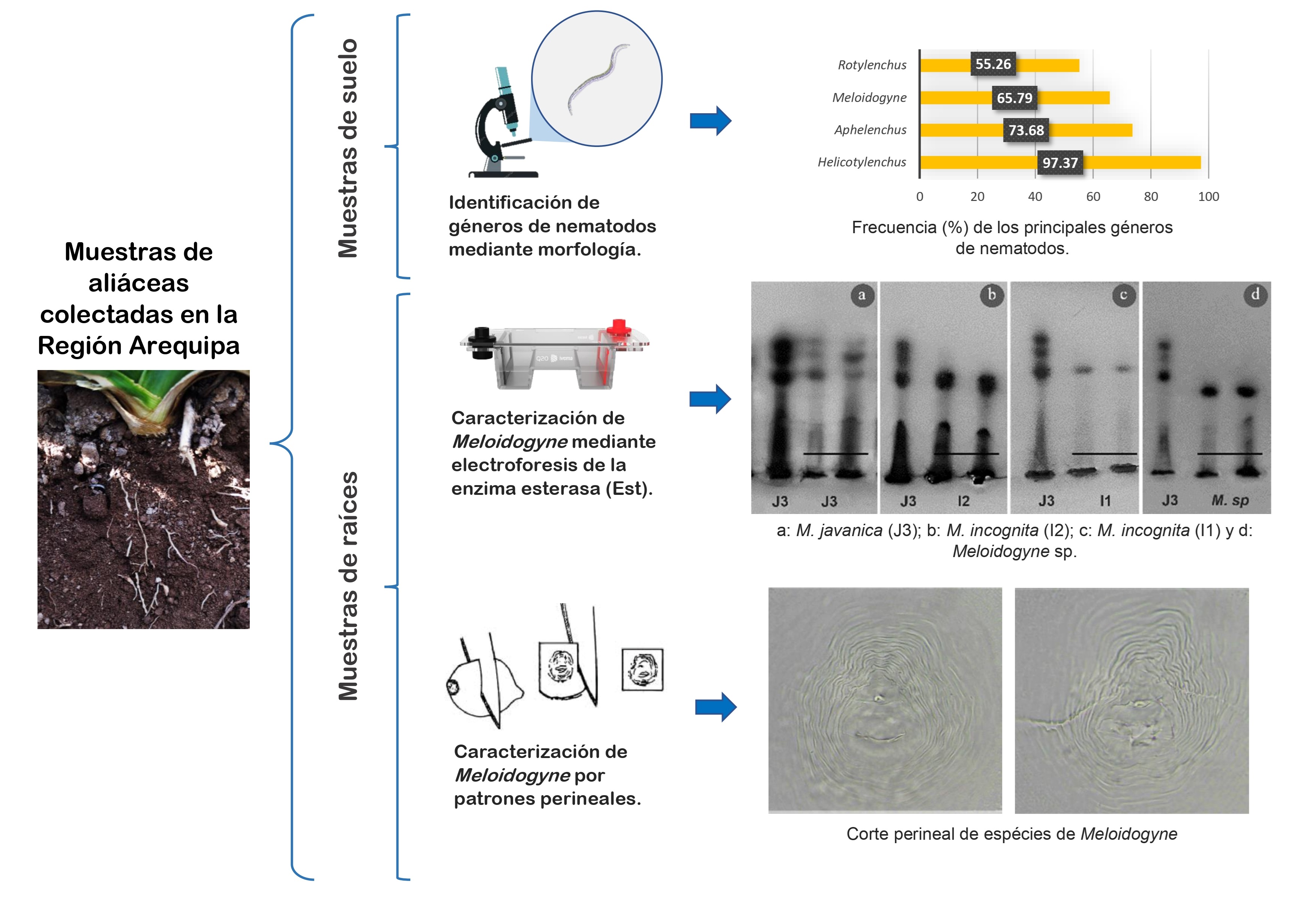
Alliaceae crops includes several species of agricultural importance for the Arequipa region, among them the onion is the most produced in the country, however, these crops are affected by phytoparasitic nematodes, including Meloidogyne spp. which causes significant losses in the yield. The aim of the present study was to characterise the root-knot nematode (Meloidogyne spp) and determine the population density of phytoparasitic nematodes in alliaceae crops in the main producing localities of the Arequipa region. Samples of roots and soil were collected in onion, chinese onion, leek and chives crops in the provinces of Arequipa, Castilla, Caylloma and Islay. The identification of nematode genus was found by morphological characteristics and the characterization of Meloidogyne were performed by perineal patterns and electrophoretic pattern of esterase (Est). In the 38 soil samples, different genus of plant-parasitic nematodes was found: Aphelenchus, Dorylaimus, Helicotylenchus, Hemicycliophora, Meloidogyne, Mesocriconema, Mononchus, OGMA, Pratylenchus, Rotylenchus, Tylenchus, Xiphinema and free-living nematodes, in root samples, eight populations of Meloidogyne spp. were found. distributed among three species: (1) M. incognita phenotype Est I1, Rm: 1.0 with 33.33% of frequency and Est I2, Rm: 1.03, 1.07 (50%); (2) M. javanica Est J3, Rm: 1.03, 1.24, 1.37 (16.67%) and an atypical species named Meloidogyne sp. Rm: 0.85 (33.33%). The identification of genus and species phytoparasitic nematodes in alliaceae will allow the adoption of more efficient integrated management measures, because have a distinct parasitism behavior.
References
Amaya, J. (1982). El "Nematodo del nudo de la raíz" en la costa norte del Perú. In Proceedings of the Third Research & Planning Conference on Root-Knot Nematodes, Meloidogyne spp. Department of Plant Pathology, North Carolina State University, 40-45 pp.
Apcho, E., Caballero, M., & Miranda, R. (2017). Planeamiento Estratégico de la Cebolla en el Perú al 2027. Pontificia Universidad Católica del Perú.
Asmus, G. L., & Ferraz, L. C. (2001). Relações entre a densidade populacional de Meloidogyne javanica e a área foliar, a fotossíntese e os danos causados a variedades de soja. Nematologia Brasileira, 25(1), 1-13.
Caballero-Luque, T. M., Casa-Coila, V. H., & Lima-Medina, I. (2021). Characterization of root-knot nematode (Meloidogyne spp.) and frequency of nematodes associated with artichoke crops in the “Irrigación Majes”, Arequipa, Peru. Journal of Plant Diseases and Protection, 128(2), 627-632. https://doi.org/10.1007/s41348-020-00398-8
Carneiro, R. G., & Almeida, M. R. (2001). Técnica de eletroforese usada no estudo de enzimas dos nematoides de galhas para identificação de espécies. Nematologia Brasileira, 25(1), 35-34.
DAPRO, D. G. (2020). Informe Estadístico de la Cebolla. Bolivia. Ministerio de Desarrollo productivo y Economía Rural.
Eisenback, J. D., Sasser, J., & Carter, C. (1985). Diagnostic characters useful in the identification of the four most common species of root-knot nematodes (Meloidogyne spp.). An advanced treatise on Meloidogyne, 1, 95-99.
Enyiukwu, D. N., Ononuju, C. C., Okeke, C., & Chukwu, L. A. (2021). Plant Parasitic Nematodes, Serious but Most Trivialized Biotic Challenge against Food Security: A spotlight on their Management for Sustainable Agriculture and Public Health. Direct Research Journal of Public Health and Environmental Technology, 6, 104-112. https://doi.org/10.26765/DRJPHET947520168
FAO, (07 de 11 de 2023). Food and Agriculture Organization of the United Nations. FAOSTAT Website. Obtenido de http://www.fao.org/faostat/en/#data
Faruk, I. (2019). Efficacy of Organic Soil Amendments and a Nematicide for Management of Root-Knot Nematode Meloidogyne Spp. of Onion. American Journal of Bioscience and Bioengineering, 7(4), 57-64. https://doi.org/10.11648/j.bio.20190704.11
Gürkan, T., & Çetintaş, R. (2024). Detection of Root-Knot Nematode Species and Races in Kahramanmaraş Province, Türkiye. Kahramanmaraş Sütçü İmam Üniversitesi Tarım ve Doğa Dergisi, 27(1), 174-182. https://doi.org/10.18016/ksutarimdoga.vi.1296708
Hartman, K., & Sasser, J. (1985). Identification of Meloidogyne species on the basis of differential host test and perineal-pattern morphology. An advanced treatise on Meloidogyne. North Carolina State University Graphics, 2, 69-77.
Hunt, D. J., & Handoo, Z. A. (2009). Taxonomy, identification and principal species. In Root-knot nematodes. Wallingford UK: CABI, 55-97 pp.
Jenkins, W. (1964). A rapid centrifugal-flotation technique for separating nematodes from soil. Plant Disease Reporter, 48(9).
Khan, A., Ansari, S. A., Haris, M., Hussain, T., & Khan, A. A. (2023). Meloidogyne Species: Threat to Vegetable Produce. En In Root-Galling Disease of Vegetable Plants (págs. 61-83). Singapore: Springer Nature Singapore.
Konate, A. Y., Ouuedraogo, S. L., & Kone, D. (2019). Etude faunistique des nématodes phytoparasites de l’oignon (Allium cepae L., Alliaceae) au Burkina Faso. International Journal of Biological and Chemical Sciences, 13(3), 1388-1395. Doi: 10.4314/ijbcs.v13i3.14
Lara-Ocola, J. (1999). Determinación, distribución y evaluación del grado de ataque del “Nematodo Nodulador” Meloidogyne incognita en Allium cepa L., realizado en nueve distritos de la provincia de Arequipa. Universidad Nacional de San Agustín, 67 pp.
Machaca, C. P. (2017). Identificación de Meloidogyne spp. por morfología é isoenzimas en pimiento páprika (Capsicum annuum L.) en tres irrigaciones de la región Arequipa. Universidad Nacional de San Agustín de Arequipa.
Mai, W. F., & Mullin, P. G. (1996). Plant-parasitic nematodes: A pictorial key to genera. Ithaca, NY: Cornell University Press.
Maleita, C., Correia, A., Abrantes, I., & Esteves, I. (2022). Susceptibility of crop plants to the rootknot nematode Meloidogyne luci, a threat to agricultural productivity. Phytopathologia Mediterranea, 61(1), 169-179. https://doi.org/10.36253/phyto-13369
Miranda-Barrios, E., Quispe-Castro, R., Lima-Medina, I., Bravo-Portocarrero, R., & Anculle-Arenas. (2020). Identificación de especies del género Meloidogyne en cucurbitáceas: Distribución y ocurrencia en Arequipa, Perú. Scientia Agropecuaria, 11(2), 195–202. https://doi.org/10.17268/sci.agropecu.2020.02.06
Muhammad, B., Bibi, K., Khan, M. S., & Kiran, A. (2024). Association of Plant Parasitic Nematodes with some Vegetables Crops of Khyber Pakhtun Khwa, Pakistan. Alexandria Science Exchange Journal, 45(1), 21-26. https://doi.org/10.21608/ASEJAIQJSAE.2024.336797
Nimgarri, H., Khan, M. R., Rahimi, M. H., Yahyazai, M., & Mondal, S. (2023). Root-knot nematodes (Meloidogyne spp.) in cucumber under protected cultivation: incidence, management and avoidable yield loss in Afghanistan. Indian Phytopathology, 13-22. https://doi.org/10.1007/s42360-023-00622-z
Nydia, & Carbonell, V. (2012). Conjunto Tecnológico para la Producción de Cebolla. Universidad de Puerto Rico, Estación Experimental Agrícola, 156 pp.
Pagano, A., Macovei, A., Xia, X., Padula, G., Holubowicz, R., & Balestrazzi, A. (2023). Seed Priming Applied to Onion-Like Crops: State of the Art and Open Questions. Agronomy, 13(2), 278-288. https://doi.org/10.3390/agronomy13020288
Peraza-Padilla, W. (2021). Identificación morfológica y molecular de Meloidogyne javanica en una plantación de papaya (Carica papaya l.) en Pococí, Limón, Costa Rica. Agronomía Costarricense, 45(2), 41-55. http://dx.doi.org/10.15517/rac.v45i2.47766
Pokharel, R. R., Larsen, H., Hammon, B., Gourd, T., & Bartolo, M. (2008). Plant parasitic nematodes, soil and root health of Colorado onion fields. Western Colorado Research Center, Colorado State University. Annual report. Ft. Collins: Colorado State University.
Rawal, S. (2020). A review on root-knot nematode infestation and its management practices through different approaches in tomato. Tropical Agroecosystems (TAEC), 1(2), 92-96. http://doi.org/10.26480/taec.02.2020.92.96
Rusinque, L., Camacho, M. J., Serra, C., Nóbrega, F., & Inacio, M. L. (2023). Root-knot nematode assessment: species identification, distribution, and new host records in Portugal. Frontiers in Plant Science, 14, 1230968. https://doi.org/10.3389/fpls.2023.1230968
Rusinque, L., Maleita, C., Abrantes, I., Palomares-Rius, J. E., & Inácio, M. L. (2021). Meloidogyne graminicola: A threat to rice production: Review update on distribution, biology, identification, and management. Biology, 10(11), 1163. https://doi.org/10.3390/biology10111163
SIEA, Sistema Integrado de Estadísticas Agrarias (2023). Perfil productivo de los principales cultivos del sector. Lima: Ministerio de Desarrollo Agrario y Riego. Obtenido de https://siea.midagri.gob.pe/portal/siea_bi/index.html
Simon, S., Singh, K., & Ghosh, G. (2011). Distribution of root-knot nematode on major field crops in Uttar Pradesh (India). Archives of Phytopathology and Plant Protection, 44(2), 191-197. https://doi.org/10.1080/03235408.2010.505365
Soldatenko, A. V., Ivanova, M. I., Bukharov, A. F., Kashleva, A. I., & Seredin, T. M. (2021). Prospects for introducing into the culture wild species of the genus Allium L. food direction. Vegetable crops of Russia, 1, 20-32. https://doi.org/10.18619/2072-9146-2021-1-20-32
Taylor, A. L., & Sasser, J. N. (1983). Biología, identificación y control de los nematodos de nódulo de la raíz. Universidad de Carolina del Norte, 111 pp.
Tiganomilani, M., Carneiro, R., Defaria, M., Frazao, H., & Mccoy, C. (1995). Isozyme Characterization and Pathogenicity of Paecilomyces fumosoroseus and P. lilacinus to Diabrotica speciosa (Coleoptera: Chrysomelidae) and Meloidogyne javanica (Nematoda: Tylenchidae). Biological control, 5(3), 378-382. https://doi.org/10.1006/bcon.1995.1044
Vera, O., & Nora, J. (2014). Técnica molecular de PCR para identificar las principales especies de Meloidogyne spp. en poblaciones provenientes de Perú. Universidad Nacional Agraria La Molina.
Vuković, S., Popović-Djordjević, J. B., Kostić, A. Ž., Pantelić, N. D., Srećković, N., Akram, M., . . . Stanković, J. S. (2023). Allium Species in the Balkan Region Major Metabolites, Antioxidant and Antimicrobial Properties. Horticulturae, 9(3), 408. https://doi.org/10.3390/horticulturae9030408
Wang, Y., Xie, Y., Cui, H. D., & Dong, Y. (2013). First Report of Meloidogyne javanica on Sacha Inchi (Plukenetia volubilis) in China. Plant Disease, 98(1), 165-165. https://doi.org/10.1094/PDIS-03-13-0241-PDN
Yadav, K., Bharti, L., & Chaubey, A. K. (2023). Effect of Phytoparasitic Nematodes on Agricultural Yield: Current Progress and Challenges. En Nematode-Plant Interactions and Controlling Infection, 62-84 pp. doi: 10.4018/978-1-6684-8083-0.ch004
Yadav, S., Patil, J., & Kanwar, R. S. (2018). The role of free living nematode population in the organic matter recycling. International Journal of Current Microbiology and Applied Sciences, 7(6), 1-9. https://doi.org/10.20546/ijcmas.2018.706.321
Published
How to Cite
Issue
Section
License
Copyright (c) 2024 Scientia Agropecuaria

This work is licensed under a Creative Commons Attribution-NonCommercial 4.0 International License.
The authors who publish in this journal accept the following conditions:
a. The authors retain the copyright and assign to the magazine the right of the first publication, with the work registered with the Creative Commons attribution license, which allows third parties to use the published information whenever they mention the authorship of the work and the First publication in this journal.
b. Authors may make other independent and additional contractual arrangements for non-exclusive distribution of the version of the article published in this journal (eg, include it in an institutional repository or publish it in a book) as long as it clearly indicates that the work Was first published in this journal.
c. Authors are encouraged to publish their work on the Internet (for example, on institutional or personal pages) before and during the review and publication process, as it can lead to productive exchanges and a greater and faster dissemination of work Published (see The Effect of Open Access).