
Genetic and adaptive diversity of wild tomato (Solanum spp.) in three basins of Lima: Identification of genetic resources for resilience to abiotic stress
DOI:
https://doi.org/10.17268/sci.agropecu.2026.53Keywords:
wild tomato, abiotic resistance, resistome, crop resilience, genetic erosionAbstract
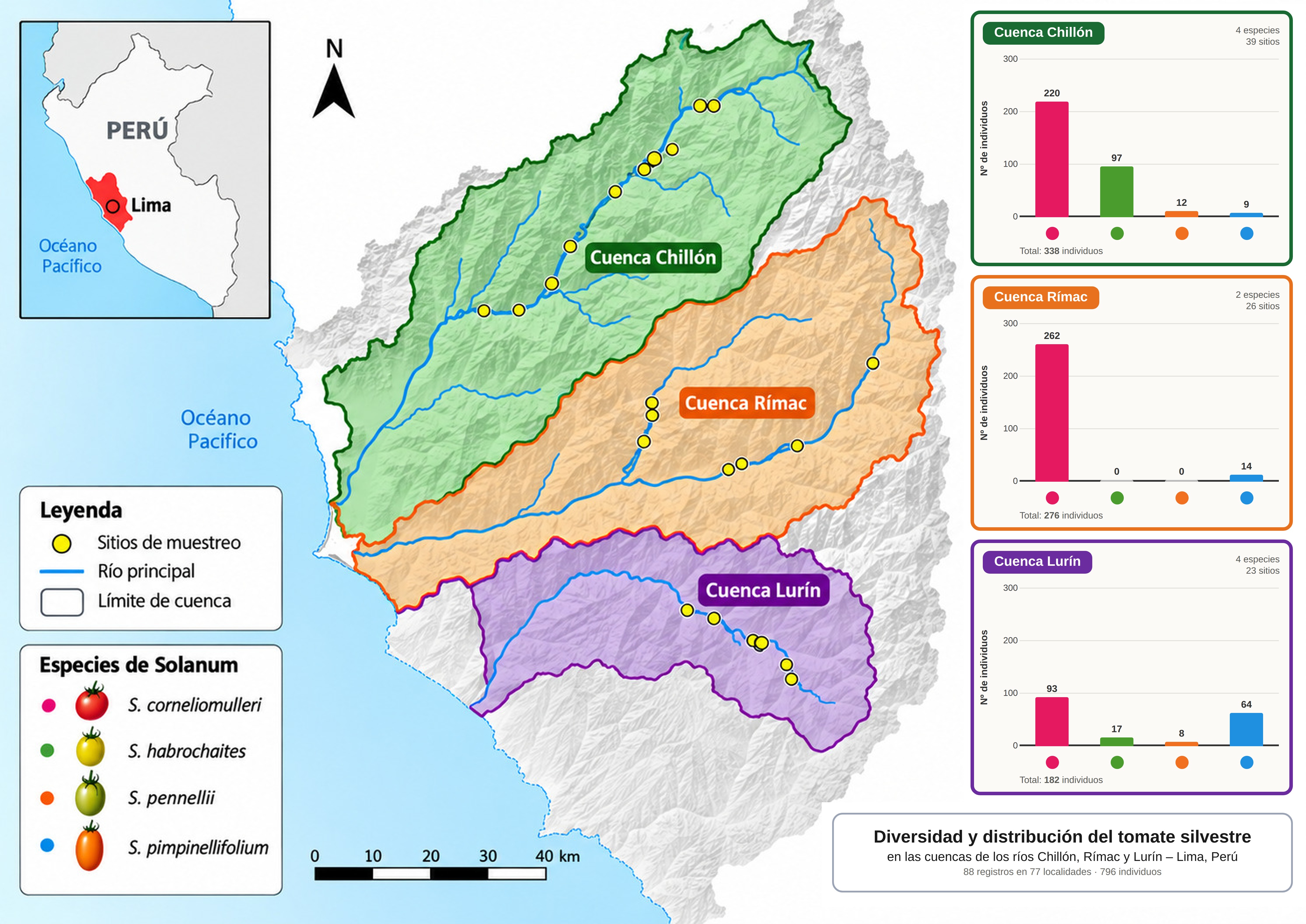
We characterised the biodiversity of wild tomato in the Lurín, Rímac and Chillón river basins, in the Lima valley, and analysed in silico five families of abiotic resistance genes. Sampling was carried out between 628 and 3694 m above sea level, using in situ taxonomic recognition, ecological indices and bioinformatic profiling of the “resistome” of the DREB, NAC and MYB transcription factor families, whose profiles were compared with those of the commercial species S. lycopersicum using an exact Poisson test with Holm correction. Four wild species were identified: S. corneliomulleri, S. habrochaites, S. pimpinellifolium and S. pennellii. Ecological analysis revealed that the Lurín basin exhibited the greatest diversity (H’ ≈ 1.07), whereas the Rímac basin was impoverished (H’ ≈ 0.20). Genomic comparisons quantified in S. lycopersicum a 45% reduction in DREB genes and a 30% reduction in NAC genes relative to S. pennellii, the species with the largest repertoire in both families. S. corneliomulleri stood out as a potential reservoir of abiotic resistance with 3095 MYB genes, and S. pennellii showed the greatest representation in the families associated with salinity and drought. Interspecific differentiation was concentrated in the two families linked to the drought response. These findings identify wild populations in Lima as critical reservoirs for reintroducing resilience into cultivated tomato in the face of climate change and its impact on food security.
References
Agresti, A. (2013). Categorical data analysis (3rd ed.). John Wiley & Sons.
Arce, P. G. (2013). Distribución geográfica de los tomates silvestres (Solanum L . sect . Lycopersicon (Mill.) Wettst.: Solanaceae) Geographical distribution of wild tomatos (Solanum L . sect . Lycopersicon (Mill.) Wettst. Arnaldoa, 20(2), 301–314.
Baek, Y. S., Royer, S. M., Broz, A. K., Covey, P. A., López-Casado, G., Nuñez, R., Kear, P. J., Bonierbale, M., Orillo, M., Van Der Knaap, E., Stack, S. M., McClure, B., Chetelat, R. T., & Bedinger, P. A. (2016). Interspecific reproductive barriers between sympatric populations of wild tomato species (Solanum section Lycopersicon). American Journal of Botany, 103(11), 1964–1978. https://doi.org/10.3732/AJB.1600356
Beddows, I., Reddy, A., Kloesges, T., & Rose, L. E. (2017). Population Genomics in Wild Tomatoes—The Interplay of Divergence and Admixture. Genome Biology and Evolution, 9(11), 3023–3038. https://doi.org/10.1093/GBE/EVX224
Bolger, A., Scossa, F., Bolger, M. E., Lanz, C., Maumus, F., Tohge, T., Quesneville, H., Alseekh, S., Sørensen, I., Lichtenstein, G., Fich, E. A., Conte, M., Keller, H., Schneeberger, K., Schwacke, R., Ofner, I., Vrebalov, J., Xu, Y., Osorio, S., … Fernie, A. R. (2014). The genome of the stress-tolerant wild tomato species Solanum pennellii. Nature Genetics, 46(9), 1034–1038. https://doi.org/10.1038/NG.3046;TECHMETA
Calafiore, R., Aliberti, A., Ruggieri, V., Olivieri, F., Rigano, M. M., & Barone, A. (2019). Phenotypic and molecular selection of a superior solanum pennellii introgression sub-line suitable for improving quality traits of cultivated tomatoes. Frontiers in Plant Science, 10, 437141. https://doi.org/10.3389/FPLS.2019.00190
Chiș, A. A., Rus, L. L., Morgovan, C., Arseniu, A. M., Frum, A., Vonica-țincu, A. L., Gligor, F. G., Mureșan, M. L., & Dobrea, C. M. (2022). Microbial Resistance to Antibiotics and Effective Antibiotherapy. Biomedicines, 10(5), 1121. https://doi.org/10.3390/biomedicines10051121
Congreso de la República del Perú. (2021). Ley N° 31111 que modifica la Ley 29811, Ley que establece la moratoria al ingreso y producción de organismos vivos al territorio nacional por un período de 15 años, a fin de establecer la moratoria hasta el 31 de diciembre de 2035. https://busquedas.elperuano.pe/dispositivo/NL/1917468-1
Congreso de la República del Perú. (2024). Ley que declara de interés nacional la protección, conservación y recuperación de los ecosistemas de la cuenca hidrográfica del río Lurín - Ley - N° 32025. Portal Del Congreso de La República Del Perú. https://busquedas.elperuano.pe/dispositivo/NL/2288660-3
Egea, I., Albaladejo, I., Meco, V., Morales, B., Sevilla, A., Bolarin, M. C., & Flores, F. B. (2018). The drought-tolerant Solanum pennellii regulates leaf water loss and induces genes involved in amino acid and ethylene/jasmonate metabolism under dehydration. Scientific Reports, 8(1), 2791. https://doi.org/10.1038/s41598-018-21187-2
Egea, I., Estrada, Y., Flores, F. B., & Bolarín, M. C. (2022). Improving production and fruit quality of tomato under abiotic stress: Genes for the future of tomato breeding for a sustainable agriculture. Environmental and Experimental Botany, 204(2), 105086. https://doi.org/10.1016/j.envexpbot.2022.105086
Gao, L., Gonda, I., Sun, H., Ma, Q., Bao, K., Tieman, D. M., Burzynski-Chang, E. A., Fish, T. L., Stromberg, K. A., Sacks, G. L., Thannhauser, T. W., Foolad, M. R., Diez, M. J., Blanca, J., Canizares, J., Xu, Y., van der Knaap, E., Huang, S., Klee, H. J., … Fei, Z. (2019). The tomato pan-genome uncovers new genes and a rare allele regulating fruit flavor. Nature Genetics, 51(6), 1044–1051. https://doi.org/10.1038/s41588-019-0410-2
García-Morales, S., Gómez-Merino, F. C., Trejo-Téllez, L. I., & Herrera-Cabrera, É. B. (2013). Transcription factors involved in molecular responses of plants to osmotic stress. Revista Fitotecnia Mexicana, 36(2), 105–115.
Gobierno del Perú. (2011). Ley N.° 29811 - Ley que establece la moratoria al ingreso y producción de organismos vivos modificados al territorio nacional por un periodo de 10 años. https://www.gob.pe/institucion/minam/normas-legales/3595-29811
Golldack, D., Lüking, I., & Yang, O. (2011). Plant tolerance to drought and salinity: stress regulating transcription factors and their functional significance in the cellular transcriptional network. Plant Cell Reports, 30(8), 1383–1391. https://doi.org/10.1007/s00299-011-1068-0
Gong, P., Zhang, J., Li, H., Yang, C., Zhang, C., Zhang, X., Khurram, Z., Zhang, Y., Wang, T., Fei, Z., & Ye, Z. (2010). Transcriptional profiles of drought-responsive genes in modulating transcription signal transduction, and biochemical pathways in tomato. Journal of Experimental Botany, 61(13), 3563–3575. https://doi.org/10.1093/JXB/ERQ167
Guedes Corrêa, L. G., Riaño-Pachón, D. M., Guerra Schrago, C., Vicentini dos Santos, R., Mueller-Roeber, B., & Vincentz, M. (2008). The Role of bZIP Transcription Factors in Green Plant Evolution: Adaptive Features Emerging from Four Founder Genes. PLOS ONE, 3(8), e2944. https://doi.org/10.1371/JOURNAL.PONE.0002944
Herman, B. (2022). Evaluation of methods for monitoring herbaceous vegetation. ERDC. https://doi.org/10.21079/11681/45100
Hivert, G., Davidovich-Rikanati, R., Bar, E., Sitrit, Y., Schaffer, A., Dudareva, N., & Lewinsohn, E. (2020). Prenyltransferases catalyzing geranyldiphosphate formation in tomato fruit. Plant Science, 296, 110504. https://doi.org/10.1016/J.PLANTSCI.2020.110504
Holm, S. (1979). A simple sequentially rejective multiple test procedure. Scandinavian Journal of Statistics, 6(2), 65–70.
Jakoby, M., Weisshaar, B., Dröge-Laser, W., Vicente-Carbajosa, J., Tiedemann, J., Kroj, T., & Parcy, F. (2002). bZIP transcription factors in Arabidopsis. Trends in Plant Science, 7(3), 106–111. https://doi.org/10.1016/S1360-1385(01)02223-3
Jin, X. F., Xiong, A. S., Peng, R. H., Liu, J. G., Gao, F., Chen, J. M., & Yao, Q. H. (2010). OsAREB1, an ABRE-binding protein responding to ABA and glucose, has multiple functions in Arabidopsis. BMB Reports, 43(1), 34–39. https://doi.org/10.5483/BMBRep.2010.43.1.034
Ludovicy, S., Noroozi, J., Semenchuk, P., Moser, D., Wessely, J., Talebi, A., & Dullinger, S. (2022). Protected area network insufficiently represents climatic niches of endemic plants in a Global Biodiversity Hotspot. Biological Conservation, 275(6), 109768. https://doi.org/10.1016/j.biocon.2022.109768
Ministerio del Ambiente. (2023). Decreto Supremo N.° 012-2023-MINAM - Normas y documentos legales - Ministerio del Ambiente. Plataforma Del Estado Peruano. https://www.gob.pe/institucion/minam/normas-legales/4985758-012-2023-minam
Ministerio del Ambiente. (2026). R.M. No D000068-2026-MINAM-DM. El Peruano, 3–4. https://busquedas.elperuano.pe/dispositivo/NL/2493598-1
Moradi, H., Noroozi, J., & Fourcade, Y. (2025). Plant endemic diversity in the Irano-Anatolian global biodiversity hotspot is dramatically threatened by future climate change. Biological Conservation, 302(5), 110963. https://doi.org/10.1016/j.biocon.2024.110963
Moreno, C. E. (2001). Métodos para medir la biodiversidad. M&T–Manuales y Tesis SEA.
Moreno-Castillo, K. R. (2025). Rehabilitation of the Rimac river [The University of Arizona].
Naciones Unidas. (2015). Objetivos y metas de desarrollo sostenible - Objetivos de Desarrollo Sostenible (ODS). https://www.un.org/sustainabledevelopment/es/objetivos-de-desarrollo-sostenible/
Nagy, O., Nuez, I., Savisaar, R., Peluffo, A. E., Yassin, A., Lang, M., Stern, D. L., Matute, D. R., David, J. R., & Courtier-Orgogozo, V. (2018). Correlated evolution of two copulatory organs via a single cis-regulatory nucleotide change. Current Biology, 28(21), 3450–3457.
Paolo, C., Débora Pamela, A., Elizabeth, T., & Guillermo Raúl, P. (2021). Structural and functional analysis of two sHSP subfamilies in tomato ripening. Plant Gene, 27, 100297. https://doi.org/10.1016/j.plgene.2021.100297
Peralta, I., Knapp, S., Spooner, D., & Lammers, T. (2005). New species of wild tomatoes (Solanum section Lycopersicon: Solanaceae) from Northern Peru. Systematic Botany, 30(2), 424–434.
Pessoa, H. P., Dariva, F. D., Copati, M. G. F., de Paula, R. G., de Oliveira Dias, F., & Gomes, C. N. (2023). Uncovering tomato candidate genes associated with drought tolerance using Solanum pennellii introgression lines. PLOS ONE, 18(6), e0287178. https://doi.org/10.1371/JOURNAL.PONE.0287178
Przyborowski, J., & Wilenski, H. (1940). Homogeneity of results in testing samples from Poisson series with an application to testing clover seed for dodder. Biometrika, 31(3–4), 313–323.
Ramírez-Ojeda, G., Rodríguez-Pérez, J. E., Rodríguez-Guzmán, E., Sahagún-Castellanos, J., Chávez-Servia, J. L., Peralta, I. E., & Barrera-Guzmán, L. Á. (2022). Distribution and Climatic Adaptation of Wild Tomato (Solanum lycopersicum L.) Populations in Mexico. Plants, 11(15), 2007. https://doi.org/10.3390/PLANTS11152007
Rezapouraghdam, H., Hidalgo-Garcia, D., & Karatepe, O. M. (2024). Rising temperatures and sinking hopes: An in-depth analysis of the interplay between climate change, land use patterns, and the desiccation of a global biosphere reserve. Environmental Development, 52(6), 101084. https://doi.org/10.1016/j.envdev.2024.101084
Rezk, A., Abhary, M., & Akhkha, A. (2021). Tomato (Solanum lycopersicum L.) Breeding Strategies for Biotic and Abiotic Stresses. Advances in Plant Breeding Strategies: Vegetable Crops: Volume 9: Fruits and Young Shoots, 363–405. https://doi.org/10.1007/978-3-030-66961-4_10
Salmerón, A., Gonzales, A., Barbán, L., & Álvarez, L. O. (2015). Abundancia y diversidad de plantas leñosas en áreas de bosques semideciduos micrófilos, sometidos a diferentes niveles de perturbaciones antrópicas. Foresta Veracruzana, 17(2), 11–20.
Schouten, H. J., Tikunov, Y., Verkerke, W., Finkers, R., Bovy, A., Bai, Y., & Visser, R. G. F. (2019). Breeding Has Increased the Diversity of Cultivated Tomato in The Netherlands. Frontiers in Plant Science, 10, 500236. https://doi.org/10.3389/FPLS.2019.01606
Seo, P. J., Lee, S. B., Suh, M. C., Park, M. J., & Park, C. M. (2011). The MYB96 transcription factor regulates cuticular wax biosynthesis under drought conditions in Arabidopsis. The Plant Cell, 23(3), 1138–1152. https://doi.org/10.1105/TPC.111.083485
Shu, J., Zhang, L., Liu, G., Wang, X., Liu, F., Zhang, Y., & Chen, Y. (2024). Transcriptome Analysis and Metabolic Profiling Reveal the Key Regulatory Pathways in Drought Stress Responses and Recovery in Tomatoes. International Journal of Molecular Sciences, 25(4), 2187. https://doi.org/10.3390/IJMS25042187/S1
Singini, E. J., & Baso, N. C. (2025). Land use change, invasive species, and climate change: Drivers of biodiversity decline across IUCN conservation categories. South African Journal of Botany, 180, 730–739. https://doi.org/10.1016/j.sajb.2025.03.048
Tang, X., Xue, Y., Cao, D., Luan, X., Zhao, K., Liu, Q., Ren, Y., Zhu, Z., Li, Y., & Liu, X. (2023). Identification of candidate genes for drought resistance during soybean seed development. Agriculture, 13. https://doi.org/10.3390/AGRICULTURE13050949
Vega-Jácome, F., Lavado-Casimiro, W. S., & Felipe-Obando, O. G. (2017). Assessing hydrological changes in a regulated river system over the last 90 years in Rimac Basin (Peru). Theoretical and Applied Climatology, 132(1), 347–362. https://doi.org/10.1007/s00704-017-2084-y
Villanueva-Gutierrez, E. E., Johansson, E., Prieto-Linde, M. L., Centellas Quezada, A., Olsson, M. E., & Geleta, M. (2022). Simple Sequence Repeat Markers Reveal Genetic Diversity and Population Structure of Bolivian Wild and Cultivated Tomatoes (Solanum lycopersicum L.). Genes, 13(9), 1505. https://doi.org/10.3390/GENES13091505/S1
Yoshida, T., Fujita, Y., Sayama, H., Kidokoro, S., Maruyama, K., Mizoi, J., Shinozaki, K., & Yamaguchi-Shinozaki, K. (2010). AREB1, AREB2, and ABF3 are master transcription factors that cooperatively regulate ABRE-dependent ABA signaling involved in drought stress tolerance and require ABA for full activation. The Plant Journal : For Cell and Molecular Biology, 61(4), 672–685. https://doi.org/10.1111/J.1365-313X.2009.04092.X
Zsögön, A., Čermák, T., Naves, E. R., Notini, M. M., Edel, K. H., Weinl, S., Freschi, L., Voytas, D. F., Kudla, J., & Peres, L. E. P. (2018). De novo domestication of wild tomato using genome editing. Nature Biotechnology, 36(12), 1211–1216. https://doi.org/10.1038/nbt.4272
Downloads
Additional Files
Published
Issue
Section
License
Copyright (c) 2026 Scientia Agropecuaria

This work is licensed under a Creative Commons Attribution-NonCommercial 4.0 International License.
The authors who publish in this journal accept the following conditions:
a. The authors retain the copyright and assign to the magazine the right of the first publication, with the work registered with the Creative Commons attribution license, which allows third parties to use the published information whenever they mention the authorship of the work and the First publication in this journal.
b. Authors may make other independent and additional contractual arrangements for non-exclusive distribution of the version of the article published in this journal (eg, include it in an institutional repository or publish it in a book) as long as it clearly indicates that the work Was first published in this journal.
c. Authors are encouraged to publish their work on the Internet (for example, on institutional or personal pages) before and during the review and publication process, as it can lead to productive exchanges and a greater and faster dissemination of work Published (see The Effect of Open Access).