
Oxidation of soybean oil during the frying of fresh and dried Ipomoea batatas
DOI:
https://doi.org/10.17268/agroind.sci.2026.03.01Keywords:
Ipomoea batatas, frying, lipid oxidation, natural antioxidants, soybean oilAbstract
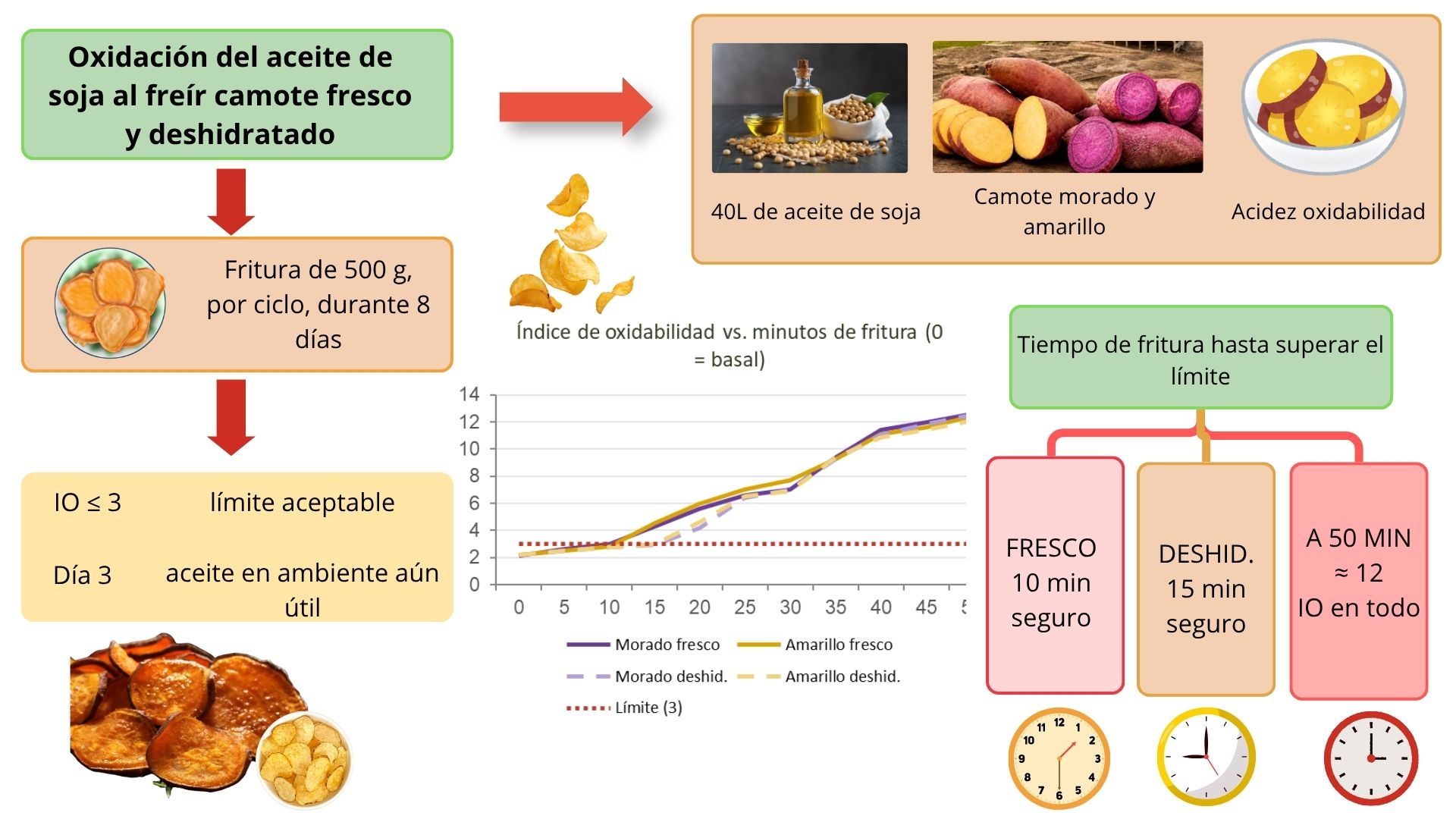
Frying is a widely used method in the food industry; however, continuous exposure of oils to high temperatures promotes oxidative degradation. This study evaluated the effect of fresh and dehydrated sweet potato (Ipomoea batatas), in purple and yellow varieties, on the oxidative stability of soybean oil during frying. Forty liters of Glycine max oil were used in tests with and without frying, using 500 g of sweet potato per cycle. Samples were taken every six hours over eight days, and acidity and oxidability indexes were determined through titration with KMnO₄. Results showed that oil stored at ambient temperature maintained acceptable quality up to the third day, whereas oil subjected to frying with fresh sweet potato deteriorated faster due to its higher moisture content. This study provides technical evidence on the degradation kinetics of soybean oil, demonstrating that reducing the moisture content of the beans through dehydration is an effective strategy for mitigating hydrolysis and extending the shelf life of the frying medium, thereby ensuring food safety during high-temperature cooking processes.
References
Abrante-Pascual, S., Nieva-Echevarría, B., & Goicoechea-Oses, E. (2024). Vegetable oils and their use for frying: A review of their compositional differences and degradation. Foods, 13(24), 4186. https://doi.org/10.3390/foods13244186
Cao, L., Jia, P., Liu, H., Kang, S., Jiang, S., & Pang, M. (2023). Effects of high-canolol phenolic extracts on fragrant rapeseed oil quality and flavor compounds during frying. Foods, 12(4), 827. https://doi.org/10.3390/foods12040827
Chabni, A., Bañares, C., & Torres, C. F. (2024). Study of the oxidative stability via Oxitest and Rancimat of phenolic-rich olive oils obtained by a sequential process of dehydration, expeller and supercritical CO2 extractions. Frontiers in Nutrition, 11, 1494091. https://doi.org/10.3389/fnut.2024.1494091
Figueiredo, P. S., Martins, T. N., Ravaglia, L. M., Alcantara, G. B., Guimarães, R. de C. A., Freitas, K. de C., Nunes, Â. A., de Oliveira, L. C. S., Cortês, M. R., Michels, F. S., Kadri, M. C. T., Bonfá, I. S., Filiú, W. F. de O., Asato, M. A., de Faria, B. B., Nascimento, V. A. do, & Hiane, P. A. (2022). Linseed, Baru, and coconut oils: NMR-based metabolomics, leukocyte infiltration potential in vivo, and their oil characterization. Are there still controversies? Nutrients, 14(6), 1161. https://doi.org/10.3390/nu14061161
Gautam, N., Karki, A., Khadka, N., & Prakash, O. (2024). Thermal degradation of soybean and palm olein during deep fat frying. Ecronicon.net.
Hu, B., Wu, R., Sun, J., Shi, H., Jia, C., Liu, R., & Rong, J. (2023). Monitoring the oxidation process of soybean oil during deep-frying of fish cakes with 1H nuclear magnetic resonance. Food Chemistry: X, 17(100587), 100587. https://doi.org/10.1016/j.fochx.2023.100587
Kandiyil, S. P., Illam, S. P., & Raghavamenon, A. C. (2023). Normolipidic diet containing deep-fried saturated and unsaturated fatty acids rich edible oils promotes metabolic dysregulation and inflammatory microenvironment in Wistar rats. Food and Chemical Toxicology, 180, 114029. https://doi.org/10.1016/j.fct.2023.114029
Laveriano-Santos, E. P., López-Yerena, A., Jaime-Rodríguez, C., González-Coria, J., Lamuela-Raventós, R. M., Vallverdú-Queralt, A., Romanyà, J., & Pérez, M. (2022). Sweet potato is not simply an abundant food crop: A comprehensive review of its phytochemical constituents, biological activities, and the effects of processing. Antioxidants, 11(9), 1648. https://doi.org/10.3390/antiox11091648
Lee, J., & Surh, J. (2022). Effects of sweet potato powder selected based on the polar paradox hypothesis on oil oxidation in the preparation of deep-fried croquettes. Preventive Nutrition and Food Science, 27(2), 248–256. https://doi.org/10.3746/pnf.2022.27.2.248
Majid, M., Farhan, A., Baig, M. W., Khan, M. T., Kamal, Y., Hassan, S. S. U., Bungau, S., & Haq, I.-U. (2022). Ameliorative effect of structurally divergent oleanane triterpenoid, 3-epifriedelinol from Ipomoea batatas against BPA-induced gonadotoxicity by targeting PARP and NF-κB signaling in rats. Molecules, 28(1), 290. https://doi.org/10.3390/molecules28010290
Martín-Torres, S., Tello-Jiménez, J. A., López-Blanco, R., González-Casado, A., & Cuadros-Rodríguez, L. (2022). Monitoring the shelf life of refined vegetable oils under market storage conditions-A kinetic chemofoodmetric approach. Molecules, 27(19), 6508. https://doi.org/10.3390/molecules27196508
Naresuan University, Jittrepotch, N., Kraboun, K., Rojsuntornkitti, K., Thanasukarn, P., Kongbangkerd, T., Uthai, N., & Wattanakul, J. (2025). Influence of sweet potato peel extract on oxidative stability of palm oil during frying. African Journal of Food Agriculture Nutrition and Development, 25(05), 26727–26745. https://doi.org/10.18697/ajfand.142.25660
Nili-Ahmadabadi, A., Torabi, K., Mohammadi, M., & Heshmati, A. (2022). Thermally oxidized sunflower oil diet alters leptin/ghrelin balance and lipid profile in rats: Possible role of reactive aldehydes in dyslipidemia. Journal of Food Biochemistry, 46(12), e14514. https://doi.org/10.1111/jfbc.14514
Rosell, M. de L. Á., Quizhpe, J., Ayuso, P., Peñalver, R., & Nieto, G. (2024). Proximate composition, health benefits, and food applications in bakery products of purple-fleshed sweet potato (Ipomoea batatas L.) and its by-products: A comprehensive review. Antioxidants, 13(8), 954. https://doi.org/10.3390/antiox13080954
Soliman, H. M. (2023). Preparation of a regioselective quercetin-3-palmitate and its using for boosting cooking oil stability. Journal of Oleo Science, 72(2), 139–151. https://doi.org/10.5650/jos.ess22162
Ujong, A. E., Emelike, N. J. T., Owuno, F., & Okiyi, P. N. (2023). Effect of frying cycles on the physical, chemical and antioxidant properties of selected plant oils during deep-fat frying of potato chips. Food Chemistry Advances, 3(100338), 100338. https://doi.org/10.1016/j.focha.2023.100338
Xiong, X., Yang, W., Huang, G., & Huang, H. (2023). Ultrasonic-assisted extraction, characteristics and activity of Ipomoea batatas polysaccharide. Ultrasonics Sonochemistry, 96, 106420. https://doi.org/10.1016/j.ultsonch.2023.106420
Yi, S., Kong, S., Say, M., & Tan, R. (2025). Thermal stability of blending soybean oil with coconut oil during continuous deep frying of banana chips. The 5th International Electronic Conference on Foods, 33.
Yılmaz, B., Şahin, T. Ö., & Ağagündüz, D. (2023). Oxidative changes in ten vegetable oils caused by the deep-frying process of potato. Journal of Food Biochemistry, 2023, 1–11. https://doi.org/10.1155/2023/6598528
Downloads
Published
Issue
Section
License
Copyright (c) 2026 Rubén Jesús Aro Díaz, Edmundo Arturo Venegas Casanova, Maricarmen Jackelyn Jaico Cruz, Christopher Mark Tolentino Lavado

This work is licensed under a Creative Commons Attribution-NonCommercial 4.0 International License.
The author does not retain copyright or publication rights indefinitely. The author retains all moral rights, particularly the right of authorship and the right to the integrity of the article.