
Isotermas dinámicas de sorción y análisis termodinámico de granos de quinua
DOI:
https://doi.org/10.17268/agroind.sci.2026.03.03Palabras clave:
Quinua, isotermas de sorción, actividad de agua crítica, propiedades termodinámicas, DDI, DVSResumen
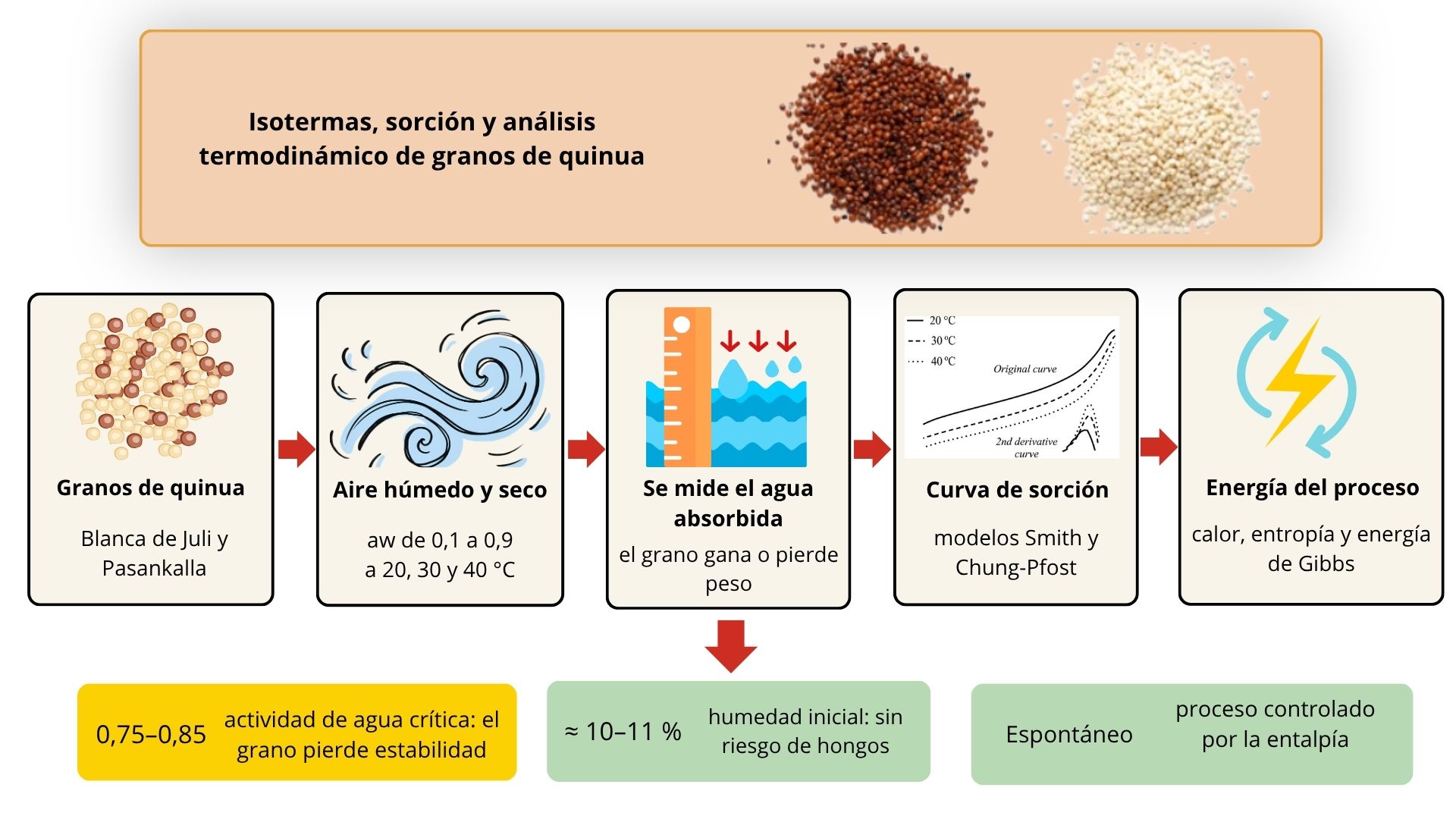
Las isotermas de sorción de dos variedades de granos de quinua (Chenopodium quinoa) fueron determinados usando los métodos DVS y DDI a tres temperaturas (20, 30 y 40 °C) en un rango de actividad de agua de 0,1 – 0,9. Las isotermas DDI fueron usadas para determinar la actividad de agua crítica aplicando de la segunda derivada Savistky-Golay. Siete modelos matemáticos fueron usados para ajustar los datos experimentales de sorción. Calor isostérico de sorción, entropía de sorción, energía libre de Gibbs y compensación entalpía-entropía fueron evaluadas. Los resultados indicaron que el contenido de humedad en equilibrio de los granos de quinua (PK y BJ) tienden a incrementar junto a la actividad de agua y la disminución de la temperatura. Las isotermas de los granos de quinua (PK y BJ) presentaron una forma sigmoidal tipo II. Los modelos Chung-Pfost y Smith fueron los mejores ajustados a los datos experimentales. La región de la actividad de agua crítica para los granos de quinua fue 0,75~0,85. El calor isostérico de sorción, entropía de sorción disminuyeron al incremento del contenido de humedad. Así mismo el incremento de contenido de humedad y temperatura influyeron en el decrecimiento de los valores de energía libre de Gibbs. La compensación entalpía-entropía fue corroborada (Tβ ≠ Thm), los procesos fueron llevados a cabo por la entalpía (Tβ > Thm) y son espontáneos (∆G > 0).
Referencias
Abdullah, N., Nawawi, A., & Othman, I. (2000). Fungal spoilage of starch-based foods in relation to its water activity (aw). Journal of Stored Products Research, 36(1), 47-54. https://doi.org/10.1016/S0022-474X(99)00026-0
Aguerre, R., Suarez, C., & Viollaz, P. E. (1989). New BET type multilayer sorption isotherms. Part II: Modeling water sorption in foods. Lebensmittel-Wissenschaft und-Technologie, 22(4), 192–195.
Aldred, D., Magan, N., & Olsen, M. (2004). 7 - The use of HACCP in the control of mycotoxins: the case of cereals. In N. Magan & M. Olsen (Eds.), Mycotoxins in Food (pp. 139-173). Woodhead Publishing. https://doi.org/10.1533/9781855739086.2.139
Al-Muhtaseb, A. H., McMinn, W. A. M., & Magee, T. R. A. (2002). Moisture Sorption Isotherm Characteristics of Food Products: A Review. Food and Bioproducts Processing, 80(2), 118-128. https://doi.org/10.1205/09603080252938753
Arslan-Tontul, S. (2021). Moisture sorption isotherm and thermodynamic analysis of quinoa grains. Heat and Mass Transfer, 57(3), 543-550. https://doi.org/10.1007/s00231-020-02978-8
Brasil. (2009). Regras para análise de sementes (1a ed.). Ministério da Agricultura, Pecuária e Abastecimento. Brasília, DF.
Brunauer, S., Emmett, P. H., & Teller, E. (1938). Adsorption of Gases in Multimolecular Layers. Journal of the American Chemical Society, 60(2), 309-319. https://doi.org/10.1021/ja01269a023
Bustos-Vanegas, J. D., Corrêa, P. C., Zeymer, J. S., Baptestini, F. M., & Campos, R. C. (2018). Moisture Sorption Isotherms of Quinoa Seeds: Thermodynamic Analysis. Engenharia Agrícola, 38(6), 941-950. https://doi.org/10.1590/1809-4430
Cano-Higuita, D., Villa-Vélez, M., Harvey, A., Telis-Romero, J., Váquiro, H., Alexander, T., & Nicoletti, V. (2015). Influence of alternative drying aids on water sorption of spray dried mango mix powders: A thermodynamic approach. Food and Bioproducts Processing, 93, 19-28. https://doi.org/10.1016/j.fbp.2013.10.005.
Carter, B. P., Galloway, M. T., Campbell, G. S. et al. (2015). The critical water activity from dynamic dewpoint isotherms as an indicator of crispness in low moisture cookies. Food Measure 9, 463–470. https://doi.org/10.1007/s11694-015-9254-3.
Carter, Brady, P., Galloway, Mary, T., Campbel, Gaylon, S., & Carter, Arron, H. (2016). Changes in the Moisture Permeability of Grain at the Critical Water Activity from Dynamic Dewpoint Isotherms. American Society of Agricultural and Biological Engineers. 59(3), 1023-1028. doi: 10.13031/trans.59.11379.
Chen, C.-C., & Morey, R. V. (1989). Comparison of Four EMC/ERH Equations. Transactions of the ASAE, 32(3), 983-0990. https://doi.org/10.13031/2013.31103
Corrêa, P. C., Oliveira, G. H. H., & Santos, H. S. (2012). Thermody-namic Properties of Agricultural Products Processes. In I. Arana (Ed.), Physical Properties of Foods: Novel Measurement Techniques and Applications (1st ed., pp. 131–142). CRC Press. https://doi.org/10.1201/b11542
CXS 333-2019. (2020). Standard for Quinoa. In: Codex Alimentarius. Internacional Food Standards.
da Silva, H. W., Rodovalho, R. S., & Silva, I. L. (2018). Hysteresis and thermodynamic properties of water sorption in ‘Malagueta’ pepper seeds. Revista Brasileira de Engenharia Agrícola e Ambiental, 22(9), 658-663. https://doi.org/10.1590/1807-1929/agriambi.v22n9p658-663
Harkins, W. D., & Jura, G. (1944). Surfaces of Solids. XIII. A Vapor Adsorption Method for the Determination of the Area of a Solid without the Assumption of a Molecular Area, and the Areas Occupied by Nitrogen and Other Molecules on the Surface of a Solid. Journal of the American Chemical Society, 66(8), 1366-1373. https://doi.org/10.1021/ja01236a048
Hassini, L., Bettaieb, E., Desmorieux, H., Torres Sandoval, S., Touil, A. (2015). Desorption isotherms and thermodynamic properties of prickly pear seeds. Industrial Crops and Products, 67, 457-465. https://doi.org/10.1016/j.indcrop.2015.01.078.
Iglesias, H. A., & Chirife, J. (1976). Prediction of the effect of temperature on water sorption isotherms of food material. International Journal of Food Science & Technology, 11(2), 109-116. https://doi.org/10.1111/j.1365-2621.1976.tb00707.x
INACAL. (2022). Granos Andinos. Quinua en grano. Requisitos. In Normas Técnicas Peruanas. NTP 205.062:2021 (Vol. 3): Instituto Nacional de Calidad (INACAL). Perú.
Jayas, D. S., & Mazza, G. (1993). Comparison of Five, Three-parameter Equations for the Description of Adsorption Data of Oats. Transactions of the ASAE, 36(1), 119-125. https://doi.org/10.13031/2013.28322
Lahsasni, S., Kouhila, M., & Mahrouz, M. (2004). Adsorption–desorption isotherms and heat of sorption of prickly pear fruit (Opuntia ficus indica). Energy Conversion and Management, 45(2), 249-261. https://doi.org/10.1016/S0196-8904(03)00133-X
Miranda, M., Vega-Gálvez, A., Sanders, M., López, J., Lemus-Mondaca, R., Martínez, E., & Di Scala, K. (2012). Modelling the Water Sorption Isotherms of Quinoa Seeds (Chenopodium quinoa Willd.) and Determination of Sorption Heats. Food and Bioprocess Technology, 5(5), 1686-1693. https://doi.org/10.1007/s11947-011-0610-y
Oduola, A., Luthra, K., & Atungulu, G. (2022). Determination of moisture sorption isotherms of industrial hemp (Cannabis sativa L.) flower and leaf composite powders. Industrial Crops and Products, 168, 115201. https://doi.org/10.1016/j.indcrop.2022.115201
Pavon-García, L. M. A., Gallardo-Rivera, R., Román-Guerrero, A., Carrillo-Navas, H., Rodríguez-Huezo, M. E., Guadarrama-Lezama, A. Y., & Pérez-Alonso, C. (2015). Moisture sorption properties and storage stability conditions. Revista Mexicana de Ingeniería Química, 14(3), 601-613.
Perdomo, J., Cova, A., Sandoval, A. J., Laredo, E., Müller, A. J., & García Rodríguez, H. L. (2009). Glass transition temperatures and water sorption isotherms of cassava starch. Carbohydrate Polymers, 76(2), 305-313. https://doi.org/10.1016/j.carbpol.2008.10.023
Pfost, H. B., Maurer, S. G., Chung, D. S., & Milliken, G. A. (1976). Summarizing and reporting equilibrium moisture data for grains. ASAE(ASAE paper), 76–3520.
Pumacahua-Ramos, A., Gomez Vieira, J. A., Telis- Romero, J., Villa-Vélez, H. A., & Lopes Filho, J. F. (2016). Isotherms and isosteric heat of sorption of two varieties of Peruvian quinoa. Scientia Agropecuaria, 7(4), 409-417. https://doi.org/10.17268/sci.agropecu.2016.04.06
Ramos Diaz, J. M., Sundarrajan, L., Kariluoto, S., Lampi, A.-M., Tenitz, S., & Jouppila, K. (2017). Effect of Extrusion Cooking on Physical Properties and Chemical Composition of Corn-Based Snacks Containing Amaranth and Quinoa: Application of Partial Least Squares Regression. Journal of Food Process Engineering, 40(1), e12320. https://doi.org/10.1111/jfpe.12320
Rohvein, C., Santalla, E., & Gely, M. C. (2004). Estimation of sorption isotherm and the heat of sorption of quinoa (Chenopodium quinoa Willd.) seeds. Food Science and Technology International, 10(6), 409-413. https://doi.org/10.1177/1082013204049513
Rosentrater, K. A. (2022). Chapter 17 - Biochemical, functional, and nutritive changes during storage. In K. A. Rosentrater (Ed.), Storage of Cereal Grains and Their Products (Fifth Edition) (pp. 443-501). Woodhead Publishing. https://doi.org/10.1016/B978-0-12-812758-2.00010-6
Roos, Y. H., & Bambang, N. (2016). Dynamic water sorption for the study of amorphous content of vacuum-dried honey powder. Powder Technology, 301, 981-988. https://doi.org/10.1016/j.powtec.2016.07.055.
Spada, C., Zapata, J., Caciano, N., Ferreira, P., Ligia, M., Tessaro, D., & Cristina, I. (2013). Water adsorption isotherms of microcapsules with hydrolyzed pinhão (Araucaria angustifolia seeds) starch as wall material. Journal of Food Engineering, 114(1), 64-69. https://doi.org/10.1016/j.jfoodeng.2012.07.019
Savitzky, A., & Golay, M. J. E. (1964). Smoothing and Differentiation of Data by Simplified Least Squares Procedures. Analytical Chemistry, 36, 1627-1639. https://doi.org/10.1021/ac60214a047
Smith, S. E. (1947). The Sorption of Water Vapor by High Polymers. Journal of the American Chemical Society, 69(3), 646-651. https://doi.org/10.1021/ja01195a053
Thompson, T. L., Peart, R. M., & Foster, G. H. (1968). Mathematical Simulation of Corn Drying — A New Model. Transactions of the ASAE, 11(4), 582–586.
Tolaba, M. P., Peltzer, M., Enriquez, N., & Lucı́a Pollio, M. (2004). Grain sorption equilibria of quinoa grains. Journal of Food Engineering, 61(3), 365-371. https://doi.org/10.1016/S0260-8774(03)00143-2
Vega-Gálvez, A., Miranda, M., Vergara, J., Uribe, E., Puente, L., & Martinez, E. (2010). Nutrition facts and functional potential of quinoa (Chenopodium quinoa willd.), an ancient Andean grain: a review. Journal Science Food Agricultural (90), 2541-2547. https://doi.org/10.1002/jsfa.4158
Wolf, M., Walker, J. E., & Kapsalis, J. G. (1972). Water vapor sorption hysteresis in dehydrated food. Journal of Agricultural and Food Chemistry, 20(5), 1073-1077. https://doi.org/10.1021/jf60183a021
Yu, L., Mazza, G., & Jayas, D. S. (1999). Moisture sorption characteristics of freeze-dried, osmofreeze-dried, and osmo-air-dried cherries and blueberries. Transactions of the ASAE, 42(1), 141-147. https://doi.org/10.13031/2013.13189
Zhang, Zhen-shan, Li, Xiao-dan, Jía, Hui-jie, Liu, Yu-lan (2022). Moisture sorption isotherms and thermodynamic properties of tiger nuts: An oil-rich tuber. LWT, 167, 113866. https://doi.org/10.1016/j.lwt.2022.113866.
Zeymer, J. S., Corrêa, P. C., Oliveira, G. H. H. d., Araujo, M. E. V. d., Guzzo, F., & Baptestini, F. M. (2022). Moisture sorption isotherms and hysteresis of soybean grains. Acta Scientiarum. Agronomy, 45(1). https://doi.org/10.4025/actasciagron.v45i1.56615
Publicado
Número
Sección
Licencia
Derechos de autor 2026 Brislyn Osmayo Huacan, Ciro Suca-Colana, Jhony Mayta-Hancco

Esta obra está bajo una licencia internacional Creative Commons Atribución-NoComercial 4.0.
El autor no conserva los derechos de autor ni los derechos de publicación de forma ilimitada. El autor conserva la totalidad de sus derechos morales, en particular el de paternidad y el de integridad del artículo.