
Forecasting Brazilian aquaculture production using multivariate analysis and time-series models
DOI:
https://doi.org/10.17268/agroind.sci.2026.03.16Keywords:
aquaculture production, tilapia farming, ARIMA forecasting, principal component analysis, Brazil, aquaculture economicsAbstract
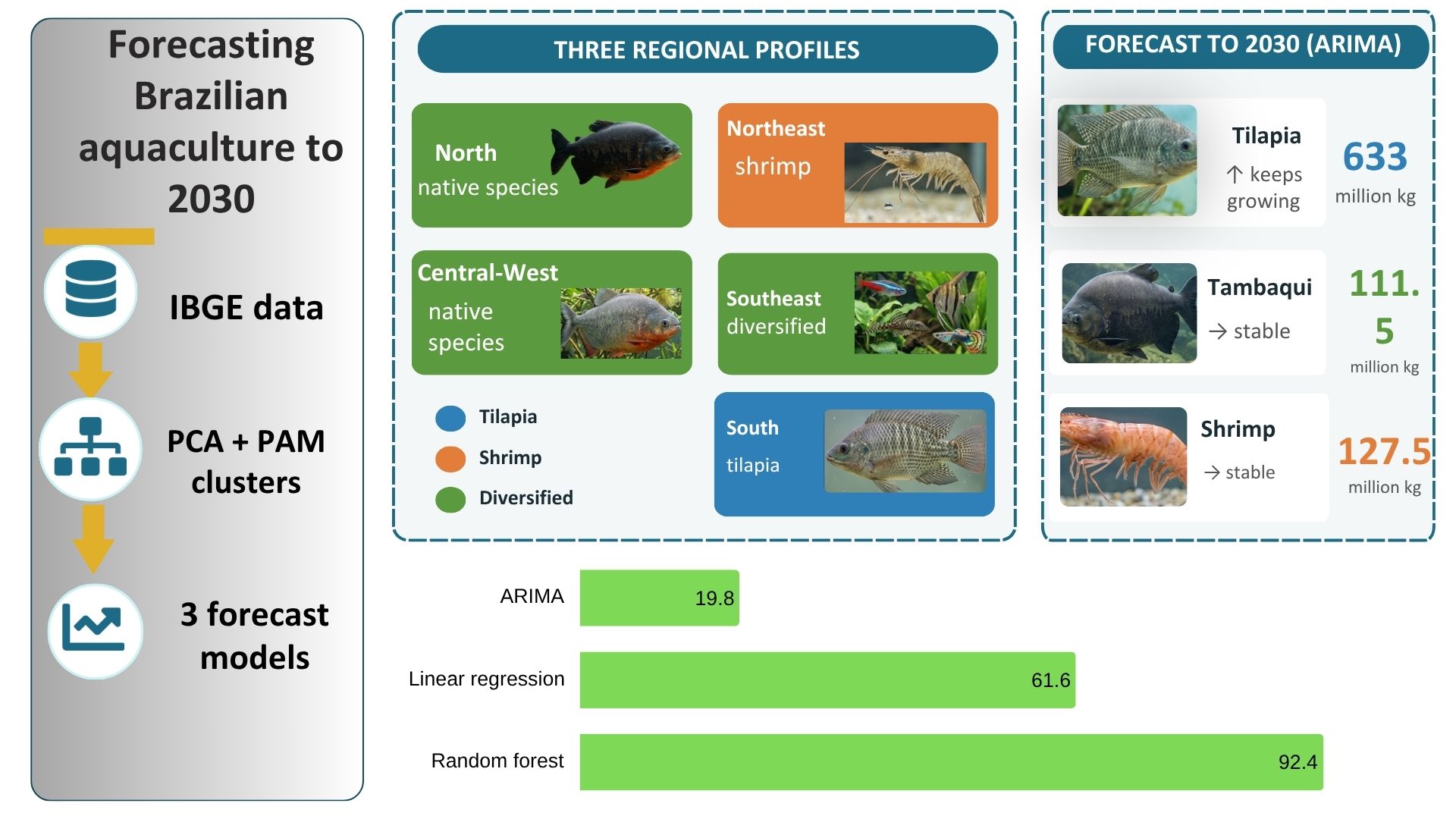
This study analyzed Brazilian aquaculture production between 2013 and 2023, focusing on tilapia, tambaqui, and shrimp, using official data from the Brazilian Institute of Geography and Statistics (IBGE). Principal Component Analysis (PCA) and PAM clustering identified three regional production profiles: the South, associated with tilapia farming; the Northeast, specialized in shrimp; and a third group (North, Central-West, and Southeast) with diversified production. Results highlight the strong growth of tilapia, consolidating its dominance in Brazilian aquaculture. Predictive models, including Linear Regression, ARIMA, and Random Forest, were evaluated using Mean Absolute Error (MAE). ARIMA showed the best performance, capturing temporal patterns and projecting continued tilapia growth until 2030, with stability for other species. Limitations include the use of aggregated annual data, which may not capture recent sectoral changes. The findings support planning and policy development in aquaculture.
References
Abdel-Hady, M. M., Zaki, M. A., Barrania, A. A., Abdel-Khalek, Z. M., & Haggag, S. M. (2025). Sustainable development of aquaculture in Egypt: A review of key challenges and solutions. Reviews in Fisheries Science & Aquaculture, 34(2), 146–174. https://doi.org/10.1080/23308249.2025.2531206
Associação Brasileira de Criadores de Camarão. (n.d.). Boletim Nacional da Carcinicultura. https://abccam.com.br/category/boletim-nacional/
Biau, G., & Scornet, E. (2016). A random forest guided tour. TEST, 25(2), 197–227. https://doi.org/10.1007/s11749-016-0481-7
Box, G. E. P., Jenkins, G. M., Reinsel, G. C., & Ljung, G. M. (2015). Time series analysis: Forecasting and control (5th ed.). John Wiley & Sons.
Carneiro, C. J., Brum, A. L., Thesing, N. J., & Prochnow, D. A. (2022). Cadeia produtiva da piscicultura: Um olhar para a evolução da tilapicultura no Brasil. Revista Perspectiva, 46(175), 25–34. https://doi.org/10.31512/persp.v46.n175.2022.223.p25-34
Cleveland, W. S. (1985). The elements of graphing data. Wadsworth Publishing.
de Fatima Vidal, M. (2022). Piscicultura. Caderno Setorial ETENE, 7(252).
Food and Agriculture Organization of the United Nations. (2024). The State of World Fisheries and Aquaculture 2024: Blue transformation in action. FAO.
Hu, J., Yin, J., Yang, C., Zhou, Y., & Li, C. (2025). Intelligent forecasting model for aquatic production based on artificial neural network. Frontiers in Marine Science, 12, 1556294. https://doi.org/10.3389/fmars.2025.1556294
Hyndman, R. J., & Athanasopoulos, G. (2018). Forecasting: Principles and practice (2nd ed.). OTexts.
Hyndman, R. J., & Koehler, A. B. (2006). Another look at measures of forecast accuracy. International Journal of Forecasting, 22(4), 679–688. https://doi.org/10.1016/j.ijforecast.2006.03.001
Instituto Brasileiro de Geografia e Estatística. (2023). Pesquisa da Pecuária Municipal: Produção da aquicultura.
Jolliffe, I. T., & Cadima, J. (2016). Principal component analysis: A review and recent developments. Philosophical Transactions of the Royal Society A: Mathematical, Physical and Engineering Sciences, 374(2065), 20150202. https://doi.org/10.1098/rsta.2015.0202
Kassambara, A. (2017). Unsupervised machine learning: Practical guide to cluster analysis in R. STHDA.
Kaufman, L., & Rousseeuw, P. J. (2009). Finding groups in data: An introduction to cluster analysis. John Wiley & Sons.
Little, R. J. A., & Rubin, D. B. (2002). Statistical analysis with missing data (2nd ed.). John Wiley & Sons.
Lukambagire, I., Matovu, B., Alkoyak-Yildiz, M., SN, R., & Sarfo, I. (2023). Relevance of data analytics in sustainable fisheries management: An evidence-based study. Acta Scientiarum Polonorum. Formatio Circumiectus, 22(4), 49–74. https://doi.org/10.15576/ASP.FC/2023.22.4.49
Nabi, N., Ahmed, I., Qadir, M., & Reshi, Q. M. (2025). Global Aquaculture: Scenarios and Nutritional Implications. In: Ahmed, I., Ahmad, I. (eds) Aquaculture: Enhancing Food Security and Nutrition. Springer, Cham. https://doi.org/10.1007/978-3-031-92858-1_6
Panagiotelis, A., Athanasopoulos, G., Gamakumara, P., & Hyndman, R. J. (2021). Forecast reconciliation: A geometric view with new insights on bias correction. International Journal of Forecasting, 37(1), 343–359. https://doi.org/10.1016/j.ijforecast.2020.02.004
Peixe BR – Associação Brasileira da Piscicultura. (2025). Anuário 2025 da Piscicultura. https://www.peixebr.com.br/anuario2025
Presenza, L., Galvão, J. A., & Armelin, D. A. (2025). Segmentation of the Brazilian aquatic food market: Analysis of consumption patterns and trends. Journal of Aquatic Food Product Technology, 34(6), 368–385. https://doi.org/10.1080/10498850.2025.2532502
Rather, M. A., Ahmad, I., Shah, A., Hajam, Y. A., Amin, A., Khursheed, S., Ahmad, I., & Rasool, S. (2024). Exploring opportunities of artificial intelligence in aquaculture to meet increasing food demand. Food Chemistry: X, 22, 101309. https://doi.org/10.1016/j.fochx.2024.101309
Rencher, A. C., & Christensen, W. F. (2012). Methods of multivariate analysis (3rd ed.). John Wiley & Sons.
Shumway, R. H., & Stoffer, D. S. (2017). ARIMA models. In Time series analysis and its applications: With R examples (4th ed., pp. 75–163). Springer. https://doi.org/10.1007/978-3-319-52452-8
Published
Issue
Section
License
Copyright (c) 2026 Murilo Henriqe Tank Fortunato, Karoline Moreira Barbuio, Juliana Antunes Galvão, Wagner Dos Anjos Carvalho

This work is licensed under a Creative Commons Attribution-NonCommercial 4.0 International License.
The author does not retain copyright or publication rights indefinitely. The author retains all moral rights, particularly the right of authorship and the right to the integrity of the article.