
In vitro propagation of purple-fleshed pitahaya (Selenicereus costaricensis) genotypes from seeds and areoles
DOI:
https://doi.org/10.17268/agroind.sci.2026.03.15Keywords:
exotic crop, in vitro propagation, explant rooting, quality plantlets, nutraceutical valueAbstract
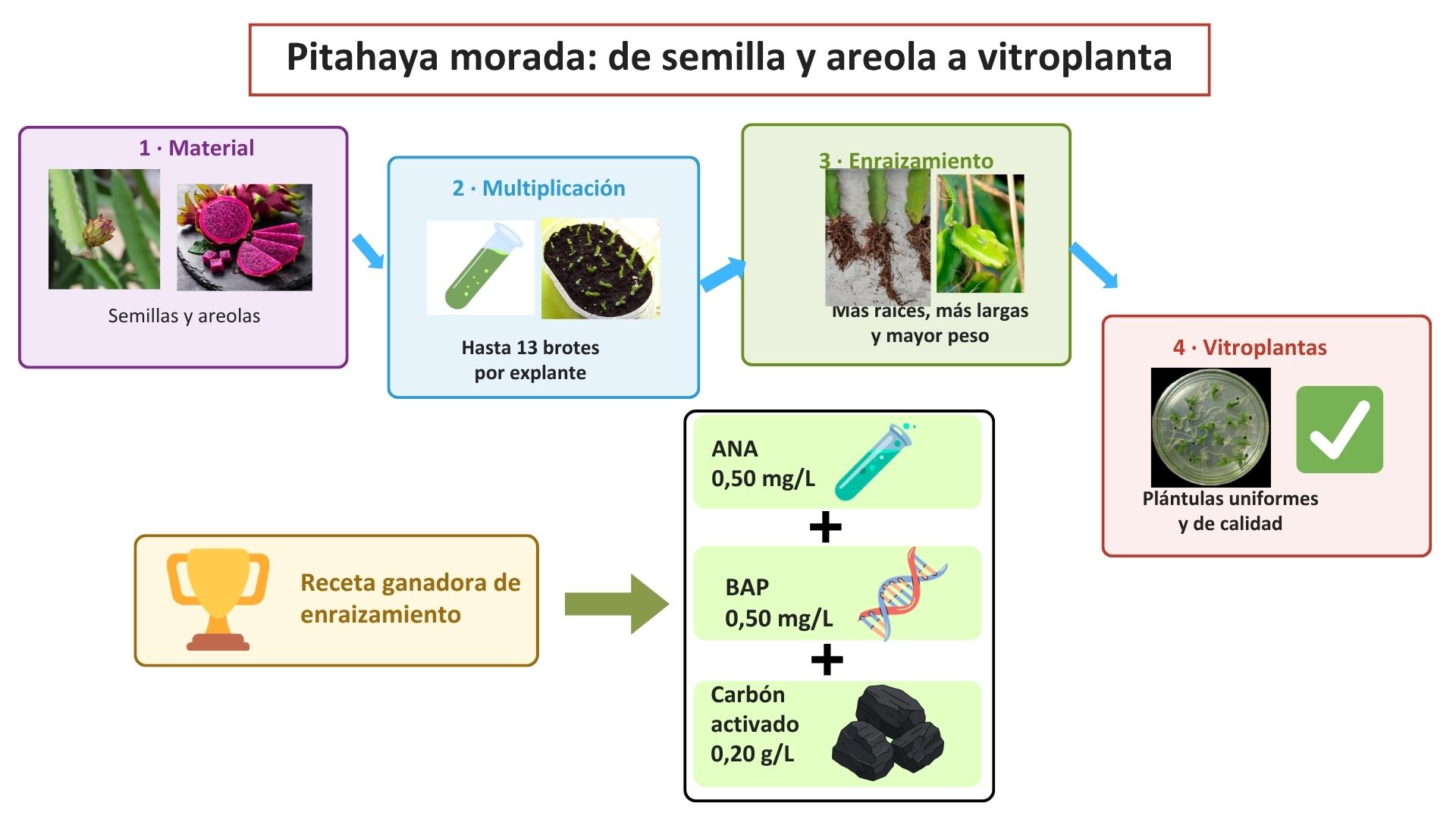
Purple-fleshed pitahaya is an exotic crop with growing agro-industrial potential, but its conventional propagation is limited by genetic variability, restricted availability of plant material, and slow crop growth. The objective of this research, conducted in two phases at the laboratory level, was to develop an alternative in vitro propagation method for purple-fleshed pitahaya genotypes from seeds and areoles to promote its cultivation in the province of Manabí. In the multiplication phase, two completely randomized trials with a factorial arrangement of auxin and cytokinin doses were performed in Murashige & Skoog culture medium. In the explant rooting phase, in the two completely randomized trials, auxin and cytokinin doses, as well as two levels of activated charcoal, were tested. The combination of 0 mg/L of auxin (IAA) and 2 mg/L of cytokinin (BAP) proved to be the optimal multiplication dose for both seeds and areoles. It was also determined that a mixture containing 0.50 mg/L of auxins (NAA) and 0.50 mg/L of cytokinins (BAP) promotes a better response in terms of the number and length of shoots. In the rooting of explants derived from seeds and areoles, the best response was achieved with 0.20 g/L of activated charcoal, 0.50 mg/L of auxins, and 0.50 mg/L of cytokinins, with significant effects on the number and length of roots, as well as on fresh weight, resulting in plantlets with high nutraceutical value.
References
Abughnia, E., Saleh, A., Belkair, S., Salem, M., & Lazrag, K. (2025). Evaluation Role of Activated Charcoal and Growth Regulators on Enhancement of Thymus Capitatus Micropropagation. Faculty of Science-Sirte University, 5(2), 1–8. https://doi.org/10.37375/issn.2789-858X
Ahmed, E., Hussien, E., Ahmed, M., Nasser, M., Razik, A., & Aly, H. (2026). Integrated media and plant growth regulators comparative evaluation for enhanced in vitro propagation and acclimatization of Selenicereus Costaricensis. BMC Plant Biol, 26, 1–14. https://doi.org/10.1186/s12870-026-08246-x
Bello, J., Schettino, S., Ortega, J., & Spinoso, J. (2021). A temporary immersion system for mass micropropagation of pitahaya (Hylocereus undatus). 3 Biotech, 11(10), 1–8. https://doi.org/10.1007/s13205-021-02984-5
Bettoni, J., Wang, M., & Wang, Q. (2024). In Vitro Regeneration, Micropropagation and Germplasm Conservation of Horticultural Plants. Horticulturae, 10(1), 1–5. https://doi.org/10.3390/horticulturae10010045
Bozkurt, T., İnan, S., & Dündar, İ. (2020). Micropropagation of Different Pitaya Varieties. International Journal of Agricultural and Natural Sciences, 13(1), 39–46.
Bozkurt, T., İnan, S., Dündar, İ., & Özdemir, S. (2022). Effect of Different Plant Growth Regulators on Micropropagation of Some Pitaya Varieties. Journal of Tropical Life Science, 12(2), 183–190. https://doi.org/10.11594/jtls.12.02.04
Canales, E., Navarro, B., Melgarejo, M., Ricky, P., Campos, Á., & Luis, G. (2025). Pitahaya (Hylocereus guatemalensis) explants from areoles: Protocol for in vitro regeneration regeneration and successful acclimatization. Scientia Agropecuaria, 16(3), 427–438. https://doi.org/10.17268/sci.agropecu.2025.033
Carmona, E., Conde, F., & Cesar, P. (2025). Progress towards in vitro shoot regeneration and genetic transformation in pitaya (Hylocereus undatus) cladode sections. Plant Biotechnology, 162(2), 1–10. https://doi.org/10.1007/s11240-025-03153-9
Chen, M., Li, R., Zhang, L., Zhang, B., Dong, X., Wang, S., Zhang, W., & Bai, X. (2026). Current progress on identifying chemical constituents, bioactivities, and food-industry applications of pitaya (Selenicereus spp.) whole plant. Frontiers in Nutrition, 13. https://doi.org/10.3389/fnut.2026.1886438
Cortés, C., Guerra, V., Blanca, V., & Rodríguez, A. (2023). Fancy (Cactaceae): Developmental responses to different explant types and hormone conditions. Plants, 12(23), 1–30. https://doi.org/10.3390/plants12233932
Dewir, Y., Habib, M., Alaizari, A., Malik, J., Al-ali, A., Al-qarawi, A., & Alwahibi, M. (2023). Promising Application of Automated Liquid Culture System and Arbuscular Mycorrhizal Fungi for Large-Scale Micropropagation of Red Dragon Fruit. Plants, 12(5), 1–13. https://doi.org/10.3390/ plants12051037
Gonzáles, G. (2020). Micropropagación in vitro de pitahaya amarilla (Selenicereus megalanthus Haw) a partir de tallos seleccionados de siembra comerciales, Limoncito - Santa Elena [Universidad Agraria del Ecuador].
Hamm, T., Boggess, S., Kandel, J., Staton, M., Huff, M. L., Hadziabdic, D., Shoemaker, D., Adamczyk, J., Nowicki, M., & Trigiano, R. (2022). Development and Characterization of 20 Genomic SSR Markers for Ornamental Cultivars of Weigela. Plants, 11(11), 1–12. https://doi.org/10.3390/plants11111444
Ismail, A., Abd El-kader, E., Eid, A., & Abdelsalam, E. (2022). Clonal Micropropagation of Purplish-Red Dragon Fruit (Selenicereus costaricensis) Newly Introduced To Egypt. Alfarama Journal of Basic & Applied Sciences, 4(2), 235–254. https://doi.org/10.21608/ajbas.2022.147236.1113
Izadi, S., Kunnummel, V., Steinkellner, H., Werner, S., & Castilho, A. (2023). Assessment of transient expression strategies to sialylate recombinant proteins in N. benthamiana. Biotechnology, 365, 48–53. https://doi.org/10.1016/j.jbiotec.2023.02.004
Kabir, M., Monirul, M., Das, P., & Mamun, A. (2024). In vitro regeneration of exotic fruit dragon (Hylocereus undatus) from stem fraction. Biological and Pharmaceutical Sciences Archive, 11(1), 40–47. https://doi.org/10.53771/ijbpsa.2024.7.1.0018
Lee, Y., & Chang, J. (2022). Development of an improved micropro-pagation protocol for red-fleshed pitaya ‘Da Hong’ with and without activated charcoal and plant growth regulator combinations. Horticulturae, 8(2), 1–17. https://doi.org/10.3390/horticulturae8020104
Maldonado-Cervantes, E., López-Palacios, C., Ramírez-Tobías, H. M., & Michel-Cuello, C. (2026). Evaluación morfo-química de frutos de pitaya de la Zona Media de San Luis Potosí. Ecosistemas y Recursos Agropecuarios, 13(2), e4309-e4309
Mállap, G., Vilca, N., Meléndez, J., Huaman, E., & Oliva, M. (2021). In vitro multiplication of yellow dragon fruit (Hylocereus megalanthus) from seedlings obtained in vitro. Agronomia Mesoamericana, 33(1), 1–13. https://doi.org/10.15517/am.v33i1.45472
Mustafa, S., & Saad, M. (2020). Propagation and Preservation of Hylocereus undatus via Tissue Culture Technique. Journal of Basic and Applied Scientific Research, 10(1), 7–12.
Neta, T., Santiago, D., Santos, W., Silva, J., Gallo, C., & Pinto, E. (2022). Micropropagation and acclimatization of two pitaya species under different concentrations of growth regulators and substrates. Research, Society and Development., 11(17), 1–15. https://doi.org/10.33448/rsd-v11i17.38756
Oo, K., Lynn, Z., Oo, K., Htwe, M., Htet, W., Soe, W., & Tun, W. (2023). In vitro Propagation of Three Pitaya Varieties (Hylocereus undatus, Hylocereus polyrhizus and Hylocereus megalanthus) with the Use of Different BAP Concentrations. Journal of Scientific and Innovative Research, 12(2), 33–39.
Pech, C., Salgado, P., Hernandez, A., & Muñoz, L. (2026). establishment and shoot development responses of Hylocereus undatus under plant growth regulator treatments. Crops, 6(1), 1–18. https://doi.org/10.3390/crops6010021
Reyes-Díaz, J. I., Nava-Becerril, R. M., & Arzate-Fernández, A. M. (2026). Respuesta morfogenética de Agave angustifolia al gradiente auxina-citocinina durante el desarrollo de embriones somáticos indirectos. Polibotánica, 61, 311-327.
Sabina, Y., Hasan, J., Hossain, S., Saha, S., & Khatun, F. (2022). Auxin and cytokinin synergism in micropropagation for mass production of Aloe vera. Computational Biology and Bionanotechnology, 103(3), 301–310. http://doi.org/10.5114/bta.2022.118672
Sarmiento, E., Luján, M., Porraz, M., Gutiérrez, F., & Santiz, J. (2025). Germinación de semillas y propagación in vitro de pitahaya (Hylocereus undatus). Biotecnia, 27, 1–7. https://doi.org/10.18633/biotecnia.v27.2366
Shah, K., Chen, J., Chen, J., & Qin, Y. (2023). Pitaya Nutrition , Biology , and Biotechnology : A Review. Molecular Sciences Review, 24(18), 1–28. https://doi.org/10.3390/ijms241813986
Sudiarta, I., Saputra, I., Singapurwa, N., Candra, I., & Semariyani, A. (2021). Ethanol and methanol levels of red dragon fruit wine (Selenicereus costaricensis) with the treatment of sugar and fermentation time. Journal of Physics: Conference Series, 1869(1), 1–5. https://doi.org/10.1088/1742-6596/1869/1/012032
Tineo, J. (2024). Efecto de diferentes dosis de ácido indolbutírico (aib) en el enraizamiento de pitahaya amarilla (Selenicereus megalanthus haw.) bajo condiciones de vivero en pucallpa [Universidad Nacional de Ucayali].
Trindade, A., Matias, P., Lacerda, V., Pestana, M., Marques, N., & Duarte, A. (2026). Pitaya as a New Alternative Crop for Iberian Peninsula : Cultural Practices. Plants, 15(5), 1–35. https://doi.org/10.3390/plants15050807
Trivellini, A., Lucchesini, M., Ferrante, A., Massa, D., Orlando, M., Incrocci, L., & Mensuali-Sodi, A. (2020). Pitaya, an attractive alternative crop for mediterranean region. Agronomy, 10(8), 1–19. https://doi.org/10.3390/agronomy10081065
Verona, A., Urcia, J., & Paucar, L. (2020). Pitahaya (Hylocereus spp.): Culture, physicochemical characteristics, nutritional composition, and bioactive compounds. Scientia Agropecuaria, 11(3), 439–453. https://doi.org/10.17268/sci.agropecu.2020.03.16
Downloads
Published
Issue
Section
License
Copyright (c) 2026 Elvis Loor-Marcillo, Andreina Armijos-Gaspar, Luis Duicela-Guambi, Veris Saldarriaga-Lucas

This work is licensed under a Creative Commons Attribution-NonCommercial 4.0 International License.
The author does not retain copyright or publication rights indefinitely. The author retains all moral rights, particularly the right of authorship and the right to the integrity of the article.