
First isolation and characterisation of the Steinernema carpocapsae/Xenorhabdus nematophila complex in Hidalgo, Mexico: Morphometric, molecular, and virulence insights
DOI:
https://doi.org/10.17268/sci.agropecu.2025.059Keywords:
Biological control, Morphometrics, Nematoda: Rhabditida, Symbiotic Bacterium, BioassaysAbstract
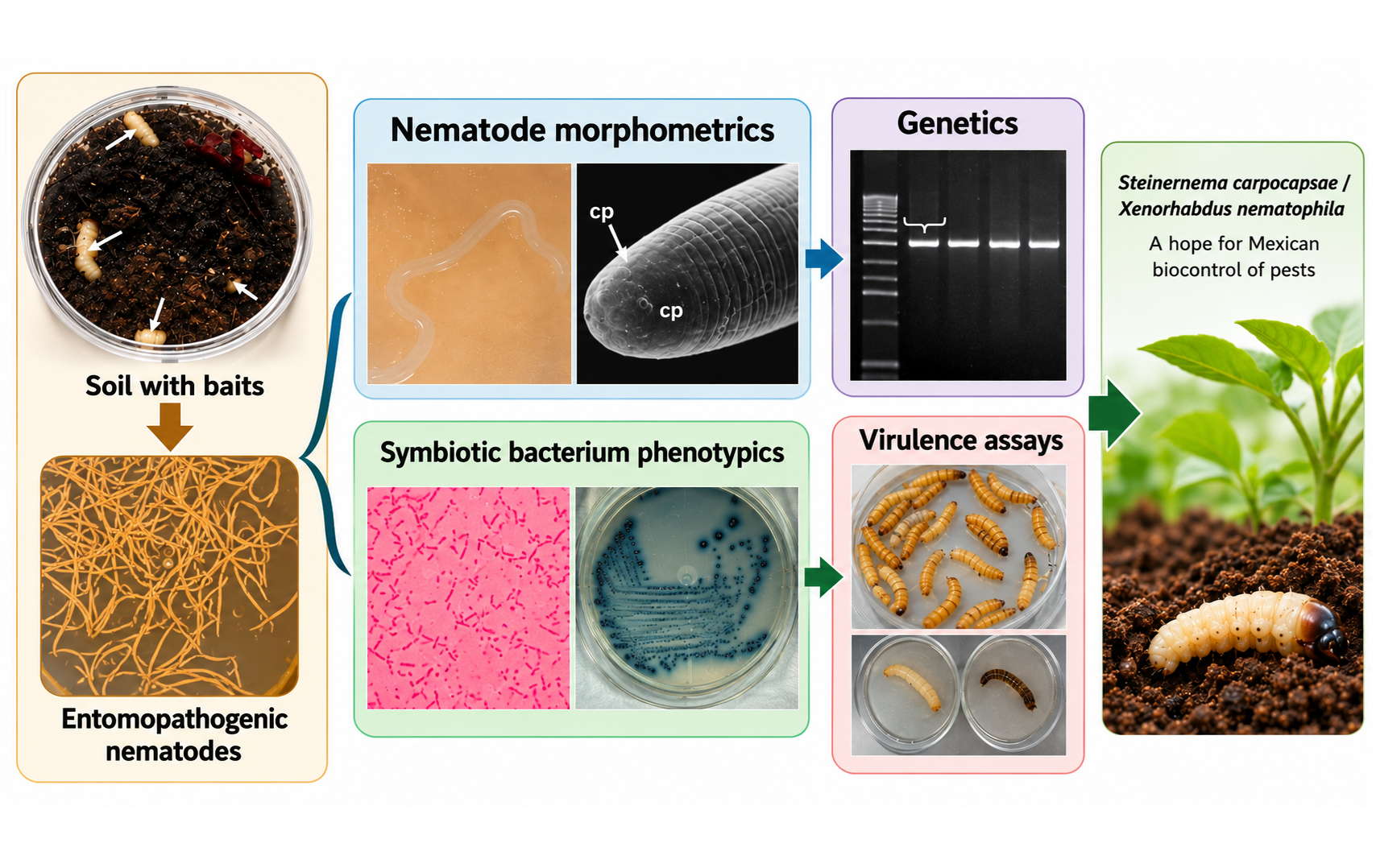
This is the first report on the isolation and full characterisation (i.e., morphological, molecular, virulence) of the entomopathogenic nematode/symbiotic bacterium complex, Steinernema carpocapsae / Xenorhabdus nematophila, in soils of the State of Hidalgo, Mexico. The nematode was characterised based on morphometrics with the aid of both light and scanning electron microscopy, and analysis of the internal transcribed spacer (ITS) region of the ribosomal DNA. The symbiotic bacterium was characterised based on its phenotypic characteristics (i.e., growth on nutrient agar plus bromothymol blue and triphenyltetrazolium chloride, and 17 biochemical tests) and analysis of the 16S rDNA gene sequencing. The constructed phylogenetic trees of both nematodes and bacteria were associated with bootstrap values of 99-100. The virulence of the infective juvenile (IJ) stages of the nematode was tested against larvae of Galleria mellonella at doses (IJ:larva): 1:1, 5:1, 10:1, 30:1, 60:1, and 100:1, resulting in mortality rates ranging from 22% (standard deviation, SD = 2) to 100% (SD = 1) in three days.
References
Ansen, S. P. H., Alan, A. P. M., Aran, J. M. H., Dunn, M. D., & Addison, P. (2024). Steinernema yirgalemense (Steinernematidae) to control Phlyctinus callosus and Phlyctinus xerophilus (Curculionidae). Nematology, 26(3), 239-254. https://doi.org/10.1163/15685411-bja10305
Avila-Lopez, M. B., Garcia-Maldonado, J. Q., Estrada-Medina, H., Hernandez-Mena, D. I., Cerqueda-Garcia, D., & Vidal-Martinez, V. M. (2021). First record of entomopathogenic nematodes from Yucatan State, Mexico and their infectivity capacity against Aedes aegypti. PeerJ, 9, e11633. https://doi.org/10.7717/peerj.11633
Campos-Herrera, R., Escuer, M., Labrador, S., Robertson, L., Barrios, L., & Gutierrez, C. (2007). Distribution of the entomopathogenic nematodes from La Rioja (Northern Spain). J Invertebr Pathol, 95(2), 125-139. https://doi.org/10.1016/j.jip.2007.02.003
Chandrakasan, G., Ávila López, M. B., Gastauer, M., Soto Zarazua, G. M., Sánchez Gutiérrez, A. E., & Martinez Cano, B. (2025). Distribution, Characterization, and Pathogenicity of Entomopathogenic Nematodes in Agricultural Crops in Amazcala, Querétaro. Agriculture, 15(15). https://doi.org/10.3390/agriculture15151603
Chang, V. C., Koutros, S., Hurwitz, L. M., Zhou, W., Andreotti, G., et al. (2025). The association between glyphosate use and mosaic loss of chromosome Y in buccal samples among male pesticide applicators in the Agricultural Health Study. Environ Int, 203, 109755. https://doi.org/10.1016/j.envint.2025.109755
Chavarría-Hernández, N., & de la Torre, M. (2001). Population growth kinetics of the nematode, Steinernema feltiae, in submerged monoxenic culture. Biotechnology Letters, 23, 311-315. https://doi.org/10.1023/A:1005694709366
Claasen, N. J., Dunn, M. D., & Malan, A. P. (2024). Selection of a South African Heterorhabditis bacteriophora Isolate for in vitro Liquid Mass Production for the Control of Thaumatotibia leucotreta in Grapevine. South African Journal of Enology and Viticulture, 45(2), 121-129. https://doi.org/10.21548/45-2-6571
Cortés-Martínez, C. I., & Chavarría-Hernández, N. (2020). Production of entomopathogenic nematodes in submerged monoxenic culture: A review. Biotechnology and Bioengineering, 117(12), 3968-3985. https://doi.org/10.1002/bit.27515
Cortes-Martínez, C. I., Rodríguez-Hernández, A. I., Avila-López, M. B., & Chavarría-Hernández, N. (2023). Impact of egg yolk type in liquid culture production of Steinernema carpocapsae JAP1 and their virulence. Biological Control, 184, Article 105279. https://doi.org/10.1016/j.biocontrol.2023.105279
Costa, J. C., Dias, R. J., & Morenz, M. J. (2007). Determining the adaptation potential of entomopathogenic nematode multiplication of Heterorhabditis riobravus and Steinernema carpocapsae (Rhabditida: Heterorhabditidae, Steinernematidae) in larvae of Alphitobius diaperinus (Coleoptera: Tenebrionidae) and Galleria mellonella (Lepidoptera: Pyralidae). Parasitol Res, 102(1), 139-144. https://doi.org/10.1007/s00436-007-0747-9
FAO. (2026). Pesticides use and trade – 1990–2024. FAOSTAT Analytical Briefs, No. 131. Rome. https://doi.org/https://doi.org/10.4060/ce0954en
Fischer-Le Saux, M., Arteaga-Hernandez, E., Mracek, Z., & Boemare, N. E. (1999). The bacterial symbiont Xenorhabdus poinarii (Enterobacteriaceae) is harbored by two phylogenetic related host nematodes: the entomopathogenic species Steinernema cubanum and Steinernema glaseri (Nematoda: Steinernematidae). FEMS Microbiology Ecology, 29, 149-157.
Georgis, R., & Hom, A. (1992). Introduction of Entomopathogenic Nematode Products into Latin America and the Caribbean. Nematropica, 22(1), 81-98.
Gobierno del Estado de Hidalgo. (2002). Enciclopedia de los Municipios de México. Estado de Hidalgo. Acatlán. In. México: INFDM-GEH.
Gontijo, L.-M., Torres, J.-B., Abram, P.-K., Alfaro-Tapia, A., Arredondo-Bernal, H.-C., et al. (2025). Insect biological control: a global perspective. Entomologia Generalis, 45(4), 879-904. https://doi.org/10.1127/entomologia/3237
Google Maps (2025). Google Maps. Available at: https://www.google.com/maps/ (accessed 1 May 2025)
Grifaldo-Alcantara, P. F., Alatorre-Rosas, R., Segura-León, O., & Hernandez-Rosas, F. (2017). Steinernema ralatorei n. sp. Isolated from Sugarcane Areas at Veracruz, Mexico. Southwestern Entomologist, 42(1), 171-190. https://doi.org/10.3958/059.042.0117
Hazir, S., Keskin, N., Stock, S. P., & Kaya, H. K. (2003). Diversity and distribution of entomopathogenic nematodes (Rhabditida: Steinernematidae and Heterorhabditidae) in Turkey. Biodiversity & Conservation, 12, 375-386.
Hominick, W. M. (2002). Biogeography. In R. Gaugler (Ed.), Entomopathogenic Nematology. CABI International.
Kaur, S., Thakur, N., & Yadav, A. N. (2024). Evaluation of Different Mass Production Techniques to Enhance the Progeny of Isolated Indigenous Entomopathogenic Nematodes from Indian Himalayan Region. National Academy Science Letters-India. https://doi.org/10.1007/s40009-024-01506-0
Kaya, H. K., & Patricia Stock, S. (1997). Chapter VI - Techniques in insect nematology. In L. A. Lacey (Ed.), Manual of Techniques in Insect Pathology (pp. 281-324). Academic Press. https://doi.org/10.1016/B978-012432555-5/50016-6
Kazimierczak, W., Lis, M., Skrzypek, T., & Kreft, A. (2017). Comparison of the methods applicable for the pathogenicity assessment of entomopathogenic nematodes. Biocontrol, 63(2), 289-298. https://doi.org/10.1007/s10526-017-9856-2
Kreick, L., Magarey, R. D., Love, M., & Carley, D. S. (2025). Can we resolve the pesticide quandary with eco-efficiency metrics? Frontiers in Agronomy, 7. https://doi.org/10.3389/fagro.2025.1660772
Kumar, S., Stecher, G., Suleski, M., Sanderford, M., Sharma, S., & Tamura, K. (2024). MEGA12: Molecular Evolutionary Genetic Analysis Version 12 for Adaptive and Green Computing. Molecular Biology and Evolution, 41(12). https://doi.org/10.1093/molbev/msae263
MEGA-Molecular Evolutionary Genetics Analysis. (2025). Available at: https://www.megasoftware.net (accessed 1 May 2025)
Molina-Ochoa, J., Lezama-Gutierrez, R., Gonzalez-Ramirez, M., Lopez-Edwards, M., Rodriguez-Vega, M. A., & Arceo-Palacios, F. (2003). Pathogens and parasitic nematodes associated with populations of fall armyworm (Lepidoptera: Noctuidae) larvae in Mexico. Florida Entomologist, 86(3), 244-253.
NCBI-National Center for Biotechnology Information (2025). Available at: http://www.ncbi.nlm.nih.gov/ (1 May 2025)
Nguyen, K. B., Puza, V., & Mracek, Z. (2008). Steinernema cholashanense n. sp. (Rhabditida, Steinernematidae) a new species of entomopathogenic nematode from the province of Sichuan, Chola Shan Mountains, China. J Invertebr Pathol, 97(3), 251-264. https://doi.org/10.1016/j.jip.2007.06.006
Nguyen, K. B., Shapiro-Ilan, D., Stuart, R. J., Mccoy, C. W., James, R. R., & Adams, B. J. (2004). Heterorhabditis mexicana n. sp. (Rhabditida: Heterorhabditidae) from Tamaulipas, Mexico, and morphological studies of the bursa of Heterorhabditis spp. Nematology, 6(2), 231-244.
Poinar, G. O. (1990). Taxonomy and Biology of Steinernematidae and Heterhabditidae. In R. Gaugler & H. K. Kaya (Eds.), Entomopathogenic Nematodes in Biological Control (pp. 23-61). CRC Press.
Qiu, L., Hu, X., Zhou, Y., Mei, S., Nguyen, K. B., & Pang, Y. (2005). Steinernema akhursti sp. n. (Nematoda: Steinernematidae) from Yunnan, China. J Invertebr Pathol, 90(3), 151-160. https://doi.org/10.1016/j.jip.2005.09.004
Ramakuwela, T., Tarasco, E., Chavarria-Hernandez, N., & Toepfer, S. (2025). Entomopathogenic nematodes: Commercial use and future perspectives. J Invertebr Pathol, 212, 108388. https://doi.org/10.1016/j.jip.2025.108388
Ruiz Vega, J., Aquino Bolaños, T., Kaya, H. K., & Stock, P. (2003). Colecta y evaluación de nemátodos entomopatógenos para el control de gallinas ciegas Phyllophaga vetula (Horn) en Oaxaca, México. Folia Entomol. Mex, 42(2), 169-175.
Saitou, N., & Nei, M. (1987). The neighbor-joining method: a new method for reconstructing phylogenetic trees. Molecular Biology and Evolution, 4(4), 406-425. https://doi.org/10.1093/oxfordjournals.molbev.a040454
Sambrook, J., & Russell, D. W. (2001). Molecular Cloning. A laboratory manual (3rd ed., Vol. 1). Cold Spring Harbor Laboratory Press.
Shapiro-Ilan, D. I., & Lewis, E. E. (Eds.). (2024). Entomopathogenic Nematodes as Biological Control Agents. CABI. https://doi.org/10.1079/9781800620322.0000.
Shishiniova, M., Budurova, L., & Gradinarov, D. (1998). Steinernema carpocapsae (Weiser, 1955) (Nematoda, Rhabditida) - new species for entomopathogenic fauna of Bulgaria. Experimental Pathology and Parasitology, 1, 30-35.
Singh, A. K., Patil, J., Nekkanti, A., Paschapur, A. U., Bhat, S., et al. (2025). Isolation, morphological, and molecular characterization of a native Heterorhabditis indica strain from the Mid-Indian Himalayas with insights into biocontrol potential. Front Plant Sci, 16, 1576159. https://doi.org/10.3389/fpls.2025.1576159
STAB VIDA, Lda (2015). Laboratorio STAB VIDA. Available at: https://www.stabvida.com/es
Stock, S. P., & Gress, J. C. (2006). Diversity and phylogenetic relationships of entomopathogenic nematodes (Steinernematidae and Heterorhabditidae) from the Sky Islands of southern Arizona. Journal of Invertebrate Pathology, 92(2), 66-72. https://doi.org/https://doi.org/10.1016/j.jip.2006.02.001
Stock, S. P., & Hunt, D. J. (2005). Morphology and Systematics of Nematodes Used in Biocontrol. In P. S. Grewal, R. U. Ehlers, & D. I. Shapiro-Ilan (Eds.), Nematodes as Biocontrol Agents (pp. 3-43). CABI International.
Stock, S. P., Rivera-Orduno, B., & Flores-Lara, Y. (2009). Heterorhabditis sonorensis n. sp. (Nematoda: Heterorhabditidae), a natural pathogen of the seasonal cicada Diceroprocta ornea (Walker) (Homoptera: Cicadidae) in the Sonoran desert. J Invertebr Pathol, 100(3), 175-184. https://doi.org/10.1016/j.jip.2008.11.011
Stuart, R. J., Barbercheck, M. E., Grewal, P. S., Taylor, R. A. J., & Hoy, C. W. (2006). Population biology of entomopathogenic nematodes: Concepts, issues, and models. Biological Control, 38(1), 80-102. https://doi.org/10.1016/j.biocontrol.2005.09.019
Suan, M. D., Nimkingrat, P., Aryal, S., Bhat, A. H., Noosidum, A., Ataya, F. S., & Sumaya, N. H. (2025). First Report of Oscheius colombianus (Nematoda: Rhabditidae) in the Philippines and Its Virulence Against Different Developmental Stages of the Common Cutworm, Spodoptera litura. Journal of Applied Entomology, 149(5), 795-810. https://doi.org/10.1111/jen.13418
Susurluk, I. A., & Ulu, T. C. (2015). Virulence comparisons of high-temperature-adapted Heterorhabditis bacteriophora, Steinernema feltiae and S. carpocapsae. Helminthologia, 52(2), 118-122.
Tailliez, P., Pages, S., Ginibre, N., & Boemare, N. (2006). New insight into diversity in the genus Xenorhabdus, including the description of ten novel species. Int J Syst Evol Microbiol, 56(Pt 12), 2805-2818. https://doi.org/10.1099/ijs.0.64287-0
Therese, M. O., & Bashey, F. (2012). Natal-host environmental effects on juvenile size, transmission success, and operational sex ratio in the entomopathogenic nematode Steinernema carpocapsae. J Parasitol, 98(6), 1095-1100. https://doi.org/10.1645/GE-3069.1
Treviño-Cueto, D., Mayorga, E. H., Subbotin, S., Siller, M. C., & Sanchez-Peña, S. R. (2023). Virulence and Reproduction of Entomopathogenic Nematodes Isolated from a Single Mexican Locality. Journal of Entomological Science, 58(4), 460-470. https://doi.org/10.18474/JES22-72
Veres, A., Wyckhuys, K. A. G., Kiss, J., Toth, F., Burgio, G., et al. (2020). An update of the Worldwide Integrated Assessment (WIA) on systemic pesticides. Part 4: Alternatives in major cropping systems. Environ Sci Pollut Res Int, 27(24), 29867-29899. https://doi.org/10.1007/s11356-020-09279-x
Villanueva-Sánchez, E., Ramírez-Alarcón, S., Villanueva-Verduzco, C., & Herbert-Pucheta, J. E. (2022). Native entomopathogenic nematodes in the cultivation of prickly pear in Milpa Alta, Mexico. 2022, 25(3). https://doi.org/10.56369/tsaes.4123
Vrain, T. C., Wakarchuk, D., Lévesque, A. C., & Hamilton, R. (1992). Intraspecific rDNA Restriction Fragment Length Polymorphism in the Xiphinema americanum group. Fundamental and Applied Nematology, 15(6), 563-573.
Weiser, J. (1955). Neoaplectana carpocapsae sp. n. (Anguillulata, Steinernematinae), nový cizopasník housenek obaleče jablečného, Carpocapsa pomonella L. Věstník Československé zoologické společnosti, 19, 44–52.
Woodring, J. L., & Kaya, H. K. (1988). Steinernematid and Heterorhabditid nematodes: A Handbook of Biology and Techniques. Arkansas, USA: Arkansas Agricultural Experiment Station.
Xi, J., Wu, T., Liu, L., Xu, Y., Lin, X., et al. (2027). Indigenous entomopathogenic nematodes from China for the biological control of Spodoptera litura (Lepidoptera: Noctuidae): a multistage evaluation. Crop Protection, 211. https://doi.org/10.1016/j.cropro.2026.107847
Downloads
Published
Issue
Section
License
Copyright (c) 2026 Scientia Agropecuaria

This work is licensed under a Creative Commons Attribution-NonCommercial 4.0 International License.
The authors who publish in this journal accept the following conditions:
a. The authors retain the copyright and assign to the magazine the right of the first publication, with the work registered with the Creative Commons attribution license, which allows third parties to use the published information whenever they mention the authorship of the work and the First publication in this journal.
b. Authors may make other independent and additional contractual arrangements for non-exclusive distribution of the version of the article published in this journal (eg, include it in an institutional repository or publish it in a book) as long as it clearly indicates that the work Was first published in this journal.
c. Authors are encouraged to publish their work on the Internet (for example, on institutional or personal pages) before and during the review and publication process, as it can lead to productive exchanges and a greater and faster dissemination of work Published (see The Effect of Open Access).