
Native arbuscular mycorrhizal fungi in tropical agroecosystems: Agronomic evidence, bioeconomic potential and research gaps in Ecuador
DOI:
https://doi.org/10.17268/sci.agropecu.2026.070Keywords:
arbuscular mycorrhizal fungi, native inoculants, bioeconomy, ecosystem services, tropical agriculture, EcuadorAbstract
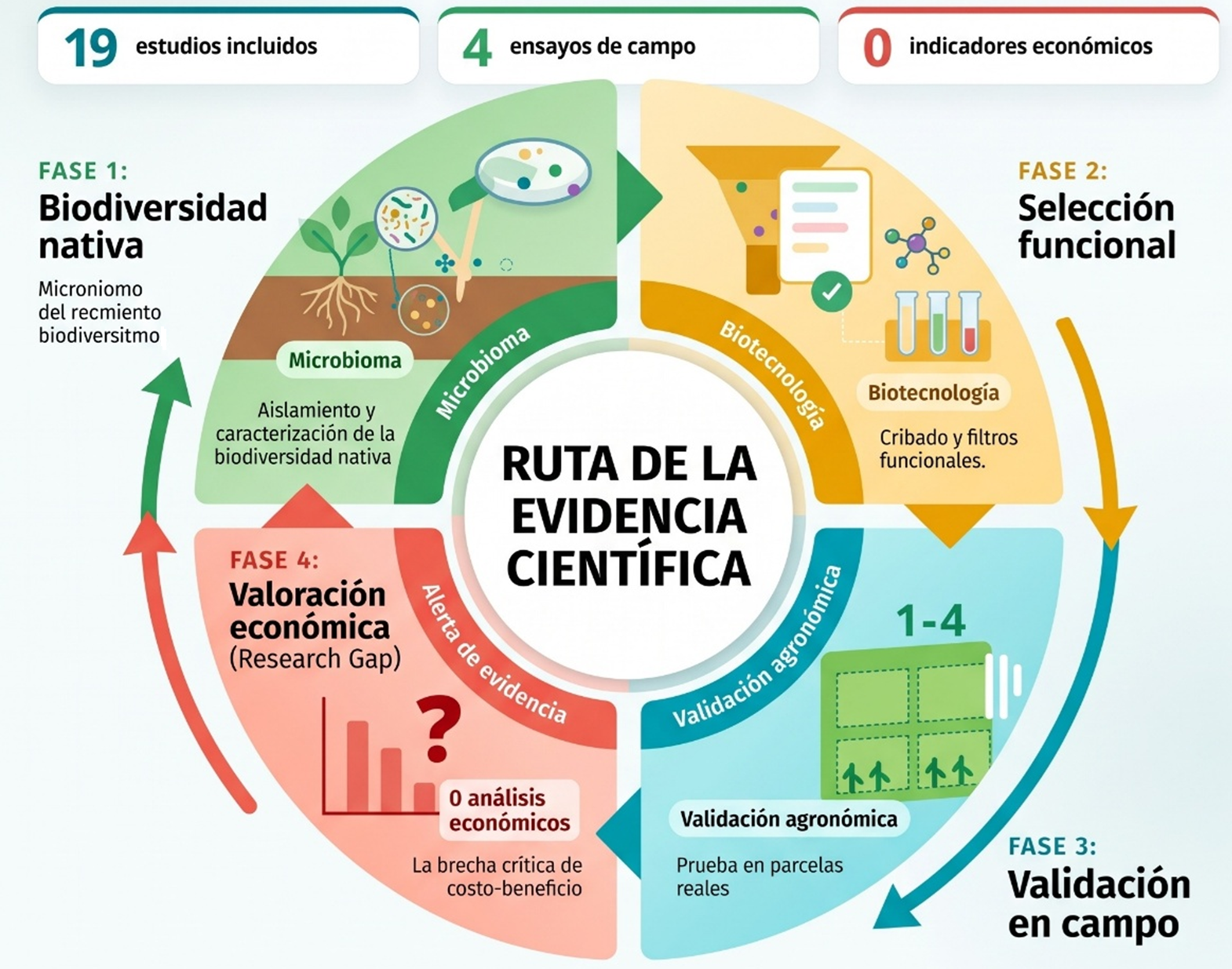
Native consortia of arbuscular mycorrhizal fungi (AMF) have been proposed as bio-inputs for low-fertility tropical soils. This systematized review examined which agronomic, ecological and economic evidence supports their use in tropical agroecosystems and which gaps limit it in Ecuador. Scopus, Web of Science and PubMed (2005–2026) and reference lists were searched; selection was reported following PRISMA 2020 and quality was appraised with Joanna Briggs Institute (JBI) checklists. Of 361 records, 234 were screened and, of 92 potentially eligible reports, 13 were assessed in full text. Twenty-five studies were included (11 from the databases and 14 from reference lists): 14 inoculation trials, 10 community studies and one review of mechanisms. Of the 24 primary studies, 19 were rated high quality, and 13 trials did not measure the response before inoculation. The four field trials recorded yield or nutritional gains over uninoculated controls. Two Ecuadorian greenhouse trials compared native inocula with commercial or exotic ones, with results favourable or equivalent to the native inoculum; no study made that comparison in the field or reported economic indicators. The three Ecuadorian field trials identified used imported inoculants, and of the twelve Ecuadorian studies included only one analysed soil from Amazonian agroecosystems. We propose a biotechnological sovereignty framework, a verifiable sequence from molecular identification to agronomic validation, and a phased route. Moving from potential resource to bioeconomic asset requires multi-season field trials that compare native consortia with commercial inoculants and record costs and benefits.
References
Agencia Ecuatoriana de Aseguramiento de la Calidad del Agro (AGROCALIDAD). (2017). Resolución 0046: Atribuciones y responsabilidades de la Coordinación General de Registros de Insumos Agropecuarios. Registro Oficial 1009.
Akpodé, C., Assogba, S. A., Hoteyi, S. M. I., Aguégué, M. R., Adoko, M. Y., Alao, L. T., et al. (2024). Impact of combinations of native arbuscular mycorrhizal fungi and mineral fertilizers on the production and nutrition of maize plants on ferruginous soil. Agricultural Research, 14(4), 782–793. https://doi.org/10.1007/s40003-024-00808-5
Akter, S., Kamruzzaman, Sarder, P., Amin, S., Joardar, J. C., Islam, S., et al. (2024). Mycorrhizal fungi increase plant nutrient uptake, aggregate stability and microbial biomass in the clay soil. Symbiosis, 93(2), 163–176. https://doi.org/10.1007/s13199-024-00994-4
Alguacil, M. M., Torrecillas, E., García-Orenes, F., & Roldán, A. (2014). Changes in the composition and diversity of AMF communities mediated by management practices in a Mediterranean soil are related with increases in soil biological activity. Soil Biology and Biochemistry, 76, 34–44. https://doi.org/10.1016/j.soilbio.2014.05.002
Arcidiacono, M., Ercoli, L., Piazza, G., & Pellegrino, E. (2025). Field inoculation with a local arbuscular mycorrhizal fungal consortium promotes sunflower agronomic traits without changing the composition of AM fungi coexisting inside the crop roots. Applied Soil Ecology, 206, 105830. https://doi.org/10.1016/j.apsoil.2024.105830
Arévalo-Granda, V., Hickey-Darquea, A., Prado-Vivar, B., Zapata, S., Duchicela, J., & van 't Hof, P. (2023). Exploring the mycobiome and arbuscular mycorrhizal fungi associated with the rhizosphere of the genus Inga in the pristine Ecuadorian Amazon. Frontiers in Fungal Biology, 4, 1086194. https://doi.org/10.3389/ffunb.2023.1086194
Asamblea Constituyente. (2008). Constitución de la República del Ecuador. Registro Oficial 449, 20 de octubre de 2008.
Asamblea Nacional del Ecuador. (2016). Código Orgánico de la Economía Social de los Conocimientos, Creatividad e Innovación. Registro Oficial Suplemento 899.
Asamblea Nacional del Ecuador. (2017a). Código Orgánico del Ambiente. Registro Oficial Suplemento 983.
Asamblea Nacional del Ecuador. (2017b). Ley Orgánica de Sanidad Agropecuaria. Registro Oficial Suplemento 27.
Avila-Salem, M. E., Montesdeoca, F., Orellana, M., Pacheco, K., Alvarado, S., Becerra, N., et al. (2020). Soil biological properties and arbuscular mycorrhizal fungal communities of representative crops established in the Andean region from Ecuadorian highlands. Journal of Soil Science and Plant Nutrition, 20(4), 2156–2163. https://doi.org/10.1007/s42729-020-00283-1
Barker, T. H., Habibi, N., Aromataris, E., Stone, J. C., Leonardi-Bee, J., Sears, K., et al. (2024). The revised JBI critical appraisal tool for the assessment of risk of bias for quasi-experimental studies. JBI Evidence Synthesis, 22(3), 378–388.
Boyno, G., Danesh, Y. R., Çevik, R., Teniz, N., Demir, S., Calayır, O., et al. (2025). Plant–fungus synergy against soil salinity: The cellular and molecular role of arbuscular mycorrhizal fungi. iScience, 28(9), 113384. https://doi.org/10.1016/j.isci.2025.113384
Capa-Morocho, M., Macas-Camacho, E., Ruilova, E. V., & Abad-Guamán, R. (2024). Influence of mycorrhizal fungi and nitrogen on the growth and yield of white maize in Ecuadorian Andes. AgriScientia, 41(2), 101–112. https://doi.org/10.31047/1668.298x.v41.n2.42721
Carballar-Hernández, S., Hernández-Cuevas, L. V., Montaño, N. M., Larsen, J., Ferrera-Cerrato, R., Taboada-Gaytán, O. R., et al. (2017). Native communities of arbuscular mycorrhizal fungi associated with Capsicum annuum L. respond to soil properties and agronomic management under field conditions. Agriculture, Ecosystems & Environment, 245, 43–51. https://doi.org/10.1016/j.agee.2017.05.004
Cardoso, E. J. B. N., Nogueira, M. A., & Zangaro, W. (2017). Importance of mycorrhizae in tropical soils. In J. Azevedo & M. Quecine (Eds.), Diversity and benefits of microorganisms from the tropics (pp. 245–267). Springer. https://doi.org/10.1007/978-3-319-55804-2_11
Ceballos, I., Ruiz, M., Fernández, C., Peña, R., Rodríguez, A., & Sanders, I. R. (2013). The in vitro mass-produced model mycorrhizal fungus, Rhizophagus irregularis, significantly increases yields of the globally important food security crop cassava. PLoS ONE, 8(8), e70633. https://doi.org/10.1371/journal.pone.0070633
Cely, M. V. T., de Oliveira, A. G., de Freitas, V. F., de Luca, M. B., Barazetti, A. R., dos Santos, I. M. O., et al. (2016). Inoculant of arbuscular mycorrhizal fungi (Rhizophagus clarus) increase yield of soybean and cotton under field conditions. Frontiers in Microbiology, 7, 720. https://doi.org/10.3389/fmicb.2016.00720
Ciccolini, V., Ercoli, L., Davison, J., Vasar, M., Öpik, M., & Pellegrino, E. (2016). Land-use intensity and host plant simultaneously shape the composition of arbuscular mycorrhizal fungal communities in a Mediterranean drained peatland. FEMS Microbiology Ecology, 92(12), fiw186. https://doi.org/10.1093/femsec/fiw186
Comunidad Andina. (1996). Decisión 391: Régimen común sobre acceso a los recursos genéticos. Gaceta Oficial del Acuerdo de Cartagena, 213.
Corazon-Guivin, M. A., Rengifo del Aguila, S., Corrêa, R. X., Cordova-Sinarahua, D., Costa Maia, L., Alves da Silva, D. K., et al. (2024). Native arbuscular mycorrhizal fungi promote Plukenetia volubilis growth and decrease the infection levels of Meloidogyne incognita. Journal of Fungi, 10(7), 451. https://doi.org/10.3390/jof10070451
De La Cruz, H. J., Marro, N., Caccia, M., Žďárská, K., & Janoušková, M. (2026). Competitive dynamics of arbuscular mycorrhizal fungi as depending on fungal traits and host plant species. Mycorrhiza, 36, 10. https://doi.org/10.1007/s00572-026-01254-7
Demir, S., Danesh, Y. R., Boyno, G., & Najafi, S. (2022). Arbuscular mycorrhizal fungi in biotic and abiotic stress conditions: Function and management in horticulture. In M. Seymen, E. S. Kurtar, C. Erdinc, & A. Kumar (Eds.), Sustainable horticulture (pp. 157–183). Academic Press. https://doi.org/10.1016/B978-0-323-91861-9.00011-2
Dhiman, M., Sharma, L., Kaushik, P., Singh, A., & Sharma, M. M. (2022). Mycorrhiza: An ecofriendly bio-tool for better survival of plants in nature. Sustainability, 14(16), 10220. https://doi.org/10.3390/su141610220
Djotan, A. K. G., Matsuda, Y., Matsushita, N., & Fukuda, K. (2026). Origin and cohabitation of arbuscular mycorrhizal fungi matter: Forest-derived Gigaspora species are promising candidates for bioinoculant development in forest tree production. Mycorrhiza, 36, 8. https://doi.org/10.1007/s00572-026-01253-8
EFSA PPR Panel, Ockleford, C., Adriaanse, P., Berny, P., Brock, T., Duquesne, S., et al. (2017). Scientific opinion addressing the state of the science on risk assessment of plant protection products for in-soil organisms. EFSA Journal, 15(2), e04690. https://doi.org/10.2903/j.efsa.2017.4690
Frew, A., Öpik, M., Oja, J., Vahter, T., Hiiesalu, I., & Aguilar-Trigueros, C. A. (2024). Herbivory-driven shifts in arbuscular mycorrhizal fungal community assembly: Increased fungal competition and plant phosphorus benefits. New Phytologist, 241(5), 1891–1899. https://doi.org/10.1111/nph.19474
Gagou, E., El Yeznasni, H., Chafai, W., Chakroune, K., Abbas, M., Lamkami, T., et al. (2026). Monoxenic root organ culture enables high-yield production of viable indigenous Rhizophagus irregularis inoculum for arid oasis agroecosystems. Microbiology Research, 17(1), 28. https://doi.org/10.3390/microbiolres17010028
Garcés-Ruiz, M., Senés-Guerrero, C., Declerck, S., & Cranenbrouck, S. (2019). Community composition of arbuscular mycorrhizal fungi associated with native plants growing in a petroleum-polluted soil of the Amazon region of Ecuador. MicrobiologyOpen, 8(4), e00703. https://doi.org/10.1002/mbo3.703
Ghorui, M., Chowdhury, S., & Burla, S. (2025). Recent advances in the commercial formulation of arbuscular mycorrhizal inoculants. Frontiers in Industrial Microbiology, 3, 1553472. https://doi.org/10.3389/finmi.2025.1553472
Giovannini, L., Palla, M., Agnolucci, M., Avio, L., Sbrana, C., Turrini, A., et al. (2020). Arbuscular mycorrhizal fungi and associated microbiota as plant biostimulants: Research strategies for the selection of the best performing inocula. Agronomy, 10(1), 106. https://doi.org/10.3390/agronomy10010106
Haug, I., Setaro, S., & Suárez, J. P. (2021). Global AM fungi are dominating mycorrhizal communities in a tropical premontane dry forest in Laipuna, South Ecuador. Mycological Progress, 20(6), 837–845. https://doi.org/10.1007/s11557-021-01699-4
Hijri, M. (2016). Analysis of a large dataset of mycorrhiza inoculation field trials on potato shows highly significant increases in yield. Mycorrhiza, 26, 209–214. https://doi.org/10.1007/s00572-015-0661-4
Hoeksema, J. D., Chaudhary, V. B., Gehring, C. A., Johnson, N. C., Karst, J., Koide, R. T., et al. (2010). A meta-analysis of context-dependency in plant response to inoculation with mycorrhizal fungi. Ecology Letters, 13(3), 394–407. https://doi.org/10.1111/j.1461-0248.2009.01430.x
Iglesias, L., Salas, E., Leblanc, H. A., & Nygren, P. (2011). Response of Theobroma cacao and Inga edulis seedlings to cross-inoculated populations of arbuscular mycorrhizal fungi. Agroforestry Systems, 83, 63–73. https://doi.org/10.1007/s10457-011-9400-9
Johnson, N. C. (1993). Can fertilization of soil select less mutualistic mycorrhizae? Ecological Applications, 3(4), 749–757. https://doi.org/10.2307/1942106
Johnson, N. C., Graham, J. H., & Smith, F. A. (1997). Functioning of mycorrhizal associations along the mutualism–parasitism continuum. New Phytologist, 135(4), 575–585. https://doi.org/10.1046/j.1469-8137.1997.00729.x
Karmakar, B., & Chakraborty, M. (2026). Plant-based dyes as eco-friendly alternative for visualization of arbuscular mycorrhizal fungi. Journal of Microbiological Methods, 242, 107416. https://doi.org/10.1016/j.mimet.2026.107416
Kouadio, A. N. M.-S., Nandjui, J., Krou, S. M., Séry, D. J.-M., Nelson, P., & Zézé, A. (2017). A native arbuscular mycorrhizal fungus inoculant outcompetes an exotic commercial species under two contrasting yam field conditions. Rhizosphere, 4, 112–118. https://doi.org/10.1016/j.rhisph.2017.10.001
Koziol, L., McKenna, T. P., & Bever, J. D. (2025). Meta-analysis reveals globally sourced commercial mycorrhizal inoculants fall short. New Phytologist, 246(3), 821–827. https://doi.org/10.1111/nph.20278
Loján, P., Senés-Guerrero, C., Suárez, J. P., Kromann, P., Schüßler, A., & Declerck, S. (2017). Potato field-inoculation in Ecuador with Rhizophagus irregularis: No impact on growth performance and associated arbuscular mycorrhizal fungal communities. Symbiosis, 73(1), 45–56. https://doi.org/10.1007/s13199-016-0471-2
Lucas, L. S., Ramos, M. L. G., Souza, R. F., Moura, J. B., & Vieira Junior, W. G. (2025). Mycorrhizae and soil pathogens in tropical regions. In Q. S. Wu (Ed.), Management of mycorrhizal symbiosis for mycoremediation and phytostabilization (pp. 261–272). Elsevier. https://doi.org/10.1016/B978-0-443-24863-4.00015-7
Lumini, E., Vallino, M., Alguacil, M. M., Romani, M., & Bianciotto, V. (2011). Different farming and water regimes in Italian rice fields affect arbuscular mycorrhizal fungal soil communities. Ecological Applications, 21(5), 1696–1707. https://doi.org/10.1890/10-1542.1
Marrassini, V., Ercoli, L., Kuramae, E. E., Kowalchuk, G. A., & Pellegrino, E. (2024). Arbuscular mycorrhizal fungi originated from soils with a fertility gradient highlight a strong intraspecies functional variability. Applied Soil Ecology, 197, 105344. https://doi.org/10.1016/j.apsoil.2024.105344
Marrassini, V., Ercoli, L., Cardelli, R., Cantini, V., & Pellegrino, E. (2026). Lack of complementary or synergistic benefits of arbuscular mycorrhizal fungi (AMF) and organic amendments but functional differentiation among AMF species in a maize–wheat rotation. Science of the Total Environment, 1012, 181292. https://doi.org/10.1016/j.scitotenv.2025.181292
Marro, N., Grilli, G., Soteras, F., Caccia, M., Longo, S., Cofré, N., et al. (2022). The effects of arbuscular mycorrhizal fungal species and taxonomic groups on stressed and unstressed plants: A global meta-analysis. New Phytologist, 235, 320–332. https://doi.org/10.1111/nph.18102
Michel, J., Lehnert, M., Nebel, M., & Quandt, D. (2025). Low and facultative mycorrhization of ferns in a low-montane tropical rainforest in Ecuador. PLoS ONE, 20(7), e0326712. https://doi.org/10.1371/journal.pone.0326712
Moola, S., Munn, Z., Tufanaru, C., Aromataris, E., Sears, K., Sfetcu, R., et al. (2024). Systematic reviews of etiology and risk. In E. Aromataris, C. Lockwood, K. Porritt, B. Pilla, & Z. Jordan (Eds.), JBI manual for evidence synthesis. JBI.
Nagy, V., Sándor, R., Klem, K., & Urban, O. (2026). Functional limitations of glomalin-related soil protein as an indicator of arbuscular mycorrhizal fungi while remaining relevant to soil health. Soil Biology and Biochemistry, 214, 110076. https://doi.org/10.1016/j.soilbio.2025.110076
Naranjo-Morán, J., Olivo-Fernández, K., Barcos-Arias, M., & Oviedo-Archundia, R. (2025). Choice of trap plant and substrate for mycorrhizal inoculum production. La Granja, 42(2), 78–89. https://doi.org/10.17163/lgr.n42.2025.05
Naranjo-Moran, J., Pincay-Orrala, Z., & Navarrete-Mite, T. (2026). Autotrophic in vitro culture method, inoculated with native arbuscular mycorrhizae, for the adaptation of trap plants of the Asteraceae family. Scientia Agropecuaria, 17(1), 67–75. https://doi.org/10.17268/sci.agropecu.2026.004
Nath, D., Kumari, V., & Durga, M. L. (2025). Optimizing plant growth and resilience under abiotic stresses through arbuscular mycorrhizal symbiosis. In H. I. Mohamed (Ed.), Elicitors for sustainable crop production (pp. 169–185). Springer. https://doi.org/10.1007/978-981-95-3533-0_7
Njaramanana, N. M. R., Rahetlah, V. B., Trap, J., & Autfray, P. (2022). Field arbuscular mycorrhizal inoculation increased plant performance without phosphorus fertilizer supply of four promoted upland rice varieties in Madagascar. Experimental Agriculture, 58, e57. https://doi.org/10.1017/S0014479722000527
Pacheco Flores de Valgaz, A., Naranjo-Morán, J., Reyes Román, G., Oviedo-Anchundia, J., Ratti Torres, M., & Barcos-Arias, M. (2022). Discovering the diversity of arbuscular mycorrhizal fungi associated with two cultivation practices of Theobroma cacao. Diversity, 14(8), 651. https://doi.org/10.3390/d14080651
Page, M. J., McKenzie, J. E., Bossuyt, P. M., Boutron, I., Hoffmann, T. C., Mulrow, C. D., et al. (2021). The PRISMA 2020 statement: An updated guideline for reporting systematic reviews. BMJ, 372, n71. https://doi.org/10.1136/bmj.n71
Presidencia de la República del Ecuador. (2011). Decreto Ejecutivo 905: Reglamento nacional al régimen común sobre acceso a los recursos genéticos en aplicación a la Decisión 391 de la Comunidad Andina. Registro Oficial Suplemento 553.
Presidencia de la República del Ecuador. (2019). Decreto Ejecutivo 752: Reglamento al Código Orgánico del Ambiente. Registro Oficial Suplemento 507.
Presidencia de la República del Ecuador. (2025). Decreto Ejecutivo 100.
Quilambo, O. A., Weissenhorn, I., Doddema, H., Kuiper, P. J. C., & Stulen, I. (2005). Arbuscular mycorrhizal inoculation of peanut in low-fertile tropical soil. II. Alleviation of drought stress. Journal of Plant Nutrition, 28(9), 1645–1662. https://doi.org/10.1080/01904160500203606
Rayo Sánchez, C. L., & Avellaneda-Torres, L. M. (2022). Efecto de la aplicación de hongos micorrízicos arbusculares sobre microorganismos del ciclo del nitrógeno en suelos cultivados con café. Ciencia y Tecnología Agropecuaria, 23(3), 2342. https://doi.org/10.21930/rcta.vol23_num3_art:2342
Sakha, M., Gweyi-Onyango, J. P., Kaushal, M., Baijukya, F. P., & Masso, C. (2025). Native arbuscular mycorrhizal fungal communities in trap cultures are shaped by traditional host plants and agricultural soils. Journal of Fungi, 11(11), 792. https://doi.org/10.3390/jof11110792
Salomon, M. J., Watts-Williams, S. J., McLaughlin, M. J., Bücking, H., Singh, B. K., Hutter, I., et al. (2022). Establishing a quality management framework for commercial inoculants containing arbuscular mycorrhizal fungi. iScience, 25(7), 104636. https://doi.org/10.1016/j.isci.2022.104636
Secretaría del Convenio sobre la Diversidad Biológica. (s. f.). Access and Benefit-Sharing Clearing-House: Ecuador.
SENESCYT & Ministerio del Ambiente. (2018). Acuerdo Interministerial SENESCYT-MAE-2018-001: Lineamientos y directrices para la coordinación interinstitucional relativa a procesos administrativos relacionados con autorizaciones, permisos y contratos de acceso a recursos biológicos, genéticos y sus derivados, asociados o no a conocimientos tradicionales.
Séry, D. J.-M., Kouadjo, Z. G. C., Voko, B. R. R., & Zézé, A. (2016). Selecting native arbuscular mycorrhizal fungi to promote cassava growth and increase yield under field conditions. Frontiers in Microbiology, 7, 2063. https://doi.org/10.3389/fmicb.2016.02063
Sisalima-Ortega, L., Ruilova, V., & Capa-Morocho, M. (2023). Efecto de inoculación micorrízica en la etapa productiva del cacao nacional (Theobroma cacao L.) en la Amazonía ecuatoriana. CEDAMAZ, 13(1), 17–24. https://doi.org/10.54753/cedamaz.v13i1.1742
Smith, S. E., & Read, D. J. (2008). Mycorrhizal symbiosis (3rd ed.). Academic Press.
Sofi, M. N., Bhat, R. A., Rashid, A., Mir, N. A., Mir, S. A., & Lone, R. (2017). Rhizosphere mycorrhizae communities: An input for organic agriculture. In A. Varma, R. Prasad, & N. Tuteja (Eds.), Mycorrhiza (pp. 387–413). Springer. https://doi.org/10.1007/978-3-319-68867-1_21
Stewart, J. D., Ramirez, D. X., León-Reyes, A., Barriga, N., Llerena, S., Manley, B. F., et al. (2026). Land use change reshapes climate-driven diversity patterns of tropical arbuscular mycorrhizal fungi. Molecular Ecology, 35(2), e70253. https://doi.org/10.1111/mec.70253
Stürmer, S. L., Bever, J. D., Schultz, P. A., & Bentivenga, S. P. (2021). Celebrating INVAM: 35 years of the largest living culture collection of arbuscular mycorrhizal fungi. Mycorrhiza, 31(1), 117–126. https://doi.org/10.1007/s00572-020-01008-z
Symanczik, S., Gisler, M., Thonar, C., Schlaeppi, K., Van der Heijden, M., Kahmen, A., et al. (2017). Application of mycorrhiza and soil from a permaculture system improved phosphorus acquisition in naranjilla. Frontiers in Plant Science, 8, 1263. https://doi.org/10.3389/fpls.2017.01263
Tchabi, A., Coyne, D., Hountondji, F., Lawouin, L., Wiemken, A., & Oehl, F. (2010). Efficacy of indigenous arbuscular mycorrhizal fungi for promoting white yam (Dioscorea rotundata) growth in West Africa. Applied Soil Ecology, 45(2), 92–100. https://doi.org/10.1016/j.apsoil.2010.03.001
Tedersoo, L., Bahram, M., & Zobel, M. (2020). How mycorrhizal associations drive plant population and community biology. Science, 367(6480), eaba1223. https://doi.org/10.1126/science.aba1223
Turrini, A., & Giovannetti, M. (2012). Arbuscular mycorrhizal fungi in national parks, nature reserves and protected areas worldwide: A strategic perspective for their in situ conservation. Mycorrhiza, 22(2), 81–97. https://doi.org/10.1007/s00572-011-0419-6
Van Nuland, M. E., Averill, C., Stewart, J. D., Prylutskyi, O., Corrales, A., van Galen, L. G., et al. (2025). Global hotspots of mycorrhizal fungal richness are poorly protected. Nature, 645(8080), 414–422. https://doi.org/10.1038/s41586-025-09277-4
Větrovský, T., Kolaříková, Z., Lepinay, C., Awokunle Hollá, S., Davison, J., Fleyberková, A., et al. (2023). GlobalAMFungi: A global database of arbuscular mycorrhizal fungal occurrences from high-throughput sequencing metabarcoding studies. New Phytologist, 240(5), 2151–2163. https://doi.org/10.1111/nph.19283
Viera, W., Campaña, D., Lastra, A., Vásquez, W., Viteri, P., & Sotomayor, A. (2017). Micorrizas nativas y su efecto en dos portainjertos de tomate de árbol (Solanum betaceum Cav.). Bioagro, 29(2), 105–114.
Vivanco Galván, O., Sánchez-Rodríguez, A., & Suárez, J. P. (2020). Wild Solanum cajanumensis species as a potential reservoir of arbuscular mycorrhizal fungi diversity compatible with cultivated Solanum betaceum species. Agriculture and Natural Resources, 54(5), 567–574. https://doi.org/10.34044/j.anres.2020.54.5.15
Wu, Y., Chen, C., & Wang, G. (2024). Inoculation with arbuscular mycorrhizal fungi improves plant biomass and nitrogen and phosphorus nutrients: A meta-analysis. BMC Plant Biology, 24, 960. https://doi.org/10.1186/s12870-024-05638-9
Xia, G., Zhu, S., Zhao, W., Yang, X., Sheng, L., & Mao, H. (2023). Arbuscular mycorrhizal fungi alter rhizosphere fungal community characteristics of Acorus calamus to improve Cr resistance. PeerJ, 11, e15681. https://doi.org/10.7717/peerj.15681
Xu, Y., Chen, Z., Li, X., Tan, J., Liu, F., & Wu, J. (2023). The mechanism of promoting rhizosphere nutrient turnover for arbuscular mycorrhizal fungi attributes to recruited functional bacterial assembly. Molecular Ecology, 32(9), 2335–2350. https://doi.org/10.1111/mec.16880
Yang, X., Yuan, M., Guo, J., Shi, L., & Zhang, T. (2021). Suppression of arbuscular mycorrhizal fungi aggravates the negative interactive effects of warming and nitrogen addition on soil bacterial and fungal diversity and community composition. Applied and Environmental Microbiology, 87(22), e01523-21. https://doi.org/10.1128/AEM.01523-21
Yonas, M. W., & Zawar, S. (2024). Optimizing chickpea growth: Unveiling the interplay of arbuscular mycorrhizal fungi and rhizobium for sustainable agriculture. Soil Use and Management, 40(2), e13057. https://doi.org/10.1111/sum.13057
Yue, J., He, Y., Ma, W., Zhao, C., Liu, Y., Zhang, L., et al. (2026). Arbuscular mycorrhizal fungi mitigate microplastic-induced shifts in soil nematode communities. Applied Soil Ecology, 219, 106765. https://doi.org/10.1016/j.apsoil.2025.106765
Zhang, E., Wang, Y., Chen, S., Zhou, D., Shangguan, Z., Huang, J., et al. (2024). Mycorrhizal symbiosis increases plant phylogenetic diversity and regulates community assembly in grasslands. Ecology Letters, 27(9), e14516. https://doi.org/10.1111/ele.14516
Downloads
Additional Files
Published
Issue
Section
License
Copyright (c) 2026 Scientia Agropecuaria

This work is licensed under a Creative Commons Attribution-NonCommercial 4.0 International License.
The authors who publish in this journal accept the following conditions:
a. The authors retain the copyright and assign to the magazine the right of the first publication, with the work registered with the Creative Commons attribution license, which allows third parties to use the published information whenever they mention the authorship of the work and the First publication in this journal.
b. Authors may make other independent and additional contractual arrangements for non-exclusive distribution of the version of the article published in this journal (eg, include it in an institutional repository or publish it in a book) as long as it clearly indicates that the work Was first published in this journal.
c. Authors are encouraged to publish their work on the Internet (for example, on institutional or personal pages) before and during the review and publication process, as it can lead to productive exchanges and a greater and faster dissemination of work Published (see The Effect of Open Access).