Morpho-physiological, water productivity and hyperspectral responses of lettuce to regulated deficit irrigation and mulching: Plastic mulch sustains yield under a 14-day pre-harvest deficit at 70% ETc
DOI:
https://doi.org/10.17268/sci.agropecu.2025.065Keywords:
Crop production, Lactuca sativa L., productive efficiency, yieldAbstract
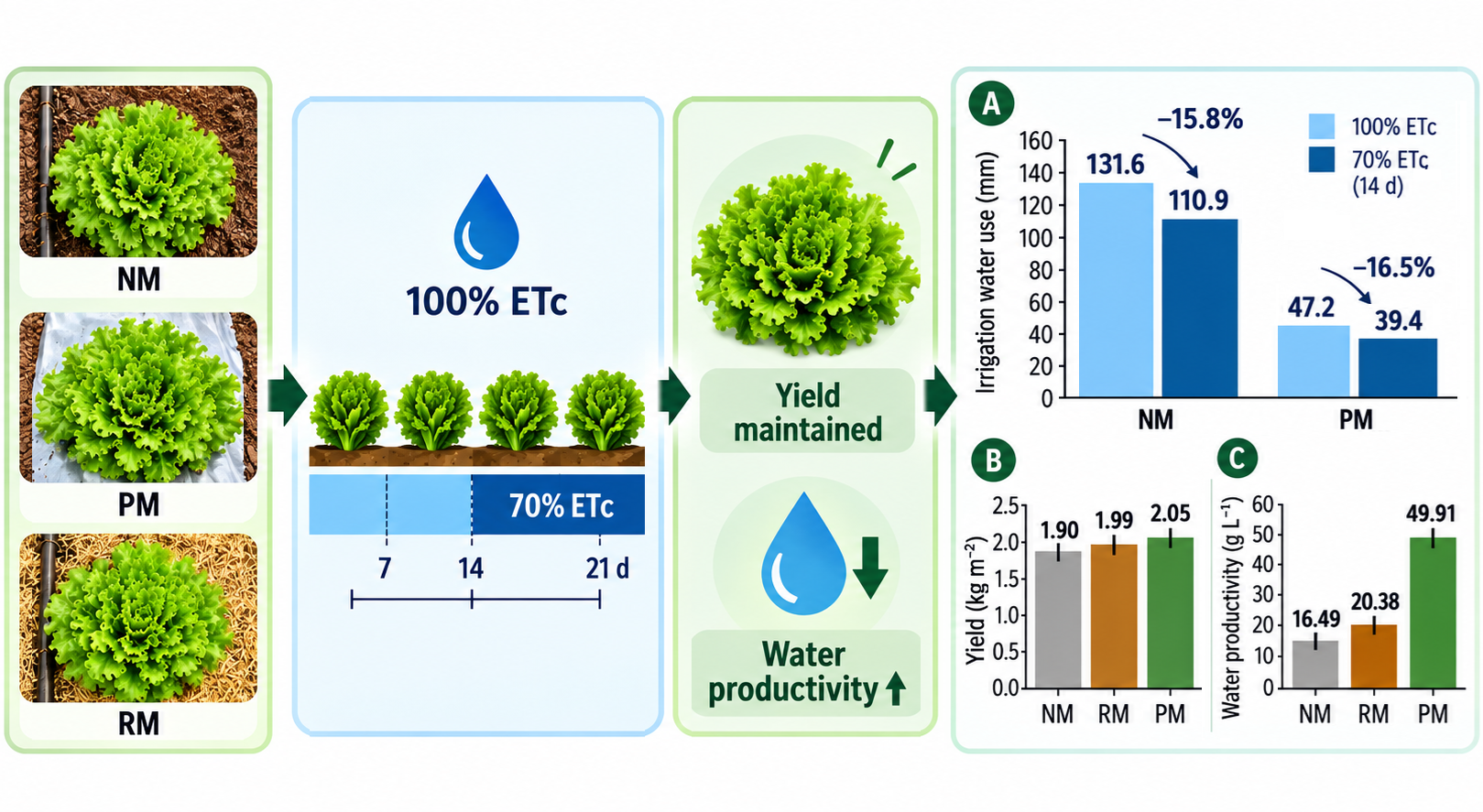
Regulated deficit irrigation (RDI) combined with soil mulching may reduce irrigation requirements while limiting yield losses in leafy vegetables. This study evaluated the morpho-physiological, productive, and hyperspectral responses of lettuce subjected to pre-harvest RDI under different mulching conditions. The experiment was conducted in a protected environment using a randomized block design with three soil cover conditions (no mulch, double-sided black-and-white plastic mulch, and rice straw mulch), four periods of RDI imposed before harvest (0, 7, 14, and 21 days), and four replications. During the deficit periods, irrigation was reduced to 70% of crop evapotranspiration (ETc), which was determined daily using constant water-table lysimeters. A 14-day RDI period reduced the irrigation depth from 131.6 to 110.9 mm without mulch and from 47.2 to 39.4 mm with plastic mulch, corresponding to water savings of 15.8 and 16.5%, respectively. Plastic mulch resulted in the highest overall yield (2.05 kg/m²) and water productivity (49.91 g/L), compared with 1.90 kg/m² and 16.49 g/L without mulch. Lettuce maintained shoot fresh mass and yield under plastic mulch when irrigation at 70% ETc was imposed during the 14 days preceding harvest, whereas extending the deficit to 21 days reduced plant growth and yield and increased electrolyte leakage. These responses were also reflected in the spectral behavior of the plants. Therefore, combining plastic mulch with irrigation at 70% ETc during the final 14 days before harvest reduced irrigation water use by 16.5% while maintaining lettuce yield, indicating a defined pre-harvest window for reducing water application without a significant productive penalty.
References
Adhikari, B., Olorunwa, O. J., Wilson, J., Barickman, T. C., & Walters, K. J. (2025). Morpho-physiological, leaf hyperspectral, and nutritional responses of lettuce to salt stress. Plant Physiology Reports, 30, 721–735. https://doi.org/10.1007/s40502-025-00885-w
Almeida, W. F., Lima, L. A., & Pereira, G. M. (2015). Drip pulses and soil mulching effect on American crisphead lettuce yield. Engenharia Agrícola, 35(6), 1009–1018. https://doi.org/10.1590/1809-4430-Eng.Agric.v35n6p1009-1018/2015
Andrian, A., Rezende, R., Soares Wenneck, G., Villa e Vila, V., de Souza Terassi, D., & Maldonado da Silva, L. H. (2022). Water requirements and fruit development rate of Cantaloupe melons cultivated in summer-autumn. Comunicata Scientiae, 13, e3879. https://doi.org/10.14295/cs.v13.3879
Bonetti, J. A., & Fink, J. R. (2020). Manejo e conservação da água e do solo. Editora UFLA.
Bueno, J. B., & Rodrigues, G. A. (2019). Palha sobre o solo no crescimento da cultura do nabo forrageiro em área degradada. Revista Interface Tecnológica, 16(1), 370–377. https://doi.org/10.31510/infa.v16i1.548
Campos, P. S., & Pham Thi, A. T. (1997). Effects of an abscisic acid pretreatment on membrane leakage and lipid composition of Vigna unguiculata leaf discs subjected to osmotic stress. Plant Science, 130(1), 11–18. https://doi.org/10.1016/S0168-9452(97)00199-4
Cataldo, D. A., Maroon, M., Schrader, L. E., & Youngs, V. L. (1975). Rapid colorimetric determination of nitrate in plant tissue by nitration of salicylic acid. Communications in Soil Science and Plant Analysis, 6(1), 71–80. https://doi.org/10.1080/00103627509366547
Cavalli, E., Lange, A., Cavalli, C., & Behling, M. (2018). Decomposição e liberação de nutrientes de resíduos de culturas no sistema de cultivo soja-milho. Revista Brasileira de Ciências Agrárias, 13(2), 1–8. https://doi.org/10.5039/agraria.v13i2a5527
Chai, Q., Gan, Y., Zhao, C., Xu, H. L., Waskom, R. M., Niu, Y., & Siddique, K. H. M. (2016). Regulated deficit irrigation for crop production under drought stress: A review. Agronomy for Sustainable Development, 36, 3. https://doi.org/10.1007/s13593-015-0338-6
Chen, Z., Han, Y., Ning, K., Luo, C., Sheng, W., Wang, S., Fan, S., Wang, Y., & Wang, Q. (2019). Assessing the performance of different irrigation systems on lettuce (Lactuca sativa L.) in the greenhouse. PLOS ONE, 14(2), e0209329. https://doi.org/10.1371/journal.pone.0209329
Cunha, T. P. L. da, Mingotte, F. L. C., Carmeis Filho, A. C. A., Chiamolera, F. M., Lemos, L. B., & Fornasieri Filho, D. (2015). Agronomic performance of common bean in straw mulch systems and topdressing nitrogen rates in no-tillage. Revista Ceres, 62(5), 489–495. https://doi.org/10.1590/0034-737X201562050010
Damm, A., Paul-Limoges, E., Haghighi, E., Simmer, C., Morsdorf, F., Schneider, F. D., van der Tol, C., Migliavacca, M., & Rascher, U. (2018). Remote sensing of plant-water relations: An overview and future perspectives. Journal of Plant Physiology, 227, 3–19. https://doi.org/10.1016/j.jplph.2018.04.012
Devi, K. L., Panda, J., Yadav, S. R., Jhajharia, D., Sakharam, I. N., & Sharma, A. P. M. (2020). Effect of drip and mulch on growth, yield and WUE of tomato under low cost polyhouse in Sikkim condition. International Journal of Current Microbiology and Applied Sciences, 9(1), 193–198. https://doi.org/10.20546/ijcmas.2020.901.022
Ferreira, D. F. (2019). SISVAR: A computer analysis system to fixed effects split plot type designs. Brazilian Journal of Biometrics, 37(4), 529–535. https://doi.org/10.28951/rbb.v37i4.450
Helmy, H. S., Abuarab, M. E., Abdeldaym, E. A., Abdelaziz, S. M., & Abdelbaset, M. M. (2025). Field-grown lettuce production optimized through precision irrigation water management using soil moisture-based capacitance sensors and biodegradable soil mulching. Irrigation Science, 43, 1045–1070. https://doi.org/10.1007/s00271-024-00969-9
Ji, X. W., Cheng, Z. Y., Zhao, X., & Zhang, R. (2015). Effect of regulated deficit drip irrigation on yield and quality of wine grape in desert oasis. Journal of Arid Land Resources and Environment, 29(4), 184–188.
Kader, M. A., Senge, M., Mojid, M. A., & Ito, K. (2017). Recent advances in mulching materials and methods for modifying soil environment. Soil and Tillage Research, 168, 155–166. https://doi.org/10.1016/j.still.2017.01.001
Kovaleski, A. P., & Grossman, J. J. (2021). Standardization of electrolyte leakage data and a novel liquid nitrogen control improve measurements of cold hardiness in woody tissue. Plant Methods, 17, 53. https://doi.org/10.1186/s13007-021-00755-0
Li, J., Abbas, K., Wang, L., Gong, B., Hou, S., Wang, W., Dai, B., Xia, H., Wu, X., Lü, G., & Gao, H. (2023). Drought resistance index screening and evaluation of lettuce under water deficit conditions on the basis of morphological and physiological differences. Frontiers in Plant Science, 14, 1228084. https://doi.org/10.3389/fpls.2023.1228084
Li, Y., Fan, H., Su, J., Fei, C., Wang, K., Tian, X., & Ma, F. (2019). Regulated deficit irrigation at special development stages increases sugar beet yield. Agronomy Journal, 111(3), 1293–1303. https://doi.org/10.2134/agronj2018.05.0318
Longhini, K. L., Sanches, R. E., Mannigel, A. R., & Soares, E. (2019). Avaliação do reaproveitamento de resíduos vegetais na produção de alface, visando o aumento de atributos biométricos. Revista Brasileira de Agroecologia, 14(4), 6. https://doi.org/10.33240/rba.v14i4.22977
Lu, J., Shao, G., Cui, J., Wang, X., & Keabetswe, L. (2019). Yield, fruit quality and water use efficiency of tomato for processing under regulated deficit irrigation: A meta-analysis. Agricultural Water Management, 222, 301–312. https://doi.org/10.1016/j.agwat.2019.06.008
Martins, A. C., Larré, C. F., Bortolini, F., Borella, J., Eichholz, R., Delias, D., & Amarante, L. do. (2018). Tolerância ao déficit hídrico: Adaptação diferencial entre espécies forrageiras. Iheringia, Série Botânica, 73(3), 228–239. https://doi.org/10.21826/2446-8231201873302
Menezes, C. S. L., Rezende, R., Terassi, D. S., Hachmann, T. L., & Lozano, C. S. (2022). Lettuce and radish grown in single crop and intercropping systems under different irrigation water depths in a protected environment. Revista Caatinga, 35(3), 658–666. https://doi.org/10.1590/1983-21252022v35n317rc
Michelon, N., Pennisi, G., Ohn Myint, N., Orsini, F., & Gianquinto, G. (2020). Strategies for improved water use efficiency (WUE) of field-grown lettuce (Lactuca sativa L.) under a semi-arid climate. Agronomy, 10(5), 668. https://doi.org/10.3390/agronomy10050668
Nouri, H., Stokvis, B., Galindo, A., Blatchford, M. L., & Hoekstra, A. Y. (2019). Water scarcity alleviation through water footprint reduction in agriculture: The effect of soil mulching and drip irrigation. Science of the Total Environment, 653, 241–252. https://doi.org/10.1016/j.scitotenv.2018.10.311
Pacetti, T., Renzi, N., Lompi, M., Setti, A., Spinelli, D., Castelli, G., Bresci, E., & Caporali, E. (2025). Water footprint and water productivity analysis of an alternative organic mulching technology for irrigated agriculture. Agricultural Water Management, 310, 109380. https://doi.org/10.1016/j.agwat.2025.109380
Pauletti, V., & Motta, A. C. V. (2019). Manual de adubação e calagem para o Estado do Paraná (2nd ed.). Sociedade Brasileira de Ciência do Solo – Núcleo Estadual Paraná.
Queiroga, G. M. T., Sousa, M. L. R., Silva, J. K., Rodrigues, D. N. J., & Siqueira, E. S. (2015). Os impactos da tecnologia de mulching utilizada no cultivo do melão na região de Mossoró. Revista Verde de Agroecologia e Desenvolvimento Sustentável, 10(3), 77–82. https://doi.org/10.18378/rvads.v10i3.3397
Refai, E. F. S., Mostafa, H. H. A., Hefzy, M., & Zahran, M. M. A. A. (2019). Enhance of water use efficiency, productivity and quality of lettuce (Lactuca sativa L.) on newly reclaimed soils. Middle East Journal of Applied Sciences, 9(2), 464–473.
Romero-Trigueros, C., Cabañero, J. J. A., Tortosa, P. A. N., Gambín, J. M. B., Maestre-Valero, J. F., & Nicolás, E. N. (2020). Medium-long term effects of saline reclaimed water and regulated deficit irrigation on fruit quality of citrus. Journal of the Science of Food and Agriculture, 100(3), 1350–1357. https://doi.org/10.1002/jsfa.10091
Smart, R. E., & Bingham, G. E. (1974). Rapid estimates of relative water content. Plant Physiology, 53(2), 258–260. https://doi.org/10.1104/pp.53.2.258
Terassi, D. S., Rezende, R., Wenneck, G. S., Menezes, C. S. L., Andrean, A. F. B. A., Vila, V. V., & Silva, L. H. M. (2021). Broccoli production with regulated deficit irrigation at different phenological stages. Journal of Agricultural Science, 13(12), 71–80. https://doi.org/10.5539/jas.v13n12p71
Urbutis, M., Vaseva, I. I., Simova-Stoilova, L., Todorova, D., Pukalskas, A., & Samuolienė, G. (2024). Drought protective effects of exogenous ABA and kinetin on lettuce: Sugar content, antioxidant enzyme activity, and productivity. Plants, 13(12), 1641. https://doi.org/10.3390/plants13121641
Vialle, L., Coelho, E. L., & Alves, R. E. A. (2024). Development and production of curly and iceberg lettuce under the influence of different types of mulch. Revista Agrogeoambiental, 16, e20241812. https://doi.org/10.18406/2316-1817v16nunico20241812
Villa e Vila, V., Marques, P. A. A., Gomes, T. M., Nunes, A. F., Montenegro, V. G., Wenneck, G. S., & Franco, L. B. (2024). Deficit irrigation with silicon application as strategy to increase yield, photosynthesis and water productivity in lettuce crops. Plants, 13(7), 1029. https://doi.org/10.3390/plants13071029
Wang, Y., Zhang, H., He, Z., Li, F., Wang, Z., Zhou, C., Han, Y., & Lei, L. (2022). Effects of regulated deficit irrigation on yield and quality of Isatis indigotica in a cold and arid environment. Water, 14(11), 1798. https://doi.org/10.3390/w14111798
Wenneck, G. S., Saath, R., Araujo, L. L. de, Pereira, G. L., Rezende, R., & Wenneck, G. S. (2021). Decomposition of the remaining straw during soybean growing in the Midwestern Paraná, Brazil. Revista de Agricultura Neotropical, 8(4), e6534. https://doi.org/10.32404/rean.v8i4.6534
Wenneck, G. S., Saath, R., Rezende, R., Terassi, D. de S., Villa e Vila, V., Oliveira, K. M. de, Moro, A. L., & Freitas, P. S. L. de. (2024). Performance of tomato grown under different water replacement depths and silicon application forms. Semina: Ciências Agrárias, 44(6), 2147–2162. https://doi.org/10.5433/1679-0359.2023v44n6p2147
Yang, H., Du, T., Qiu, R., Chen, J., Wang, F., Li, Y., Wang, C., Gao, L., & Kang, S. (2017). Improved water use efficiency and fruit quality of greenhouse crops under regulated deficit irrigation in northwest China. Agricultural Water Management, 179, 193–204. https://doi.org/10.1016/j.agwat.2016.05.029
Yu, S., Fan, J., Lu, X., Wen, W., Shao, S., Liang, D., Yang, X., Guo, X., & Zhao, C. (2023). Deep learning models based on hyperspectral data and time-series phenotypes for predicting quality attributes in lettuces under water stress. Computers and Electronics in Agriculture, 211, 108034. https://doi.org/10.1016/j.compag.2023.108034
Zhang, F., & Zhou, G. (2019). Estimation of vegetation water content using hyperspectral vegetation indices: A comparison of crop water indicators in response to water stress treatments for summer maize. BMC Ecology, 19, 18. https://doi.org/10.1186/s12898-019-0233-0
Downloads
Published
Issue
Section
License
Copyright (c) 2026 Scientia Agropecuaria

This work is licensed under a Creative Commons Attribution-NonCommercial 4.0 International License.
The authors who publish in this journal accept the following conditions:
a. The authors retain the copyright and assign to the magazine the right of the first publication, with the work registered with the Creative Commons attribution license, which allows third parties to use the published information whenever they mention the authorship of the work and the First publication in this journal.
b. Authors may make other independent and additional contractual arrangements for non-exclusive distribution of the version of the article published in this journal (eg, include it in an institutional repository or publish it in a book) as long as it clearly indicates that the work Was first published in this journal.
c. Authors are encouraged to publish their work on the Internet (for example, on institutional or personal pages) before and during the review and publication process, as it can lead to productive exchanges and a greater and faster dissemination of work Published (see The Effect of Open Access).