Compatibility of biological agents with chemical seed treatments in soybean assessed by seed colonization and minimum inhibitory concentration assays
DOI:
https://doi.org/10.17268/sci.agropecu.2025.060Keywords:
biological control, agricultural microbiology, microbial inoculants, phytosanitary formulationsAbstract
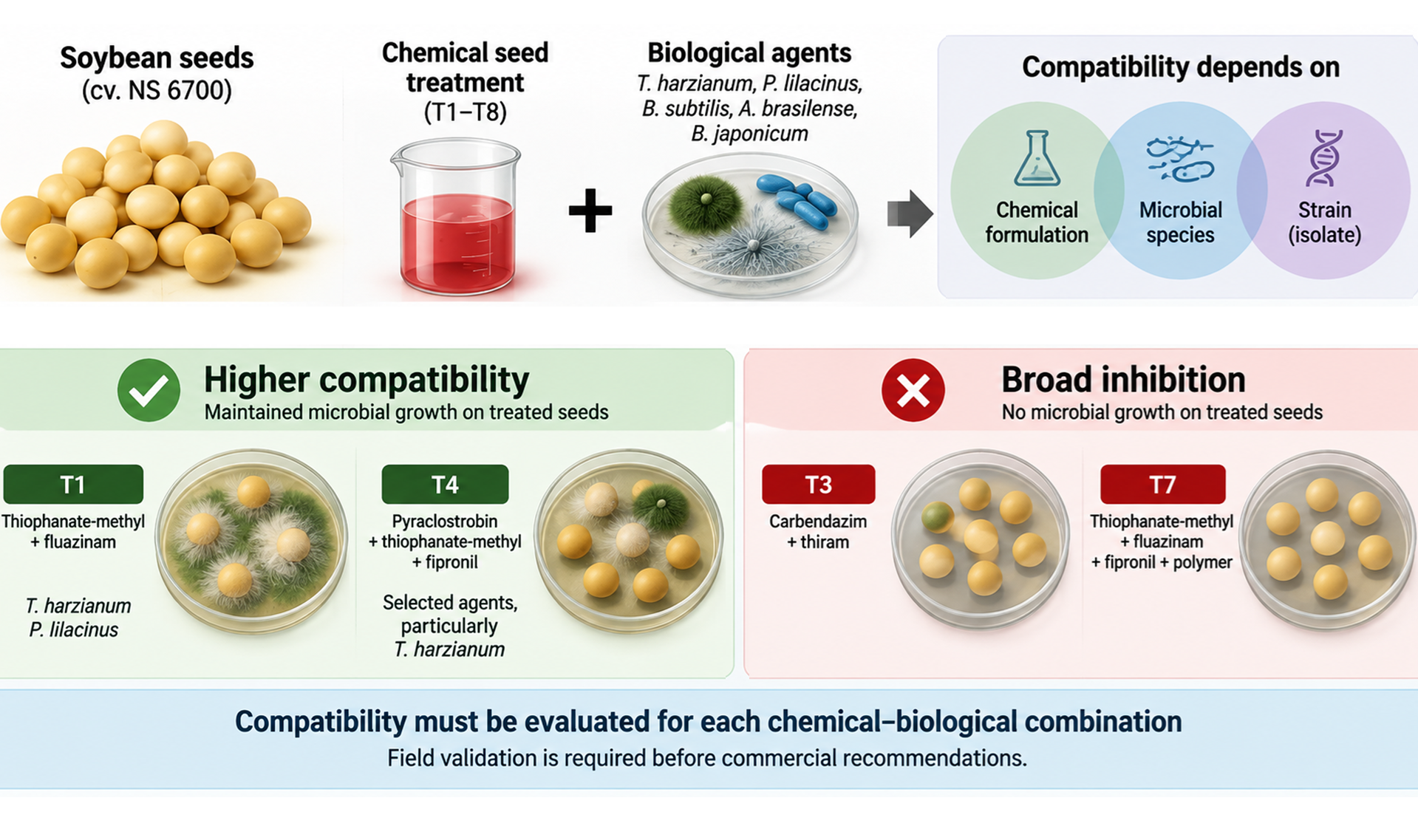
Chemical seed treatment is widely used to manage diseases and pests during the early stages of crop development. However, the integration of this practice with biological agents may be limited by incompatibility between chemical products and beneficial microorganisms. The objective of this study was to evaluate the compatibility of chemical seed treatments with the biological agents Trichoderma harzianum, Paecilomyces lilacinus, Bacillus subtilis, Azospirillum brasilense, and Bradyrhizobium japonicum using seeds of soybean cultivar NS 6700. Seeds were subjected to different chemical treatments and subsequently inoculated with the microorganisms. Compatibility was assessed through the percentage of microbial growth on treated seeds incubated on culture medium and by determining the minimum inhibitory concentration (MIC) using the broth microdilution method. The results demonstrated that compatibility was highly dependent on the chemical formulation evaluated. The treatment containing thiophanate-methyl + fluazinam showed high compatibility with the fungal antagonists, allowing 88% growth of both T. harzianum and P. lilacinus, whereas the formulation composed of pyraclostrobin + thiophanate-methyl + fipronil supported 83% growth of T. harzianum and 100% growth of B. subtilis. In contrast, treatments containing carbendazim + thiram and thiophanate-methyl + fluazinam + fipronil completely inhibited the growth of all biological agents evaluated. MIC assays complemented the results observed in seed colonization, revealing marked differences in the sensitivity of biological agents to the chemical treatments. It can be concluded that compatibility between biological products and chemical seed treatments depends on the formulation used, and prior compatibility assessments are essential to ensure the successful integration of these technologies in agricultural production systems.
References
Alcântara Neto, F., Pacheco, L. P., Araújo, A. S. F., Petter, F. A., Almeida, F. A., & Albuquerque, J. A. A. (2014). Tempo de contato e de combinações de fungicidas, aditivo e inoculante sobre a sobrevivência de rizóbios e nodulação da soja. Revista Agro@mbiente On-line, 8(1), 149–154. https://doi.org/10.18227/1982-8470ragro.v8i1.1396
Baudet, L. M., & Villela, F. A. (2012). Armazenamento de sementes. In S. T. Peske, F. A. Villela, & G. E. Meneghello (Eds.), Sementes: fundamentos científicos e tecnológicos (pp. 481–528). Editora UFPel.
Folorunso, E. A., Bohata, A., & Mraz, J. (2024). Factors influencing pesticide-biocontrol agent compatibility: A metadata-based review. Pesticide Biochemistry and Physiology, 206, 106204. https://doi.org/10.1016/j.pestbp.2024.106204
Izidoro-Morimitsu, S. C., Knob, A., Matos, C. K., Faria, C. M. D. R., & Kawakami, J. (2026). Native Trichoderma spp. as biocontrol agents against common beans anthracnose. Journal of Plant Diseases and Protection, 133, Article 70. https://doi.org/10.1007/s41348-026-01262-x
Kim, S. H., Lee, Y., Balaraju, K., & Jeon, Y. (2023). Evaluation of Trichoderma atroviride and Trichoderma longibrachiatum as biocontrol agents in controlling red pepper anthracnose in Korea. Frontiers in Plant Science, 14, 1201875. https://doi.org/10.3389/fpls.2023.1201875
Liu, M., Liu, J., & Wang, W. M. (2012). Isolation and functional analysis of Thmfs1, the first major facilitator superfamily transporter from the biocontrol fungus Trichoderma harzianum. Biotechnology Letters, 34(10), 1857–1862. https://doi.org/10.1007/s10529-012-0972-x
Loureiro, E. S., Dias Neto, J. A., Pessoa, L. G. A., Dias, P. M., Adão, D. V., & Yokota, L. A. (2020). Effect of plant protection chemicals about the fungi Trichoderma harzianum and Purpureocillium lilacinum. Research, Society and Development, 9(6), e141963506. https://doi.org/10.33448/rsd-v9i6.3506
Lucas, J. A., Hawkins, N. J., & Fraaije, B. A. (2015). The evolution of fungicide resistance. Advances in Applied Microbiology, 90, 29–92. https://doi.org/10.1016/bs.aambs.2014.09.001
Mercante, F. M., Costa, M. R., Kawski, N. L., Tarasiuk, V. A., & Goulart, A. C. P. (2007). Sobrevivência de Bradyrhizobium spp. em sementes de soja tratadas com fungicidas e seus efeitos na nodulação das plantas. In Anais do XXXI Congresso Brasileiro de Ciência do Solo (pp. 1–4). Sociedade Brasileira de Ciência do Solo.
Ribeiro, F. C., Colombo, G. A., Carvalho, E. V., Pelúzio, J. M., & Erasmo, E. A. L. (2017). Controle químico de mancha-alvo da soja (Corynespora cassiicola) no cerrado tocantinense – Brasil. Journal of Biotechnology and Biodiversity, 6(1), 26–36. https://doi.org/10.20873/jbb.uft.cemaf.v6n1.ribeiro
Richetti, A., & Goulart, A. C. P. (2019). Custo de tratar. Revista Cultivar, 244, 18–20.
Sánchez-Montesinos, B., Santos, M., Moreno-Gavira, A., Marín-Rodulfo, T., Gea, F. J., & Diánez, F. (2021). Biological control of fungal diseases by Trichoderma aggressivum f. europaeum and its compatibility with fungicides. Journal of Fungi, 7(8), 598. https://doi.org/10.3390/jof7080598
Silva, D. M. M. da, Santos, C. C., Wagner, F. E., Martins, L. O. M., Ozório, J. P. A., et al. (2024). Seed biopriming with Parachlorella, Bacillus subtilis, and Trichoderma harzianum alleviates the effects of salinity in soybean. BMC Plant Biology, 24, Article 1149. https://doi.org/10.1186/s12870-024-05646-9
Xia, X. J., Huang, Y. Y., Wang, L., Huang, L. F., Yu, Y. L., Zhou, Y. H., & Yu, J. Q. (2006). Pesticides-induced depression of photosynthesis was alleviated by 24-epibrassinolide pretreatment in Cucumis sativus L. Pesticide Biochemistry and Physiology, 86(1), 42–48. https://doi.org/10.1016/j.pestbp.2006.01.005
Downloads
Published
Issue
Section
License
Copyright (c) 2026 Scientia Agropecuaria

This work is licensed under a Creative Commons Attribution-NonCommercial 4.0 International License.
The authors who publish in this journal accept the following conditions:
a. The authors retain the copyright and assign to the magazine the right of the first publication, with the work registered with the Creative Commons attribution license, which allows third parties to use the published information whenever they mention the authorship of the work and the First publication in this journal.
b. Authors may make other independent and additional contractual arrangements for non-exclusive distribution of the version of the article published in this journal (eg, include it in an institutional repository or publish it in a book) as long as it clearly indicates that the work Was first published in this journal.
c. Authors are encouraged to publish their work on the Internet (for example, on institutional or personal pages) before and during the review and publication process, as it can lead to productive exchanges and a greater and faster dissemination of work Published (see The Effect of Open Access).