
Soil fertility response to land-use changes in agroforestry and silvopastoral systems of the Ecuadorian Amazon: A multivariate and stratification ratio approach
DOI:
https://doi.org/10.17268/sci.agropecu.2026.068Keywords:
Soil fertility, land-use change, silvopastoral systems, stratification ratio, multivariate analysis, Ecuadorian AmazonAbstract
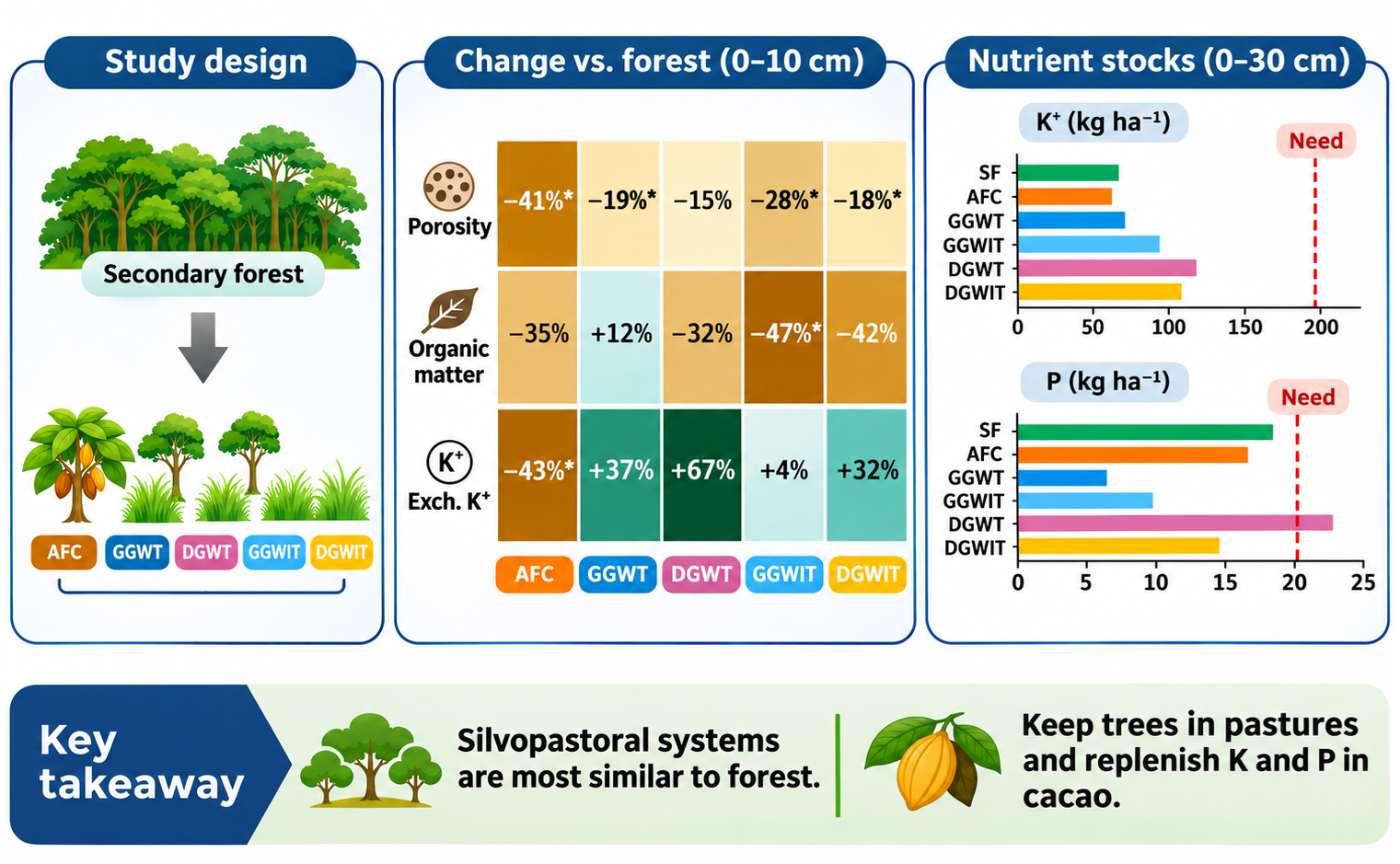
Conversion of Amazonian forests to pastures and crops threatens soil fertility, but whether tree-based land uses conserve it remains poorly quantified in the Ecuadorian Amazon. We compared a secondary forest (SF, reference) with a cacao agroforestry system (AFC), two silvopastoral systems (Axonopus scoparius and Paspalum dilatatum pastures with trees; GGWT, DGWT) and the same pastures without trees (GGWIT, DGWIT) in Napo and Pastaza provinces. Each land use comprised three plots (5 – 7 sampling points each) sampled at 0 – 10 and 10 – 30 cm (184 samples). Land-use effects were tested with linear mixed models with plot as a random effect. In the topsoil, land use affected aeration porosity (AP; 11.4 % in AFC to 19.2 % in SF), soil organic matter (SOM; 8.5 % in GGWIT to 17.9 % in GGWT) and exchangeable K+ (0.09 cmolc/kg in AFC vs. 0.22 – 0.28 cmolc/kg in GGWT, DGWT and DGWIT), whereas bulk density, pH, total N, available P, Ca2+ and Mg2+ did not differ significantly. Relative to SF, AP decreased by 15 % – 41 % in all land uses, SOM by 47 % in GGWIT and K+ by 43 % in AFC. Most nutrients were concentrated in the topsoil. Stocks in the 0 – 30 cm layer of exchangeable K+ (53 – 102 kg/ha) and, except in DGWT, of available P (6.5 – 22.2 kg/ha) were below forest-maintenance thresholds, whereas NH4+ stocks were highest in treeless pastures and lowest in AFC. Multivariate analyses isolated AFC and grouped the silvopastoral systems with SF. Retaining trees in pastures and replenishing K and P in cacao agroforestry systems are recommended.
References
Álvarez, F., Casanoves, F., & Suárez, J. C. (2021). Influence of scattered trees in grazing areas on soil properties in the Piedmont region of the Colombian Amazon. PLoS ONE, 16(12), Article e0261612. https://doi.org/10.1371/journal.pone.0261612
Bahr, E., Chamba Zaragocin, D., & Makeschin, F. (2014). Soil nutrient stock dynamics and land-use management of annuals, perennials and pastures after slash-and-burn in the Southern Ecuadorian Andes. Agriculture, Ecosystems & Environment, 188, 275–288. https://doi.org/10.1016/j.agee.2014.03.005
Bates, D., Mächler, M., Bolker, B., & Walker, S. (2015). Fitting linear mixed-effects models using lme4. Journal of Statistical Software, 67(1), 1–48. https://doi.org/10.18637/jss.v067.i01
Blake, G. R., & Hartge, K. H. (1986). Bulk density. In A. Klute (Ed.), Methods of soil analysis: Part 1. Physical and mineralogical methods (2nd ed., pp. 363–375). American Society of Agronomy; Soil Science Society of America. https://doi.org/10.2136/sssabookser5.1.2ed.c13
Blanco-Canqui, H., & Ruis, S. J. (2018). No-tillage and soil physical environment. Geoderma, 326, 164–200. https://doi.org/10.1016/j.geoderma.2018.03.011
Bond, W. J. (2010). Do nutrient-poor soils inhibit development of forests? A nutrient stock analysis. Plant and Soil, 334(1), 47–60. https://doi.org/10.1007/s11104-010-0440-0
Bravo-Medina, C., Goyes-Vera, F., Arteaga-Crespo, Y., García-Quintana, Y., & Changoluisa, D. (2021). A soil quality index for seven productive landscapes in the Andean-Amazonian foothills of Ecuador. Land Degradation & Development, 32(6), 2226–2241. https://doi.org/10.1002/ldr.3897
Bravo-Medina, C., Marín, H., Marrero-Labrador, P., Ruiz, M. E., Torres-Navarrete, B., Navarrete-Alvarado, H., Durazno-Alvarado, G., & Changoluisa-Vargas, D. (2017). Evaluación de la sustentabilidad mediante indicadores en unidades de producción de la provincia de Napo, Amazonia Ecuatoriana. Bioagro, 29(1), 23–36.
Bravo-Medina, C., Sarabia-Guevara, D., & Sancho-Aguilera, D. (2024). Changes in soil quality indicators in response to land use based on a minimum data set. Scientia Agropecuaria, 15(4), 525–535. https://doi.org/10.17268/sci.agropecu.2024.039
Bravo-Medina, C., Torres-Navarrete, B., Arteaga-Crespo, Y., García-Quintana, Y., Reyes-Morán, H., Changoluisa-Vargas, D., & Paguay-Sayay, D. (2023). Soil properties variation in a small-scale altitudinal gradient of an evergreen foothills forest, Ecuadorian Amazon region. European Journal of Forest Research, 142(6), 1325–1339. https://doi.org/10.1007/s10342-023-01593-6
Coq-Huelva, D., Higuchi, A., Alfalla-Luque, R., Burgos-Morán, R., & Arias-Gutiérrez, R. (2017). Co-evolution and bio-social construction: The Kichwa agroforestry systems (chakras) in the Ecuadorian Amazonia. Sustainability, 9(10), Article 1920. https://doi.org/10.3390/su9101920
Custode, E., & Sourdat, M. (1986). Paisajes y suelos de la Amazonía ecuatoriana: Entre la conservación y la explotación. Cultura, 325–338.
Espinosa, J., Moreno, J., & Bernal, G. (Eds.). (2018). The soils of Ecuador. Springer. https://doi.org/10.1007/978-3-319-25319-0
Ewunetu, T., Selassie, Y. G., Molla, E., Admase, H., & Gezahegn, A. (2025). Soil properties under different land uses and slope gradients: Implications for sustainable land management in the Tach Karnuary watershed, Northwestern Ethiopia. Frontiers in Environmental Science, 13, Article 1518068. https://doi.org/10.3389/fenvs.2025.1518068
Garcia, L., Dubeux, J. C. B., Sollenberger, L. E., Vendramini, J. M. B., DiLorenzo, N., Santos, E. R. S., Jaramillo, D. M., & Ruiz-Moreno, M. (2021). Nutrient excretion from cattle grazing nitrogen-fertilized grass or grass–legume pastures. Agronomy Journal, 113(4), 3110–3123. https://doi.org/10.1002/agj2.20675
Guillaume, T., Maranguit, D., Murtilaksono, K., & Kuzyakov, Y. (2016). Sensitivity and resistance of soil fertility indicators to land-use changes: New concept and examples from conversion of Indonesian rainforest to plantations. Ecological Indicators, 67, 49–57. https://doi.org/10.1016/j.ecolind.2016.02.039
Hartemink, A. E. (2005). Nutrient stocks, nutrient cycling, and soil changes in cocoa ecosystems: A review. Advances in Agronomy, 86, 227–253. https://doi.org/10.1016/S0065-2113(05)86005-5
Horneck, D. A., Sullivan, D. M., Owen, J. S., & Hart, J. M. (2011). Soil test interpretation guide (EC 1478). Oregon State University Extension Service.
Huera-Lucero, T., Lopez-Piñeiro, A., & Bravo-Medina, C. (2025). Soil quality indicators for different land uses in the Ecuadorian Amazon rainforest. Forests, 16(8), Article 1275. https://doi.org/10.3390/f16081275
Huera-Lucero, T., Lopez-Piñeiro, A., Torres, B., & Bravo-Medina, C. (2024). Biodiversity and carbon sequestration in chakra-type agroforestry systems and humid tropical forests of the Ecuadorian Amazon. Forests, 15(3), Article 557. https://doi.org/10.3390/f15030557
Jiménez, L., Carrera, R., Fierro, N., Lasso, J., Roa, J., Ochoa, P., Loján, C., Donoso, R., & Capa-Mora, D. (2026). Tree-based production systems and their relationships with topsoil fertility and carbon storage in tropical regions. Journal of Agriculture and Food Research, 31, Article 103350. https://doi.org/10.1016/j.jafr.2026.103350
Kuznetsova, A., Brockhoff, P. B., & Christensen, R. H. B. (2017). lmerTest package: Tests in linear mixed effects models. Journal of Statistical Software, 82(13), 1–26. https://doi.org/10.18637/jss.v082.i13
Lal, R., Negassa, W., & Lorenz, K. (2015). Carbon sequestration in soil. Current Opinion in Environmental Sustainability, 15, 79–86. https://doi.org/10.1016/j.cosust.2015.09.002
Lenth, R. V. (2024). emmeans: Estimated marginal means, aka least-squares means (R package version 1.10.0). https://CRAN.R-project.org/package=emmeans
Mainville, N., Webb, J., Lucotte, M., Davidson, R., Betancourt, O., Cueva, E., & Mergler, D. (2006). Decrease of soil fertility and release of mercury following deforestation in the Andean Amazon, Napo River Valley, Ecuador. Science of the Total Environment, 368(1), 88–98. https://doi.org/10.1016/j.scitotenv.2005.09.064
McGrath, J. M., Spargo, J., & Penn, C. J. (2014). Soil fertility and plant nutrition. In N. K. Van Alfen (Ed.), Encyclopedia of agriculture and food systems (Vol. 5, pp. 166–184). Elsevier. https://doi.org/10.1016/B978-0-444-52512-3.00249-7
McLean, E. O. (1965). Aluminum. In C. A. Black (Ed.), Methods of soil analysis: Part 2. Chemical and microbiological properties (Agronomy Monograph 9, pp. 978–998). American Society of Agronomy. https://doi.org/10.2134/agronmonogr9.2.c16
Melkani, S., Singh, V., & Bhadha, J. H. (2024). Quantifying the impact of different agroforestry systems on soil carbon fractions lability and long-term carbon sequestration in Central Himalayas. Soil Use and Management, 40(1), Article e13012. https://doi.org/10.1111/sum.13012
Murgueitio, E., Calle, Z., Uribe, F., Calle, A., & Solorio, B. (2011). Native trees and shrubs for the productive rehabilitation of tropical cattle ranching lands. Forest Ecology and Management, 261(10), 1654–1663. https://doi.org/10.1016/j.foreco.2010.09.027
Nascimento, C. M., de Sousa Mendes, W., Quiñonez Silvero, N. E., Poppiel, R. R., Sayão, V. M., et al. (2024). Nitrogen, phosphorus, and potassium cycling in pasture ecosystems. Brazilian Animal Science, 25, Article e-76743E. https://doi.org/10.1590/1809-6891v25e-76743E
Nelson, D. W., & Sommers, L. E. (1982). Total carbon, organic carbon, and organic matter. In A. L. Page, R. H. Miller, & D. R. Keeney (Eds.), Methods of soil analysis: Part 2. Chemical and microbiological properties (2nd ed., Agronomy Monograph 9, pp. 539–579). American Society of Agronomy; Soil Science Society of America. https://doi.org/10.2134/agronmonogr9.2.2ed.c29
Nieto, C., & Caicedo, C. (2012). Análisis reflexivo sobre el desarrollo agropecuario sostenible en la Amazonía Ecuatoriana (Publicación Miscelánea No. 405). Instituto Nacional Autónomo de Investigaciones Agropecuarias (INIAP).
Okalebo, J. R., Gathua, K. W., & Woomer, P. L. (2002). Laboratory methods of soil and plant analysis: A working manual (2nd ed.). SACRED Africa.
Olaya-Montes, A., Llanos-Cabrera, M. P., Cherubin, M. R., Herrera-Valencia, W., Ortiz-Morea, F. A., & Silva-Olaya, A. M. (2021). Restoring soil carbon and chemical properties through silvopastoral adoption in the Colombian Amazon region. Land Degradation & Development, 32(13), 3720–3730. https://doi.org/10.1002/ldr.3832
Pla, I. (2010a). Medición y evaluación de propiedades físicas de los suelos: Dificultades y errores más frecuentes. II. Propiedades hidrológicas. Suelos Ecuatoriales, 40(2), 94–127.
Pla, I. (2010b). Medición y evaluación de propiedades físicas de los suelos: Dificultades y errores más frecuentes. I. Propiedades mecánicas. Suelos Ecuatoriales, 40(2), 75–92.
Quesada, C. A., Lloyd, J., Anderson, L. O., Fyllas, N. M., Schwarz, M., & Czimczik, C. I. (2011). Soils of Amazonia with particular reference to the RAINFOR sites. Biogeosciences, 8(6), 1415–1440. https://doi.org/10.5194/bg-8-1415-2011
R Core Team. (2024). R: A language and environment for statistical computing (Version 4.3.3). R Foundation for Statistical Computing. https://www.R-project.org/
Rabot, E., Wiesmeier, M., Schlüter, S., & Vogel, H.-J. (2018). Soil structure as an indicator of soil functions: A review. Geoderma, 314, 122–137. https://doi.org/10.1016/j.geoderma.2017.11.009
Reynolds, W. D., Drury, C. F., Tan, C. S., Fox, C. A., & Yang, X. M. (2009). Use of indicators and pore volume-function characteristics to quantify soil physical quality. Geoderma, 152(3–4), 252–263. https://doi.org/10.1016/j.geoderma.2009.06.009
Torres, B., Bravo, C., Torres, A., Tipán-Torres, C., Vargas, J. C., et al. (2023). Carbon stock assessment in silvopastoral systems along an elevational gradient: A study from cattle producers in the Sumaco Biosphere Reserve, Ecuadorian Amazon. Sustainability, 15(1), Article 449. https://doi.org/10.3390/su15010449
Torres, B., Herrera-Feijoo, R. J., Torres-Navarrete, A., Bravo, C., & García, A. (2024). Tree diversity and its ecological importance value in silvopastoral systems: A study along elevational gradients in the Sumaco Biosphere Reserve, Ecuadorian Amazon. Land, 13(3), Article 281. https://doi.org/10.3390/land13030281
Torres, V., Ramos, N., Lizazo, D., Monteagudo, F., & Noda, A. (2008). Modelo estadístico para la medición del impacto de la innovación o transferencia tecnológica en la rama agropecuaria. Revista Cubana de Ciencia Agrícola, 42(2).
Trujillo-González, J. M., Silva-Parra, A., & Torres-Mora, M. A. (2026). Soil fertility and carbon stocks in contrasting tropical grazing systems on Oxisols of the Colombian Llanos piedmont. Agroforestry Systems, 100(5), Article 130. https://doi.org/10.1007/s10457-026-01503-w
Unger, M., Leuschner, C., & Homeier, J. (2010). Variability of indices of macronutrient availability in soils at different spatial scales along an elevation transect in tropical moist forests (NE Ecuador). Plant and Soil, 336(1), 443–458. https://doi.org/10.1007/s11104-010-0494-z
Uvidia, H., Ramírez, J. L., Leonard, I., Vargas, J. C., Verdecia, D., & Andino, M. (2015). Inventario de la sucesión vegetal secundaria en la provincia Pastaza, Ecuador. REDVET. Revista Electrónica de Veterinaria, 16(11).
Viana, R. M., Ferraz, J. B. S., Neves, A. F., Vieira, G., & Pereira, B. F. F. (2014). Soil quality indicators for different restoration stages on Amazon rainforest. Soil and Tillage Research, 140, 1–7. https://doi.org/10.1016/j.still.2014.01.005
Wilcke, W., Oelmann, Y., Schmitt, A., Valarezo, C., Zech, W., & Homeier, J. (2008). Soil properties and tree growth along an altitudinal transect in Ecuadorian tropical montane forest. Journal of Plant Nutrition and Soil Science, 171(2), 220–230. https://doi.org/10.1002/jpln.200625210
Zhang, Y., Xu, X., Li, Z., Liu, M., Xu, C., Zhang, R., & Luo, W. (2019). Effects of vegetation restoration on soil quality in degraded karst landscapes of southwest China. Science of the Total Environment, 650, 2657–2665. https://doi.org/10.1016/j.scitotenv.2018.09.372
Downloads
Published
Issue
Section
License
Copyright (c) 2026 Scientia Agropecuaria

This work is licensed under a Creative Commons Attribution-NonCommercial 4.0 International License.
The authors who publish in this journal accept the following conditions:
a. The authors retain the copyright and assign to the magazine the right of the first publication, with the work registered with the Creative Commons attribution license, which allows third parties to use the published information whenever they mention the authorship of the work and the First publication in this journal.
b. Authors may make other independent and additional contractual arrangements for non-exclusive distribution of the version of the article published in this journal (eg, include it in an institutional repository or publish it in a book) as long as it clearly indicates that the work Was first published in this journal.
c. Authors are encouraged to publish their work on the Internet (for example, on institutional or personal pages) before and during the review and publication process, as it can lead to productive exchanges and a greater and faster dissemination of work Published (see The Effect of Open Access).