Effects of pre-harvest salicylic acid and irrigation interval on rhizome yield and phytochemical accumulation in Curcuma aromatica Salisb.
DOI:
https://doi.org/10.17268/sci.agropecu.2026.56Keywords:
Salicylic acid, Curcuma aromatica, essential oils, irrigation regime, pre-harvest stress, rhizome yield, secondary metabolites, water deficitAbstract
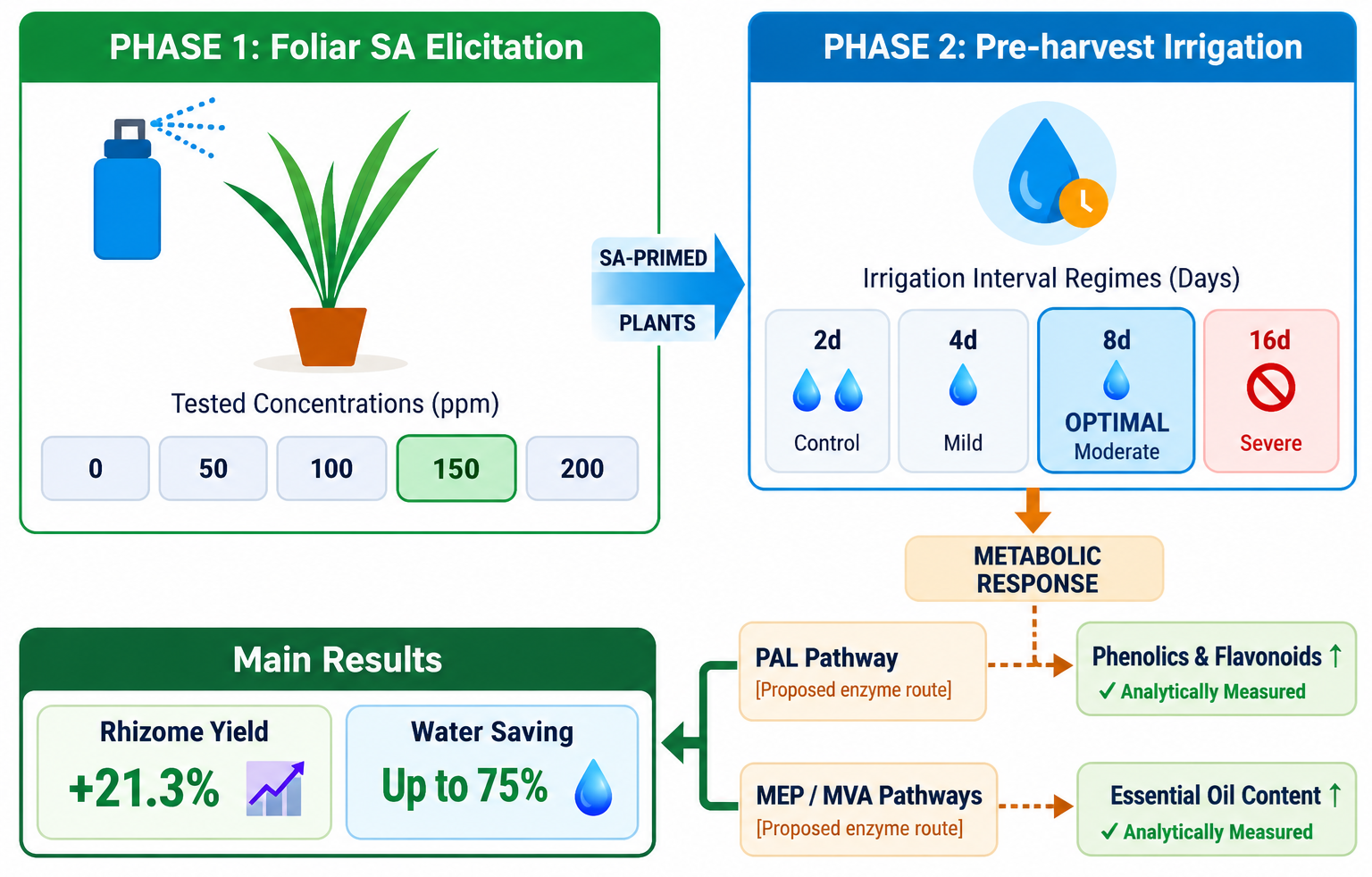
Curcuma aromatica Salisb. is a medicinal plant valued for its rhizomes rich in essential oils and phenolic compounds. This study aimed to determine (i) an optimal concentration of salicylic acid (SA) to improve plant performance and secondary metabolite accumulation, and (ii) the effects of different pre-harvest irrigation intervals on plants pre-treated with the selected SA concentration. Salicylic acid was applied as a foliar spray at 50, 100, 150 and 200 ppm at 18, 24 and 30 weeks after planting. Based on the initial evaluation, the optimal concentration was further evaluated under irrigation intervals of 2, 4, 8 and 16 days during the final 30 days prior to harvest. Foliar application of 150 ppm SA significantly increased rhizome fresh yield by 21.3% compared with the control, while concurrently enhancing rhizome number per plant as well as concentrations of essential oil, total polyphenols, and flavonoids compared with the control and lower SA levels. Following SA pre-treatment, an 8-day pre-harvest irrigation interval resulted in the highest rhizome yield and essential oil content. The results also suggest that integrating pre-harvest foliar SA application with subsequent moderate water restriction may improve both yield and phytochemical quality of C. aromatica under field conditions. These responses may be associated with the elicitor role of SA in promoting phenylpropanoid and terpenoid metabolism, while moderate water restriction may enhance the allocation of assimilates toward secondary metabolite accumulation.
References
Bates, L. S., Waldren, R. P., & Teare, I. D. (1973). Rapid determination of free proline for water-stress studies. Plant and Soil, 39, 205–207. https://doi.org/10.1007/BF00018060
Bui, C. D., Dinh, T. T., Le, T. T., Tran, T. V., Huynh, C. D. M., Le, T. H., & Tran-Van, H. (2025). Anti-tyrosinase activity of Curcuma aromatica ethyl acetate extract: From lead diarylheptanoids to melanogenesis targets. Beni-Suef University Journal of Basic and Applied Sciences, 14(1), 86. https://doi.org/10.1186/s43088-025-00673-3
Doan, C. C., Le, T. L., Ho, N. Q. C., Bui, D. T., Nguyen, T. P. T., & Hoang, N. S. (2025). Cytotoxicity evaluation of Curcuma aromatica Salisb. rhizome extract via apoptosis and reactive oxygen species generation in human gastric cancer cells. 3 Biotech, 15(6), 153. https://doi.org/10.1007/s13205-025-04318-1
DuBois, M., Gilles, K. A., Hamilton, J. K., Rebers, P. A., & Smith, F. (1956). Colorimetric method for determination of sugars and related substances. Analytical Chemistry, 28(3), 350–356. https://doi.org/10.1021/ac60111a017
Ilyas, M., Maqsood, M. F., Shahbaz, M., Zulfiqar, U., Ahmad, K., Naz, N., & Ali, H. M. (2024). Alleviating salinity stress in canola (Brassica napus L.) through exogenous application of salicylic acid. BMC Plant Biology, 24(1), 611. https://doi.org/10.1186/s12870-024-05314-y
Jafarzadeh, B., Abdiyev, V., Ismayilova, S., & Aliyeva, N. (2025). Determination of proline content in bread wheat varieties under iso-cation sodium salinity conditions. Nature & Science/Təbiət və Elm, 7(6), 14–19. https://doi.org/10.36719/2707-1146/57/14-19
Jeyasri, R., Muthuramalingam, P., Karthick, K., Shin, H., Choi, S. H., & Ramesh, M. (2023). Methyl jasmonate and salicylic acid as powerful elicitors for enhancing the production of secondary metabolites in medicinal plants: An updated review. Plant Cell, Tissue and Organ Culture, 153(3), 447–458. https://doi.org/10.1007/s11240-023-02485-8
Koo, Y. M., Heo, A. Y., & Choi, H. W. (2020). Salicylic acid as a safe plant protector and growth regulator. Plant Pathology Journal, 36(1), 1–10. https://doi.org/10.5423/PPJ.RW.12.2019.0295
Miller, G. L. (1959). Use of dinitrosalicylic acid reagent for determination of reducing sugar. Analytical Chemistry, 31(3), 426–428. https://doi.org/10.1021/ac60147a030
Nair, K. P. (2019). Turmeric (Curcuma longa L.) and ginger (Zingiber officinale Rosc.) – world’s invaluable medicinal spices: The agronomy and economy of turmeric and ginger. In Turmeric (Curcuma longa L.) and ginger (Zingiber officinale Rosc.) (pp. 271–283). Springer. https://doi.org/10.1007/978-3-030-29189-1_15
Paul, A., Kakoti, M., Dutta, P., Hazarika, B., Robertson, A., Talukdar, N., & Ray, S. (2024). Role of salicylic acid in mitigating stress and improving productivity of crops: A review. Journal of Advances in Biology & Biotechnology, 27(7), 1351–1361. https://doi.org/10.9734/jabb/2024/v27i71097
Sade, N., Galkin, E., & Moshelion, M. (2015). Measuring Arabidopsis, tomato and barley leaf relative water content (RWC). Bio-protocol, 5(9), Article e1451. https://doi.org/10.21769/BioProtoc.1451
Sainakham, M., Jantrawut, P., Kiattisin, K., Chittasupho, C., & Singh, S. (2023). Potential of green extraction using edible deep eutectic solvents on the bioactivities from Curcuma aromatica rhizome extracts for food application. Journal of Agriculture and Food Research, 14, 100868. https://doi.org/10.1016/j.jafr.2023.100868
Song, W., Shao, H., Zheng, A., Zhao, L., & Xu, Y. (2023). Advances in roles of salicylic acid in plant tolerance responses to biotic and abiotic stresses. Plants, 12(19), 3475. https://doi.org/10.3390/plants1219347
Thang, T. T., & Ngan, L. N. T. (2022). Effects of drought stress on growth and flavonoid accumulation of fish mint (Houttuynia cordata Thunb.). Plant Science Today, 9(3), 37–43. https://doi.org/10.14719/pst.1851
Xiang, H., Zhang, L., Yang, Z., Chen, F., Zheng, X., & Liu, X. (2017). Chemical compositions, antioxidative, antimicrobial, anti-inflammatory and antitumor activities of Curcuma aromatica Salisb. essential oils. Industrial Crops and Products, 108, 6–16. https://doi.org/10.1016/j.indcrop.2017.05.058
Xin, K., Wu, Y., Ikram, A. U., Jing, Y., Liu, S., Zhang, Y., & Chen, J. (2025). Salicylic acid cooperates with different small molecules to control biotic and abiotic stress responses. Journal of Plant Physiology, 304, 154406. https://doi.org/10.1016/j.jplph.2024.154406
Zhao, X., Peng, J., Zhang, L., Yang, X., Qiu, Y., Cai, C., Hu, J., Huang, T., Liang, Y., Li, Z., Tian, M., Liu, F., & Wang, Z. (2024). Optimizing the quality of horticultural crop: Insights into pre-harvest practices in controlled environment agriculture. Frontiers in Plant Science, 15, 1427471. https://doi.org/10.3389/fpls.2024.1427471
Zhao, Y., Liu, G., Yang, F., Liang, Y., Gao, Q., Xiang, C., & Yang, S. (2023). Multilayered regulation of secondary metabolism in medicinal plants. Molecular Horticulture, 3(1), 11. https://doi.org/10.1186/s43897-023-00059-y
Zhou, J., Yang, S., Ma, Y., Liu, Z., Tu, H., Wang, H., & Wang, X. (2023). Soluble sugar and organic acid composition and flavor evaluation of Chinese cherry fruits. Food Chemistry: X, 20, 100953. https://doi.org/10.1016/j.fochx.2023.100953
Downloads
Published
Issue
Section
License
Copyright (c) 2026 Scientia Agropecuaria

This work is licensed under a Creative Commons Attribution-NonCommercial 4.0 International License.
The authors who publish in this journal accept the following conditions:
a. The authors retain the copyright and assign to the magazine the right of the first publication, with the work registered with the Creative Commons attribution license, which allows third parties to use the published information whenever they mention the authorship of the work and the First publication in this journal.
b. Authors may make other independent and additional contractual arrangements for non-exclusive distribution of the version of the article published in this journal (eg, include it in an institutional repository or publish it in a book) as long as it clearly indicates that the work Was first published in this journal.
c. Authors are encouraged to publish their work on the Internet (for example, on institutional or personal pages) before and during the review and publication process, as it can lead to productive exchanges and a greater and faster dissemination of work Published (see The Effect of Open Access).