
Agroecological zoning of mezcal and tequila agaves in Mexico through MaxEnt ecological niche modeling: Sustainability and climate resilience implications
DOI:
https://doi.org/10.17268/sci.agropecu.2026.55Keywords:
agroecological zoning, climate resilience, ecological niche modeling, MaxEnt, sustainable agave production, land-use planningAbstract
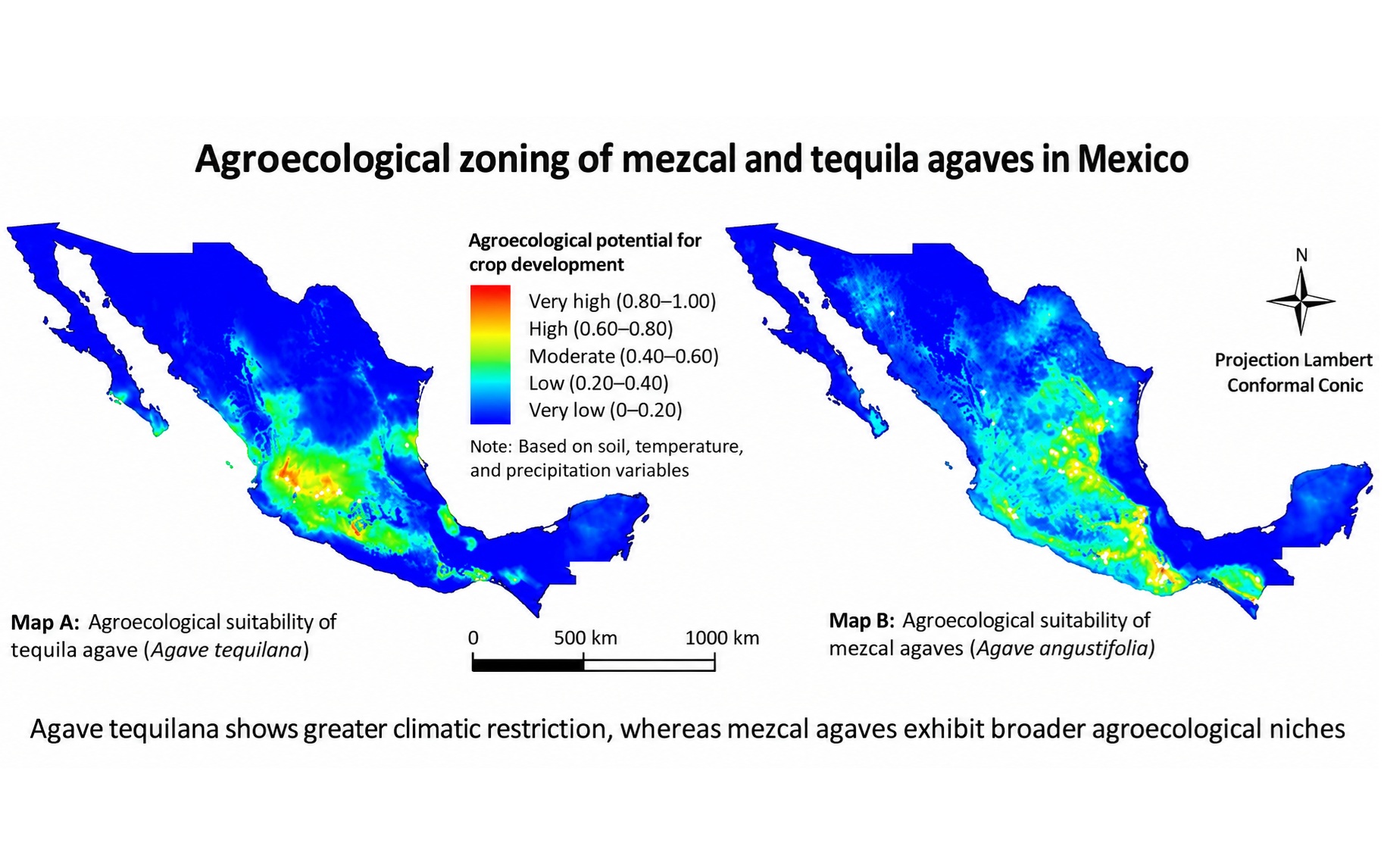
Agave‑based distilled‑beverage production in Mexico, particularly mezcal and tequila, is facing intensifying sustainability challenges driven by climate change, monocropping expansion, and degradation of socio‑ecological systems. In this context, agroecological zoning represents a strategic tool for improving territorial planning and strengthening climate resilience. This study aimed to identify agroecologically suitable areas for mezcal (Agave angustifolia) and tequila (Agave tequilana) agaves across Mexico, while minimising biodiversity impacts and supporting sustainable land‑use decision‑making. We combined bibliometric analysis with ecological niche modelling using the maximum entropy algorithm (MaxEnt), integrating georeferenced occurrence data from major producing municipalities with climatic, topographic, and edaphic variables for the 2020 - 2025 period. The resulting models showed high predictive performance, with area under the curve (AUC) values of 0.941 for A. angustifolia and 0.978 for A. tequilana. Species‑specific vulnerability patterns were identified: A. angustifolia displayed greater sensitivity to topographic and soil‑chemical factors, whereas A. tequilana was predominantly constrained by climatic variables, particularly temperature and precipitation, increasing its exposure to climate change. Threshold analyses delineated a statistically robust core area of approximately 4,578 km2 with guaranteed agroecological suitability, representing zones of long term productive stability. Expanding cultivation beyond these core areas was associated with decreasing statistical confidence and higher agronomic risk. Overall, the findings demonstrate that agroecological zoning can support climate resilient and regenerative agave production pathways in Mexico. These findings underscore the need for differentiated public policies that promote polyculture systems, genetic diversity conservation, and circular management of agave by products to ensure the long term sustainability of mezcal and tequila producing landscapes.
References
Amici, V., Marcantonio, M., La Porta, N., & Rocchini, D. (2017). A multi-temporal approach in MaxEnt modelling: A new frontier for land use/land cover change detection. Ecological Informatics, 40, 40–49. https://doi.org/10.1016/j.ecoinf.2017.04.005
Arslan, E. S., & Örücü, Ö. K. (2021). MaxEnt modelling of the potential distribution areas of cultural ecosystem services using social media data and GIS. Environment, Development and Sustainability, 23(2), 2655–2667. https://doi.org/10.1007/s10668-020-00692-3
Ávila-Reyes, S. V., Jiménez-Aparicio, A. R., Melgar-Lalanne, G., Fajardo-Espinoza, F. S., & Hernández-Sánchez, H. (2025). Mezcal: A review of chemistry, processing, and potential health benefits. Foods, 14(8), 1408. https://doi.org/10.3390/foods14081408
Bradie, J., & Leung, B. (2017). A quantitative synthesis of the importance of variables used in MaxEnt species distribution models. Journal of Biogeography, 44(6), 1344–1361. https://doi.org/10.1111/jbi.12894
Castañeda Hidalgo, E., Aquino López, R., Santiago Martínez, G. M., Lozano Trejo, S., & Jerez Salas, M. P. (2025). Evolution and dynamics of Agave cultivation in Oaxaca: A trend analysis. Textual, 85. https://doi.org/10.5154/r.textual/2024.85.09
Cruz-Cárdenas, G., López-Mata, L., Ortiz-Solorio, C. A., Villaseñor, J. L., Ortiz, E., Silva, J. T., & Estrada-Godoy, F. (2014a). Interpolation of Mexican soil properties at a scale of 1:1,000,000. Geoderma, 213, 29–35. https://doi.org/10.1016/j.geoderma.2013.07.014
Cruz-Cárdenas, G., Villaseñor, J. L., López-Mata, L., Martínez-Meyer, E., & Ortiz, E. (2014b). Selección de predictores ambientales para el modelado de la distribución de especies en MaxEnt. Chapingo Journal. Series: Forest and Environmental Sciences, 20(2), 187–201. https://doi.org/10.5154/r.rchscfa.2013.09.034
Cuéllar-Martínez, M., Moreno-Letelier, A., MacSwiney-González, M. C., & Galindo-González, J. (2026). Pollination biology and genetic neighborhood size in Agave obscura Schiede: Insights into the reproductive biology of a population from central Veracruz. Botanical Sciences, 104(1), 114–133. https://doi.org/10.17129/botsci.3766
Davis, S. C., Abatzoglou, J. T., & LeBauer, D. S. (2021). Expanded potential growing region and yield increase for Agave americana with future climate. Agronomy, 11(11), 2109. https://doi.org/10.3390/agronomy11112109
Davis, S. C., & Ortiz-Cano, H. G. (2023). Lessons from the history of Agave: Ecological and cultural context for valuation of CAM. Annals of Botany, 132(4), 819-833. https://doi.org/10.1093/aob/mcad072
De Anda-Rodríguez, F. A., Corona-Ramírez, M. R., Patiño-Arévalo, C. D., Zárate-Navarro, M. A., Zárate-Guzmán, A. I., & Romero-Cano, L. A. (2025). Mycomaterials from agave bagasse: A valorization strategy for sustainable tequila packaging. Fermentation, 11(9), 500. https://doi.org/10.3390/fermentation11090500
De Marco Júnior, P., & Nóbrega, C. C. (2018). Evaluating collinearity effects on species distribution models: An approach based on virtual species simulation. PLoS ONE, 13(9), e0202403. https://doi.org/10.1371/journal.pone.0202403
Elith, J., Phillips, S. J., Hastie, T., Dudík, M., Chee, Y. E., & Yates, C. J. (2011). A statistical explanation of MaxEnt for ecologists. Diversity and Distributions, 17(1), 43–57. https://doi.org/10.1111/j.1472-4642.2010.00725.x
Fois, M., Cuena-Lombraña, A., Fenu, G., & Bacchetta, G. (2018). Using species distribution models at local scale to guide the search of poorly known species: Review, methodological issues and future directions. Ecological Modelling, 385, 124–132. https://doi.org/10.1016/j.ecolmodel.2018.07.018
Giller, K. E., Hijbeek, R., Andersson, J. A., & Sumberg, J. (2021). Regenerative agriculture: An agronomic perspective. Outlook on Agriculture, 50(1), 13–25. https://doi.org/10.1177/0030727021998063
Guevara-Gutiérrez, R. D., Palomera-García, C., Olguín-López, J. L., Mancilla-Villa, O. R., Rosales-Almendra, M. P., & Barreto-García, O. A. (2024). Effect of blue agave (Agave tequilana Weber) management on soil erosion. Air, Soil and Water Research, 17, 1–10. https://doi.org/10.1177/11786221241236632
Hernández, C. E., Huerta-Zavala, J., Espinosa-Rodríguez, M., Sarmiento-Villagrana, A., Ochoa-Miranda, R., & Segura-Pacheco, H. R. (2024). Areas with agroecological potential for Agave cupreata (Trel. & Berger) plantations in Guerrero, Mexico. Agro Productividad, 17(12). https://doi.org/10.32854/agrop.v17i12.2920
Herrera-Pérez, L., Valtierra-Pacheco, E., Ocampo-Fletes, I., Tornero-Campante, M. A., Hernández-Plascencia, J. A., & Rodríguez-Macías, R. (2017). Ecological practices in Agave tequilana Weber under two agricultural systems in Tequila, Jalisco. Revista Mexicana de Ciencias Agrícolas, Número Especial 18, 3713-3726. https://doi.org/10.29312/remexca.v8i18.216
Hijmans, R. J., Cameron, S. E., Parra, J. L., Jones, P. G., & Jarvis, A. (2005). Very high resolution interpolated climate surfaces for global land areas. International Journal of Climatology, 25, 1965–1978. https://doi.org/10.1002/joc.1276
Honorato-Salazar, J. A., Aburto, J., & Amezcua-Allieri, M. A. (2021). Agave and Opuntia species as sustainable feedstocks for bioenergy and byproducts. Sustainability, 13(21), 12263. https://doi.org/10.3390/su132112263
López-Santiago, M. A., Sánchez-Toledano, B. I., Valdivia-Alcalá, R., Hernández-Ortiz, J., García-Vázquez, R., & Vásquez-Maya, I. I. (2024). Analysis of the normalized revealed comparative advantage index for mezcal, tequila and rum in Mexico. Journal Bio Ciencias, 10, e1414. https://doi.org/10.15741/revbio.10.e1414
Lozano-Arias, C. J. (2024). El tequila como fuente económica en México. Revista de Investigación Académica Sin Frontera, 6(41). https://doi.org/10.46589/riasf.vi41.661
Márquez-Rangel, I., Cruz, M., Ruiz, H. A., Rodríguez-Jasso, R. M., Loredo-Treviño, A., & Belmares, R. (2025). Evaluation of Agave salmiana by-products as a functional ingredient for the development of sustainable foods. Journal of the Science of Food and Agriculture, 105(8), 4349–4358. https://doi.org/10.1002/jsfa.14167
Martínez-Lona, D. I., Mendoza-Galindo, E., Herrera-Estrella, A., Simpson, J., & Hernández-Hernández, T. (2026). Clonal domestication and biocultural erosion in tequila agave (Agave tequilana Weber var. azul). Annals of Botany. mcag208. https://doi.org/10.1093/aob/mcag208
Martínez-Velasco, I., Gasca-Pineda, J., Mastretta-Yanes, A., Gargiulo, R., Klimova, A., Aguirre-Planter, E., Valiente-Banuet, A., Lira, R., & Eguiarte, L. E. (2026). Clonality, management and geography shape genetic structure in a perennial species with restricted distribution. Annals of Botany. mcag132. https://doi.org/10.1093/aob/mcag132
Merow, C., Smith, M. J., & Silander, J. A. (2013). A practical guide to MaxEnt for modeling species distributions: What it does, and why inputs and settings matter. Ecography, 36(10), 1058–1069. https://doi.org/10.1111/j.1600-0587.2013.07872.x
Molina, A., Kothari, A., Odundo, A., & Prakash, M. (2023). Agave sisalana: Towards distributed manufacturing of absorbent media for menstrual pads in semi-arid regions. Communications Engineering, 2, 130. https://doi.org/10.1038/s44172-023-00130-y
National Institute of Statistics, Geography and Informatics (INEGI). (2025). Geostatistical framework 2025. México.
Noriega-Juárez, A. D., Meza-Espinoza, L., García-Magaña, M. L., Ortiz-Basurto, R. I., Chacón-López, M. A., Anaya-Esparza, L. M., & Montalvo-González, E. (2025). Aguamiel, a traditional Mexican beverage: A review of its nutritional composition, health effects and conservation. Foods, 14(1), 134. https://doi.org/10.3390/foods14010134
Nobel, P. S., & Valenzuela, A. G. (1987). Environmental responses and productivity of the CAM plant, Agave tequilana. Agricultural and Forest Meteorology, 39, 319-334. https://doi.org/10.1016/0168-1923(87)90024-4
Nobel, P. S., Castañeda, M., North, G., Pimienta-Barrios, E., & Ruiz, A. (1998). Temperature influences on leaf CO2 exchange, cell viability and cultivation range for Agave tequilana. Journal of Arid Environments, 39(1), 1-9. https://doi.org/10.1006/jare.1998.0374
Ortiz-Cano, H. G., Hadfield, R., Gómez, T., Hultine, K., Mata-González, R., Petersen, S. L., … Stewart, J. R. (2023). Ecological niche modeling reveals current opportunities for agave dryland farming in Sonora, Mexico and Arizona, USA. PLOS ONE, 18(1), e0279877. https://doi.org/10.1371/journal.pone.0279877
Pearson, R. G., Raxworthy, C. J., Nakamura, M., & Townsend Peterson, A. (2007). Predicting species distributions from small numbers of occurrence records: A test case using cryptic geckos in Madagascar. Journal of Biogeography, 34(1), 102-117. https://doi.org/10.1111/j.1365-2699.2006.01594.x
Perez-Pimienta, J. A., Méndez-Acosta, H. O., Davis, S. C., & Tan, D. K. Y. (2024). Editorial: The role of agave as feedstock within a sustainable circular bioeconomy. Frontiers in Chemical Engineering, 5, 1343629. https://doi.org/10.3389/fceng.2023.1343629
Phillips, S. J., Anderson, R. P., Dudík, M., Schapire, R. E., & Blair, M. E. (2017). Opening the black box: An open-source release of MaxEnt. Ecography, 40(7), 887–893. https://doi.org/10.1111/ecog.03049
Phillips, S. J., Anderson, R. P., & Schapire, R. E. (2006). Maximum entropy modeling of species geographic distributions. Ecological Modelling, 190(3), 231–259. https://doi.org/10.1016/j.ecolmodel.2005.03.026
Phillips, S. J., & Dudík, M. (2008). Modeling of species distributions with MaxEnt: New extensions and a comprehensive evaluation. Ecography, 31(2), 161–175. https://doi.org/10.1111/j.0906-7590.2008.05203.x
Phillips, S. J., Dudík, M., & Schapire, R. E. (2004). A maximum entropy approach to species distribution modeling. In Proceedings of the twenty-first international conference on Machine learning (ICML '04). Association for Computing Machinery, New York, NY, USA, 83. https://doi.org/10.1145/1015330.1015412
Pimienta-Barrios, E., Robles-Murguía, C., & Nobel, P. S. (2001). Net CO2 uptake for Agave tequilana in a warm and a temperate environment. Biotropica, 33(2), 312-318. https://doi.org/10.1111/j.1744-7429.2001.tb00181.x
Queiroz, H. M., Ferreira, T. O., Cerri, C. E., Pereira, G. A., & Cherubin, M. R. (2024). Advancing the agave-soil nexus approach: A systematic review. Biofuels, Bioproducts and Biorefining, 18(5), 1306–1320. https://doi.org/10.1002/bbb.2625
Rieger, I. A. (2025). Rewilding the mezcal market: Cultural practices and the conservation of agaves in Oaxaca, Mexico. Wild, 2(2), 20. https://doi.org/10.3390/wild2020020
Rodríguez-Merino, A., García-Murillo, P., & Fernández-Zamudio, R. (2020). Combining multicriteria decision analysis and GIS to assess vulnerability within a protected area: An objective methodology for managing complex and fragile systems. Ecological Indicators, 108, 105738. https://doi.org/10.1016/j.ecolind.2019.105738
Santiago-Martínez, A., Pérez-Herrera, A., Martínez-Gutiérrez, G. A., & Meneses, M. E. (2023). Contributions of agaves to human health and nutrition. Food Bioscience, 53, 102753. https://doi.org/10.1016/j.fbio.2023.102753
Saraiva, A., Carrascosa, C., Ramos, F., Raheem, D., & Raposo, A. (2022). Agave syrup: Chemical analysis and nutritional profile, applications in the food industry and health impacts. International Journal of Environmental Research and Public Health, 19(12), 7022. https://doi.org/10.3390/ijerph19127022
Sillero, N., & Barbosa, A. M. (2021). Common mistakes in ecological niche models. International Journal of Geographical Information Science, 35(2), 213–226. https://doi.org/10.1080/13658816.2020.1798968
Soberón, J., & Townsend-Peterson, A. (2005). Interpretation of models of fundamental ecological niches and species distributional areas. Biodiversity Informatics, 2, 1–10. https://doi.org/10.17161/bi.v2i0.4
Suárez-Sánchez, M., Merritt, H., Oyoque-Salcedo, G., Estrella-Santiago, D. P., Oregel-Zamudio, E., & Arias-Martínez, S. (2025). Sustainable valorization of tequila industry vinasse: A patent review on bioeconomy-driven technologies. Agronomy, 15(7), 1567. https://doi.org/10.3390/agronomy15071567
Terán-Bustamante, A., Martínez-Velasco, A., & Leyva-Hernández, S. N. (2025). Management of scientific and ancestral knowledge: A decision-making model in mezcal industry in Mexico. Frontiers in Artificial Intelligence, 8, 1570617. https://doi.org/10.3389/frai.2025.1570617
Tetreault, D., McCulligh, C., & Lucio, C. (2021). Distilling agro-extractivism: Agave and tequila production in Mexico. Journal of Agrarian Change, 21(2), 219–241. https://doi.org/10.1111/joac.12402
Tong, R., Yesson, C., Yu, J., Luo, Y., & Zhang, L. (2023). Key factors for species distribution modeling in benthic marine environments. Frontiers in Marine Science, 10, 1222382. https://doi.org/10.3389/fmars.2023.1222382
Townsend-Peterson, A., Soberón, J., & Sánchez-Cordero, V. (1999). Conservatism of ecological niches in evolutionary time. Science, 285(5431), 1265–1267. https://doi.org/10.1126/science.285.5431.1265
Trejo-Salazar, R.-E., Eguiarte, L. E., Suro-Piñera, D., & Medellín, R. A. (2016). Save our bats, save our tequila: Industry and science join forces to help bats and agaves. Natural Areas Journal, 36(4), 523-530. https://doi.org/10.3375/043.036.0418
Trejo-Salazar, R.-E., Gámez, N., Escalona-Prado, E., Scheinvar, E., Medellín, R. A., Moreno-Letelier, A., Aguirre-Planter, E., & Eguiarte, L. E. (2023). Historical, temporal, and geographic dynamism of the interaction between Agave and Leptonycteris nectar-feeding bats. American Journal of Botany, 110(10). e16222. https://doi.org/10.1002/ajb2.16222
Trejo-Salazar, R.-E., Gasca-Pineda, J., Hernández-Bolaños, K., Hernández-Rosales, D.-C., Tapia-López, R., Aguirre-Planter, E., Medellín, R. A., León-Paniagua, L., & Eguiarte, L. E. (2025). High genetic variation, low differentiation, and Pleistocene expansions of the migratory and endangered long-nosed tequila bat (Leptonycteris nivalis) inferred using both maternal and paternal genetic markers. PLOS ONE, 20(1), e0316530. https://doi.org/10.1371/journal.pone.0316530
Tripathi, A. H., Kumari, A., Chand, G., Kumar, R., Durgapal, A., Mahajan, L., … Upadhyay, S. K. (2023). An overview of phytomedicinal, ethnobotanical applications and phytochemical constituents of four major Agave species. Indian Journal of Natural Products and Resources, 14(2), 148–161. https://doi.org/10.56042/ijnpr.v14i2.4199
Valiente-Banuet, A., & Arizmendi, M. C. (2023). Mezcal boom and extinction debts. In R. W. Jones, C. P. Ornelas-García, R. Pineda-López, & F. Álvarez (Eds.), Mexican fauna in the Anthropocene (pp. 303–318). Springer, Cham. https://doi.org/10.1007/978-3-031-17277-9_14
Vasconcelos, R. N., Cantillo-Pérez, T., Franca Rocha, W. J. S., Aguiar, W. M., Mendes, D. T., de Jesus, T. B., de Santana, C. O., de Santana, M. M. M., & Oliveira, R. P. (2024). Advances and Challenges in Species Ecological Niche Modeling: A Mixed Review. Earth, 5(4), 963-989. https://doi.org/10.3390/earth5040050
Wisz, M. S., Hijmans, R. J., Li, J., Peterson, A. T., Graham, C. H., Guisan, A., & NCEAS Predicting Species Distributions Working Group. (2008). Effects of sample size on the performance of species distribution models. Diversity and Distributions, 14(5), 763-773. https://doi.org/10.1111/j.1472-4642.2008.00482.x
Zapata-Morán, I., Lopez-Feldman, A., & Bejarano, H. (2024). Tequila, bats, and agave farmers: Towards an understanding of the right incentives to protect genetic diversity. Environmental Research Communications, 6(1), 011002. https://doi.org/10.1088/2515-7620/ad19f4
Zurell, D., Franklin, J., König, C., Bouchet, P. J., Dormann, C. F., Elith, J., … Merow, C. (2020). A standard protocol for reporting species distribution models. Ecography, 43(9), 1261–1277. https://doi.org/10.1111/ecog.04960
Downloads
Published
Issue
Section
License
Copyright (c) 2026 Scientia Agropecuaria

This work is licensed under a Creative Commons Attribution-NonCommercial 4.0 International License.
The authors who publish in this journal accept the following conditions:
a. The authors retain the copyright and assign to the magazine the right of the first publication, with the work registered with the Creative Commons attribution license, which allows third parties to use the published information whenever they mention the authorship of the work and the First publication in this journal.
b. Authors may make other independent and additional contractual arrangements for non-exclusive distribution of the version of the article published in this journal (eg, include it in an institutional repository or publish it in a book) as long as it clearly indicates that the work Was first published in this journal.
c. Authors are encouraged to publish their work on the Internet (for example, on institutional or personal pages) before and during the review and publication process, as it can lead to productive exchanges and a greater and faster dissemination of work Published (see The Effect of Open Access).