
Autotrophic in vitro culture method, inoculated with native arbuscular mycorrhizae, for the adaptation of trap plants of the Asteraceae family
DOI:
https://doi.org/10.17268/sci.agropecu.2026.004Keywords:
Antibiotics, inoculum, Murashige and Skoog medium, mycorrhization, trap plantsAbstract
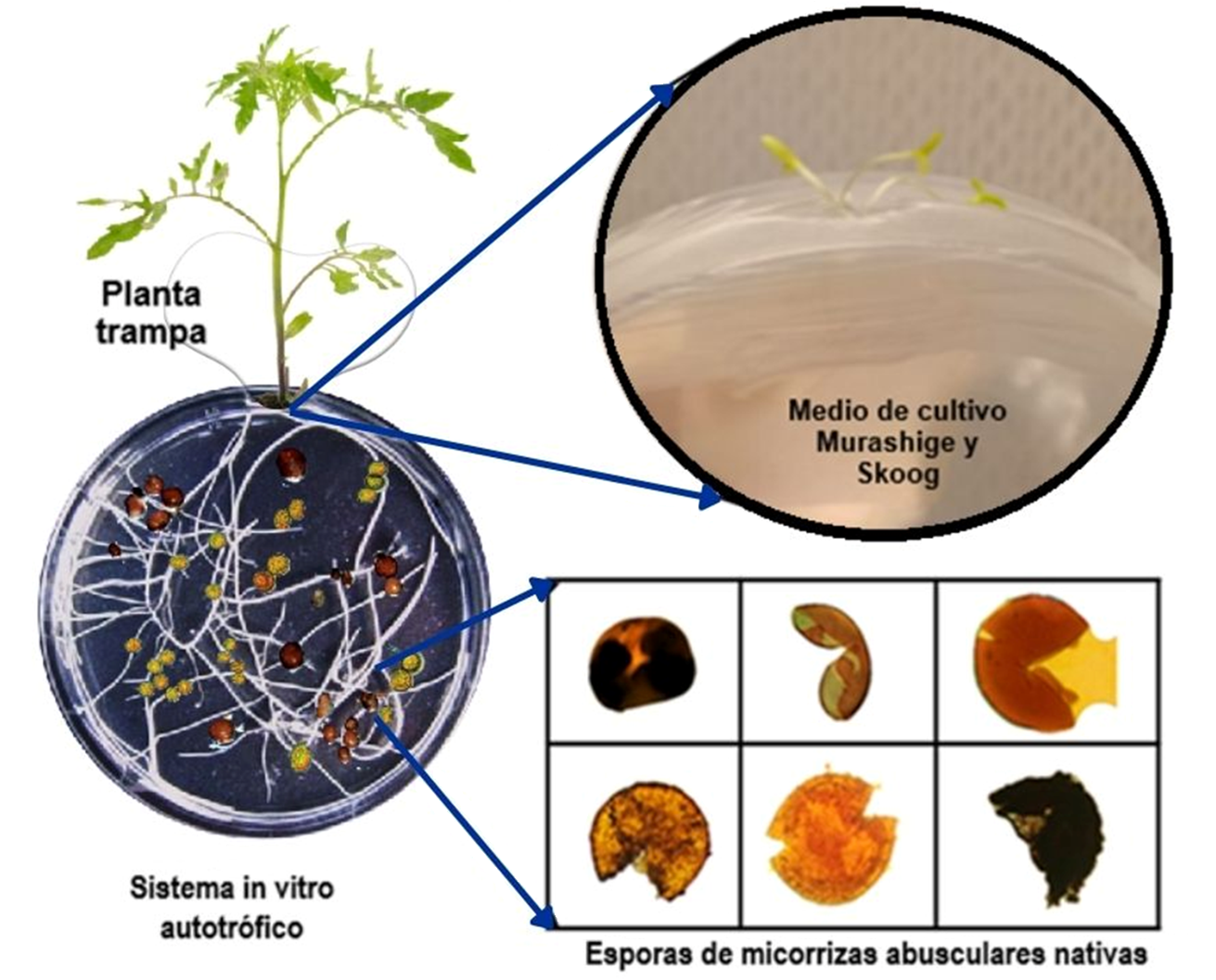
The implementation of autotrophic in vitro culture systems is revealed as a crucial strategy for the multiplication of native arbuscular mycorrhizal fungi, as it plays a fundamental role in restoring the sustainability of agricultural systems that have suffered degradation. The objective of the research was to establish an autotrophic in vitro culture method using two trap plants of native arbuscular mycorrhizal fungi under laboratory conditions. Inoculum native to Bidens pilosa and Tagetes patula were collected, spores were disinfected and cultured in vitro using a modified Murashige and Skoog medium. The results showed mycorrhization percentages greater than 50% in the trap plants and a significant reduction in microbial contamination with the use of antibiotics. The autotrophic in vitro culture system was feasible with Tagetes patula and Bidens pilosa, proving to be a promising strategy to produce mycorrhizal inoculum under laboratory conditions. In conclusion, spore disinfection and selection of suitable trap plants guarantee the success of in vitro culture inoculated with native arbuscular mycorrhizal fungi.
References
Ahmad, S., Amin, A., Haseeb, A., Bibi, S., Khan, M. I., et al. (2024). In-vitro bioassay of organic nematicides against Root-knot nematode, Meloidogyne incognita (Kofaid & White). Chitwood. Pure and Applied Biology, 14(2), 283-296. https://dx.doi.org/10.19045/bspab.2025.140027
Barajas González, J. A., Carrillo-González, R., González-Chávez, M. D. C. A., Chimal Sánchez, E., & Tapia Maruri, D. (2023). Selection of Salinity-Adapted Endorhizal Fungal Consortia from Two Inoculum Sources and Six Halophyte Plants. Journal of fungi (Basel, Switzerland), 9(9), 893. https://doi.org/10.3390/jof9090893
Benaffari, W., Boutasknit, A., Anli, M., Ait-El-Mokhtar, M., Ait-Rahou, Y., Ben-Laouane, R., Ben Ahmed, H., Mitsui, T., Baslam, M., & Meddich, A. (2022). The Native Arbuscular Mycorrhizal Fungi and Vermicompost-Based Organic Amendments Enhance Soil Fertility, Growth Performance, and the Drought Stress Tolerance of Quinoa. Plants (Basel, Switzerland), 11(3), 393. https://doi.org/10.3390/plants11030393
Darriaut, R., Lailheugue, V., Wastin, J., Tran, J., Martins, G., Ballestra, P., Masneuf-Pomarède, I., Ollat, N., & Lauvergeat, V. (2025). Rhizobacteria from vineyard and commercial arbuscular mycorrhizal fungi induce synergistic microbiome shifts within grapevine root systems. Scientific reports, 15(1), 27884. https://doi.org/10.1038/s41598-025-12673-5
Duan, S., Zhang, L., & Declerck, S. (2025). Early-stage reciprocal cooperation between the arbuscular mycorrhizal fungus Rhizophagus irregularis and the phosphate-solubilizing bacterium Rahnella aquatilis is dependent on external phosphorus availability. Communications biology, 8(1), 1075. https://doi.org/10.1038/s42003-025-08501-1
Edlinger, A., Garland, G., Hartman, K., Banerjee, S., Degrune, F., et al. (2022). Agricultural management and pesticide use reduce the functioning of beneficial plant symbionts. Nature ecology & evolution, 6(8), 1145–1154. https://doi.org/10.1038/s41559-022-01799-8
Fabiyi, O., Lateef, A., Gueguim-Kana, E. B., Beukes, L. S., Matyumza, N., Bello, T., & Olatunji, G. (2024). Characterization and nematicidal potential of copper, iron and zinc nanoparticles synthesized from Tridax procumbens L. Extract on Meloidogyne incognita infected cabbage plants. European Journal of Plant Pathology, 168(4), 683-695. https://doi.org/10.1007/s10658-023-02804-x
Ferrari Mateus, MA, Duarte Ríos Faria¹, CM, Botelho, RV, Dallemole-Giaretta, R., Martins Ferreira, SG y Zaluski, WL (2013). Evaluación in vitro y aplicación foliar de Verbena officinalis (L.), Erythrina mulungu (Mart. ex Benth.), Quassia amara (L.), Bidens pilosa (L.) y Plantago lanceolata (L.), sobre Meloidogyne incognita (Kofoid & White, 1919) Chitwood, 1949. Idesia (Arica), 31(1), 109-115. http://dx.doi.org/10.4067/S0718-34292013000100013
Gelvez-Pardo, I., Lobo-Berbesi, L., & Santos-Díaz, A. (2023). Biological Efficacy of Plant Growth-Promoting Bacteria and Arbuscular Mycorrhizae Fungi: Assessments in Laboratory and Greenhouse Conditions. Current protocols, 3(4), e732. https://doi.org/10.1002/cpz1.732
Gío-Trujillo, J. A., Alvarado-López, C. J., Pacheco-López, N. A., Cristóbal-Alejo, J., Reyes-Ramírez, A., & Candelero-de la Cruz, J. (2024). Comportamiento de Cucurbita pepo L. var. “Grey Zucchini”, en la propagación de hongos micorrizógenos arbusculares nativos de suelos con diferente manejo. Biotecnia, 26. https://doi.org/10.18633/biotecnia.v26.1972
Karima, B., Amima, H., Ahlam, M., Zoubida, B., Benoît, T., Yolande, D., & Anissa, L. S. (2023). Native Arbuscular Mycorrhizal Inoculum Modulates Growth, Oxidative Metabolism and Alleviates Salinity Stresses in Legume Species. Current microbiology, 80(2), 66. https://doi.org/10.1007/s00284-022-03145-4
Kaur, R., Choudhary, D., Bali, S., Bandral, S. S., Singh, V., Ahmad, M. A., Rani, N., Singh, T. G., & Chandrasekaran, B. (2024). Pesticides: An alarming detrimental to health and environment. The Science of the total environment, 915, 170113. https://doi.org/10.1016/j.scitotenv.2024.170113
Kokkoris, V., & Hart, M. (2019). In vitro Propagation of Arbuscular Mycorrhizal Fungi May Drive Fungal Evolution. Frontiers in microbiology, 10, 2420. https://doi.org/10.3389/fmicb.2019.02420
Kokkoris, V., & Hart, M. M. (2019). The role of in vitro cultivation on symbiotic trait and function variation in a single species of arbuscular mycorrhizal fungus. Fungal biology, 123(10), 732–744. https://doi.org/10.1016/j.funbio.2019.06.009
Kokkoris, V., Banchini, C., Paré, L., Abdellatif, L., Séguin, S., et al. (2024). Rhizophagus irregularis, the model fungus in arbuscular mycorrhiza research, forms dimorphic spores. New Phytologist, 242(4), 1771-1784. https://doi.org/10.1111/nph.19121
Lotfi, M., Fernandez, K., Vermeir, P., Mars, M., & Werbrouck, S. (2019). In vitro mycorrhization of pear (Pyrus communis). Mycorrhiza, 29, 607-614. https://doi.org/10.1007/s00572-019-00919-w
McGonigle, T. P., Miller, M. H., Evans, D. G., Fairchild, G. L. & Swan, J. a. (1990). A new method which gives an objective measure of colonization of roots by vesicular-arbuscular mycorrhizal fungi. New Phytol. 115, 495–501. https://doi.org/10.1111/j.1469-8137.1990.tb00476.x
Ntalli, N., & Caboni, P. (2022). Plant secondary metabolites mode of action in the control of root-knot nematodes. Biocontrol of Plant Disease: Recent Advances and Prospects in Plant Protection, 75.
Ockleford, C., Adriaanse, P., Berny, P., Brock, T., Duquesne, S., et al. (2017). Scientific opinion addressing the state of the science on risk assessment of plant protection products for in-soil organisms. Journal publishes the scientific advice of the European Food Safety Authority, 15, e04690. https://doi.org/10.2903/j.efsa.2017.4690
Pandit, A., Johny, L., Srivastava, S., Adholeya, A., Cahill, D., Brau, L., & Kochar, M. (2022). Recreating in vitro tripartite mycorrhizal associations through functional bacterial biofilms. Applied microbiology and biotechnology, 106(11), 4237–4250. https://doi.org/10.1007/s00253-022-11996-x
Paré, L., Banchini, C., & Stefani, F. (2024). Inoculating and Observing Arbuscular Mycorrhizal Cultures on Superabsorbent Polymer-Based Autotrophic Systems. Journal of visualized experiments: JoVE, 208, https://doi.org/10.3791/66848
Parihar, M., & Rakshit, A. (2024). In Vitro Production of Arbuscular Mycorrhizal Fungi: An Overview. Arbuscular Mycorrhizal Fungi in Sustainable Agriculture: Inoculum Production and Application, 131-143, https://doi.org/10.1007/978-981-97-0296-1_6
Peng, W. A. N. G., Mingxia, W. E. N., Longfei, J. I. N., Feng, L. I. U., Qi, L. U., et al. (2023). Effects of different fertilizer applications on citrus rhizosphere soil quality and arbuscular mycorrhizae colonization. Chinese Journal of Applied Ecology/Yingyong Shengtai Xuebao, 34(10). https://doi.org/10.13287/j.1001-9332.202310.012
Pérez, U. A., Ramírez, M. M., Moreno, L. M., & Franco, M. (2011). Metodología para la desinfección y germinación de esporas y fragmentos de raíces micorrizados con Glomus sp.(GEV02) para su uso bajo condiciones in vitro. Ciencia y Tecnología Agropecuaria, 12(2), 143-150.
Phillips, J. M. & Hayman, D. S. (1970). Improved procedures for clearing roots and staining parasitic and vesicular-arbuscular mycorrhizal fungi for rapid assessment of infection. Transactions of the British Mycological Society, 55, 158–161. https://doi.org/10.1016/S0007-1536(70)80110-3
Robles-González, K., Álvarez-Solís, J., Bertolini, V., & Pérez-Luna, Yolanda, C. (2023). Diversidad y propagación de hongos micorrízicos arbusculares nativos de un cafetal orgánico en Chiapas, México. Revista fitotecnia mexicana, 46(2), 147-155. https://doi.org/10.35196/rfm.2023.2.147
Roshanfekrrad, M., Papadopoulos, C., Calonne-Salmon, M., Schneider, C., Zhang, K., Karpouzas, D., & Declerck, S. (2025). Development of a high-throughput spore germination test to assess the toxicity of pesticides on arbuscular mycorrhizal fungi. Mycorrhiza, 35(3), 38. https://doi.org/10.1007/s00572-025-01211-w
Salas, E., & Blanco, F. (2000). Seleccion de plantas bospederas y efecto del fosforo para la producción de inoculo de bongos formadores de micorrizas arbusculares por el método de cultivo en macetas. Agronomía Costarricense, 24(1), 19-28.
Sangwan, S., & Prasanna, R. (2022). Mycorrhizae Helper Bacteria: Unlocking their potential as bioenhancers of plant-arbuscular mycorrhizal fungal associations. Microbial ecology, 84(1), 1–10. https://doi.org/10.1007/s00248-021-01831-7
Sweeney, C. J., Bottoms, M., Ellis, S., Ernst, G., Kimmel, S., Loutseti, S., Schimera, A., Carniel, L. S. C., Sharples, A., Staab, F., & Marx, M. T. (2022). Arbuscular Mycorrhizal Fungi and the Need for a Meaningful Regulatory Plant Protection Product Testing Strategy. Environmental toxicology and chemistry, 41(8), 1808–1823. https://doi.org/10.1002/etc.5400
Tenzin, U. W., Noirungsee, N., Runsaeng, P., Noppradit, P., & Klinnawee, L. (2022). Dry-Season Soil and Co-Cultivated Host Plants Enhanced Propagation of Arbuscular Mycorrhizal Fungal Spores from Sand Dune Vegetation in Trap Culture. Journal of fungi, 8(10), 1061. https://doi.org/10.3390/jof8101061
Trappe, J. M. (2010). James Wessell Gerdemann, 1921–2008. Mycologia , 102(6), 1518-1522.
Ujvári, G., Turrini, A., Avio, L., & Agnolucci, M. (2021). Possible role of arbuscular mycorrhizal fungi and associated bacteria in the recruitment of endophytic bacterial communities by plant roots. Mycorrhiza, 31(5), 527–544. https://doi.org/10.1007/s00572-021-01040-7
Urías-Salazar, A. A., Ayil-Gutiérrez, B. A., López-Santillán, J. A., Estrada-Drauaillet, B., Cano-González, M. Á., Hernández-Martínez, J. G., & Poot-Poot, W. A. (2024). Hongos micorrizícos arbusculares mejoran el establecimiento de plantas de chile jalapeño (Capsicum annuum L.) en condiciones de salinidad. Biotecnia, 26. https://doi.org/10.5377/ce.v15i2.19633
Vasistha, P., Singh, P. P., Srivastava, D., Johny, L., & Shukla, S. (2025). Effector proteins of Funneliformis mosseae BR221: unravelling plant-fungal interactions through reference-based transcriptome analysis, in vitro validation, and protein‒protein docking studies. BMC genomics, 26(1), 42. https://doi.org/10.1186/s12864-024-10918-7
Vaishnav, A., Rozmoš, M., Kotianová, M., Hršelová, H., Bukovská, P., & Jansa, J. (2025). Protists are key players in the utilization of protein nitrogen in the arbuscular mycorrhizal hyphosphere. The New phytologist, 246(6), 2753–2764. https://doi.org/10.1111/nph.70153
Ważny, R., Jędrzejczyk, R. J., Rozpądek, P., Domka, A., Tokarz, K. M., Janicka, M., & Turnau, K. (2024). Bacteria Associated with Spores of Arbuscular Mycorrhizal Fungi Improve the Effectiveness of Fungal Inocula for Red Raspberry Biotization. Microbial ecology, 87(1), 50. https://doi.org/10.1007/s00248-024-02364-5
Wu, Y. H., Wang, H., Liu, M., Li, B., Chen, X., Ma, Y. T., & Yan, Z. Y. (2021). Effects of Native Arbuscular Mycorrhizae Isolated on Root Biomass and Secondary Metabolites of Salvia miltiorrhiza Bge. Frontiers in plant science, 12, 617892. https://doi.org/10.3389/fpls.2021.617892
Yadav, R., Ror, P., Rathore, P., & Ramakrishna, W. (2020). Bacteria from native soil in combination with arbuscular mycorrhizal fungi augment wheat yield and biofortification. Plant physiology and biochemistry: PPB, 150, 222–233. https://doi.org/10.1016/j.plaphy.2020.02.039
Zhang, L., Zuluaga, M. Y. A., Pii, Y., Barone, A., Amaducci, S., Miras-Moreno, B., Martinelli, E., Bellotti, G., Trevisan, M., Puglisi, E., & Lucini, L. (2023). A Pseudomonas Plant Growth Promoting Rhizobacterium and Arbuscular Mycorrhiza differentially modulate the growth, photosynthetic performance, nutrients allocation, and stress response mechanisms triggered by a mild Zinc and Cadmium stress in tomato. Plant science: An International Journal of Experimental Plant Biology, 337, 111873. https://doi.org/10.1016/j.plantsci.2023.111873
Downloads
Published
Issue
Section
License
Copyright (c) 2025 Scientia Agropecuaria

This work is licensed under a Creative Commons Attribution-NonCommercial 4.0 International License.
The authors who publish in this journal accept the following conditions:
a. The authors retain the copyright and assign to the magazine the right of the first publication, with the work registered with the Creative Commons attribution license, which allows third parties to use the published information whenever they mention the authorship of the work and the First publication in this journal.
b. Authors may make other independent and additional contractual arrangements for non-exclusive distribution of the version of the article published in this journal (eg, include it in an institutional repository or publish it in a book) as long as it clearly indicates that the work Was first published in this journal.
c. Authors are encouraged to publish their work on the Internet (for example, on institutional or personal pages) before and during the review and publication process, as it can lead to productive exchanges and a greater and faster dissemination of work Published (see The Effect of Open Access).