Spray deposition efficiency of two multirotor UAV sprayers versus conventional methods in Coffea arabica under mechanizable and non-mechanizable field
DOI:
https://doi.org/10.17268/sci.agropecu.2026.071Keywords:
coffea arabica, UAV sprayers, air-blast sprayer, spray deposition, mountainous terrainAbstract
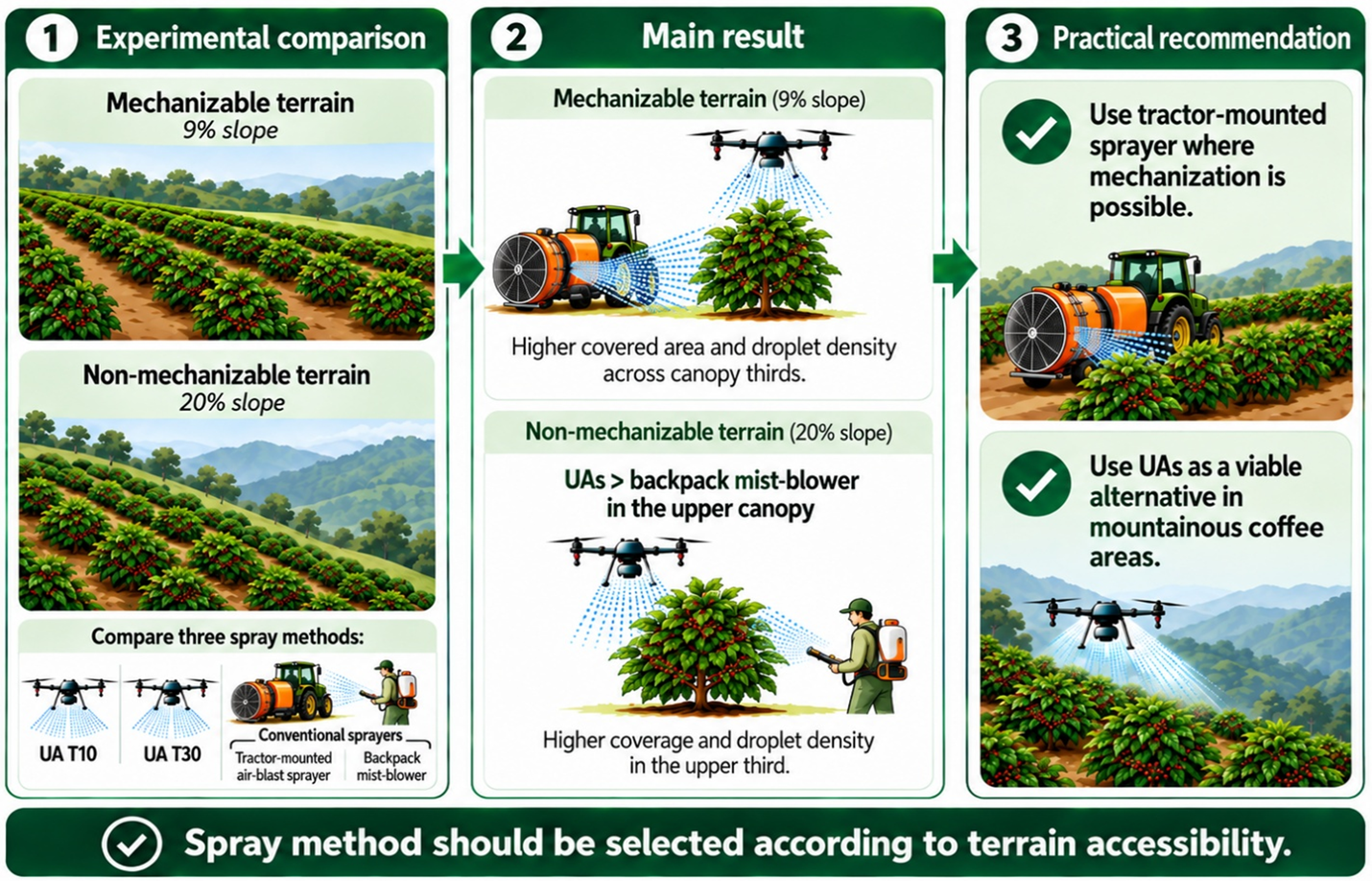
Comparative evidence on UAV sprayer applications and conventional techniques in coffee plantations under contrasting terrain conditions remains limited. This study evaluated the spray deposition efficiency of two multirotor unmanned aircraft, DJI Agras T10 and DJI Agras T30, compared with conventional spraying methods in Coffea arabica fields under mechanizable and non-mechanizable terrain. Two experimental sites were evaluated: a 9 % slope area sprayed using UAV sprayers and a tractor-mounted air-blast sprayer, and a 20 % slope area sprayed using UAV sprayers and a backpack mist-blower. At each site, three application methods were arranged in strips, with four sampled trees per treatment and six water-sensitive papers per tree distributed across the lower, middle, and upper canopy strata. Covered area, droplet density, and volumetric median diameter were quantified and analyzed using generalized linear models. On mechanizable terrain, the air-blast sprayer achieved up to sevenfold higher coverage and four- to sixfold greater droplet density than UAV sprayers across canopy strata. On non-mechanizable terrain, UAV sprayers reached more than 50 droplets cm⁻² in the upper canopy, whereas the backpack mist-blower did not exceed 5 droplets cm⁻² and showed similar performance to UAV sprayers only in the middle and lower strata. Droplets produced by UAV sprayers had a consistent VMD of around 220 μm, while the backpack method produced very fine droplets with higher drift-risk potential inferred from droplet size. These results indicate that UAV sprayers are a technically viable alternative for mountainous coffee areas, whereas tractor-mounted air-blast sprayers remain superior where mechanization is possible.
References
Alves, F. D., & Lindner, M. (2020). Agronegócio do café no sul de minas gerais: Territorialização, mundialização e contradições. Revista OKARA: Geografia Em Debate, 14(2), 433–451.
Alves, R. F. Q., Silva, J. E., Barboza, T. O. C., Ferraz, M. A. J., Costa, O. P. et al. (2025). Comparison of volumetric distribution in drone spraying considering height, application volume, and nozzle type. AgriEngineering, 7(4), 123. https://doi.org/10.3390/agriengineering7040123
American Society of Agricultural and Biological Engineers. (2025). Spray nozzle classification by droplet spectra (ANSI/ASAE S572.3 FEB2020 (R2025)). ASABE.
Arakawa, T., & Kamio, S. (2023). Control efficacy of UAV-based ultra-low-volume application of pesticide in chestnut or-chards. Plants, 12(14). https://doi.org/10.3390/plants12142597
Biglia, A., Grella, M., Bloise, N., Comba, L., Mozzanini, E., et al. (2022). UAV-spray application in vineyards: Flight modes and spray system adjustment effects on canopy deposit, coverage, and off-target losses. Science of the Total Environment, 845, 157292. https://doi.org/10.1016/j.scitotenv.2022.157292
Carneiro, R. P., Garcia, L. C., Dalazen, G., Gomes, J. A., Raetano, C. G., & Boller, W. (2024). Variation of glyphosate spray volume in the drying of ground cover plants with an unmanned aerial vehicle. Crop Protection, 181, 106694. https://doi.org/10.1016/j.cropro.2024.106694
Dhananjayan, V., Jayakumar, S., & Ravichandran, B. (2020). Conventional methods of pesticide application in agricultural field and fate of the pesticides in the environment and human health. In K. R. Rakhimol, S. Thomas, T. Volova, & K. Jayachandran (Eds.), Controlled release of pesticides for sustainable agriculture (pp. 1–39). Springer International Publishing. https://doi.org/10.1007/978-3-030-23396-9_1
DJI. (2021a). DJI agras T10 user manual (v1.4 ed.). User manual. https://dl.djicdn.com/downloads/t10/T10_User_Manual_v1.4_EN.pdf
DJI. (2021b). DJI agras T30 user manual (v1.4 ed.). User manual. https://dl.djicdn.com/downloads/t30/20210727/T30_User_Manual_v1.4_EN.pdf
Gil, E., & Escolà, A. (2009). Design of a decision support method to determine volume rate for vineyard spraying. Applied Engineering in Agriculture, 25(2), 145–151. https://doi.org/10.13031/2013.26323
Gugan, G., & Haque, A. (2023). Path planning for autonomous drones: Challenges and future directions. Drones, 7(3). https://doi.org/10.3390/drones7030169
Guo, H., Zhou, J., Liu, F., He, Y., Huang, H., & Wang, H. (2020). Application of machine learning method to quantitatively evaluate the droplet size and deposition distribution of the UAV spray nozzle. Applied Sciences, 10(5). https://doi.org/10.3390/app10051759
Irfan, M., Ahmad, F., Kahliq, A., Awais, M., & Hamid, S. (2021). UAV sprayers use for mango orchards spraying to control the environmental pollution. Book of Abstracts, 296.
Lan, Y., Qian, S., Chen, S., Zhao, Y., Deng, X., Wang, G., Zang, Y., Wang, J., & Qiu, X. (2021). Influence of the downwash wind field of plant protection UAV on droplet deposition distribution characteristics at different flight heights. Agronomy, 11(12). https://doi.org/10.3390/agronomy11122399
Li, X., Giles, D. K., Niederholzer, F. J., Andaloro, J. T., Lang, E. B., & Watson, L. J. (2021). Evaluation of an unmanned aerial vehicle as a new method of pesticide application for almond crop protection. Pest Management Science, 77(1), 527–537. https://doi.org/10.1002/ps.6052
Marques Filho, A. C., Santana, L. S., Ferraz, G. A. e S., Faria, R. de O., Saka, A. J., et al. (2025). Remotely piloted aircraft spraying in coffee cultivation: Effects of two spraying systems on drop deposition. AgriEngineering, 7(11), 379. https://doi.org/10.3390/agriengineering7110379
Martinez-Guanter, J., Agüera, P., Agüera, J., & Pérez-Ruiz, M. (2020). Spray and economics assessment of a UAV-based ultra-low-volume application in olive and citrus orchards. Precision Agriculture, 21(1), 226–243. https://doi.org/10.1007/s11119-019-09665-7
Meng, Y., Su, J., Song, J., Chen, W.-H., & Lan, Y. (2020). Experimental evaluation of UAV spraying for peach trees of different shapes: Effects of operational parameters on droplet distribution. Computers and Electronics in Agriculture, 170, 105282. https://doi.org/10.1016/j.compag.2020.105282
Ministério da Agricultura e Pecuária. (2025). Sumário executivo do café – abril 2025. Portal Gov.br.
Miranda-Fuentes, A., Llorens, J., Rodrı́guez-Lizana, A., Cuenca, A., Gil, E., Blanco-Roldán, G. L., & Gil-Ribes, J. A. (2016). Assessing the optimal liquid volume to be sprayed on isolated olive trees according to their canopy volumes. Science of the Total Environment, 568, 296–305. https://doi.org/10.1016/j.scitotenv.2016.06.013
Nishimoto, J., Dzurisin, J., Rodriguez, R., & Johnson, M. A. (2026). Canopy position and wind drive agrochemical deposition across aerial and ground-based spray systems in coffee. AgriEngineering, 8(8), 336. https://doi.org/10.3390/agriengineering8080336
Radoglou-Grammatikis, P., Sarigiannidis, P., Lagkas, T., & Moscholios, I. (2020). A compilation of UAV applications for precision agriculture. Computer Networks, 172, 107148. https://doi.org/10.1016/j.comnet.2020.107148
Reddy Maddikunta, P. K., Hakak, S., Alazab, M., Bhattacharya, S., Gadekallu, T. R., Khan, W. Z., & Pham, Q.-V. (2021). Unmanned aerial vehicles in smart agriculture: Applications, requirements, and challenges. IEEE Sensors Journal, 21(16), 17608–17619. https://doi.org/10.1109/JSEN.2021.3049471
Ribeiro, L. F. O., Vitória, E. L. da, Bastos, H. P., Zanelato, J. V., Martins Júnior, J. de A., et al. (2025). Droplet distribution and mitigation of occupational exposure risk in eucalyptus sprout eradication using a remotely piloted aircraft. Frontiers in Plant Science, 15, 1504608. https://doi.org/10.3389/fpls.2024.1504608
Ribeiro, L. F. O., Vitória, E. L. da, Soprani Júnior, G. G., Chen, P., & Lan, Y. (2023). Impact of operational parameters on droplet distribution using an unmanned aerial vehicle in a papaya orchard. Agronomy, 13(4). https://doi.org/10.3390/agronomy13041138
Richardson, B., Rolando, C. A., Somchit, C., Dunker, C., Strand, T. M., & Kimberley, M. O. (2020). Swath pattern analysis from a multi-rotor unmanned aerial vehicle configured for pesticide application. Pest Management Science, 76(4), 1282–1290. https://doi.org/10.1002/ps.5638
Semenišin, M., Steponavičius, D., Kemzūraitė, A., & Savickas, D. (2025). Optimizing UAV spraying for sustainability: Different system spray drift control and adjuvant performance. Sustainability, 17(5). https://doi.org/10.3390/su17052083
Shan, C., Wu, J., Song, C., Chen, S., Wang, J., Wang, H., Wang, G., & Lan, Y. (2022). Control efficacy and deposition characteristics of an unmanned aerial spray system low-volume application on corn fall armyworm spodoptera frugiperda. Frontiers in Plant Science, 13, 900939. https://doi.org/10.3389/fpls.2022.900939
Silva, J. E., da Silva, W. H. B., Ferraz, M. A. J., Menezes, E. A. S., da Costa, O. P., et al. (2024). Impact of spray volume and flight speed on the efficiency of drone applications in coffee plants of different ages. Smart Agricultural Technology, 9, 100694. https://doi.org/10.1016/j.atech.2024.100694
United States Department of Agriculture. (2022). Coffee: World markets and trade. Foreign Agricultural Service (FAS). https://www.fas.usda.gov/commodities/coffee
Vargas, L., & Gleber, L. (2005). Sistema de produção de ameixa européia: Tecnologia de aplicação de defensivos. Embrapa Uva e Vinho. Sistema de Produção (n. 7).
Verma, A., Singh, M., Parmar, R. P., & Bhullar, K. S. (2022). Feasibility study on hexacopter UAV based sprayer for application of environment-friendly biopesticide in guava orchard. Journal of Environmental Biology, 43(1), 97–104. https://doi.org/10.22438/JEB/43/1/MRN-1912
Vitória, E. L. da, Krohling, C. A., Borges, F. R. P., Ribeiro, L. F. O., Ribeiro, M. E. A., et al. (2023). Efficiency of fungicide application and using an unmanned aerial vehicle and pneumatic sprayer for control of Hemileia vastatrix and Cercospora coffeicola in mountain coffee crops. Agronomy, 13(2). https://doi.org/10.3390/agronomy13020340
Vitória, E. L. da, & Oliveira Ribeiro, L. F. (2026). Deposition of insecticide applied with remotely piloted aircraft in dense Coffea canephora crops. Revista Ciência Agronômica, 57, 1–9. https://doi.org/10.5935/1806-6690.v57e202392250
Vitória, E. L. da, Oliveira, R. F. de, Crause, D. H., & Ribeiro, L. F. O. (2022). Effect of flight operative height and genotypes on conilon coffee spraying using an unmanned aerial vehicle. Coffee Science, 17, e172003. https://doi.org/10.25186/.v17i.2003
Wang, C., Liu, Y., Zhang, Z., Han, L., Li, Y., Zhang, H., Wongsuk, S., Li, Y., Wu, X., & He, X. (2022). Spray performance evaluation of a six-rotor unmanned aerial vehicle sprayer for pesticide application using an orchard operation mode in apple orchards. Pest Management Science, 78(6), 2449–2466. https://doi.org/10.1002/ps.6875
Wang, G., Lan, Y., Qi, H., Chen, P., Hewitt, A., & Han, Y. (2019). Field evaluation of an unmanned aerial vehicle (UAV) sprayer: Effect of spray volume on deposition and the control of pests and disease in wheat. Pest Management Science, 75(6), 1546–1555. https://doi.org/10.1002/ps.5321
Wang, S., Nuyttens, D., Lu, D., Van Beek, J., & Li, X. (2023). Airflow characteristics of a spray UAV and its effect on spray droplet transportation. Engenharia Agrícola, 43(6), e20230041. https://doi.org/10.1590/1809-4430-Eng.Agric.v43n6e20230041/2023
Wen, S., Han, J., Ning, Z., Lan, Y., Yin, X., Zhang, J., & Ge, Y. (2019). Numerical analysis and validation of spray distributions disturbed by quad-rotor drone wake at different flight speeds. Computers and Electronics in Agriculture, 166, 105036. https://doi.org/10.1016/j.compag.2019.105036
Downloads
Published
Issue
Section
License
Copyright (c) 2026 Scientia Agropecuaria

This work is licensed under a Creative Commons Attribution-NonCommercial 4.0 International License.
The authors who publish in this journal accept the following conditions:
a. The authors retain the copyright and assign to the magazine the right of the first publication, with the work registered with the Creative Commons attribution license, which allows third parties to use the published information whenever they mention the authorship of the work and the First publication in this journal.
b. Authors may make other independent and additional contractual arrangements for non-exclusive distribution of the version of the article published in this journal (eg, include it in an institutional repository or publish it in a book) as long as it clearly indicates that the work Was first published in this journal.
c. Authors are encouraged to publish their work on the Internet (for example, on institutional or personal pages) before and during the review and publication process, as it can lead to productive exchanges and a greater and faster dissemination of work Published (see The Effect of Open Access).