
Morphophysiological diversity in rice: A trait-based framework for carbon capture, allocation, and genotype selection
DOI:
https://doi.org/10.17268/sci.agropecu.2025.067Keywords:
plant-soil interactions, functional traits, carbon allocation, root architecture, photosynthetic efficiency, source-sink dynamicsAbstract
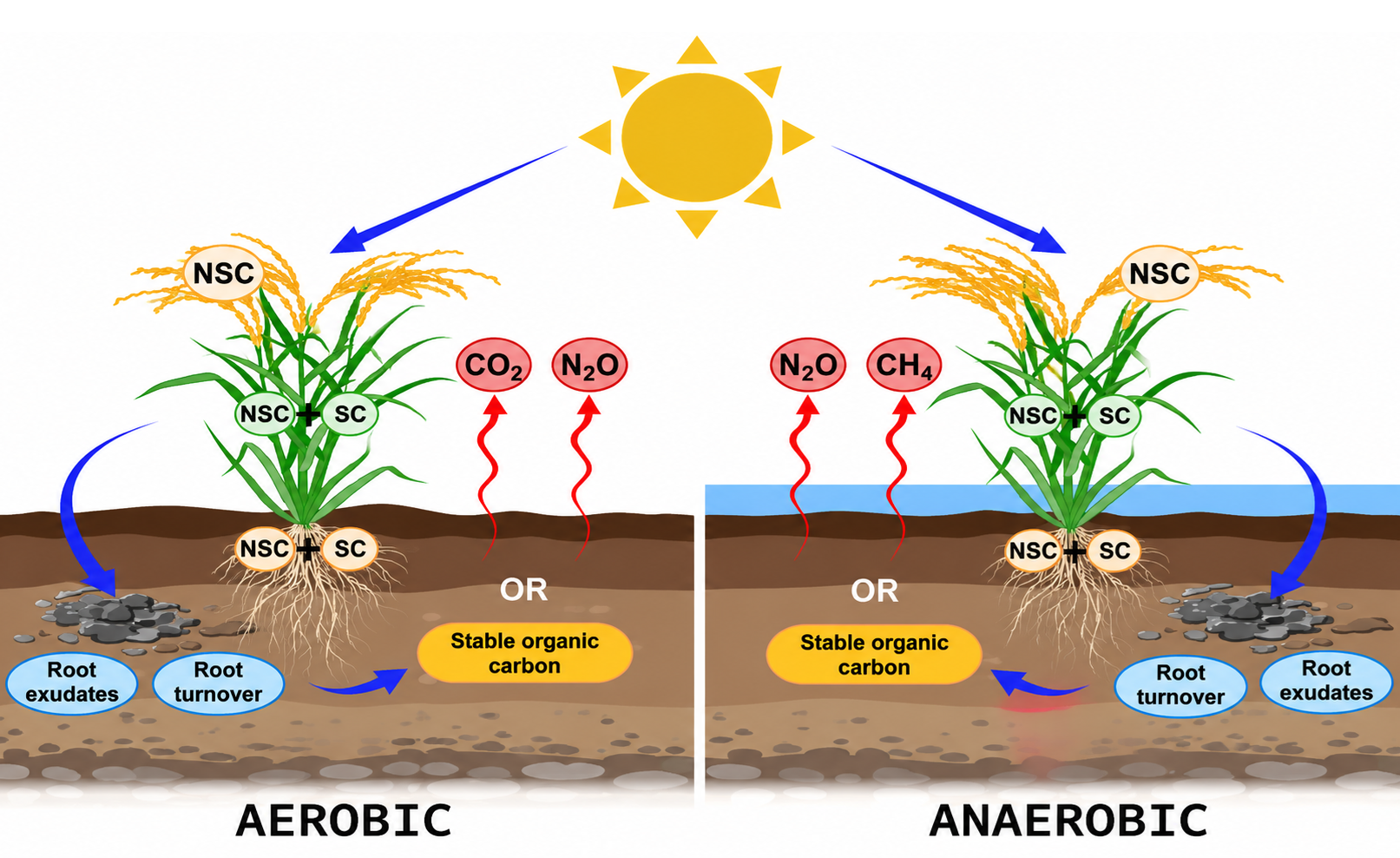
Rice (Oryza sativa L.) provides a primary source of caloric intake for over half of the global population. Aligning grain production with climate mitigation requires understanding how plant traits influence carbon balance under contrasting water regimes, which affect both trait expression and the fate of plant-derived carbon in soil and greenhouse-gas emissions. Here, the morphological and physiological attributes that govern carbon acquisition, allocation, and retention in rice were reviewed. Belowground, root traits contribute through soil exploration, rhizosphere activity, and structural accumulation, influencing resource acquisition, carbon inputs, and gas transport. Aboveground, shoot architecture, stay-green behavior, and source–sink coordination regulates canopy photosynthesis, reserve remobilization, and allocation to grain and residues. These complementary functions across genotypes, developmental stages, and water regimes, distinguishing plant carbon gain from soil retention and the net greenhouse-gas balance, were examined. Four operational archetypes, deep explorer, source maximizer, sink maximizer, and balanced integrator, are proposed as combinations of candidate traits for rice improvement and management. These proposed selection criteria are distinct from previously published observations, and their combined performance requires field validation. Evaluation would consider calibrated multimodal phenotyping with field measurements of yield, carbon allocation, ecosystem carbon budgets, and greenhouse-gas balances. The central hypothesis proposed as a result of this review is as follows: Combining deep root exploration with a coordinated supply of assimilates, the remobilization of reserves, and grain demand could improve carbon retention while maintaining grain yield, with outcomes that depend on the water regime and the fate of the residues.
References
Anilkumar, C., & Bernardo, R. (2026). Genomewide selection in rice (Oryza sativa L.) breeding: Balancing cost and time for higher genetic gain. Plant Breeding, 145(2), 298–305. https://doi.org/10.1111/pbr.70042
Aulakh, M. S., Bodenbender, J., Wassmann, R., & Rennenberg, H. (2000). Methane transport capacity of rice plants. II. Variations among different rice cultivars and relationship with morphological characteristics. Nutrient Cycling in Agroecosystems, 58, 367-375. https://doi.org/10.1023/A:1009839929441
Bañoc, D. M., Yamauchi, A., Kamoshita, A., Wade, L., & Pardales, J. (2000a). Dry matter production and root system development of rice cultivars under fluctuating soil moisture. Plant Production Science, 3(2), 197-207. https://doi.org/10.1626/pps.3.197
Bañoc, D. M., Yamauchi, A., Kamoshita, A., Wade, L., & Pardales, J. (2000b). Genotypic variations in response of lateral root development to fluctuating soil moisture in rice. Plant Production Science, 3(3), 335-343. https://doi.org/10.1626/pps.3.335
Bellini, C., Pacurar, D. I., & Perrone, I. (2014). Adventitious roots and lateral roots: Similarities and differences. Annual Review of Plant Biology, 65, 639-666. https://doi.org/10.1146/annurev-arplant-050213-035645
Brüggemann, N., Gessler, A., Kayler, Z., Keel, S. G., Badeck, F., Barthel, M., et al. (2011). Carbon allocation and carbon isotope fluxes in the plant-soil-atmosphere continuum: A review. Biogeosciences, 8(11), 3457–3489. https://doi.org/10.5194/bg-8-3457-2011
Bueno, C. S., & Lafarge, T. (2009). Higher crop performance of rice hybrids than of elite inbreds in the tropics: 1. Hybrids accumulate more biomass during each phenological phase. Field Crops Research, 112(2–3), 229–237. https://doi.org/10.1016/j.fcr.2009.03.006
Burgess, A. J., Retkute, R., Herman, T., & Murchie, E. H. (2017). Exploring relationships between canopy architecture, light distribution, and photosynthesis in contrasting rice genotypes using 3D canopy reconstruction. Frontiers in Plant Science, 8, 734. https://doi.org/10.3389/fpls.2017.00734
Chauhan, B. S., Jabran, K., & Mahajan, G. (Eds.). (2017). Rice Production Worldwide. Springer International Publishing, Switzerland. https://doi.org/10.1007/978-3-319-47516-5
Chawade, A., Van Ham, J., Blomquist, H., Bagge, O., Alexandersson, E., & Ortiz, R. (2019). High-throughput field-phenotyping tools for plant breeding and precision agriculture. Agronomy, 9(5), 258. https://doi.org/10.3390/agronomy9050258
Chen, T., Yang, X., Fu, W., Li, G., Feng, B., Fu, G., & Tao, L. (2022). Strengthened assimilate transport improves yield and quality of super rice. Agronomy, 12(4), 753. https://doi.org/10.3390/agronomy12040753
Chen, Y. L., & Rengel, Z. (2015). Phenotyping for root traits. In Phenomics in Crop Plants: Trends, Options and Limitations (pp. 101–128). Springer India. https://doi.org/10.1007/978-81-322-2226-2_8
Cheng, W., & Kuzyakov, Y. (2005). Root effects on soil organic matter decomposition. In R. W. Zobel & S. F. Wright (Eds.), Roots and Soil Management: Interactions between Roots and the Soil (Vol. 48, pp. 119–143). John Wiley & Sons, Ltd. https://doi.org/10.2134/agronmonogr48.c7
Colmer, T. D. (2003a). Aerenchyma and an inducible barrier to radial oxygen loss facilitate root aeration in upland, paddy and deep-water rice (Oryza sativa L.). Annals of Botany, 91, 301–309. https://doi.org/10.1093/aob/mcf114
Colmer, T. D. (2003b). Long-distance transport of gases in plants: a perspective on internal aeration and radial oxygen loss from roots. Plant, Cell & Environment, 26, 17–36. https://doi.org/10.1046/j.1365-3040.2003.00846.x
Colmer, T. D., & Pedersen, O. (2008). Oxygen dynamics in submerged rice (Oryza sativa). New Phytologist, 178(2), 326–334. https://doi.org/10.1111/j.1469-8137.2007.02364.x
Colmer, T. D., & Voesenek, L. A. C. J. (2009). Flooding tolerance: suites of plant traits in variable environments. Functional Plant Biology, 36, 665–681. https://doi.org/10.1071/fp09144
Core Writing Team, Lee, H., & Romero, J. (Eds.). (2023). IPCC, 2023: Climate Change 2023: Synthesis Report. Contribution of Working Groups I, II and III to the Sixth Assessment Report of the Intergovernmental Panel on Climate Change. IPCC. https://doi.org/10.59327/IPCC/AR6-9789291691647
Das, S. R., Nayak, B. K., Dey, S., Sarkar, S., Chatterjee, D., Saha, S., Sarkar, D., Pradhan, A., Saha, S., & Nayak, A. K. (2023). Potential soil organic carbon sequestration vis-a-vis methane emission in lowland rice agroecosystem. Environmental Monitoring and Assessment, 195(9). https://doi.org/10.1007/s10661-023-11673-0
Deng, Z., Chen, J., Wang, S., Li, T., Huang, K., Gu, P., Peng, H., & Chen, Z. (2025). Response of vegetation photosynthesis to the 2022 drought in Yangtze River Basin by diurnal Orbiting Carbon Observatory-2/3 satellite observations. Journal of Remote Sensing, 5,0445. https://doi.org/10.34133/remotesensing.0445
Dijkstra, F. A., Zhu, B., & Cheng, W. (2021). Root effects on soil organic carbon: a double-edged sword. New Phytologist, 230(1), 60-65. https://doi.org/10.1111/nph.17082
Ding, H., Jiang, Y., & Cao, C. (2021). Deep rice root systems reduce methane emissions in rice paddies. Plant and Soil, 468, 337-352. https://doi.org/10.1007/s11104-021-05118-1
Dinh, L. T., Pandey, B. K., Ueda, Y., Leftley, N., Atkinson, B. S., Bennett, M. J., & Wissuwa, M. (2026). Quantitative trait locus qLDC5 regulates primary root branching in an auxin-dependent manner. Journal of Experimental Botany, 77(17), 5639–5650. https://doi.org/10.1093/jxb/erag232
Fageria, N. K. (2007). Yield physiology of rice. Journal of Plant Nutrition, 30(6), 843-879. https://doi.org/10.1080/15226510701374831
Falqueto, A. R., Silva, F. S. P., Cassol, D., Magalhães, A. M., Oliveira, A. C., & Bacarin, M. A. (2010). Chlorophyll fluorescence in rice: probing of senescence driven changes of PSII activity on rice varieties differing in grain yield capacity. Brazilian Journal of Plant Physiology, 22(1), 35–41. https://doi.org/10.1590/S1677-04202010000100004
Fang, S., Yu, N., Zhu, W., Yin, C., Ma, T., Zhu, T., You, C., He, H., Zhang, Q., Xu, C., Wu, L., & Ke, J. (2026). Stage-specific drivers of double-peak methane mitigation in paddy fields with high-yield rice varieties. Field Crops Research, 346, 110603. https://doi.org/10.1016/j.fcr.2026.110603
Fei, C., Geng, X., Xu, Z., & Xu, Q. (2019). Multiple areas investigation reveals the genes related to vascular bundles in rice. Rice, 12(17). https://doi.org/10.1186/s12284-019-0278-x
Ferguson, J. N., Mcausland, L., Smith, K. E., Price, A., Wilson, Z., & Murchie, E. (2020). Rapid temperature responses of photosystem II efficiency forecast genotypic variation in rice vegetative heat tolerance. The Plant Journal, 104(3), 839-855. https://doi.org/10.1111/tpj.14956
Fonta, J. E., Vejchasarn, P., Henry, A., Lynch, J., & Brown, K. (2022). Many paths to one goal: Identifying integrated rice root phenotypes for diverse drought environments. Frontiers in Plant Science, 13, 959629. https://doi.org/10.3389/fpls.2022.959629
Freschet, G. T., Pagès, L., Iversen, C. M., Comas, L. H., Rewald, B., Roumet, C., et al. (2021a). A starting guide to root ecology: strengthening ecological concepts and standardising root classification, sampling, processing and trait measurements. New Phytologist, 232(3), 973–1122. https://doi.org/10.1111/nph.17572
Freschet, G. T., Roumet, C., Comas, L. H., Weemstra, M., Bengough, A. G., Rewald, B., et al. (2021b). Root traits as drivers of plant and ecosystem functioning: current understanding, pitfalls and future research needs. New Phytologist, 232(3), 1123–1158. https://doi.org/10.1111/nph.17072
Fu, P., Montes, C. M., Siebers, M. H., Gómez-Casanovas, N., McGrath, J., Ainsworth, E., & Bernacchi, C. (2022). Advances in field-based high-throughput photosynthetic phenotyping. Journal of Experimental Botany, 73(10), 3157-3172. https://doi.org/10.1093/jxb/erac077
Fukuda, S., Okamura, M., & Sugiura, D. (2025). Non-destructive estimation of rice canopy LAI using NIR/PAR: application to four rice cultivars with diverse leaf characteristics and plant architectures. Discover Agriculture, 3, 153. https://doi.org/10.1007/s44279-025-00343-z
Furbank, R. T., & Tester, M. (2011). Phenomics – technologies to relieve the phenotyping bottleneck. Trends in Plant Science, 16(12), 635–644. https://doi.org/10.1016/j.tplants.2011.09.005
Gangopadhyay, S., Banerjee, R., Batabyal, S., Das, N., Mondal, A., Pal, S., & Mandal, S. (2022). Carbon sequestration and greenhouse gas emissions for different rice cultivation practices. Sustainable Production and Consumption, 34, 90-104. https://doi.org/10.1016/j.spc.2022.09.001
Gu, D., Zhen, F., Hannaway, D. B., Zhu, Y., Liu, L., Cao, W., & Tang, L. (2017). Quantitative classification of rice (Oryza sativa L.) root length and diameter using image analysis. PLoS ONE, 12(1), e0169968. https://doi.org/10.1371/journal.pone.0169968
Guimarães, P. H. R., Pereira de Lima, I., Pereira de Castro, A., Lanna, A. C., Guimarães Santos Melo, P., & de Raïssac, M. (2020). Phenotyping root systems in a set of japonica rice accessions: Can structural traits predict the response to drought? Rice, 13, 67.https://doi.org/10.1186/s12284-020-00404-5
Gul, S., & Whalen, J. (2013). Plant life history and residue chemistry influences emissions of CO2 and N2O from soil: Perspectives for genetically modified cell wall mutants. Critical Reviews in Plant Sciences, 32(5), 344–368. https://doi.org/10.1080/07352689.2013.781455
Guo, Y., & Lv, Y. (2025). Evaluation of models for describing photosynthetic light–response curves and estimating parameters in rice leaves at various canopy positions. Agronomy, 15(1), 125. https://doi.org/10.3390/agronomy15010125
Haque, M. M., Biswas, J. C., Hwang, H. Y., & Kim, P. J. (2020). Annual net carbon budget in rice soil. Nutrient Cycling in Agroecosystems, 116, 31-40. https://doi.org/10.1007/s10705-019-10029-w
Henry, A., Gowda, V. R. P., Torres, R. O., McNally, K. L., & Serraj, R. (2011). Variation in root system architecture and drought response in rice (Oryza sativa): Phenotyping of the OryzaSNP panel in rainfed lowland fields. Field Crops Research, 120, 205–214. https://doi.org/10.1016/j.fcr.2010.10.003
Henry, A., Cal, A. J., Batoto, T. C., Torres, R., & Serraj, R. (2012). Root attributes affecting water uptake of rice (Oryza sativa L.) under drought. Journal of Experimental Botany, 63(13), 4751-4763. https://doi.org/10.1093/jxb/ers150
Hinsinger, P., Bengough, A. G., Vetterlein, D., & Young, I. M. (2009). Rhizosphere: biophysics, biogeochemistry and ecological relevance. Plant and Soil, 321, 117–152. https://doi.org/10.1007/s11104-008-9885-9
Hirayama, M., Wada, Y., & Nemoto, H. (2006). Estimation of drought tolerance based on leaf temperature in upland rice breeding. Breeding Science, 56, 47–54. https://doi.org/10.1270/jsbbs.56.47
Hodge, A., Berta, G., Doussan, C., Merchan, F., & Crespi, M. (2009). Plant root growth, architecture and function. Plant Soil, 321, 153-187. https://doi.org/10.1007/s11104-009-9929-9
Horii, H., Nemoto, K., Miyamoto, N., & Harada, J. (2006). Quantitative trait loci for adventitious and lateral roots in rice. Plant Breeding, 125(2), 198–200. https://doi.org/10.1111/j.1439-0523.2006.01124.x
Hossain, M. L., & Li, J. (2021). Biomass partitioning of C3- and C4-dominated grasslands in response to climatic variability and climate extremes. Environmental Research Letters, 16, 074016. https://doi.org/10.1088/1748-9326/ac027a
Hou, L., Gao, W., van der Bom, F., Weng, Z., Doolette, C., Maksimenko, A., et al. (2022). Use of X-ray tomography for examining root architecture in soils. Geoderma, 405, 115405. https://doi.org/10.1016/j.geoderma.2021.115405
Hussain, S., Peng, S., Fahad, S., Khaliq, A., Huang, J., Cui, K., & Nie, L. (2015). Rice management interventions to mitigate greenhouse gas emissions: a review. Environmental Science and Pollution Research, 22, 3342-3360. https://doi.org/10.1007/s11356-014-3760-4
Iqbal, M. F., Liu, S., Zhu, J., Zhao, L., Qi, T., Liang, J., Luo, J., Xiao, X., & Fan, X. (2021). Limited aerenchyma reduces oxygen diffusion and methane emission in paddy. Journal of Environmental Management, 1(279), 111583. https://doi.org/10.1016/j.jenvman.2020.111583
Jat, M. L., Dagar, J. C., Sapkota, T. B., Yadvinder-Singh, G. B., Ridaura, S., Saharawat, Y., et al. (2016). Climate change and agriculture: Adaptation strategies and mitigation opportunities for food security in South Asia and Latin America. In D. L. Sparks (Ed.) Advances in Agronomy. Academic Press Inc, pp. 127-235.https://doi.org/10.1016/bs.agron.2015.12.005
Ji, Y., Zhou, Y., Li, Z., Feng, K., Sun, X., Xu, Y., Wu, W., & Zou, H. (2024). Carbon footprint research and mitigation strategies for rice-cropping systems in China: a review. Frontiers in Sustainable Food Systems, 8, 1375092. https://doi.org/10.3389/fsufs.2024.1375092
Jiménez, J de la C., & Pedersen, O. (2023). Mitigation of greenhouse gas emissions from rice via manipulation of key root traits. Rice, 16(24). https://doi.org/10.1186/s12284-023-00638-z
Jones, D. L., Nguyen, C., & Finlay, R. D. (2009a). Carbon flow in the rhizosphere: carbon trading at the soil–root interface. Plant and Soil, 321, 5–33. https://doi.org/10.1007/s11104-009-9925-0
Jones, H. G., Serraj, R., Loveys, B. R., Xiong, L., Wheaton, A., & Price, A. H. (2009b). Thermal infrared imaging of crop canopies for the remote diagnosis and quantification of plant responses to water stress in the field. Functional Plant Biology, 36(11), 978–989. https://doi.org/10.1071/fp09123
Kakar, N., Bheemanahalli, R., Jumaa, S., Redoña, E., Warburton, M., & Reddy, K. (2021). Assessment of agro-morphological, physiological and yield traits diversity among tropical rice. PeerJ, 9, e11752. https://doi.org/10.7717/peerj.11752
Kalaji, H. M., Schansker, G., Brestic, M., Bussotti, F., Calatayud, A., Ferroni, L., et al. (2017). Frequently asked questions about chlorophyll fluorescence, the sequel. In Photosynthesis Research, 132, 13-66. https://doi.org/10.1007/s11120-016-0318-y
Kato, T., & Horibata, A. (2011). Non-random distribution of the alleles for good grain filling at OsAGPS2 and OsSUT1 among a wide range of rice (Oryza sativa L.) cultivars. Breeding Science, 61(2), 217–220. https://doi.org/10.1270/jsbbs.61.217
Kato, Y., Tajima, R., Homma, K., Toriumi, A., Yamagishi, J., Shiraiwa, T., Mekwatanakarn, P., & Jongdee, B. (2013). Root growth response of rainfed lowland rice to aerobic conditions in northeastern Thailand. Plant Soil, 368, 557-567. https://doi.org/10.1007/s11104-012-1538-3
Kaya, C. (2025). Optimizing crop production with plant phenomics through high-throughput phenotyping and AI in controlled environments. Food and Energy Security, 14(1), e70050. https://doi.org/10.1002/fes3.70050
Kimura, M., Murase, J., & Lu, Y. (2004). Carbon cycling in rice field ecosystems in the context of input, decomposition and translocation of organic materials and the fates of their end products (CO2 and CH4). Soil Biology and Biochemistry, 36(9), 1399-1416. https://doi.org/10.1016/j.soilbio.2004.03.006
Kingra, P. K., Kaur, R., & Kaur, S. (2019). Climate change impacts on rice (Oryza sativa L.) productivity and strategies for its sustainable management. The Indian Journal of Agricultural Sciences, 89(2), 171-180. https://doi.org/10.56093/ijas.v89i2.86981
Kirk, G. J. D., Boghi, A., Affholder, M. C., Keyes, S. D., Heppell, J., & Roose, T. (2019). Soil carbon dioxide venting through rice roots. Plant Cell and Environment, 42(12), 3197–3207. https://doi.org/10.1111/pce.13638
Kuzyakov, Y., & Domanski, G. (2000). Carbon input by plants into the soil. Review. Journal of Plant Nutrition and Soil Science, 163(4), 421-431. https://doi.org/10.1002/1522-2624(200008)163:4<421::AID-JPLN421>3.0.CO;2-R
Lafitte, H. R., Champoux, M. C., Mclaren, G., & O’Toole, J. C. (2001). Rice root morphological traits are related to isozyme group and adaptation. Field Crops Research, 71(1), 57-70. https://doi.org/10.1016/S0378-4290(01)00150-2
Lal, R. (2004). Soil carbon sequestration impacts on global climate change and food security. Science, 304(5677), 1623-1627. https://doi.org/10.1126/science.1097396
Lawson, T., & Blatt, M. R. (2014). Stomatal size, speed, and responsiveness impact on photosynthesis and water use efficiency. Plant Physiology, 164(4), 1556-1570. https://doi.org/10.1104/pp.114.237107
Li, A., Zhu, L., Xu, W., Liu, L., & Teng, G. (2022). Recent advances in methods for in situ root phenotyping. PeerJ, 10, e13638. https://doi.org/10.7717/peerj.13638
Li, G., Chen, X., Zhou, C., Yang, Z., Zhang, C., Huang, Z., Pan, W., & Xu, K. (2022). Vascular bundle characteristics of different rice variety treated with nitrogen fertilizers and its relation to stem assimilates allocation and grain yield. Agriculture, 12(6), 779. https://doi.org/10.3390/agriculture12060779
Li, G., Hu, Q., Zhang, G., Shi, Y., Wang, W., Wang, Z., Xiong, D., Huang, J., Peng, S., & Cui, K. (2026). Sucrose unloading in grains modulates the disparity in grain filling of superior and inferior spikelets in rice. Physiologia Plantarum, 178, e70809. https://doi.org/10.1111/ppl.70809
Li, L., Zhang, Q., & Huang, D. (2014). A review of imaging techniques for plant phenotyping. Sensors, 14(11), 20078–20111. https://doi.org/10.3390/s141120078
Li, S., Zhang, Y., Zhao, J., van Groenigen, K. J., Shen, X., Zhang, H., Gu, J., Zhang, W., Hui, D., Chen, Y., & Liu, L. (2025). Water-saving irrigation practices in rice paddies reverse the impact of root aerenchyma on methane emissions. Agriculture, Ecosystems & Environment, 378, 109309. https://doi.org/10.1016/j.agee.2024.109309
Li, X., Yan, W., Agrama, H., Jia, L., Jackson, A., Moldenhauer, K., Yeater, K., McClung, A., & Wu, D. (2012). Unraveling the complex trait of harvest index with association mapping in rice (Oryza sativa L.). PLOS ONE, 7(1), e29350. https://doi.org/10.1371/journal.pone.0029350
Liao, S., Yan, J., Xing, H., Tu, Y., Zhao, H., & Wang, G. (2021). Genetic basis of vascular bundle variations in rice revealed by genome-wide association study. Plant Science, 302, 110715. https://doi.org/10.1016/j.plantsci.2020.110715
Lin, C., Zhu, T., Ogorek, L. L. P., Wang, Y., Sauter, M., & Pedersen, O. (2022). The pyramiding of three key root traits aid breeding of flood-tolerant rice. Plants, 11(15). https://doi.org/10.3390/plants11152033
Lin, H.-C., Dionora, J., Chebotarov, D., Laza, M. R., Naredo, M. E. B., Muyco, P. A., et al. (2026). Diversity of photosynthesis-related and high-throughput phenotyping traits in indica rice. Current Plant Biology, 47, 100613. https://doi.org/10.1016/j.cpb.2026.100613
Liu, Q., Chen, S., Zhou, L., Tao, Y., Tian, J., Xing, Z., Wei, H., & Zhang, H. (2022). Characteristics of population quality and rice quality of semi-waxy japonica rice varieties with different grain yields. Agriculture, 12(2), 241. https://doi.org/10.3390/agriculture12020241
Liu, S., Xiong, Z., Zhang, Z., Wei, Y., Xiong, D., Wang, F., & Huang, J. (2023). Exploration of chlorophyll fluorescence characteristics gene regulatory in rice (Oryza sativa L.): a genome-wide association study. Frontiers in Plant Science, 14, 1234866. https://doi.org/10.3389/fpls.2023.1234866
Liu, Y., Ge, T., Zhu, Z., Liu, S., Luo, Y., Li, Y., Wang, P., et al. (2019). Carbon input and allocation by rice into paddy soils: A review. Soil Biology and Biochemistry, 133, 97-107. https://doi.org/10.1016/j.soilbio.2019.02.019
Lu, B. R., Cai, X., & Jin, X. (2009). Efficient indica and japonica rice identification based on the InDel molecular method: Its implication in rice breeding and evolutionary research. Progress in Natural Science, 19(10), 1241-1252. https://doi.org/10.1016/j.pnsc.2009.01.011
Lu, Y., Watanabe, A., & Kimura, M. (2003). Carbon dynamics of rhizodeposits, root- and shoot-residues in a rice soil. Soil Biology and Biochemistry, 35(9), 1223–1230. https://doi.org/10.1016/S0038-0717(03)00184-6
Luan, Y., Xu, J., Lv, Y., Liu, X., Wang, H., & Liu, S. (2021). Improving the performance in crop water deficit diagnosis with canopy temperature spatial distribution information measured by thermal imaging. Agricultural Water Management, 246, 106699. https://doi.org/10.1016/j.agwat.2020.106699
Lynch, J. P. (2007). Roots of the second green revolution. Australian Journal of Botany, 55(5), 493–512. https://doi.org/10.1071/bt06118
Mandal, U. K., Bhardwaj, A. K., Lama, T. D., Nayak, D. B., Samui, A., Burman, D., Mahanta, K. K., Sarangi, S. K., Mandal, S., & Raut, S. (2021). Net ecosystem exchange of carbon, greenhouse gases, and energy budget in coastal lowland double cropped rice ecology. Soil and Tillage Research, 212, 105076. https://doi.org/10.1016/j.still.2021.105076
Mao, T., Xu, H., Xu, Q., Guo, Y., Zhu, C., Chen, K., Wang, J., & Xu, Z. (2010). Comparison of morphological and genetic differentiations in filial generation of cross between indica and japonica rice. Rice Science, 17(1), 82-86. https://doi.org/10.1016/S1672-6308(08)60108-0
Maqbool, S., Hassan, M. A., Xia, X., York, L., Rasheed, A., & He, Z. (2022). Root system architecture in cereals: progress, challenges and perspective. The Plant Journal, 110(1), 23–42. https://doi.org/10.1111/tpj.15669
Mayanja, I. K., Diepenbrock, C. H., Vadez, V., Lei, T., & Bailey, B. N. (2024). Practical considerations and limitations of using leaf and canopy temperature measurements as a stomatal conductance proxy: Sensitivity across environmental conditions, scale, and sample size. Plant Phenomics, 6, 0169. https://doi.org/10.34133/plantphenomics.0169
Mertens, S., Verbraeken, L., Sprenger, H., De Meyer, S., Demuynck, K., Cannoot, B., et al. (2023). Monitoring of drought stress and transpiration rate using proximal thermal and hyperspectral imaging in an indoor automated plant phenotyping platform. Plant Methods, 19(132). https://doi.org/10.1186/s13007-023-01102-1
Mi, W., Yang, B., Guo, S., Gao, F., Zhu, K., & Chen, S. (2026). Growth stage mediates the effects of water regime and long-term fertilization on carbon partitioning in the rice–rhizosphere system. Plant and Soil, 525, 1589–1601. https://doi.org/10.1007/s11104-026-08849-1
Mishra, A., & Salokhe, V. M. (2011). Rice root growth and physiological responses to SRI water management and implications for crop productivity. Paddy Water Environment, 9, 41–52. https://doi.org/10.1007/s10333-010-0240-4
Mohammed, G. H., Colombo, R., Middleton, E. M., Rascher, U., van der Tol, C., et al. (2019). Remote sensing of solar-induced chlorophyll fluorescence (SIF) in vegetation: 50 years of progress. Remote Sensing of Environment, 231, 111177. https://doi.org/10.1016/j.rse.2019.04.030
Mohapatra, P. K., Panigrahi, R., & Turner, N. C. (2011). Physiology of Spikelet Development on the Rice Panicle: Is Manipulation of Apical Dominance Crucial for Grain Yield Improvement? In: Advances in Agronomy. Elsevier Inc., pp. 333-359. https://doi.org/10.1016/b978-0-12-385531-2.00005-0
Mohapatra, P. K., & Sahu, B. B. (2021). Panicle Architecture of Rice and its Relationship with Grain Filling. In: Panicle Architecture of Rice and its Relationship with Grain Filling. Springer International Publishing, Switzerland. https://doi.org/10.1007/978-3-030-67897-5
Moradi, F., & Ismail, A. M. (2007). Responses of photosynthesis, chlorophyll fluorescence and ROS-scavenging systems to salt stress during seedling and reproductive stages in rice. Annals of Botany, 99(6), 1161-1173. https://doi.org/10.1093/aob/mcm052
Nguyen, V. N. T., Moon, S., Koh, H. J., Nguyen, Q. N., Yoon, B. S., Kim, B., Koh, H. J., & Jung, K. H. (2015). Genome-wide transcriptome comparison of flag leaves among japonica and indica varieties. Journal of Plant Biology, 58(5), 333–343. https://doi.org/10.1007/s12374-015-0333-0
Ni, C., Zhang, J., Zhu, C., Hu, Q., Huo, Z., Dai, Q., Xu, K., & Li, G. (2026). Sucrose metabolism and translocation regulate stem–grain biomass partitioning to enhance grain yield in rice. Field Crops Research, 342, 110457. https://doi.org/10.1016/j.fcr.2026.110457
Ohsumi, A., Hamasaki, A., Nakagawa, H., Homma, K., Horie, T., & Shiraiwa, T. (2008). Response of leaf photosynthesis to vapor pressure difference in rice (Oryza sativa L.) varieties in relation to stomatal and leaf internal conductance. Plant Production Science, 11(2), 184-191. https://doi.org/10.1626/pps.11.184
Oo, A. Z., Tsujimoto, Y., Ranjakason, M. N. A., Andrianary, B. H., Raharinivo, V., Takai, T., & Uga, Y. (2025). Shallow root system with a DRO1 homolog combined with localized P application via P-dipping improves P use efficiency for rice production in nutrient-deficient lowlands in Madagascar. Field Crops Research, 331, 110008. https://doi.org/10.1016/j.fcr.2025.110008
Oue, H. (2023). Comparisons of the stomatal conductance and electron transport rate of three Japanese rice cultivars including Himenorin in Ehime Prefecture. Journal of Agricultural Meteorology, 79(2), 77–84. https://doi.org/10.2480/agrmet.D-22-00025
Ouyang, W., Struik, P. C., Yin, X., & Yang, J. (2017). Stomatal conductance, mesophyll conductance, and transpiration efficiency in relation to leaf anatomy in rice and wheat genotypes under drought. Journal of Experimental Botany, 68(18), 5191-5205. https://doi.org/10.1093/jxb/erx314
Paez-Garcia, A., Motes, C. M., Scheible, W.-R., Chen, R., Blancaflor, E. B., & Monteros, M. J. (2015). Root traits and phenotyping strategies for plant improvement. Plants, 4, 334–355. https://doi.org/10.3390/plants4020334
Park, H. J., Lim, S. S., Kwak, J. H., Lee, K. S., In Yang, H., Kim, H. Y., Lee, S. M., & Choi, W. J. (2020). Biomass, chemical composition, and microbial decomposability of rice root and straw produced under co-elevated CO2 and temperature. Biology and Fertility of Soils, 56, 991–1005. https://doi.org/10.1007/S00374-020-01471-y
Paul, M. J., Oszvald, M., Jesus, C., Rajulu, C., Griffiths, C. A., & Raines, C. (2017). Increasing crop yield and resilience with trehalose 6-phosphate: targeting a feast-famine mechanism in cereals for better source-sink optimization. Journal of Experimental Botany, 68(16), 4455– 4462. https://doi.org/10.1093/jxb/erx083
Pausch, J., & Kuzyakov, Y. (2018). Carbon input by roots into the soil: Quantification of rhizodeposition from root to ecosystem scale. Global Change Biology, 24(1), 1–12. https://doi.org/10.1111/gcb.13850
Phule, A. S., Barbadikar, K. M., Madhav, M. S., Subrahmanyam, D., Senguttuvel, P., Babu, M. B. B. P., & Kumar, P. A. (2019). Studies on root anatomy, morphology and physiology of rice grown under aerobic and anaerobic conditions. Physiology and Molecular Biology of Plants, 25(1), 197–205. https://doi.org/10.1007/s12298-018-0599-z
Pierret, A., Doussan, C., Capowiez, Y., Bastardie, F., & Pagès, L. (2007). Root functional architecture: A framework for modeling the interplay between roots and soil. Vadose Zone Journal, 6(2), 269–281. https://doi.org/10.2136/vzj2006.0067
Pierret, A., Maeght, J. L., Clément, C., Montoroi, J. P., Hartmann, C., & Gonkhamdee, S. (2016). Understanding deep roots and their functions in ecosystems: an advocacy for more unconventional research. Annals of Botany, 118(4), 621–635. https://doi.org/10.1093/aob/mcw130
Pieruschka, R., & Schurr, U. (2019). Plant phenotyping: Past, present, and future. Plant Phenomics, 2019, 7507131. https://doi.org/10.34133/2019/7507131
Poirier, V., Roumet, C., & Munson, A. D. (2018). The root of the matter: Linking root traits and soil organic matter stabilization processes. Soil Biology and Biochemistry, 120, 246-259. https://doi.org/10.1016/j.soilbio.2018.02.016
Pu, X., Dong, X., Cheng, H., Xie, J., Zhang, Y., Lu, L., Hu, Y., Song, W., & Xu, H. (2021). Dissolved organic carbon loss from paddy fields by drainage and roles of common ions. Agriculture, Ecosystems and Environment, 307, 107221. https://doi.org/10.1016/j.agee.2020.107221
Pump, J., & Conrad, R. (2014). Rice biomass production and carbon cycling in 13CO2 pulse-labeled microcosms with different soils under submerged conditions. Plant and Soil, 384(1-2), 213-229. https://doi.org/10.1007/s11104-014-2201-y
Quero, G., Bonnecarrère, V., Fernández, S., Silva, P., Simondi, S., & Borsani, O. (2019). Light-use efficiency and energy partitioning in rice is cultivar dependent. Photosynthesis Research, 140(1), 51-63. https://doi.org/10.1007/s11120-018-0605-x
Rasse, D. P., Rumpel, C., & Dignac, M. F. (2005). Is soil carbon mostly root carbon? Mechanisms for a specific stabilisation. Plant and Soil, 269, 341-356. https://doi.org/10.1007/s11104-004-0907-y
Reynolds, D., Baret, F., Welcker, C., Bostrom, A., Ball, J., Cellini, F., et al. (2019). What is cost-efficient phenotyping? Optimizing costs for different scenarios. Plant Science, 282, 14–22. https://doi.org/10.1016/j.plantsci.2018.06.015
Reynolds, M., Chapman, S., Crespo-Herrera, L., Molero, G., Mondal, S., Pequeño, D., Pinto, F., Pinera Chavez, F., Poland, J., Rivera-Amado, C., Saint, C., & Sukumaran, S. (2020). Breeder friendly phenotyping. Plant Science, 295, 110396. https://doi.org/10.1016/j.plantsci.2019.110396
Rizi, M. S., & Mohammadi, M. (2023). Breeding crops for enhanced roots to mitigate against climate change without compromising yield. Rhizosphere, 26, 100702. https://doi.org/10.1016/j.rhisph.2023.100702
Robin, A. H. K., & Saha, P. S. (2015). Morphology of lateral roots of twelve rice cultivars of Bangladesh: Dimension increase and diameter reduction in progressive root branching at the vegetative stage. Plant Root, 9, 34-42. https://doi.org/10.3117/plantroot.9.34
Rosenqvist, E., Großkinsky, D. K., Ottosen, C. O., & van de Zedde, R. (2019). The phenotyping dilemma—the challenges of a diversified phenotyping community. Frontiers in Plant Science, 10(163). https://doi.org/10.3389/fpls.2019.00163
Sharma, N., Singh, B., Krishnan, S. G., Bollinedi, H., Mandal, P. K., Lal, M. K., Jha, P. K., Anand, A., & Vara Prasad, P. V. (2024). Higher grain-filling rate in inferior spikelets of tolerant rice genotype offset grain yield loss under post-anthesis high night temperatures. Rice Science, 31(5), 572–586. https://doi.org/10.1016/J.RSCI.2024.06.003
Shi, L.-D., Ercoli, M. F., Kim, J., Teixeira de Araujo Junior, A., Estera-Molina, K., et al. (2026). Reduced methane emissions in transgenic rice genotypes are associated with altered rhizosphere microbial hydrogen cycling. Nature Communications, 17, 2028. https://doi.org/10.1038/s41467-026-68640-9
Shi, W., Raveendran, M., Rahman, H., Selvam, J., Peng, S., Zou, Y., & Jagadish, K. S. V. (2013). Source-sink dynamics and proteomic reprogramming under elevated night temperature and their impact on rice yield and grain quality. New Phytologist, 197(3), 825–837. https://doi.org/10.1111/nph.12088
Soremi, P. A. S., Chirinda, N., & Graterol, E. (2023). Potential of rice (Oryza sativa L.) cultivars to mitigate methane emissions from irrigated systems in Latin America and the Caribbean. All Earth, 35(1), 149-157. https://doi.org/10.1080/27669645.2023.2207941
Stella, T., Bregaglio, S., & Confalonieri, R. (2016). A model to simulate the dynamics of carbohydrate remobilization during rice grain filling. Ecological Modelling, 320, 366-371. https://doi.org/10.1016/j.ecolmodel.2015.10.026
Takahashi, H., & Pradal, C. (2021). Root phenotyping: important and minimum information required for root modeling in crop plants. Breeding Science, 71, 109-116. https://doi.org/10.1270/jsbbs.20126
Tanaka, M., Keira, M., Yoon, D. K., Mae, T., Ishida, H., Makino, A., & Ishiyama, K. (2022). Photosynthetic enhancement, lifespan extension, and leaf area enlargement in flag leaves increased the yield of transgenic rice plants overproducing Rubisco under sufficient N fertilization. Rice, 15(1):1–15. https://doi.org/10.1186/S12284-022-00557-5
Tang, H., Liu, Y., Li, X., Muhammad, A., & Huang, G. (2019). Carbon sequestration of cropland and paddy soils in China: potential, driving factors, and mechanisms. Greenhouse Gases: Science and Technology, 9(5), 872-885. https://doi.org/10.1002/ghg.1901
Tang, Y., Li, F., Zhou, Z., Huang, H., Guo, T., Wei, X., & Zhuang, J. (2026). DFM-Net: A UAV-based multimodal network for rice SPAD estimation using RGB and thermal infrared images. Infrared Physics & Technology, 158, 106796. https://doi.org/10.1016/j.infrared.2026.106796
Tang, Z., Jiang, T., Wang, Y., & Sun, X. (2024). LiDAR: a new player in analyzing plant phenotypes. Trends in Plant Science, 29(12), 1383–1384. https://doi.org/10.1016/j.tplants.2024.10.007
Toyofuku, K., Matsunami, M., & Ogawa, A. (2015). Genotypic variation in osmotic stress tolerance among rice cultivars and its association with L-type lateral root development. Plant Production Science, 18(3), 246-253. https://doi.org/10.1626/pps.18.246
Trumbore, S. (2006). Carbon respired by terrestrial ecosystems – recent progress and challenges. Global Change Biology, 12(2), 141-153. https://doi.org/10.1111/j.1365-2486.2005.01067.x
Tu, D., Jiang, Y., Salah, A., Cai, M., Peng, W., Zhang, L., Li, C., & Cao, C. (2022). Response of source-sink characteristics and rice quality to high natural field temperature during reproductive stage in irrigated rice system. Frontiers in Plant Science 13, 911181. https://doi.org/10.3389/fpls.2022.911181
U.S. Department of Agriculture. (2018). Crop technology readiness level (TRL). United States Department of Agriculture National Institute of Food and Agriculture Institute of Food Production and Sustainability. https://www.nifa.usda.gov/sites/default/files/resources/Crop-Research-Technology-Readiness-Level-2018.pdf
Ueda, T., Taniguchi, Y., Adachi, S., Shenton, M., Hori, K., & Tanaka, J. (2025). Gene pyramiding strategies for sink size and source capacity for high-yield japonica rice breeding. Rice, 18(6). https://doi.org/10.1186/s12284-025-00756-w
Vaughan, D. A., Lu, B. R., & Tomooka, N. (2008). The evolving story of rice evolution. Plant Science, 174, 394-408. https://doi.org/10.1016/j.plantsci.2008.01.016
Vishwakarma, C., Krishna, G. K., Kapoor, R. T., Mathur, K., Dalal, M., Singh, N., Mohapatra, T., & Chinnusamy, V. (2024). Physiological analysis of source–sink relationship in rice genotypes with contrasting grain yields. Plants, 13(62). https://doi.org/10.3390/plants13010062
Wang, H., Inukai, Y., & Yamauchi, A. (2006). Root development and nutrient uptake. Critical Reviews in Plant Sciences, 25(3), 279–301. https://doi.org/10.1080/07352680600709917
Watt, M., Fiorani, F., Usadel, B., Rascher, U., Muller, O., & Schurr, U. (2020). Phenotyping: New windows into the plant for breeders. Annual Reviews of Plant Biology, 71, 689-712. https://doi.org/10.1146/annurev-arplant-042916-041124
Wen, T., Li, J. H., Wang, Q., Gao, Y., Hao, G., & Song, B. (2023). Thermal imaging: The digital eye facilitates high-throughput phenotyping traits of plant growth and stress responses. Science of The Total Environment, 899, 165626. https://doi.org/10.1016/j.scitotenv.2023.165626
Win, E. P., Win, K. K., Bellingrath-Kimura, S. D., & Oo, A. (2020). Greenhouse gas emissions, grain yield and water productivity: a paddy rice field case study based in Myanmar. Greenhouse Gases: Science and Technology, 10(5), 884-897. https://doi.org/10.1002/ghg.2011
Wu, Z. H., Yang, C. W., & Yang, M. Y. (2014). Photosynthesis, photosystem II efficiency, amino acid metabolism and ion distribution in rice (Oryza sativa L.) in response to alkaline stress. Photosynthetica, 52(1), 157-160. https://doi.org/10.1007/s11099-014-0002-4
Xiong, D. (2024). Perspectives of improving rice photosynthesis for higher grain yield. Crop and Environment, 3(3), 123-137. https://doi.org/10.1016/j.crope.2024.04.001
Xiong, D., Wang, D., Liu, X., Peng, S., Huang, J., & Li, Y. (2016). Leaf density explains variation in leaf mass per area in rice between cultivars and nitrogen treatments. Annals of Botany, 117(6), 963–971. https://doi.org/10.1093/aob/mcw022
Xu, D., Zhu, Y., Chen, Z.-F., Han, C., Hu, L., Qiu, S., et al. (2020). Yield characteristics of japonica/indica hybrids rice in the middle and lower reaches of the Yangtze River in China. Journal of Integrative Agriculture, 19(10), 2394–2406. https://doi.org/10.1016/S2095-3119(19)62872-8
Yadav, G. S., Babu, S., Das, A., Bhowmik, S. N., Datta, M., & Singh, R. (2019). Soil carbon dynamics and productivity of rice–rice system under conservation tillage in submerged and unsubmerged ecologies of Eastern Indian Himalaya. Carbon Management, 10(1), 51-62. https://doi.org/10.1080/17583004.2018.1545518
Yang, J., & Zhang, J. (2010). Crop management techniques to enhance harvest index in rice. Journal of Experimental Botany, 61(12), 3177-3189. https://doi.org/10.1093/jxb/erq112
Yang, J., & Zhang, J. (2023). Simultaneously improving grain yield and water and nutrient use efficiencies by enhancing the harvest index in rice. Crop and Environment, 2(3), 157-164. https://doi.org/10.1016/j.crope.2023.07.001
Yang, X., Shi, H., Stovall, A., Guan, K., Miao, G., Zhang, Y., et al. (2018). FluoSpec 2: An automated field spectroscopy system to monitor canopy solar-induced fluorescence. Sensors, 18(2063). https://doi.org/10.3390/s18072063
Ye, H., Wang, Z., Zhong, D., Martini, D., Zhang, Q., Jiang, Y., Ding, Y., & Wang, S. (2026). Depicting the response of crop photosynthesis to elevated CO2: The unique role of sun-induced chlorophyll fluorescence. Agricultural and Forest Meteorology, 385, 111211. https://doi.org/10.1016/j.agrformet.2026.111211
Ye, M., Zhang, Z., Huang, G., Xiong, Z., Peng, S., & Li, Y. (2020). High leaf mass per area Oryzageno types invest more leaf mass to cell wall and show a low mesophyll conductance. AoB PLANTS, 12(4), plaa028. https://doi.org/10.1093/aobpla/plaa028
Ye, M., Zhang, Z., Huang, G., & Li, Y. (2022). Leaf photosynthesis and its temperature response are different between growth stages and N supplies in rice plants. International Journal of Molecular Sciences, 23(7). https://doi.org/10.3390/ijms23073885
Zang, Y., Wu, G., Li, Q., Xu, Y., Xue, M., et al. (2024). Irrigation regimes modulate non-structural carbohydrate remobilization and improve grain filling in rice (Oryza sativa L.) by regulating starch metabolism. Journal of Integrative Agriculture, 23(5),1507-1522. https://doi.org/10.1016/j.jia.2023.05.012
Zhang, J., Li, G., Huang, Q., Liu, Z., Ding, C., Tang, S., Chen, L., Wang, S., Ding, Y., & Zhang, W. (2017). Effects of culm carbohydrate partitioning on basal stem strength in a high-yielding rice population. The Crop Journal 5(6), 478-487. https://doi.org/10.1016/j.cj.2017.08.008
Zhao, Y., Wu, J., Flo, V., Wang, J., Zhang, Q., & Mencuccini, M. (2026). Thermal regulation shapes the coordination of stomatal conductance, transpiration, and photosynthesis in rice. Journal of Experimental Botany, erag484. https://doi.org/10.1093/jxb/erag484
Zheng, Z., Huang, J., Tian, M., Liu, H.-J., Li, X., Sun, Y., et al. (2026). A dual-substrate X-ray CT platform for in situ high-resolution and high-throughput phenotyping of crop root systems. Plant Physiology, 201(3), kiag197. https://doi.org/10.1093/plphys/kiag197
Zhu, X. G., Long, S. P., & Ort, D. R. (2010). Improving photosynthetic efficiency for greater yield. Annual Review of Plant Biology, 61, 235-261. https://doi.org/10.1146/annurev-arplant-042809-112206
Zhu, Z., Ge, T., Xiao, M., Yuan, H., Wang, T., Liu, S., Atere, C. T., Wu, J., & Kuzyakov, Y. (2017). Belowground carbon allocation and dynamics under rice cultivation depends on soil organic matter content. Plant and Soil, 410, 247–258. https://doi.org/10.1007/S11104-016-3005-z
Zou, J., Xu, H., Qin, B., Lan, C., Li, J., Zhang, B., et al. (2026). Ratoon season rice reduces methane emissions by limiting acetic acid transport to the rhizosphere and inhibiting methanogens. Advanced Science, 13, e07916. https://doi.org/10.1002/advs.202507916
Downloads
Additional Files
Published
Issue
Section
License
Copyright (c) 2026 Scientia Agropecuaria

This work is licensed under a Creative Commons Attribution-NonCommercial 4.0 International License.
The authors who publish in this journal accept the following conditions:
a. The authors retain the copyright and assign to the magazine the right of the first publication, with the work registered with the Creative Commons attribution license, which allows third parties to use the published information whenever they mention the authorship of the work and the First publication in this journal.
b. Authors may make other independent and additional contractual arrangements for non-exclusive distribution of the version of the article published in this journal (eg, include it in an institutional repository or publish it in a book) as long as it clearly indicates that the work Was first published in this journal.
c. Authors are encouraged to publish their work on the Internet (for example, on institutional or personal pages) before and during the review and publication process, as it can lead to productive exchanges and a greater and faster dissemination of work Published (see The Effect of Open Access).