Food perceptions and breakfast choices among school-age children and parents in southern Peru: A cross-sectional study using projective techniques
DOI:
https://doi.org/10.17268/sci.agropecu.2025.066Keywords:
Food perception, Projective techniques, School-age children, Sociodemographic determinants, Andean diet, Southern PeruAbstract
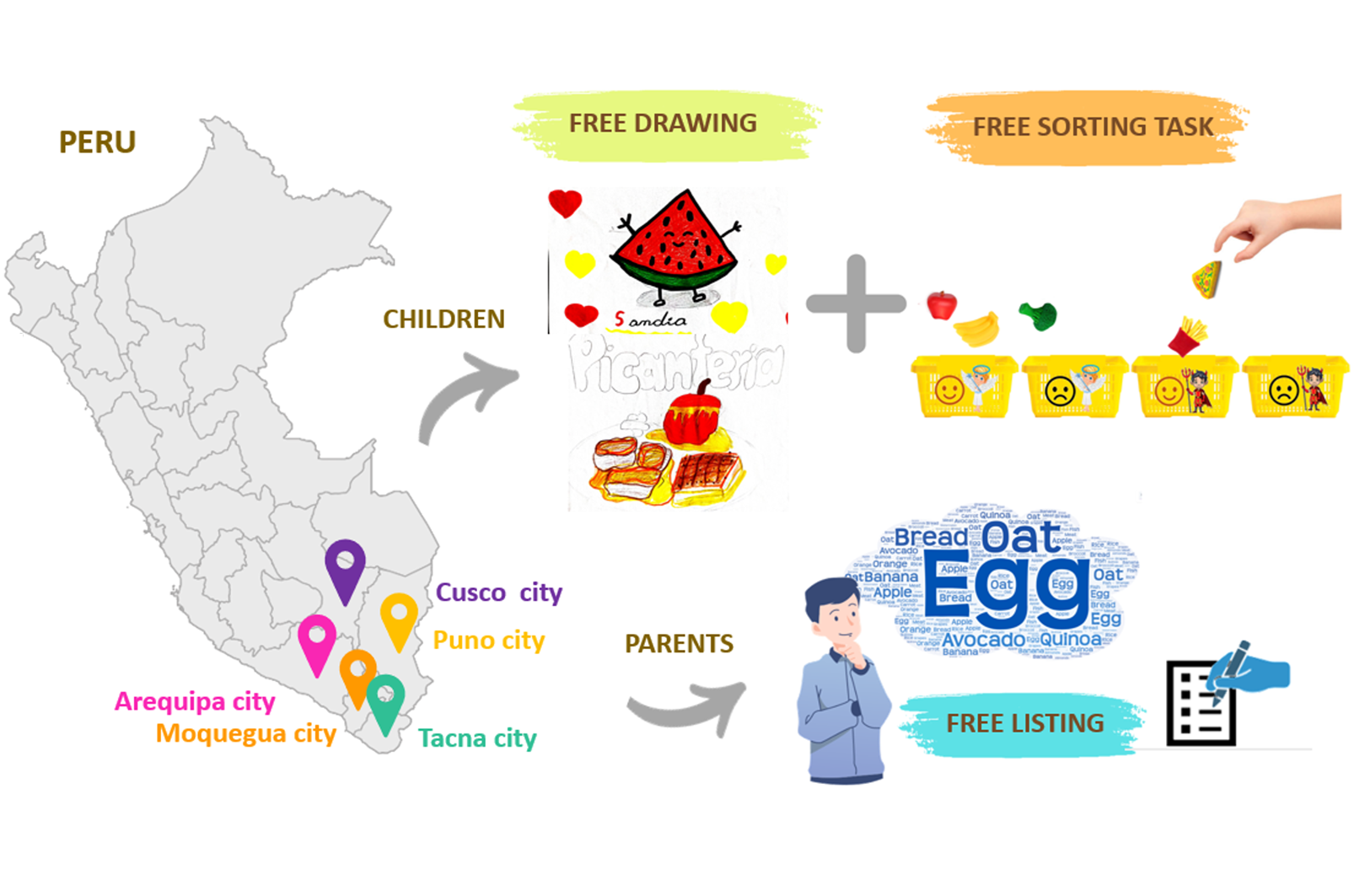
Peru's school feeding program applies largely uniform menus across regions with very different food cultures, yet little is known about how children and parents in these regions represent food. This cross-sectional study compared food perceptions and breakfast choices among school-age children (10-12 years) and their parents in five cities of southern Peru (Arequipa, Cusco, Moquegua, Puno and Tacna). Three projective techniques were applied: free drawing and a sorting task with 600 children from public primary schools (120 per city), and a breakfast composition task with 576 parents. Drawings were analyzed by correspondence analysis, sorting data by DISTATIS, and the cognitive salience index (CSI) was calculated for the foods selected by parents. Of the 1,023 foods depicted, 62.7% were healthy foods, 21.8% ultra-processed foods and 15.5% traditional dishes; the share of ultra-processed foods was highest in Tacna (36.6%). Children clearly distinguished healthy from unhealthy foods: fruits were classified as healthy and liked, ultra-processed foods as liked but unhealthy, and broccoli, beans, almonds and nuts as healthy but disliked. In the breakfast task, bread, oats and eggs were the most salient foods in most cities, whereas quinoa reached the highest CSI in Puno (0.39) compared with 0.11 – 0.23 in the other cities. Native foods such as quinoa and tarwi appeared mainly in the Andean cities of Cusco and Puno. These findings reveal marked regional differences in food representations and support adapting school menus to regional food preferences.
References
Abdi, H., Valentin, D., Chollet, S., & Chrea, C. (2007). Analyzing assessors and products in sorting tasks: DISTATIS, theory and applications. Food Quality and Preference, 18(4), 627–640. https://doi.org/10.1016/j.foodqual.2006.09.003
Abdoli, M., Scotto Rosato, M., Cipriano, A., Napolano, R., Cotrufo, P., Barberis, N., & Cella, S. (2023). Affect, Body, and Eating Habits in Children: A Systematic Review. Nutrients, 15, 15. https://doi.org/10.3390/nu15153343
Adjapong, E. S., Bender, K. E., Schaefer, S., & Roe, B. E. (2024). School and meal characteristics associated with plate waste in K-12 cafeterias in the United States. PLoS ONE, 19(12). https://doi.org/10.1371/journal.pone.0299043
Aguirre-Sosa, J., Dextre, M. L., & Vargas-Merino, J. A. (2025). Peruvian ceviche: cultural heritage of humanity and its socio-cultural significance. Journal of Ethnic Foods, 12(1), 13. https://doi.org/10.1186/s42779-025-00273-7
Ajito, E. (2017). Estudio de los factores que estarían contribuyendo o limitando la calidad, monitoreo y distribución de los alimentos que entrega el programa nacional de alimentación escolar Qali Warma basado en la precepción de los actores del programa de 4 instituciones educativas del distrito de Breña. http://www.qw.gob.pe/?page_id=103
Alfaro, B., Rios, Y., Arranz, S., & Varela, P. (2020). Understanding children’s healthiness and hedonic perception of school meals via structured sorting. Appetite, 144, 104466. https://doi.org/10.1016/j.appet.2019.104466
Andrade, C. (2021). The Inconvenient Truth About Convenience and Purposive Samples. Indian Journal of Psychological Medicine, 43(1), 86–88. https://doi.org/10.1177/0253717620977000
Beaton, D., Chin Fatt, C. R., & Abdi, H. (2014). An ExPosition of multivariate analysis with the singular value decomposition in R. Computational Statistics & Data Analysis, 72, 176–189. https://doi.org/10.1016/j.csda.2013.11.006
Bernardino, M., Sison, N. K. D., Bruce, J. C., Tiribelli, C., & Rosso, N. (2024). Understanding and Exploring the Food Preferences of Filipino School-Aged Children Through Free Drawing as a Projective Technique. Nutrients, 16(23). https://doi.org/10.3390/nu16234035
Burkitt, E., Barrett, M., & Davis, A. (2003). Children’s colour choices for completing drawings of affectively characterised topics. Journal of Child Psychology and Psychiatry, 44(3), 445–455. https://doi.org/10.1111/1469-7610.00134
Carpi, C., L. Almli, V., & Wergedahl, H. (2026). ‘What would you serve as a cook in your kindergarten?’ Children’s taste perceptions and experiences across seven dimensions – a qualitative study in Norwegian kindergartens. European Early Childhood Education Research Journal, 1–18. https://doi.org/10.1080/1350293X.2026.2705507
Chawner, L. R., Birtill, P., Cockroft, J. E., & Hetherington, M. M. (2024). Eating vegetables at school lunchtimes: Pilot and feasibility studies testing strategies to improve intake. Appetite, 201, 107622. https://doi.org/10.1016/j.appet.2024.107622
Cohen, J. F. W., Hecht, A. A., Hager, E. R., Turner, L., Burkholder, K., & Schwartz, M. B. (2021). Strategies to improve school meal consumption: A systematic review. Nutrients, 13(10). https://doi.org/10.3390/nu13103520
Compañ-Gabucio, LM., Oncina-Cánovas, A., Torres-Collado, L. et al. (2026). Consumption of ultra-processed foods and associated factors in Spanish children aged 8–12 years: a cross-sectional analysis within the INMA cohort study. BMC Public Health, 26, 2471. https://doi.org/10.1186/s12889-026-28008-6
Congreso de la República del Perú. (2002, 28 de marzo). Ley N.º 27688, Ley de Zona Franca y Zona Comercial de Tacna. Diario Oficial El Peruano.
Coulthard, H., & Sealy, A. (2017). Play with your food! Sensory play is associated with tasting of fruits and vegetables in preschool children. Appetite, 113, 84–90. https://doi.org/10.1016/j.appet.2017.02.003
Courtney, D. E., & O’Reilly, É. J. (2023). Does colour variety accurately quantify nutritional value in children’s lunchboxes? A pilot study. Public Health in Practice, 5, 100363. https://doi.org/10.1016/j.puhip.2023.100363
de Lima Pereira, L., Herkrath, F. J., Siqueira, J. H., do Carmo Leal, M., de Abreu, F. M., Lopes, A. F., & Vettore, M. V. (2026). Associations between socioeconomic status, dietary habits and health-related quality of life among children in rural riverside communities: The mediation role of food insecurity. Quality of Life Research, 35(2), 41. https://doi.org/10.1007/s11136-025-04137-0
Dicken, S. J., & Batterham, R. L. (2024). Ultra-processed Food and Obesity: What Is the Evidence? Current Nutrition Reports. https://doi.org/10.1007/s13668-024-00517-z
Eduardo, K., Velásquez, J. C., Mayta-Hancco, J., Rios-Mera, J. D., Lozada-Urbano, M., & Saldaña, E. (2025). Reasons Behind (Un)Healthy Eating Among School-Age Children in Southern Peru. Foods, 14(3), 348. https://doi.org/10.3390/foods14030348
Etikan, I. (2016). Comparison of Convenience Sampling and Purposive Sampling. American Journal of Theoretical and Applied Statistics, 5(1), 1. https://doi.org/10.11648/j.ajtas.20160501.11
FAO. (2024). The State of Food and Agriculture 2024. In The State of Food and Agriculture 2024. FAO. https://doi.org/10.4060/cd2616en
Frías, J. R. G., Cadena, L. H., Villarreal, A. B., Piña, B. G. B., Mejía, M. C., Cerros, L. A. D., Gil, G. B., & Montes, J. O. A. (2023). Effect of ultra-processed food intake on metabolic syndrome components and body fat in children and adolescents: A systematic review based on cohort studies. Nutrition, 111. https://doi.org/10.1016/j.nut.2023.112038
Fuentes, A. M. (2024). Impacto del programa de alimentación Qali Warma sobre la anemia y la Desnutrición crónica infantil en el periodo del 2012 al 2022. [Tesis de licenciatura, Universidad ESAN]. Repositorio Institucional ESAN. https://hdl.handle.net/20.500.12640/4211
Girona, A., Iragola, V., Alcaire, F., Curutchet, M. R., Pereira, P., Magnani, D., Barreto, P., Petingi, S., Allegue, G., Conzalo, G., Mosteiro, C., & Ares, G. (2019). Factors underlying compliance with a healthy snacking initiative in the school environment: Accounts of school principals in Montevideo (Uruguay). Public Health Nutrition, 22(4), 726–737. https://doi.org/10.1017/S1368980018003488
Greenacre, M. (2017). Correspondence analysis in practice (3rd ed.). Chapman and Hall/CRC. https://doi.org/10.1201/9781315369983
Gross, J., & Hayne, H. (1998). Drawing Facilitates Children’s Verbal Reports of Emotionally Laden Events. In Journal of Experimental Psychology: Applied (Vol. 4, Number 2).
Guiné, R. P. F., Florença, S. G., Barroca, M. J., & Anjos, O. (2021). The duality of innovation and food development versus purely traditional foods. Trends in Food Science & Technology, 109, 16–24. https://doi.org/10.1016/j.tifs.2021.01.010
Hough, G., & Ferraris, D. (2010). Free listing: A method to gain initial insight of a food category. Food Quality and Preference, 21(3), 295–301. https://doi.org/10.1016/j.foodqual.2009.04.001
INEI. (2024). Nota de Prensa 60% de la población de 18 y más años de edad tiene alguna cuenta en el sistema financiero.
INEI. (2025). Encuesta Demográfica y de Salud Familiar 2024 Nacional y Departamental Perú.
Jaeger, S. R., & Porcherot, C. (2017). Consumption context in consumer research: methodological perspectives. Current Opinion in Food Science, 15, 30–37. https://doi.org/10.1016/j.cofs.2017.05.001
Kassambara, A., & Mundt, F. (2020). Extract and Visualize the Results of Multivariate Data Analyses [R package factoextra version 1.0.7].
König, L. M., & Renner, B. (2018). Colourful=healthy? Exploring meal colour variety and its relation to food consumption. Food Quality and Preference, 64, 66–71. https://doi.org/10.1016/j.foodqual.2017.10.011
Köster, E. P. (2003). The psychology of food choice: some often encountered fallacies. Food Quality and Preference, 14(5), 359–373. https://doi.org/10.1016/S0950-3293(03)00017-X
Lê, S., Josse, J., & Husson, F. (2008). FactoMineR: An R Package for Multivariate Analysis. Journal of Statistical Software, 25(1), 1–18. https://doi.org/10.18637/jss.v025.i01
Mahmood, L., Flores-Barrantes, P., Moreno, L. A., Manios, Y., & Gonzalez-Gil, E. M. (2021). The Influence of Parental Dietary Behaviors and Practices on Children’s Eating Habits. Nutrients, 13(4). https://doi.org/10.3390/nu13041138
Melendrez-Ruiz, J., Chambaron, S., Buatois, Q., Monnery-Patris, S., & Arvisenet, G. (2019). A central place for meat, but what about pulses? Studying French consumers’ representations of main dish structure, using an indirect approach. Food Research International, 123, 790–800. https://doi.org/10.1016/j.foodres.2019.06.004
MIDAGRI. (2024a). Boletín de abastecimiento y precio del ARROZ - JULIO 2024.
MIDAGRI. (2024b). Gobierno: Exportación de quinua creció en más de 40% hasta julio de 2024.
MIDAGRI. (2024c). MIDAGRI promueve el consumo de frutas y verduras como principal fuente para la alimentación saludable.
MIDAGRI. (2024d). Ministerio de desarrollo agrario y riego viceministerio de políticas y supervisión del desarrollo agrario.
MIDAGRI. (2024e). Observatorio de commodities del Arroz.
MIDIS. (2021). Necesidades y posibles soluciones de innovación en el Programa Nacional de Alimentación Escolar Qali Warma.
MIDIS. (2024). Qaliwarma Programa Nacional de Alimentación Escolar.
MINSA. (2017). DS 017 -2017-SA.
MINSA. (2019). Guías alimentarias para la población peruana.
MINSA. (2022). Sobrepeso y obesidad en niños por departamentos.
Monteiro, C. A., Cannon, G., Levy, R. B., Moubarac, J.-C., Louzada, M. L., Rauber, F., Khandpur, N., Cediel, G., Neri, D., Martinez-Steele, E., Baraldi, L. G., & Jaime, P. C. (2019). Ultra-processed foods: what they are and how to identify them. Public Health Nutrition, 22(5), 936–941. https://doi.org/10.1017/S1368980018003762
Monteiro, C. A., Cannon, G., Moubarac, J.-C., Levy, R. B., Louzada, M. L. C., & Jaime, P. C. (2018). The UN Decade of Nutrition, the NOVA food classification and the trouble with ultra-processing. Public Health Nutrition, 21(1), 5–17. https://doi.org/10.1017/S1368980017000234
Muñoz, A., Fontalba-Navas, A., Arrebola, J. P., & Larrea-Killinger, C. (2019). Trust and distrust in relation to food risks in Spain: An approach to the socio-cultural representations of pregnant and breastfeeding women through the technique of free listing. Appetite, 142, 104365. https://doi.org/10.1016/j.appet.2019.104365
Murillo, M., Akinsola, O., Savoie-Roskos, M. R., Durward, C. M., & Atoloye, A. T. (2024). Exploring Childhood and Adolescent Obesity: A Systematic Review of Parental Influence in the Home Food Environment. Journal of Nutrition Education and Behavior, 56(8, Supplement 1), S41. https://doi.org/10.1016/j.jneb.2024.05.096
Oliveira, G. A. L., Gonçalves, V. S. S., Nakano, E. Y., & Toral, N. (2024). The effect of parents’ lifestyle on Schoolchildren’s consumption of ultra-processed food. Public Health, 237, 443–448. https://doi.org/10.1016/j.puhe.2024.11.005
Pagliai, G., Dinu, M., Madarena, M. P., Bonaccio, M., Iacoviello, L., & Sofi, F. (2021). Consumption of ultra-processed foods and health status: A systematic review and meta-Analysis. British Journal of Nutrition, 125(3), 308–318. https://doi.org/10.1017/S0007114520002688
Patinho, I., Saldaña, E., Selani, M. M., Teixeira, A. C. B., Menegali, B. S., Merlo, T. C., Rios-Mera, J. D., Dargelio, M. D. B., Rodrigues, H., & Contreras-Castillo, C. J. (2021). Original burger (traditional) or burger with mushroom addition? A social representation approach to novel foods. Food Research International, 147, 110551. https://doi.org/10.1016/j.foodres.2021.110551
Phelps, N. H., Singleton, R. K., Zhou, B., Heap, R. A., Mishra, A., Bennett, J. E., et al. (2024). Worldwide trends in underweight and obesity from 1990 to 2022: a pooled analysis of 3663 population-representative studies with 222 million children, adolescents, and adults. The Lancet, 403(10431), 1027–1050. https://doi.org/10.1016/S0140-6736(23)02750-2
Popkin, B. M., Corvalan, C., & Grummer-Strawn, L. M. (2020). Dynamics of the double burden of malnutrition and the changing nutrition reality. The Lancet, 395(10217), 65–74. https://doi.org/10.1016/S0140-6736(19)32497-3
Quinua.pe. (2024). Quinua Carretillera: El Desayuno Clásico Peruano. https://quinua.pe/quinua-carretillera-el-desayuno-clasico-peruano/
R Core Team. (2024). R: A language and environment for statistical computing. In R Foundation for Statistical Computing. https://www.r-project.org/
Russell, A., Jansen, E., Burnett, A. J., Lee, J., & Russell, C. G. (2023). Children’s eating behaviours and related constructs: conceptual and theoretical foundations and their implications. International Journal of Behavioral Nutrition and Physical Activity, 20(1), 19. https://doi.org/10.1186/s12966-023-01407-3
Scaglioni, S., De Cosmi, V., Ciappolino, V., Parazzini, F., Brambilla, P., & Agostoni, C. (2018). Factors influencing children’s eating behaviours. Nutrients, 10, 6. https://doi.org/10.3390/nu10060706
SENAMHI. (2024). Pronóstico del tiempo. https://www.senamhi.gob.pe/?p=pronostico-meteorologico
Sleddens, E. F. C., Kremers, S. P. J., De Vries, N. K., & Thijs, C. (2010). Relationship between parental feeding styles and eating behaviours of Dutch children aged 6–7. Appetite, 54(1), 30–36. https://doi.org/10.1016/j.appet.2009.09.002
Sproesser, G., Ruby, M. B., Arbit, N., Akotia, C. S., Alvarenga, M. dos S., Bhangaokar, R., et al. (2019). Understanding traditional and modern eating: the TEP10 framework. BMC Public Health, 19(1), 1606. https://doi.org/10.1186/s12889-019-7844-4
Sproesser, G., Ruby, M. B., Arbit, N., Akotia, C. S., Alvarenga, M. dos S., Bhangaokar, R., Furumitsu, I., Hu, X., Imada, S., Kaptan, G., Kaufer-Horwitz, M., Menon, U., Fischler, C., Rozin, P., Schupp, H. T., & Renner, B. (2022). Similar or different? Comparing food cultures with regard to traditional and modern eating across ten countries. Food Research International, 157, 111106. https://doi.org/10.1016/j.foodres.2022.111106
Tang, D., Bu, T., & Dong, X. (2020). Are parental dietary patterns associated with children’s overweight and obesity in China? BMC Pediatrics, 20(1), 12. https://doi.org/10.1186/s12887-020-1910-z
Tuorila, H., & Hartmann, C. (2020). Consumer responses to novel and unfamiliar foods. Current Opinion in Food Science, 33, 1–8. https://doi.org/10.1016/j.cofs.2019.09.004
USDA. (2023). Grain and Feed Annual (Issue April 2023). USDA Foreign Agriculture. Foreign Agricultural Service.
Vallianou, N. G., Kounatidis, D., Tzivaki, I., Zafeiri, G. C. M., Rigatou, A., Daskalopoulou, S., Stratigou, T., Karampela, I., & Dalamaga, M. (2025). Ultra-Processed Foods and Childhood Obesity: Current evidence and perspectives. Current Nutrition Reports, 14(1), 5. https://doi.org/10.1007/s13668-024-00596-y
Valmorbida, J. L., Baratto, P. S., Leffa, P. S., Sangalli, C. N., Silva, J. A., & Vitolo, M. R. (2023). Consumption of ultraprocessed food is associated with higher blood pressure among 6-year-old children from southern Brazil. Nutrition Research, 116, 60–68. https://doi.org/10.1016/j.nutres.2023.05.012
Varela, P., & Salvador, A. (2014). Structured sorting using pictures as a way to study nutritional and hedonic perception in children. Food Quality and Preference, 37, 27–34. https://doi.org/10.1016/j.foodqual.2014.04.009
Vereecken, C. A., Covents, M., Matthys, C., & Maes, L. (2005). Young adolescents’ nutrition assessment on computer (YANA-C). European Journal of Clinical Nutrition, 59(5), 658–667. https://doi.org/10.1038/sj.ejcn.1602124
Vidal, L., Iragola, V., Machín, L., Brunet, G., Girona, A., Curutchet, M. R., de León, C., & Ares, G. (2022). A Qualitative Exploration of Parents’ Food Choices During Early Childhood. Journal of Nutrition Education and Behavior, 54(8), 764–775. https://doi.org/10.1016/j.jneb.2022.03.006
WHO. (2020). Healthy diet. https://www.who.int/es/news-room/fact-sheets/detail/healthy-diet
WHO. (2024a). Malnutrition. https://www.who.int/news-room/fact-sheets/detail/malnutrition
WHO. (2024b). Obesity and overweight. https://www.who.int/news-room/fact-sheets/detail/obesity-and-overweight
Downloads
Additional Files
Published
Issue
Section
License
Copyright (c) 2026 Scientia Agropecuaria

This work is licensed under a Creative Commons Attribution-NonCommercial 4.0 International License.
The authors who publish in this journal accept the following conditions:
a. The authors retain the copyright and assign to the magazine the right of the first publication, with the work registered with the Creative Commons attribution license, which allows third parties to use the published information whenever they mention the authorship of the work and the First publication in this journal.
b. Authors may make other independent and additional contractual arrangements for non-exclusive distribution of the version of the article published in this journal (eg, include it in an institutional repository or publish it in a book) as long as it clearly indicates that the work Was first published in this journal.
c. Authors are encouraged to publish their work on the Internet (for example, on institutional or personal pages) before and during the review and publication process, as it can lead to productive exchanges and a greater and faster dissemination of work Published (see The Effect of Open Access).