
Fusarium in banana from Ecuador: A morphological, molecular and pathogenic study as a control strategy
DOI:
https://doi.org/10.17268/sci.agropecu.2026.025Keywords:
Fusarium, incidence, severity, TEF1α, Rgb2Abstract
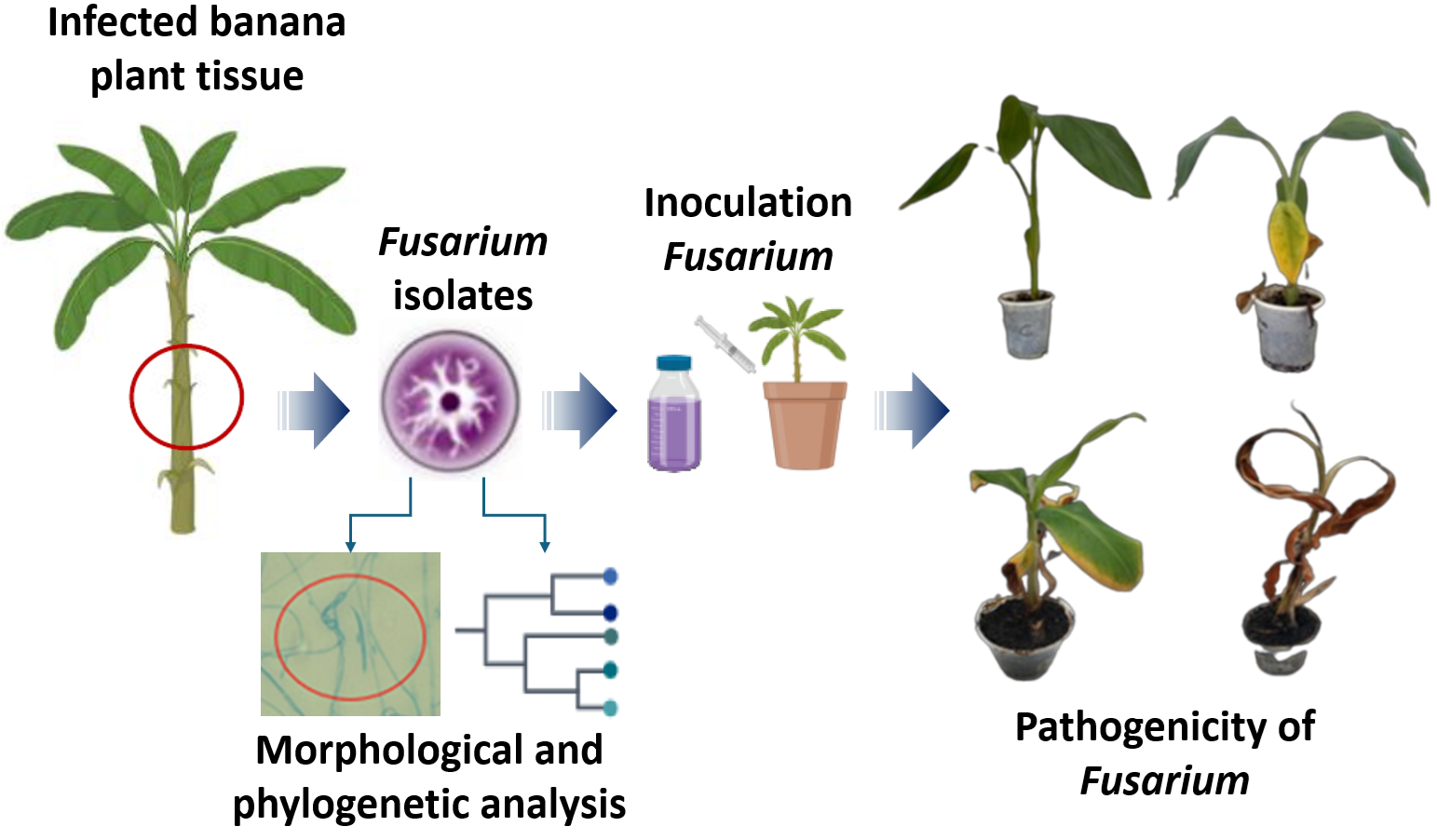
Fusarium oxysporum f. sp. cubense is associated with wilting in banana cultivation. The soil-dwelling phytopathogenic fungus has caused devastating consequences worldwide. The races that affect bananas are 1, 2 and 4, the latter very feared because of the epidemics caused since its identification, and because to date an effective control against the pathogen has not been determined. Therefore, the objective of the research was to isolate and characterize morphologically using four culture media, and molecularly the fungus in order to evaluate its pathogenicity with in vitro and greenhouse tests. 20 symptomatic samples were collected from an apple variety banana plantation. Subsequently, isolations were made from vascular tissue. The morphological identification of the isolates obtained was decisive to use a single strain for subsequent analysis and trials due to the similarity of the isolate’s strains. These strains were characterized by a cottony white mycelium that gradually changed to purple. Microscopy identified macroconidia, microconidia and chlamydospores. Molecular analysis was performed through the genes: translation elongation factor TEF1α, and Rpb2. The strain (Fus banana) was identified as F. oxysporum f. sp. cubense, accessions TEF1α (PV682586), Rpb2 (PV682587). The results were expressed in terms of incidence and severity. The medium malt extract registered a higher incidence reaching 99%. Regarding the distribution of severity, a progressive pattern in the intensity of symptoms was observed. The results obtained constitute consistent scientific support for future studies that are oriented towards the development of reliable diagnostic tools, the evaluation of pathogenicity in banana materials and the design of integrated management strategies against this pathogen with high economic and phytosanitary impact.
References
Achari, S. R., Kaur, J., Dinh, Q., & others. (2020). Phylogenetic relationship between Australian Fusarium oxysporum isolates and resolving the species complex using the multispecies coalescent model. BMC Genomics, 21, 248. https://doi.org/10.1186/s12864-020-6640-y
Acuña, R., Rouard, M., Leiva, A. M., Marques, C., Olortegui, J. A., Ureta, C., & Dita, M. (2022). First report of Fusarium oxysporum f. Sp. Cubense tropical race 4 causing fusarium wilt in Cavendish bananas in Peru. Plant Disease, 106(8), 2268. https://doi.org/10.1094/pdis-09-21-1951-pdn
Agrios, G. N. (2005). Plant pathology (5th ed.). Elsevier Academic Press.
Arie, T. (2019). Fusarium diseases of cultivated plants, control, diagnosis, and molecular and genetic studies. Journal of Pesticide Science, 44(4), 275–281. https://doi.org/10.1584/jpestics.J19-03
Asociación de Exportadores de Banano del Ecuador (AEBE). (2025). Sitio web de la AEBE. https://www.aebe.com.ec/
Ayuso-Álvarez, A., García-Pérez, J., Triviño-Juárez, J.-M., Larrinaga-Torrontegui, U., González-Sánchez, M., Ramis, R., Boldo, E., López-Abente, G., Galán, I., & Fernández-Navarro, P. (2020). Association between proximity to industrial chemical installations and cancer mortality in Spain. Environmental Pollution, 260, 113869. https://doi.org/https://doi.org/10.1016/j.envpol.2019.113869
Bakhat, N., Vielba-Fernández, A., Padilla-Roji, I., Martínez-Cruz, J., Polonio, Á., Fernández-Ortuño, D., & Pérez-García, A. (2023). Suppression of Chitin-Triggered Immunity by Plant Fungal Pathogens: A Case Study of the Cucurbit Powdery Mildew Fungus Podosphaera xanthii. Journal of Fungi, 9(7), 771. https://doi.org/10.3390/jof9070771
Balajee, S. A., Borman, A. M., Brandt, M. E., & others. (2009). Sequence-based identification of Aspergillus, Fusarium, and Mucorales species in the clinical mycology laboratory: where are we and where should we go from here. Journal of Clinical Microbiology. https://doi.org/10.1128/jcm.01685-08
Baruah, A., Bora, P., Damodaran, T., & others. (2025). Patho-Ecological Distribution and Genetic Diversity of Fusarium oxysporum f. sp. cubense in Malbhog Banana Belts of Assam, India. Journal of Fungi, 11, 195. https://doi.org/10.20944/preprints202409.1184.v1
Dita, M., Barquero, M., Heck, D., Mizubuti, E. S. G., & Staver, C. P. (2018). Fusarium Wilt of Banana: Current Knowledge on Epidemiology and Research Needs Toward Sustainable Disease Management. Frontiers in Plant Science, 9, 1468. https://doi.org/10.3389/fpls.2018.01468
Drenth, A., & Kema, G. (2021). The Vulnerability of Bananas to Globally Emerging Disease Threats. Phytopathology, 111(12), 2146–2161. https://doi.org/10.1094/PHYTO-07-20-0311-RVW
FAO. (2020). Perspectiva a mediano plazo de la producción y el comercio mundial de bananos y frutas tropicales.
FAOSTAT. (2023). FAOSTAT Statistical Database.
García, L., Grajales, A., Cárdenas, M. E., Sierra, R., Lozano, G., Garavito, M., & others. (2011). Isolation and characterization of two strains of Fusarium oxysporum causing potato dry rot in Solanum tuberosum in Colombia. Rev Iberoam Micol, 28(4), 166–172.
García-Bastidas, F., Van Der Veen, A. J. T., Nakasato-Tagami, G., Meijer, H. J. G., Arango-Isaza, R. E., & Kema, G. H. J. (2019). An improved phenotyping protocol for Panama disease in banana. Frontiers in Plant Science. https://doi.org/10.3389/fpls.2019.01006
Leslie, J. F., & Summerell, B. A. (2006). The Fusarium Laboratory Manual. Blackwell Publishing. https://doi.org/10.1002/9780470278376
Ma, L. J., Geiser, D. M., Proctor, R. H., Rooney, A. P., O’Donnell, K., Trail, F., Gardiner, D. M., Manners, J. M., & Kazan, K. (2013). Fusarium pathogenomics. Annual Review of Microbiology, 67, 399–416. https://doi.org/10.1146/annurev-micro-092412-155650
Magdama, F., Magdama, F., Monserrate-Maggi, L., Serrano, L., Sosa, D., Geiser, D. M., & Jiménez-Gasco, M. del M. (2019). Comparative analysis uncovers the limitations of current molecular detection methods for Fusarium oxysporum f. sp. cubense race 4 strains. PLOS ONE, 14(9). https://doi.org/10.1371/journal.pone.0222727
Martínez, G., Olivares, B. O., Rey, J. C., Rojas, J., Cardenas, J., Muentes, C., & Dawson, C. (2023). The advance of Fusarium wilt tropical race 4 in musaceae of Latin America and the Caribbean: current situation. Pathogens, 12(2), 277. https://doi.org/10.3390/pathogens12020277
Mejías, R., Hernández, Y., Magdama, F., Mostert, D., Bothma, S., Paredes, E. M., Terán, D., González, E., Angulo, R., Angel, L., Rodríguez, Y., Ortega, R., Viljoen, A., & Marys, E. E. D. R. (2022). First report of Fusarium wilt of cavendish bananas caused by Fusarium oxysporum f. Sp. Cubense tropical race 4 in Venezuela. Plant Disease. https://doi.org/10.1094/pdis-04-23-0781-pdn
Nozawa, S., Seto, Y., Takata, Y., Narreto, L. A., Valle, R. R., Okui, K., Taida, S., Alvindia, D. G., Reyes, R. G., & Watanabe, K. (2023). Fusarium mindanaoense sp. nov., a New Fusarium Wilt Pathogen of Cavendish Banana from the Philippines Belonging to the F. fujikuroi Species Complex. Journal of Fungi, 9(4), 443. https://doi.org/10.3390/jof9040443
O’Donnell, K., Ward, T., Robert, V., Crous, P., Geiser, D., & Kang, S. (2015). DNA sequence-based identification of Fusarium: current status and future directions. Phytoparasitica, 43, 583–595. https://doi.org/10.1007/s12600-015-0484-z
Olivares, B. O., Rey, J. C., Lobo, D., Navas-Cortés, J. A., Gómez, J. A., & Landa, B. B. (2021). Marchitez por Fusarium del banano: una revisión de los factores agroambientales del sistema productivo venezolano que afectan su desarrollo. Agronomía, 11(5), 986. https://doi.org/10.3390/agronomy11050986
Pérez-Vicente, L., Dita, M. A., & la Parte, E. (2014). Prevención y diagnóstico de la marchitez por Fusarium (mal de Panamá) del banano causada por Fusarium oxysporum f. sp. cubense. Raza Tropical 4 (RT4).
Ploetz, R. C. (2000). Panama disease: A classic and destructive disease of banana. Plant Health Progress. https://doi.org/10.1094/PHP-2000-1204-01-HM
Ploetz, R. C., Kema, G. H. J., & Ma, L.-J. (2015). Impact of diseases on export and smallholder production of banana. Annual Review of Phytopathology, 53, 269–288.
Purwati, R., Hidayah, N., Sudjindro, & Sudarsono. (2008). Inoculation methods and conidial densities of Fusarium oxysporum f.sp. cubense in abaca. Hayati Journal of Biosciences, 15(1), 1–7. https://doi.org/10.4308/hjb.15.1.1
Rodríguez-Yzquierdo, G., Olivares, B. O., González-Ulloa, A., León-Pacheco, R., Gómez-Correa, J. C., Yacomelo-Hernández, M., Carrascal-Pérez, F., Florez-Cordero, E., Soto-Suárez, M., Dita, M., & Betancourt-Vásquez, M. (2023). Soil predisposing factors to Fusarium oxysporum f.sp cubense tropical race 4 on banana crops of la Guajira, Colombia. Agronomy, 13(10), 2588. https://doi.org/10.3390/agronomy13102588
Singha, I. M., Kakoty, Y., Unni, B. G., Das, J., & Kalita, M. C. (2016). Identification and characterization of Fusarium sp. Using its and RAPD causing Fusarium wilt of tomato isolated from Assam, North East India. Journal of Genetic Engineering and Biotechnology. https://doi.org/10.1016/j.jgeb.2016.07.001
Ferreira, D. F. (2019). SISVAR: A computer analysis system to fixed to effects split plot type designs. Brazilian Journal of Biometrics, 37(4), 529–535. https://doi.org/10.28951/rbb.v37i4.450
Strobl, E., & Mohan, P. (2020). Climate and the Global Spread and Impact of Bananas’ Black Leaf Sigatoka Disease. Atmosphere, 11(9), 947. https://doi.org/10.3390/atmos11090947
Su, Y., Liu, C., Fang, H., & Zhang, D. (2020). Bacillus subtilis: a universal cell factory for industry, agriculture, biomaterials and medicine. Microbial Cell Factories, 19, 173. https://doi.org/10.1186/s12934-020-01436-8
Validov, S. Z., Kamilova, F. D., & Lugtenberg, B. J. (2011). Monitoring of pathogenic and non-pathogenic Fusarium oxysporum strains during tomato plant infection. Microbial Biotechnology, 4(1), 82–88. https://doi.org/10.1111/j.1751-7915.2010.00214.x
Downloads
Published
Issue
Section
License
Copyright (c) 2026 Scientia Agropecuaria

This work is licensed under a Creative Commons Attribution-NonCommercial 4.0 International License.
The authors who publish in this journal accept the following conditions:
a. The authors retain the copyright and assign to the magazine the right of the first publication, with the work registered with the Creative Commons attribution license, which allows third parties to use the published information whenever they mention the authorship of the work and the First publication in this journal.
b. Authors may make other independent and additional contractual arrangements for non-exclusive distribution of the version of the article published in this journal (eg, include it in an institutional repository or publish it in a book) as long as it clearly indicates that the work Was first published in this journal.
c. Authors are encouraged to publish their work on the Internet (for example, on institutional or personal pages) before and during the review and publication process, as it can lead to productive exchanges and a greater and faster dissemination of work Published (see The Effect of Open Access).