
Nutritional profile, processing potential and food applications of Macrotermes nigeriensis powder: A comprehensive review
DOI:
https://doi.org/10.17268/sci.agropecu.2026.042Keywords:
edible insect, functional properties, Macrotermes nigeriensis powder, sustainable proteinAbstract
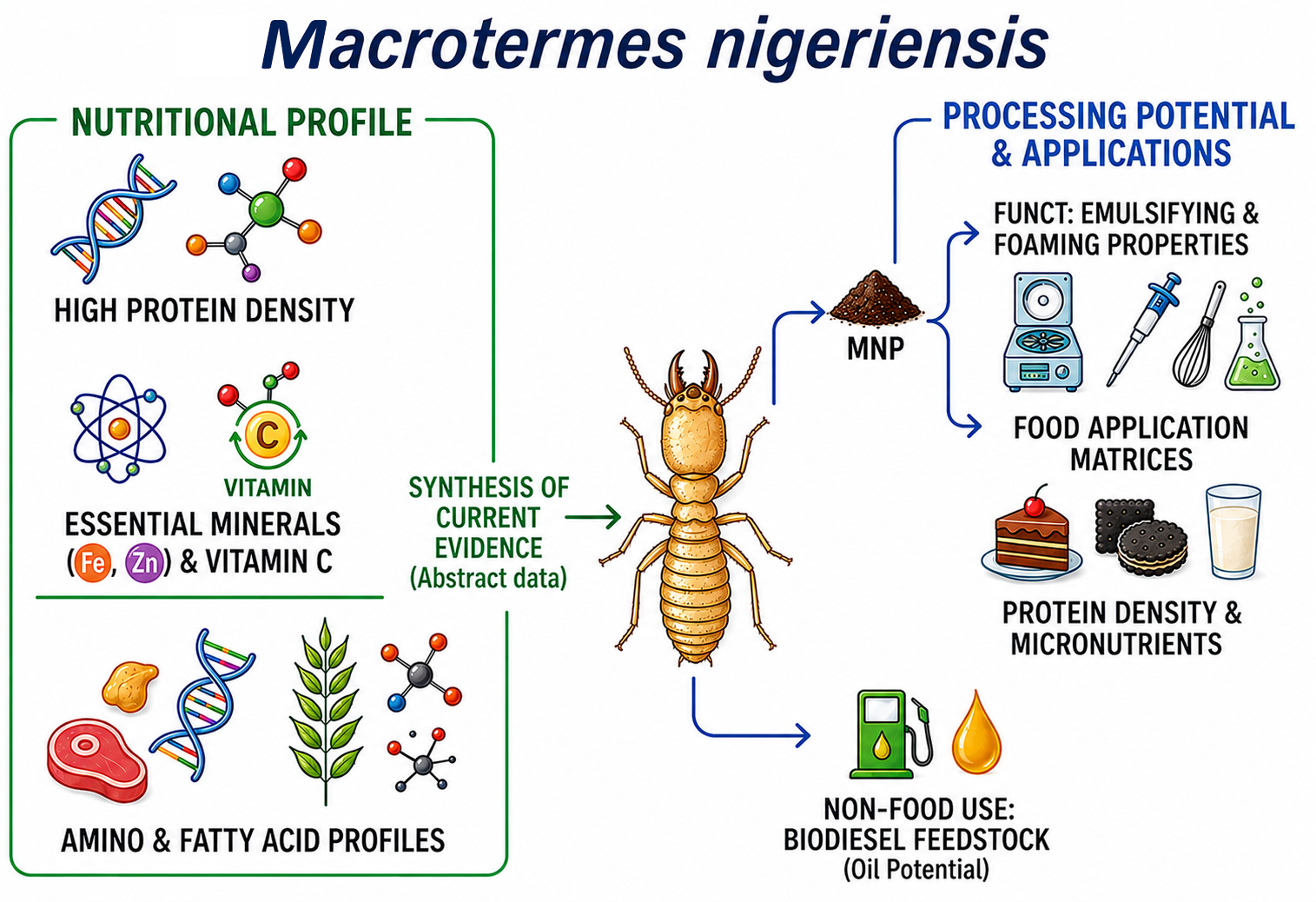
Macrotermes nigeriensis is increasingly recognized as a nutrient-dense edible insect with significant potential for food and non-food applications. This review synthesizes current evidence on proximate composition, mineral and vitamin content, amino acid and fatty acid profiles, functional properties, and safety considerations of its powder. Existing studies consistently report high levels of protein, essential minerals (Fe, Zn), and vitamin C, together with low concentrations of antinutritional factors. When incorporated into various food matrices (including cakes, biscuits, and fermented cassava beverages) M. nigeriensis powder markedly enhances protein density, micronutrient content, and, in some cases, sensory acceptability. Protein isolates exhibit desirable emulsifying and foaming properties, supporting their potential use in food formulation. Beyond nutrition, the species also provides oils that may serve as unconventional feedstock for biodiesel production. Overall, M. nigeriensis represents a promising sustainable protein resource, but further multidisciplinary investigation is required to support its large-scale utilization. Future research should focus on: (i) long-term safety and toxicological evaluation, (ii) nutrient bioavailability and digestibility, (iii) detailed lipid profiling and its health implications, (iv) standardization of processing and preservation methods, and (v) consumer acceptance and market feasibility beyond endemic regions.
References
Abbasi, E. (2025). Edible insects as a sustainable and innovative approach to addressing global food security and environmental challenges: a comprehensive review. Journal of Insects as Food and Feed, 11(13), 2255-2266.
Adepoju, O. T., & Omotayo, O. A. (2014). Nutrient composition and potential contribution of winged termites (Macrotermes bellicosus Smeathman) to micronutrient intake of consumers in Nigeria. British Journal of Applied Science & Technology, 4(7), 1149–1158.
Ajayi, O. E. (2012). Biochemical analysiss and nutrition content of four castes of subterranean termites, Macrotermes subhyalinus (Rambur)(Isoptera: Termitidae): differences in digestibility and anti-nutrient contents among castes. International Journal of Biology, 4(4), 54. https://doi.org/10.5539/ijb.v4n4p54
Anyiam, P. N., Nwuke, C. P., Adimuko, G. C., Nwamadi, C. P., Salvador, E. M., Ajibade, G. F., & Maxwell, E. C. (2022a). Inclusion of African winged termites (Macrotermes nigeriensis) improves the nutrients and quality of fermented cassava mahewu. African Journal of Biotechnology, 21(2), 46–54. https://doi.org/10.5897/AJB2021.17444
Anyiam, P. N., Nwuke, C. P., Onyeabo, C., Uche, P. C., Adimuko, G. C., Guibunda, F. A., & Ononogbu, E. C. (2022b). Potential contribution of Macrotermes nigeriensis-improved fermented cassava mahewu to nutrient intake adequacy of school children in Umudike, Nigeria. Food Chemistry Advances, 1, 100062. https://doi.org/10.1016/j.focha.2022.100062
Anyiam, P. N., Nwuke, C. P., Uhuo, E. N., Ajah, O., Uche, C. P., Dike, O. G., & Onyemuchara, T. C. (2024). Influence of pH and salt conditions on extraction efficiency and functional properties of Macrotermes nigeriensis protein concentrate for food applications. Discover Food, 4(1), 100. https://doi.org/10.1007/s44187-024-00181-w
Anyiam, P. N., Nwuke, C. P., Uhuo, E. N., Ije, U. E., Salvador, E. M., Mahumbi, B. M., & Boyiako, B. H. (2023). Effect of fermentation time on nutritional, antinutritional factors and in-vitro protein digestibility of macrotermes nigeriensis-cassava mahewu. Measurement: Food, 11, 100096. https://doi.org/10.1016/j.meafoo.2023.100096
Atowa, C. O., Okoro, B. C., Umego, E. C., Atowa, A. O., Emmanuel, O., Ude, V. C., & Ugbogu, E. A. (2021). Nutritional values of Zonocerus variegatus, Macrotermes bellicosus and Cirina forda insects: Mineral composition, fatty acids and amino acid profiles. Scientific African, 12, e00798. https://doi.org/10.1016/j.sciaf.2021.e00798
Boulogne, I., Constantino, R., Amusant, N., Falkowski, M., Rodrigues, A. M., & Houël, E. (2017). Ecology of termites from the genus Nasutitermes (Termitidae: Nasutitermitinae) and potential for science-based development of sustainable pest management programs. Journal of Pest Science, 90(1), 19–37. https://doi.org/10.1007/s10340-016-0796-x
Cheseto, X., Ochieng, B. O., Subramanian, S., & Tanga, C. M. (2024). Unravelling the nutritional and health benefits of marketable winged termites (Macrotermes spp.) as sustainable food sources in Africa. Scientific Reports, 14(1), 9993. https://doi.org/10.1038/s41598-024-60729-9
Choi, Y. S., Lee, J. H., Cha, J. Y., & Kim, Y. J. (2026). Use of Insects and/or Insect-Derived Compounds as Ingredients in Food Formulation. In Insects for Human Consumption (pp. 139-177). CRC Press.
Gachihi, A., Tanga, C., Nyambaka, H., & Kimiywe, J. (2023). Effect of processing methods on nutrient and anti-nutrient composition of grasshopper and termites. CyTA - Journal of Food, 21(1), 745–750. https://doi.org/10.1080/19476337.2023.2281984
Igwe, C. U. (2014). Biochemical and Haematologic Effects of Intake of Macrotermes nigeriensis Fortified Functional Diet. Pakistan Journal of Biological Sciences, 17(2), 282–286. https://doi.org/10.3923/pjbs.2014.282.286
Igwe, C. U., Onwuliri, V. A., Ojiako, A. O., & Arukwe, J. U. (2011b). Effects of Macrotermes nigeriensis based diet on hepatic and serum lipids of albino rats. Australian Journal of Basic and Applied Sciences, 5(7), 906–910.
Igwe, C. U., Ujowundu, C. O., Nwaogu, L. A., & Okwu, G. N. (2011a). Chemical analysis of an edible African termite Macrotermes nigeriensis, a potential antidote to food security problem. Biochemistry and Analytical Biochemistry, 1(105). https://doi.org/10.4172/2161-1009.1000105
Kalu-Uka, G. M., Kumar, S., Kalu-Uka, A. C., Vikram, S., Okorafor, O. O., Kigozi, M., Ihekweme, G. O., & Onwualu, A. P. (2021). Prospects for biodiesel production from Macrotermes nigeriensis: Process optimization and characterization of biodiesel properties. Biomass and Bioenergy, 146, 105980. https://doi.org/10.1016/j.biombioe.2021.105980
Kinyuru, J. N., Konyole, S. O., Roos, N., Onyango, C. A., Owino, V. O., Owuor, B. O., Estambale, B. B., Friis, H., Aagaard-Hansen, J., & Kenji, G. M. (2013). Nutrient composition of four species of winged termites consumed in western Kenya. Journal of Food Composition and Analysis, 30(2), 120–124. https://doi.org/10.1016/j.jfca.2013.02.008
Khadijah, B., Ahmad Khan, A., & Razid Sarbini, S. (2025). Comparative nutritional profile, fatty acid composition and in-vitro antioxidant properties of flour derived from four edible winged termite species from Uganda. CyTA-Journal of Food, 23(1), 2544935.
Kunatsa, Y., Chidewe, C., & Zvidzai, C. J. (2020). Phytochemical and antinutrient composite from selected marginalized Zimbabwean edible insects and vegetables. Journal of Agriculture and Food Research, 2, 100027. https://doi.org/10.1016/j.jafr.2020.100027
Muinat, M. I., & Tariq, A. M. (2021). Evaluation of proximate compositions of some edible insects in Zaria Kaduna State Nigeria. International Journal of Science for Global Sustainability, 7(1), 44–53. https://doi.org/10.57233/ijsgs.v7i1.45
Musundire, R., Chidewe, C., Samende, B. K., Chemura, A., Bangira, C., Andika, O. A., & Chiwona-Karltun, L. (2021). Soil characteristics and nutritional traits of Mactrotermes natalensis (Isoptera: Macrotermitinae) as indicators of nutritional quality in Zimbabwe. International Journal of Tropical Insect Science, 41(3), 2113–2124. https://doi.org/10.1007/s42690-020-00394-3
Ogunlakin, G. O., Oni, V. T., & Olaniyan, S. A. (2018). Quality evaluation of biscuit fortified with edible termite (Macrotermes nigeriensis). Asian Journal of Biotechnology and Bioresource Technology, 4(2), 1–7. https://doi.org/10.9734/AJB2T/2018/43659
Oibiokpa, F. I., Akanya, H. O., Jigam, A. A., Saidu, A. N., & Egwim, E. C. (2018). Protein quality of four indigenous edible insect species in Nigeria. Food Science and Human Wellness, 7(2), 175–183. https://doi.org/10.1016/j.fshw.2018.05.003
Ojinnaka, M. C., Ofoelo, M. U., & Ezenwa, L. I. (2013). Nutritional evaluation of wheat cakes enriched with edible African termites (Macrotermes nigeriensis). Agro-Science, 12(3), 35–42.
Omotoso, O. T. (2015). Nutrient composition, mineral analysis and anti-nutrient factors of Oryctes rhinoceros L.(Scarabaeidae: Coleoptera) and winged termites, Macrotermes nigeriensis Sjostedt (Termitidae: Isoptera). British Journal of Applied Science & Technology, 8(1), 97–106.
Séré, A., Bougma, A., Bazié, B. S. R., Nikièma, P. A., Gnankiné, O., & Bassolé, I. H. N. (2022). Nutritional and functional properties of defatted powder, protein concentrates, and isolates of Brachytrupes membranaceus (Orthoptera: Gryllidae) (Drury: 1773) and Macrotermes subhyalinus (Isoptera: Blattodea) (Rambur: 1842) from Burkina Faso. Insects, 13(9), 764. https://doi.org/10.3390/insects13090764
Siulapwa, N., Mwambungu, A., Lungu, E., & Sichilima, W. (2014). Nutritional value of four common edible insects in Zambia. International Journal of Science and Research, 3(6), 876–884.
Sun, M., Jiang, D., Long, X., & Chen, X. (2025). The polyunsaturated-to-monounsaturated fatty acid ratio and cardiovascular risk prediction: a prospective cohort study of 183,237 adults. Lipids in Health and Disease, 24, 322. https://doi.org/10.1186/s12944-025-02745-w
Downloads
Published
Issue
Section
License
Copyright (c) 2026 Scientia Agropecuaria

This work is licensed under a Creative Commons Attribution-NonCommercial 4.0 International License.
The authors who publish in this journal accept the following conditions:
a. The authors retain the copyright and assign to the magazine the right of the first publication, with the work registered with the Creative Commons attribution license, which allows third parties to use the published information whenever they mention the authorship of the work and the First publication in this journal.
b. Authors may make other independent and additional contractual arrangements for non-exclusive distribution of the version of the article published in this journal (eg, include it in an institutional repository or publish it in a book) as long as it clearly indicates that the work Was first published in this journal.
c. Authors are encouraged to publish their work on the Internet (for example, on institutional or personal pages) before and during the review and publication process, as it can lead to productive exchanges and a greater and faster dissemination of work Published (see The Effect of Open Access).