
Fungistatic and fungicidal activity of bioactive compounds on the in vitro growth of Moniliophthora roreri
DOI:
https://doi.org/10.17268/agroind.sci.2026.02.04Keywords:
Cacao frosty pod rot, secondary metabolites, phenolic acids, flavonoids, β-caroteneAbstract
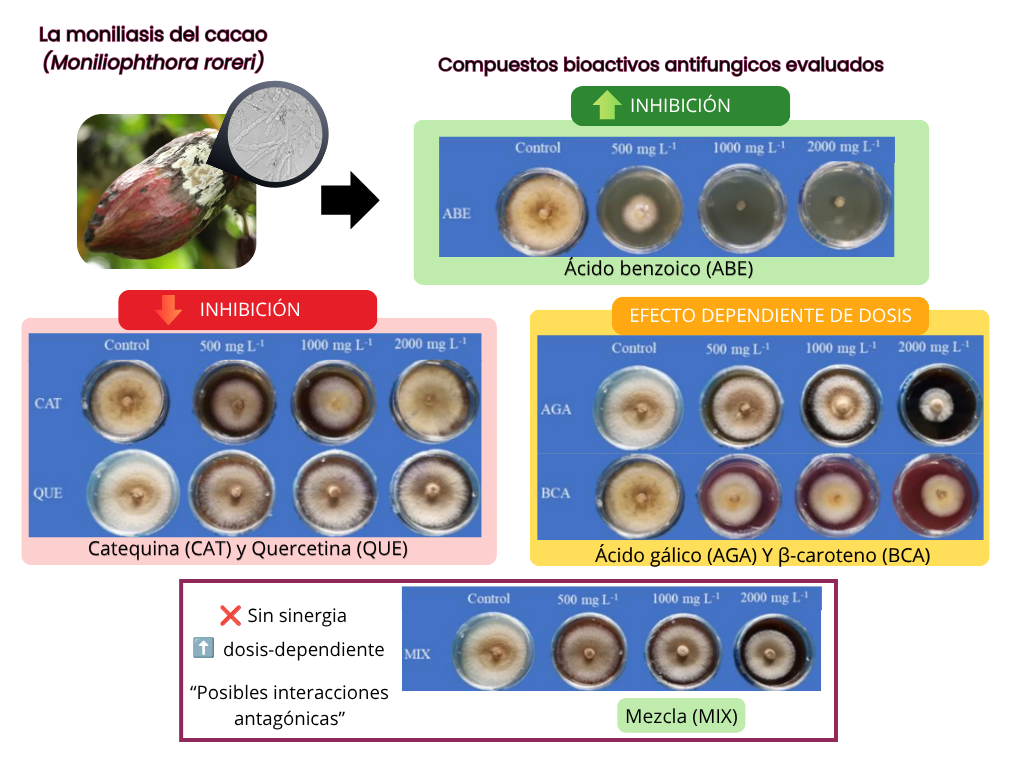
Frosty pod rot, caused by Moniliophthora roreri, is one of the main constraints on cacao production in Latin America. Control strategies based on cultural practices and synthetic fungicides can be costly and pose environmental and health risks. This study evaluated in vitro the antifungal activity of the bioactive compounds (BCs) benzoic acid (BA), gallic acid (GA), catechin (CAT), quercetin (QUE), and β-carotene (BCA), as well as a mixture (MIX) of these compounds. Three concentrations (500, 1000, and 2000 mg L⁻¹) were tested on the mycelial growth of M. roreri. Data were analyzed using analysis of variance (ANOVA) followed by Tukey’s test (α = 0.05) and principal component analysis (PCA). The results showed that BA was the most effective compound, exhibiting a fungicidal effect at concentrations ≥1000 mg L⁻¹ and an IC₅₀ < 500 mg L⁻¹. BCA and GA showed dose-dependent fungistatic effects. CAT exhibited a hormetic response, whereas the MIX showed no synergistic effects. BA and BCA stand out as promising candidates for the development of biofungicides against M. roreri.
References
Abdulhafedh, H. M., Al-Saadoon, A. H., & Abu-Mejdad, N. M. (2023). Efficiency of fungal β-carotene against some causative agents of dermatomycoses. Iranian Journal of War and Public Health, 15(2), 167–175. https://doi.org/10.58209/ijwph.15.2.167
Al-Khayri, J. M., Rashmi, R., Toppo, V., Chole, P. B., Banadka, A., Sudheer, W. N., Nagella, P., Shehata, W. F., Al-Mssallem, M. Q., Alessa, F. M., Almaghasla, M. I., & Rezk, A. A.-S. (2023). Plant Secondary Metabolites: The Weapons for Biotic Stress Management. Metabolites, 13(6), 716. https://doi.org/10.3390/metabo13060716
Alves, M. J., Ferreira, I. C. F. R., Froufe, H. J. C., Abreu, R. M. V., Martins, A., & Pintado, M. (2013). Antimicrobial activity of phenolic compounds identified in wild mushrooms, SAR analysis and docking studies. Journal of Applied Microbiology, 115(2), 346–357. https://doi.org/10.1111/jam.12196
Askari, N., Madani, M., Fouladgar, M., & Shakib, P. (2023). Antifungal effect of carrot carotenoids on Candida species. Current Drug Discovery Technologies, 20(3), e270223214066. https://doi.org/10.2174/1570163820666230227113802
Bailey, B. A., Evans, H. C., Phillips-Mora, W., Ali, S. S., & Meinhardt, L. W. (2018). Moniliophthora roreri, causal agent of cacao frosty pod rot. Molecular Plant Pathology, 19(7), 1580–1594. https://doi.org/10.1111/mpp.12648
Berne, S., Kovačič, L., Sova, M., Kraševec, N., Gobec, S., Križaj, I., & Komel, R. (2015). Benzoic acid derivatives with improved antifungal activity: Design, synthesis, structure–activity relationship (SAR) and CYP53 docking studies. Bioorganic & Medicinal Chemistry, 23(15), 4264–4276. https://doi.org/10.1016/j.bmc.2015.06.042
Calabrese, E. J., & Baldwin, L. A. (2003). Hormesis: The dose-response revolution. Annual Review of Pharmacology and Toxicology, 43, 175–197. https://doi.org/10.1146/annurev.pharmtox.43.100901.140223
Castano-Duque, L., Lebar, M. D., Mack, B. M., Lohmar, J. M., & Carter-Wientjes, C. (2024). Investigating the Impact of Flavonoids on Aspergillus flavus: Insights into Cell Wall Damage and Biofilms. Journal of Fungi, 10(9), 665. https://doi.org/10.3390/jof10090665
Cushnie, T. P. T., & Lamb, A. J. (2011). Recent advances in understanding the antibacterial properties of flavonoids. International Journal of Antimicrobial Agents, 38(2), 99–107. https://doi.org/10.1016/j.ijantimicag.2011.02.014
Daglia, M. (2012). Polyphenols as antimicrobial agents. Current Opinion in Biotechnology, 23(2), 174–181. https://doi.org/10.1016/j.copbio.2011.08.007
De la Cruz-Ricardez, D., Ortiz-García, C. F., Lagunes-Espinoza, L. C., & Torres-De la Cruz, M. (2020). Efecto antifúngico in vitro de extractos metanólicos de Capsicum spp. en Moniliophthora roreri. Agrociencia, 54, 813–824.
Del Río, J. A., Gómez, P., Baidez, A. G., Arcas, M. C., Botía, J. M., & Ortuño, A. (2004). Changes in the levels of polymethoxyflavones and flavanones as part of the defense mechanism of Citrus sinensis (cv. Valencia Late) fruits against Phytophthora citrophthora. Journal of Agricultural and Food Chemistry, 52(7), 1913–1917. https://doi.org/10.1021/jf030723i
Deresa, E. M., & Diriba, T. F. (2023). Phytochemicals as alternative fungicides for controlling plant diseases: A comprehensive review. Heliyon, 9(3), e13810. https://doi.org/10.1016/j.heliyon.2023.e13810
Dias, M. C., Pinto, D. C. G. A., & Silva, A. M. S. (2021). Plant Flavonoids: Chemical Characteristics and Biological Activity. Molecules, 26(17), 5377. https://doi.org/10.3390/molecules26175377
Evans, H. C. (1981). Pod rot of cacao caused by Moniliophthora (Monilia) roreri. Phytopathological Papers, 24, 1–44.
Freiesleben, S. H., & Jäger, A. K. (2014). Correlation between plant secondary metabolites and their antifungal mechanisms – A review. Medicinal & Aromatic Plants, 3(2). https://doi.org/10.4172/2167-0412.1000154
Fuentes-Estrada, M., Jiménez-González, A., Duarte, D., Saavedra-Barrera, R., Areche, C., Stashenko, E., Pino Benítez, N., Bárcenas-Pérez, D., Cheel, J., & García-Beltrán, O. (2023). GC/MS Profile and Antifungal Activity of Zanthoxylum caribaeum Lam Essential Oil against Moniliophthora roreri Cif and Par, a Pathogen That Infects Theobroma cacao L Crops in the Tropics. Chemosensors, 11(8), 447. https://doi.org/10.3390/chemosensors11080447
Joaquín-Ramos, A. de J., López-Palestina, C. U., Pinedo-Espinoza, J. M., Altamirano-Romo, S. E., Santiago-Saenz, Y. O., Aguirre-Mancilla, C. L., & Gutiérrez-Tlahque, J. (2020). Phenolic compounds, antioxidant properties and antifungal activity of jarilla (Barkleyanthus salicifolius [Kunth] H. Rob & Brettell). Chilean Journal of Agricultural Research, 80(3), 352-360. https://dx.doi.org/10.4067/S0718-58392020000300352
Lee, J.-H., Kim, Y.-G., Park, I., & Lee, J. (2024). Antifungal and antibiofilm activities of flavonoids against Candida albicans: Focus on 3,2′-dihydroxyflavone as a potential therapeutic agent. Biofilm, 8, 100218. https://doi.org/10.1016/j.bioflm.2024.100218
McNally, D. J., Wurms, K. V., Labbé, C., & Bélanger, R. R. (2003). Synthesis of C-glycosyl flavonoid phytoalexins as a site-specific response to fungal penetration in cucumber. Physiological and Molecular Plant Pathology, 63(6), 293–303. https://doi.org/10.1016/j.pmpp.2004.03.005
Meléndez-Martínez, A. J., Mandić, A. I., Bantis, F., Böhm, V., Borge, G. I. A., Brnčić, M., & others. (2022). A comprehensive review on carotenoids in foods and feeds: Status quo, applications, patents, and research needs. Critical Reviews in Food Science and Nutrition, 62(8), 1999–2049. https://doi.org/10.1080/10408398.2020.1867959
Motulsky, H. J., & Christopoulos, A. (2003). Fitting models to biological data using linear and nonlinear regression: A practical guide to curve fitting. GraphPad Software, Inc.
Ortiz-García, C. F., Torres-De la Cruz, M., & Hernández-Mateo, S. C. (2015). Comparación de dos sistemas de manejo del cultivo del cacao, en presencia de Moniliophthora roreri, en México. Revista Fitotécnica Mexicana, 38, 191–196.
Palacios, I., Lozano, M., Moro, C., D’Arrigo, M., Rostagno, M. A., Martínez, J. A., García-Lafuente, A., Guillamón, E., & Villares, A. (2011). Antioxidant properties of phenolic compounds occurring in edible mushrooms. Food Chemistry, 128(3), 674–678. https://doi.org/10.1016/j.foodchem.2011.03.085
Plasencia-Vázquez, Alexis Herminio, Vilchez-Ponce, Cruz Ruby, Ferrer-Sánchez, Yarelys, & Veloz-Portillo, Carmen Elena. (2022). Efecto del cambio climático sobre la distribución potencial del hongo Moniliophthora roreri y el cultivo de cacao (Theobroma cacao) en Ecuador continental. Terra Latinoamericana, 40, e1151. https://doi.org/10.28940/terra.v40i0.1151
Ramaroson, M.-L., Koutouan, C., Helesbeux, J.-J., Le Clerc, V., Hamama, L., Geoffriau, E., & Briard, M. (2022). Role of Phenylpropanoids and Flavonoids in Plant Resistance to Pests and Diseases. Molecules, 27(23), 8371. https://doi.org/10.3390/molecules27238371
Rodriguez-Maturino, A., Troncoso-Rojas, R., Sánchez-Estrada, A., González-Mendoza, D., Ruiz-Sanchez, E., Zamora-Bustillos, R., Ceceña-Duran, C., Grimaldo-Juarez, O., & Aviles-Marin, M. (2015). Antifungal effect of phenolic and carotenoids extracts from chiltepin (Capsicum annum var. glabriusculum) on Alternaria alternata and Fusarium oxysporum. Revista Argentina de Microbiología, 47(1), 72–77. https://doi.org/10.1016/j.ram.2014.12.005
Swapnil, P., Meena, M., Singh, S. K., Dhuldhaj, U. P., Harish, & Marwal, A. (2021). Vital roles of carotenoids in plants and humans to deteriorate stress with its structure, biosynthesis, metabolic engineering and functional aspects. Current Plant Biology, 26, 100203. https://doi.org/10.1016/j.cpb.2021.100203
Tamayo España, L. E., Ramírez González, S. I., López Báez, O., Quiroga Madrigal, R. R., & Espinosa Zaragoza, S. (2017). Extractos por destilación de Origanum vulgare, Tradescantia spathacea y Zingiber officinale para el manejo de Moniliophthora roreri de Theobroma cacao. Revista Mexicana de Ciencias Agrícolas, 7(5), 1065–1076. https://doi.org/10.29312/remexca.v7i5.232
Torres-De la Cruz, M., Quevedo-Damián, I., Ortiz-García, C. F., Lagunes-Espinoza, L. C., Nieto-Ángel, D., & Pérez-De la Cruz, M. (2019). Control químico de Moniliophthora roreri en México. Biotecnia, 21, 55–61. https://doi.org/10.18633/biotecnia.v21i2.906
Wang, T., Li, Q., Zhang, H., & Chen, J. (2024). Flavonoids from Citrus reticulata: Inhibitory activity against pathogenic fungi and biocontrol potential. Physiological and Molecular Plant Pathology, 131, 102250. https://doi.org/10.1016/j.pmpp.2024.102250
Xu, D., Deng, Y., Han, T., Jiang, L., Xi, P., Wang, Q., Jiang, Z., & Gao, L. (2018). In vitro and in vivo effectiveness of phenolic compounds for the control of postharvest gray mold of table grapes. Postharvest Biology and Technology, 139, 106–114. https://doi.org/10.1016/j.postharvbio.2017.08.019
Xu, H., Wang, G., Zhang, J., Zhang, M., Fu, M., Xiang, K., Zhang, M., & Chen, X. (2022). Identification of phenolic compounds and active antifungal ingredients of walnut in response to anthracnose (Colletotrichum gloeosporioides). Postharvest Biology and Technology, 192, 112019. https://doi.org/10.1016/j.postharvbio.2022.112019
Yang, W., Zhang, L., Yang, Y., Xiang, H., & Yang, P. (2024). Plant secondary metabolites-mediated plant defense against bacteria and fungi pathogens. Plant Physiology and Biochemistry, 217, 109224. https://doi.org/10.1016/j.plaphy.2024.109224
Downloads
Published
Issue
Section
License
Copyright (c) 2026 Dario De la Cruz-Ricardez, Luz del Carmen Lagunes-Espinoza, Carlos Fredy Ortiz García, Ramón Marcos Soto-Hernández, Edith Hernández-Nataren

This work is licensed under a Creative Commons Attribution-NonCommercial 4.0 International License.
The author does not retain copyright or publication rights indefinitely. The author retains all moral rights, particularly the right of authorship and the right to the integrity of the article.