
Projection of fishmeal prices using ARIMA models based on the relationship between sea surface temperature and Engraulis ringens production
DOI:
https://doi.org/10.17268/agroind.sci.2025.03.12Keywords:
anchovy, time series, El Niño, landings, sustainabilityAbstract
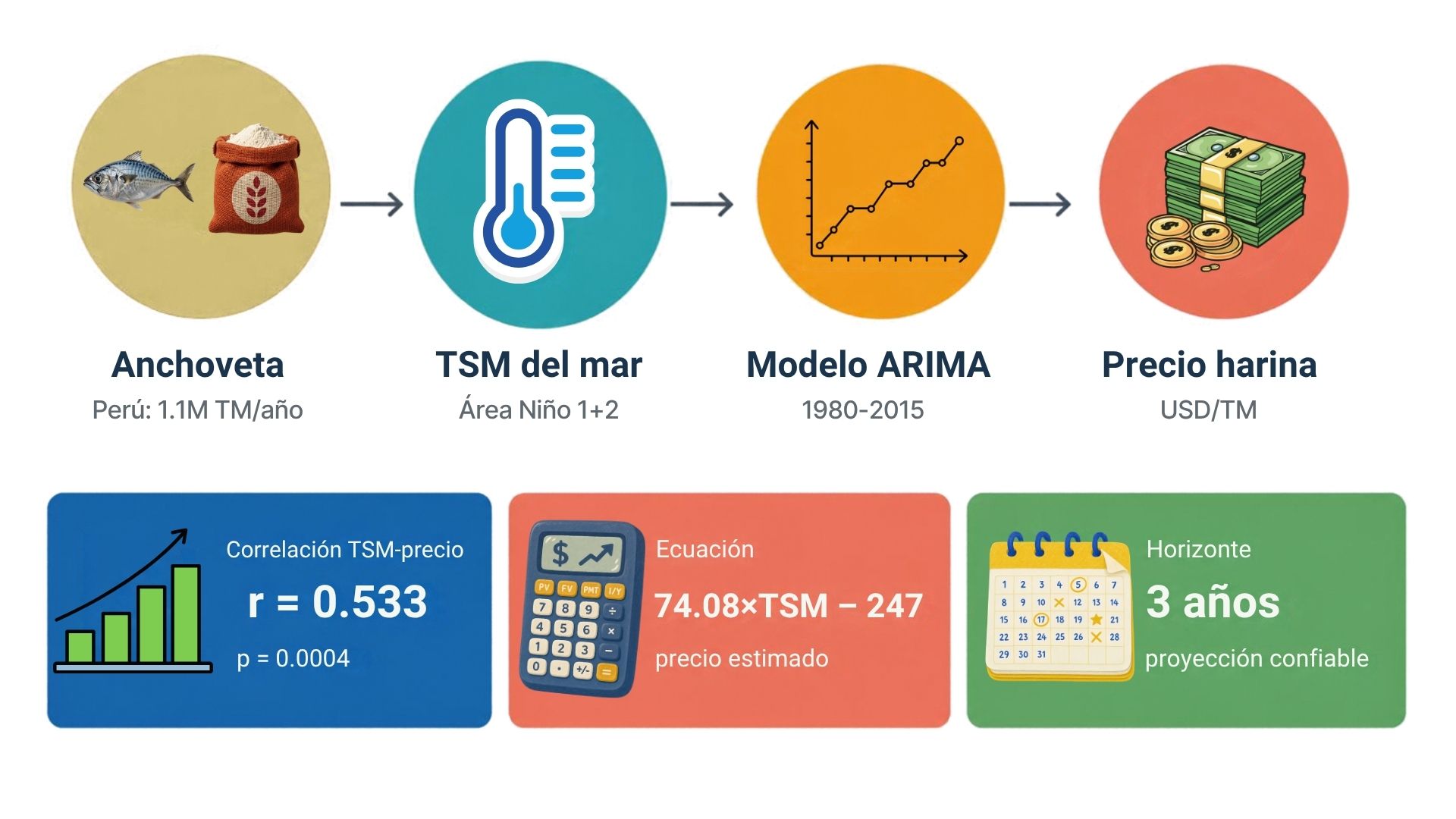
Engraulis ringens is the main species used in the production of fishmeal and fish oil for the aquaculture and agri-food industries. The distribution, abundance, and production of this species are strongly influenced by sea surface temperature (SST), directly affecting the supply and demand of fishmeal and impacting its market value. However, few studies link SST with the final price of fishmeal as a predictive mechanism. Therefore, time series analysis and modeling are appropriate tools. The Box–Jenkins ARIMA model was applied to analyze univariate time series of temperature, E. ringens landings, and fishmeal price. Twenty ARIMA model interactions were performed for each variable relationship, yielding the best results over short periods. The SST-price correlation coefficient r = 0.533 at the 95% confidence level (p = 0.0004). The SST ARIMA model is an important tool for projecting fishmeal prices for up to three years, enabling the development of effective strategies to maintain the sustainability of fishery resources and ensure market stability.
References
Arntz, W. E., Gallardo, V. A., Gutiérrez, D., Isla, E., Levin, L. A., Mendo, J., & Wolff, M. (2006). El Niño and similar perturbation effects on the benthos of the Humboldt, California, and Benguela Current upwelling ecosystems. Advances in Geosciences, 6, 243-265. https://doi.org/10.5194/adgeo-6-243-2006
Ashok, K., & Yamagata, T. (2009). The El Niño with a difference. Nature, 461(7263), 481-484. https://doi.org/10.1038/461481a
Banco Central de la Reserva de Perú - BCRP, G. C. de E. E. (2022). Pesqueros—Harina de Pescado—Precio (US$ por toneladas).
Bouchon Corrales, M., Ñiquen Carranza, M., & Ttito, H. (2018). Estadísticas de la pesquería pelágica en la costa peruana (1959- 2015). Instituto del Mar del Perú - IMARPE. https://hdl.handle.net/20.500.12958/3302
Box, G. E., Jenkins, G. M., Reinsel, G. C., & Ljung, G. M. (1994). Time series analysis: Forecasting and control (3rd edition). John Wiley & Sons. ISBN-13 978-0130607744. https://doi.org/10.1002/9781118619193
Bracamonte Bazán, G. H. (2025). Tres propuestas de mejora para el proceso productivo de una empresa de harina de pescado. http://hdl.handle.net/20.500.12404/29932
Burga Farfán, J. E., Aguirre Panta, Y. E., Lecarnaqué Arévalo, C. A., & Aldana Yarlequé, C. N. (2024). Predicción de precios de exportación del aceite y la harina de pescado, utilizando series de tiempo para el periodo 2023. Revista de Investigación Científica de la UNF – Aypate, 2(1), 43–53. https://doi.org/10.57063/ricay.v2i1.28
Cai, W., Borlace, S., Lengaigne, M., Van Rensch, P., Collins, M., Vecchi, G., & Cowan, T. (2014). Increasing frequency of extreme El Niño events due to greenhouse warming. Nature Climate Change, 4(2), 111-116. https://doi.org/10.1038/nclimate2100
Cancino, S. E., Escalante, G. O. C., & Ricketts, D. F. C. (2023). Un modelo Box Jenkins ARIMA para modelar y pronosticar la producción de mora de castilla en Colombia. Económicas CUC, 44(1), Article 1. https://doi.org/10.17981/econcuc.44.1.2023.Econ.4
Carlson, A. K., Taylor, W. W., Liu, J., & Orlic, I. (2018). Peruvian anchoveta as a telecoupled fisheries system. Ecology and Society, 23(1). https://doi.org/10.5751/ES-09923-230135
Chavez, F. P., & Messié, M. (2009). A comparison of eastern boundary upwelling ecosystems. Progress in Oceanography, 83(1-4), 80-96. https://doi.org/10.1016/j.pocean.2009.07.032
Chavez, F. P., Messié, M., & Pennington, J. T. (2017). Marine primary production in relation to climate variability and change. Annual Review of Marine Science, 9, 227-260. https://doi.org/10.1146/annurev.marine.010908.163917
Chavez, F. P., Ryan, J., Lluch-Cota, S. E., & Ñiquen, M. (2003). From anchovies to sardines and back: multidecadal change in the Pacific Ocean. Science, 299(5604), 217-221. https://doi.org/10.1126/science.1075880
Cheung, W. W., Lam, V. W., Sarmiento, J. L., Kearney, K., Watson, R., & Pauly, D. (2009). Projecting global marine biodiversity impacts under climate change scenarios. Fish and Fisheries, 10(3), 235-251. https://doi.org/10.1111/j.1467-2979.2008.00315.x
Christy, F. T. (2011). The Development and Management of Marine Fisheries in Latin America and the Caribbean. https://doi.org/10.18235/0008823
Climate Prediction Center - CPC (2023). Four El Niño Regions – NOAA. https://www.cpc.ncep.noaa.gov/products/analysis_monitoring/enso_advisory/ensodisc.shtml
De La Fuente, F. S. (2013). Series Temporales, Modelo ARIMA - Metodología de Box—Jenkins (p. 57). Universidad Autónoma de Madrid. Facultad Ciencias Económicas y Empresariales Departamento de Economía Aplicada.
Espino, M. (2013). El jurel Trachurus murphyi y las variables ambientales de macroescala. Revista Peruana de Biología, 20(1), 09-20.
Fisher, J. L., Peterson, W. T., & Rykaczewski, R. R. (2015). The impact of El Niño events on the pelagic food chain in the northern California Current. Global Change Biology, 21(12), 4401-4414. https://doi.org/10.1111/gcb.13054
Food and Agriculture Organization of the United Nations - FAO. (2009). Guide for the production of fish meal in developing countries. Food and Agriculture Organization of the United Nations. Roma, Italia.
Food and Agriculture Organization of the United Nations- FAO. (2014). The state of world fisheries and aquaculture 2014: Opportunities and challenges. Food and Agriculture Organization of the United Nations. Roma, Italia.
Fréon, P., Cury, P., Shannon, L., Roy, C., & Shin, Y. J. (2005). Sustainable exploitation of small pelagic fish stocks challenged by environmental and ecosystem changes: a review. Bulletin of Marine Science, 76(2), 385-462.
García, H. E., Locarnini, R. A., Boyer, T. P., Antonov, J.I., Mishonov, A.V., Baranova, O.K., Zweng, M.M., Reagan,J.R., Johnson, D.R. (2013). World Ocean Atlas 2013. Vol. 3: Dissolved Oxygen, Apparent Oxygen Utilization, and Oxygen Saturation. S. Levitus, Ed.; A. Mishonov, Technical Ed. NOAA Atlas NESDIS 75, 27 pp.
García-Reyes, M., Largier, J., Sydeman, W. (2014). Synoptic-scale upwelling indices and predictions of phyto-and zooplankton populations. Progress in Oceanography, 120, 177-188. https://doi.org/10.1016/j.pocean.2013.08.004
Gutiérrez, M., Swartzman, G., Bertrand, A., Bertrand, S. (2007). Anchovy (Engraulis ringens) and sardine (Sardinops sagax) spatial dynamics and aggregation patterns in the Humboldt Current ecosystem, Peru, from 1983–2003. Fisheries Oceanography, 16(2), 155-168. https://doi.org/10.1111/j.1365-2419.2006.00422.x
Instituto del Mar del Perú - IMARPE, (2020). Informe sobre las condiciones oceanográficas y la pesquería de anchoveta en la costa peruana. Lima: IMARPE.
Hsieh, C. H., Reiss, C. S., Hunter, J. R., Beddington, J. R., May, R. M., & Sugihara, G. (2019). Fishing elevates variability in the abundance of exploited species. Nature, 443(7113), 859-862. https://doi.org/10.1038/nature05232
L’Heureux, M. L., Collins, D. C., & Hu, Z.-Z. (2013). Linear trends in sea surface temperature of the tropical Pacific Ocean and implications for the El Niño-Southern Oscillation. Climate Dynamics, 40(5), 1223-1236. https://doi.org/10.1007/s00382-012-1331-2
Lehodey, P., Bertignac, M., Hampton, J., Lewis, A., & Picaut, J. (2006). El Niño Southern Oscillation and tuna in the western Pacific. Nature, 389, 715–718 (1997). https://doi.org/10.1038/39575
Montecinos, A., & Aceituno, P. (2003). Seasonality of the ENSO-related rainfall variability in central Chile and associated circulation anomalies. Journal of Climate, 16(2), 281-296. https://doi.org/10.1175/1520-0442(2003)016<0281:SOTERR>2.0.CO;2
Ñiquen, M., & Bouchon, M. (2004) Impact of El Niño events on pelagic fisheries in Peruvian waters, Deep Sea Research Part II: Topical Studies in Oceanography, Volume 5 (6-9) 563-574. https://doi.org/10.1016/j.dsr2.2004.03.001.
Pauly, D., & Zeller, D. (2017). Comments on FAOs State of World Fisheries and Aquaculture (SOFIA 2016). Marine Policy, 77, 176-181. https://doi.org/10.1016/j.marpol.2017.01.006
Richardson, A. J., & Schoeman, D. S. (2004). Climate impact on plankton ecosystems in the Northeast Atlantic. Science, 305(5690), 1609-1612. https://doi.org/10.1126/science.1100958
Rodríguez, J. (2023). Calendario anual de trabajo de la industria de harina pescado en Perú. Veterinaria Digital - Avicultura, Porcicultura, Rumiantes y Acuicultura.
Scheidereite, G. D., & Faure, O. R. (2015). Aplicación de los Modelos Autorregresivos Integrados de Media Móvil (ARIMA) a las Series de Precipitaciones de Lluvia. Revista RInCE, 6(12), 16. https://doi.org/10.54789/rince.12.1
Tafur, R., Paredes, C., Moreno, J., & Ortiz, M. (2009). Overview of the Peruvian anchoveta fisheries. In Anchovy & Its Environment in the Northern Humboldt Current System (pp. 1-13). Springer, Berlin, Heidelberg.
Timmermann, A., Oberhuber, J., Bacher, A., Esch, M., Latif, M., & Roeckner, E. (1999). Increased El Niño frequency in a climate model forced by future greenhouse warming. Nature, 398(6729), 694-697. https://doi.org/10.1038/19505
Downloads
Published
Issue
Section
License
Copyright (c) 2025 Dennis Tomalá-Solano, Francisco Javier Montalvo-Márquez, Gabriela Revelo-Salgado

This work is licensed under a Creative Commons Attribution-NonCommercial 4.0 International License.
The author does not retain copyright or publication rights indefinitely. The author retains all moral rights, particularly the right of authorship and the right to the integrity of the article.